

This article takes deep groove rims as an example to explain the pressure forming manufacturing process which has both performance advantages and processing cost advantages. By analyzing the material, structure and processing methods of wheel hub, the rim production process and equipment used are introduced in detail, and the characteristics and development direction of future production technology are prospected .
1 Preface
As a modern means of transportation, the number of cars is increasing. Wheels are necessary, fundamental and important components of automobiles. Their safety, economy and aesthetic quality are the main indicators that concern current users. The wheel hubs of different vehicles have different structures and materials, and their processing techniques are also different. By analyzing the materials and processing methods commonly used in vehicle wheels, the processing technology and characteristics of domestic automobile aluminum alloy wheels with deep groove structures are introduced.
2 Materials and manufacturing state of automobile wheels
2.1 Wheel hub structure and materials
The wheel hub is the circular structure of the car that supports the tire. It is made up of a rim and spokes. The rim and spokes can be integral, permanently connected or detachable. The commonly used structures of rims are deep groove rims and flat bottom rims, and there are different improvements on this structure, such as split rims, semi-deep groove rims, wide flat bottom rims and Fully inclined bottom rims, which are used in different occasions.
The deep groove rim is shown in Figure 1. The middle part of the cross section is groove-shaped and has a flange structure for placing the tire. The shoulder is inclined 4° to 6° towards the middle. The structure is simple, the rigidity is high, the mass is small, and it is convenient to install tires with small size and high elasticity, so it is suitable for cars and light off-road vehicles. Flat bottom rims are a common structural shape for trucks.
Figure 1 Deep Groove Rim
Common car wheels include steel wheels and aluminum alloy wheels. Steel wheels have high strength and are often used in large trucks and are heavier; aluminum alloy wheels are much lighter in comparison. Aluminum alloy wheels of the same volume are about 2/3 lighter than steel wheels, which is in line with today’s wheels. low carbon use concept, and has fast heat conduction and good heat dissipation performance.

Figure 2 Structure of the permanently connected hub
2.2 Common processing methods of wheel hubs
At present, the production methods of aluminum alloy rims include casting, forging, stamping and spinning. My country’s aluminum alloy wheels are still mainly cast by low-pressure casting. With the development of technology, their processing technology is constantly undergoing changes.
There are four main casting processes for aluminum alloys: gravity casting, low pressure casting, counter pressure casting and compression casting. Most aluminum alloy rims are produced by low pressure casting, which is the main technology of the aluminum alloy rim casting process.[1]. Casting wheels require preparing the mold, melting the metal, pouring, cooling and solidifying, then removing the casting. There are many processes and large equipment. The product is subject to quality defects such as shrinkage cavities and shrinkage porosity. The casting is thin, quality defects are more likely to occur.
In order to solve problems that may occur in castings, aluminum alloy rims are also produced using the forging-spinning process. The production process is: prefabricated forging blank → die forging → spinning → heat treatment → CNC machining. In order to meet the usage requirements, forgings have smaller wall thickness and higher strength, which has obvious advantages.
3 Analysis of wheel hub processing characteristics
The permanently connected wheel hub structure is shown in Figure 2. After the rim and spokes are produced separately, they can be connected by welding. Deep groove rims are sleeve-type structures with low wall thickness and small size differences. They can be produced from sheet metal by pressure treatment. The rim manufacturing process is designed based on this principle, the spinning process can be carried out. used. To machine processing. With the continuous development of manufacturing technology, processing technology should be integrated with information technology to facilitate the realization of automated production and integrate the characteristics of information, intelligence and ecology into production modern wheel hubs.[2]。
4 Wheel hub forging process
Before processing, analyze the structural characteristics and technical requirements of the part and select a suitable blank; change the shape, size, position and properties of the part by cutting or pressure processing, and finally form a part that meets the requirements. For deep groove wheel hubs, in addition to the traditional casting process, the forging process can be used to obtain higher performance products. The rim blank is selected from high-precision sheet material, which is rolled, welded and welded before pressure treatment to form the rim structure, and then welded to the spokes to form a complete wheel hub.
4.1 Bearing
The blank material is rolled out, flattened, cut and stripped as the object to be processed. The first step in wheel hub processing is shape changing, which requires deforming the thin plate into a cylindrical shape similar to the rim structure. In order to reduce the labor intensity and improve the processing quality, an automatic reclaimer can be used to recover the material, and then a rolling machine can be used to roll the steel plate into a round shape. Automatic rounding is shown in Figure 3, but the cylindrical part at this time is not a closed circle.
4.2 Welding
Use welding technology to weld the opening position to form a closed cylindrical processing object. The rim is welded using butt welding technology. There is no need to add additional welding materials at the weld. Resistance heat is used to heat and melt the butt joint contacts between the steel plates. When the predetermined temperature is reached, a reversing force is exerted. is quickly applied to separate metal atoms on both surfaces. The distance between them is close to the network and the welding is completed. The weld bead is formed during the high temperature thermal deformation process of the base metal. This welding method has the advantages of saving time, labor and energy.[3]. In order to make the welded parts meet the technical requirements, a flattening process is added before welding to reduce errors caused by non-welding reasons after welding. Errors caused by welding are resolved by corresponding means. Use a welding slag machine to remove the welding slag produced after rim welding (see Figure 4) to obtain a flat welding surface, and then flatten and strengthen the welded joint after slag welding. rolling is done so that the weld is flush with the base metal, and a punching mechanism is used to cut both ends of the weld.
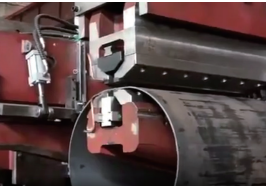
Figure 3 Weld Slag Removal
4.3 Extension
After rounding welding, the steel plate becomes a closed sleeve structure with the same diameter, and the sleeve parts have the same diameter everywhere. The rim has a larger diameter on the outside and a smaller diameter near the middle. Use an expanding machine (see Figure 5) to expand the rim and expand both ends of the cylindrical piece into a bell shape. This process ensures the reliability of part positioning during profiling and prevents the rim from being damaged during. profiling cracked due to excessive deformation.[4]. The flaring process relies on the flaring mold. When rims of different diameters are widened, flare molds of different specifications need to be replaced.
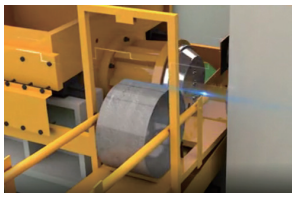
Figure 4 Rim expansion machine
4.4 Roll shape
The flared rear rim is rolled. Roll forming belongs to rotational forming. The shape of the rim exerts pressure on the metal blank through the upper and lower dies of the roller mold, forcing the metal to plastically deform between the upper and lower dies. Perform rolling processing three times to make the coaxiality, cylindricity and size of the rim meet the processing requirements. The first rolling is preforming, rolling the transition shape of the deep groove, and the center must be precisely controlled; the second rolling is mainly to ensure the processing shape, keep the shape of the groove bottom unchanged, and obtain the appropriate size of the heel seat; the third rolling shape processing is to modify the shape surface, except for leaving suitable machining allowance for the radial dimension, the rim shape surface and other dimensions are processed according to the size of design. The three rolling operations of the rolling mill are shown in Figure 6.
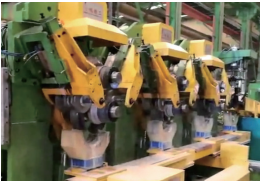
Figure 5 Rolling machine 3 times while rolling
4.5 Enlargement and finishing
The formed rim is deburred by cold rolling and the rim is repaired to achieve a smooth transition. Finally, a circular correction is carried out, i.e. finishing by expansion (see Figure 7). Through precise expansion of the expansion mold, the diameter of the formed edge meets the product design requirements.

Figure 6 Expansion finishing process
4.6 Other treatments
The dimensional accuracy and geometric accuracy of the rim have reached the design requirements after coil welding and pressure forming. Corresponding tests are necessary to see if it meets the conditions of use. The tightness of the rim is often tested. The gas sensor built into the detector is used to detect the gas leak from the room and determine if there is a problem with the room, as well as the cause of the problem and the location of the problem. default. For rims that meet the sealing requirements, the next step of processing can be carried out depending on the structural characteristics, such as flushing the valve holes.
4.7 Press fit welding
The qualified processed rim and spokes are assembled together and the spokes are pressed into the rim using the pressure fitting machine shown in Figure 8. The offset value between the spokes and the rim is set to determine the precise relative position between the rim and the Use the rim and spoke welding machine shown in Figure 9 to weld the two parts into an integrated structure. The runout requirements of the wheel hub after welding are relatively high, which is the main parameter that directly affects the movement performance of the wheel. After the welded parts pass the inspection, the wheel hub forging production process is completed.

Figure 7 Crimp assembly machine
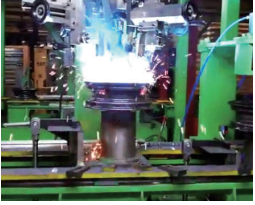
Figure 8 Rim spoke welding machine
5 Characteristics of wheel hub forging processing technology
The development of wheel hub forging processing technology is inseparable from the development of material technology. For materials with good forgeability, such as T6061 aviation aluminum, special rim steel, etc., using the forging process to process the rim has obvious advantages. Pressure during processing can improve the metal structure and mechanical properties. metal, and it can be processed after casting. Compared with cutting processing, it has high production efficiency, saves labor hours, has no chips, and saves metal materials. This processing technology can make full use of modern production equipment. The whole processing process, from material taking, rounding, shaving and enlarging weld slag, to finishing processing after three rolling processes, can use hydraulic technology and pneumatic technology which incorporates new equipment. Technologies such as control technology can optimize the production process, reduce energy loss and reduce the labor intensity of operators. The most important thing is that wheel hubs produced using this technology are lighter, stronger, stiffer and more precise in the finished product than cast wheels. Therefore, in order to meet the usage requirements, this can ensure that the vehicle. Its use is more energy efficient, thus reducing energy losses.
6Conclusion
The development of technology depends on the technical level of equipment, and technological changes promote the modernization and transformation of equipment. With the development of mechanical manufacturing technology, the wheel forging process will continue to be improved, and the process will increasingly use automation, integration and information technology which will gradually integrate and change the production process. At present, automobile wheel hub forging technology has high production efficiency, low cost, qualified processing quality, and meets the use requirements, demonstrating the dual advantages of efficiency and quality.
Daguang focuses on providing solutions such as precision CNC machining services (3-axis, 4-axis, 5-axis machining), CNC milling, 3D printing and rapid prototyping services.



















