
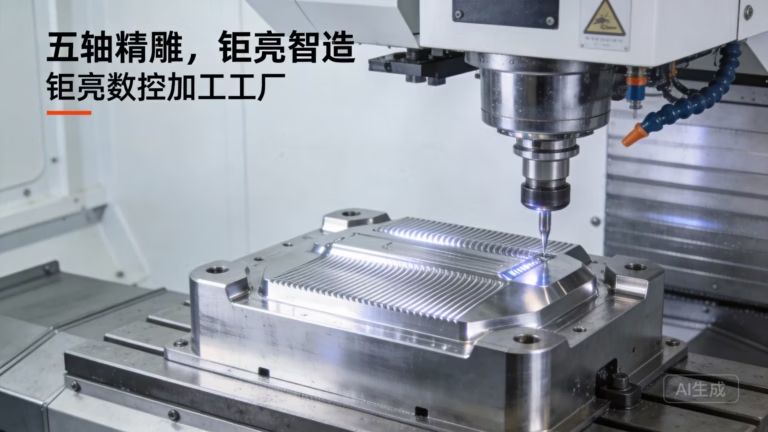
For manufacturers and machine shops of all sizes, the question of whether to invest in used CNC machines is a significant financial and operational crossroads. On one hand, the allure of accessing higher-tier capabilities at a fraction of the cost is powerful. On the other, the risks of hidden maintenance nightmares and technological obsolescence are real concerns. As a senior manufacturing engineer who has both specified new equipment and managed fleets of seasoned machines, I’ll provide a clear-eyed analysis to help you navigate this critical decision. The core question isn’t simply “are they worth it?” but rather “are they worth it for you, in your specific situation?”
Understanding the Appeal: Why Consider a Used CNC Machine?
The primary drivers for purchasing used equipment are economic and strategic.
1. Dramatic Reduction in Capital Expenditure: This is the most compelling factor. A used CNC machine can cost 30% to 60% less than its brand-new counterpart. This lower barrier to entry allows small to medium-sized enterprises (SMEs) to acquire additional capacity, diversify their capabilities (like adding a 5-axis machine), or simply start a business without crippling debt.
2. Faster Depreciation and ROI: New machines suffer their steepest depreciation in the first few years. A well-chosen used machine has already undergone this initial value drop, meaning its book value stabilizes. This can lead to a faster return on investment, especially for job shops with variable workloads.
3. Proven Reliability and Availability: Many older CNC models, particularly from top-tier manufacturers like DMG MORI, Mazak, or Haas, have legendary reputations for durability. Their performance and common failure modes are well-documented within the industry. Furthermore, you can often find a specific, proven model immediately on the secondary market, bypassing the lead times associated with new machine orders, which can span several months.
4. Access to Robust, Simple Technology: For shops that primarily run high-volume, less complex parts, older 3-axis vertical machining centers or lathes offer tremendous value. Their control systems (like Fanuc or Siemens) are simpler for operators to master, and their mechanical construction is often over-engineered for heavy, consistent cutting.
Navigating the Minefield: Key Risks and Challenges
The lower upfront cost comes with inherent trade-offs that must be meticulously evaluated.
1. Unknown Maintenance History and Hidden Wear: This is the biggest gamble. A machine’s lifespan is determined by wear on critical components: ball screws, guideways, spindle bearings, and the way covers. Without detailed maintenance logs, you are inheriting potential failures. A seemingly good deal can evaporate with a single $20,000 spindle rebuild.
2. Technological Obsolescence: Older controls may lack modern features crucial for efficiency:
Slow processing speeds: Struggling with complex CAM toolpaths.
Limited memory: Unable to load large programs.
Lack of advanced software options: No high-speed machining look-ahead, poor conversational programming, or no connectivity for DNC (drip-feeding) or networking.
Compatibility issues: Finding replacement parts for discontinued controls or drives can be difficult and expensive.
3. Higher Operational Costs and Downtime: Used machines typically consume more energy than newer, more efficient models. Their calibration may drift more frequently, requiring more metrology checks. Unplanned downtime due to age-related failures can disrupt production schedules and erode customer trust.
4. Lack of Warranty and Support: While some reputable dealers offer short-term warranties, most used machines are sold “as-is.” You become solely responsible for all repairs. Finding technicians familiar with 15-year-old control systems can be a challenge.
Industry Applications: Where Used CNC Machines Shine (and Where They Don’t)
Ideal For:
Job Shops & Startups: Adding capacity for stable, well-understood processes.
Secondary Operations: Dedicating an older machine to drilling, tapping, or deburring.
Educational & Training Institutions: Providing hands-on learning without the cost and complexity of the latest technology.
Production of “Legacy” Parts: Maintaining the ability to produce spare parts for older equipment where the program and tooling already exist for a specific machine model.
Less Suitable For:
High-Mix, High-Complexity Work: Where rapid setup, program flexibility, and tight, consistent tolerances are paramount.
Aerospace, Medical, or Automotive Tier-1 Production: These sectors often require certified processes and machine tool capability studies (e.g., IATF 16949 compliance) that are harder to validate on aged equipment.
Machining Advanced Materials: Newer machines with high-torque, high-speed spindles and rigid structures are better suited for composites, titanium, or Inconel.
The Buyer’s Checklist: How to Mitigate Risk
If you decide to proceed, a disciplined approach is non-negotiable.
Define Your Needs Precisely: Know the exact work envelope, spindle taper, torque/speed requirements, and control features you need. Don’t buy a machine looking for a job.
Source from Reputable Channels: Specialized used equipment dealers with refurbishment facilities are generally safer than anonymous online auctions. They often provide inspections, minor reconditioning, and some warranty.
Insist on a Hands-On Inspection (& Test Cut): Never buy sight-unseen. Hire an independent service technician or send your most experienced machinist. Check for:
Mechanical Play: Use a dial indicator to measure backlash in all axes.
Spindle Integrity: Run the spindle to its maximum RPM and listen for unusual noises; check for runout with a test bar.
Condition of Guideways and Ball Screws: Look for scoring, pitting, or excessive wear.
Control Functionality: Test all modes (MDI, manual, auto), ensure all I/O points work, and verify the accuracy of positioning.
Perform a Test Cut: Machine a sample part that challenges the machine’s advertised tolerances. Measure the result.
Secure Documentation: Obtain all available manuals, electrical diagrams, lubrication charts, and parameter backups. This is invaluable for future troubleshooting.
Budget for Reconditioning: Allocate 15-25% of the purchase price for immediate repairs, preventative maintenance (replacing fluids, filters, belts), and potential calibration.
Conclusion: A Strategic Tool, Not a Universal Solution
So, are used CNC machines worth it? The answer is a qualified yes—for the right buyer, with the right expectations, and with exhaustive due diligence. They are a powerful strategic tool for controlled growth and cost management. However, they represent a transfer of risk from the manufacturer to you, the owner.
For many businesses focused on innovation, supreme reliability, and navigating complex supply chain standards like ISO 13485 for medical devices or IATF 16949 for automotive, the predictability and support of a new machine—or the services of a certified partner—are irreplaceable. This is where the value proposition of an expert manufacturing partner like GreatLight Metal becomes evident.
At GreatLight Metal, we view advanced manufacturing technology as a means to an end: delivering flawless parts to our clients. Our investment in state-of-the-art 5-axis CNC machining centers and a full ecosystem of supporting technology is a direct commitment to shouldering the burdens of equipment maintenance, technological evolution, and quality assurance. For our clients, this means they access world-class precision and scalability without any of the capital risk or operational headaches associated with machine ownership. They can focus their capital on R&D and growth, leveraging our capacity as a seamless extension of their production floor.
Ultimately, the choice between buying a used CNC machine and partnering with a specialist like GreatLight Metal hinges on your core business strategy: Are you in the business of managing machine tools, or are you in the business of manufacturing exceptional products?
Frequently Asked Questions (FAQ)
Q1: What is the typical lifespan of a well-maintained CNC machine?
A: A high-quality CNC machine from a top manufacturer, with rigorous preventative maintenance, can remain productive for 20-30 years. However, its technological relevance for high-precision, efficient work often diminishes after 10-15 years due to control system obsolescence.
Q2: Is it better to buy a used machine from a dealer or directly from another shop?
A: Dealers generally offer more safety through inspection, basic reconditioning, and sometimes a warranty. Buying from another shop can yield a better price, but you inherit the machine “as-is” with all its hidden history. For first-time buyers, a reputable dealer is strongly recommended.
Q3: How much should I budget annually to maintain a used CNC machine?
A: Annual maintenance costs can range from 5% to 10% of the machine’s current value. This covers preventative maintenance (PM) kits, coolant, filter changes, and potential repairs. The first year after purchase often costs more as you address deferred maintenance.
Q4: Can I retrofit an old CNC machine with a new control system?
A: Yes, retrofitting is possible and can be an excellent way to breathe new life into a mechanically sound machine with a worn-out control. Companies like Fanuc, Siemens, and Heidenhain offer retrofit solutions. However, the cost can be significant (often $30k-$80k+) and must be weighed against the value of the refurbished machine.
Q5: When does outsourcing to a specialist like GreatLight Metal make more sense than buying a used machine?
A: Outsourcing is typically smarter when: your volume is variable or project-based; you require the latest 5-axis CNC machining technology for complex geometries; your industry demands certified processes (medical, aerospace, automotive); or you lack the in-house engineering and maintenance staff to support machine ownership. It converts fixed capital and labor costs into a variable, predictable expense. To explore the capabilities a specialized partner can bring to your project, you can learn more about our approach and community on our LinkedIn{:target=”_blank”} page.



















