

The 45 steel crankshaft is one of the important parts of motorcycle engines. Torque of exit. Consequently, the crank must resist both a large torque and an alternative flexion constraint during work, which requires that the parts have high resistance, impact tenacity, resistance to fatigue and resistance to wear.
For a long time, the motorcycle gear production process in the production plant is: Cut → industrial frequency heating the oven → Fortunately of the matrix → Preheating treatment (quality packaging) → shooting filing → Rugue treatment → Immersion “Dehydration and anti -ist oil” rust prevention → precision grinding treatment → polishing → cleaning → final assembly. Among them, the process of extinction of high -frequency inductions “which gives strong resistance to high fatigue and good resistance to wear to the parts has been used for a long time to meet the quality requirements of the technology technology of parts induction, but the midfielder is seriously rusty. CNC grinding machines, drilling machines, strong machines, etc., have attracted the attention of businesses and are looking forward to finding a new type of environmentally friendly caliber. Dehydration, anti -ist and anti-utters ”can be canceled to reduce costs.
1. Materials and methods test
1. Test of materials and technical induction hardening requirements
The test materials have been selected from 45 hot steel bars produced by an aciperial in China, and the chemical composition was presented in Table 1. The technical requirements for high frequency hardening of gear speeds Motorcycle illustrated in Figure 1 are: ① The surface hardness is 55-60hrc in the beach of the length of the newspaper 37.5-40.0 mm. ② The surface metallographic structure passes the note from level 3 to 7. ③ The effective depth of the hardening layer is 1.20 to 1.80 mm. ④ The width of the transition layer is 0.30 to 0.45 mm.
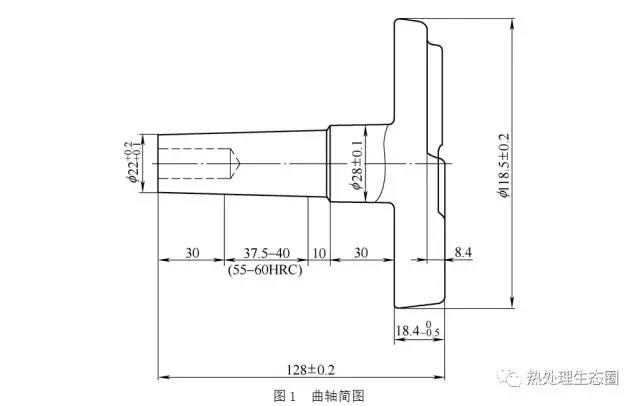
2. Test plan on the production field and equipment
The extinction cooling environments selected for the test are: tap water, 5.0%of Saline Nacl solution, a 5.0%na2co3 aqueous solution, a 0.30%PVA aqueous solution, a PAG-III caliber solution at 3.0% and a concentration of 5.0% of HSY, cooling environments, to a coolant from extinction with cooling properties similar to a naCl brine solution at 5 , 0% are preferred.
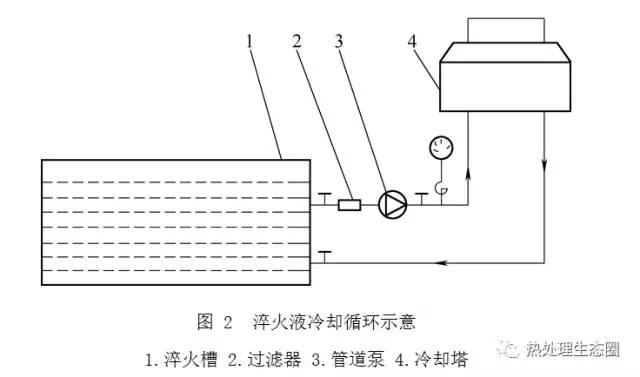
The heating equipment used in the test is a high frequency heating power supply of 100 kW used in production. have been pre-ruins and heat treated (the hardness in the newspaper is 24 ~ 28hrc, the soaked cortex is 1 to 4 levels, the central part is 5 to 6 levels) and after coarse and precision machining , high -frequency induction Mature The parameters of the heating and caliber process are: put the part φ118.5 mm × 18.4 mm disc in the induction ring turned upwards, so that the hole peak in the final face of the part of the part is inserted in the upper mobile tip. At the heating power of 1.40 ~ 1.45 kW and the heating time of 2.0 ~ 2.5 s, how many times will be immersed quickly, the liquid is cooled at 100-200 ° C in the liquid of Diz and is cooled to the air and the covered temperature. The cooling and heat exchange device of the extinction is illustrated in Figure 2.
3. Analysis and detection
According to ISO9950: 1995 (E), the infective probe of the SWEDISH IVF instrument was used to test the cooling characteristics of several extinguished cooling environments; Garden Grinder, and the Rockwell HR-150A hardness counter tests the hardness at the upper end, the intermediate and lower end of the quenching length of the Journal des Pieces illustrated in Figure 1, and the average value is taken to each of the three points. of the part is used by a metallographic cutting machine. The metallographic structure and the notation were observed under the optical microscope. Referring to the “anti-rusting test method”, the selected caliber liquid is compared to the anti-disruption effect.
2. Experimental results and discussion
1. Cooling performance of the extinction cooling medium
The typical results of the cooling performance of several measured extinction liquids by heating the OnConel600 probe to 855 ° C and by quickly submerging it in the medium to be tested with a liquid temperature of 30 ° C are presented in Table 2 , and the characteristic cooling curves are illustrated in Figure 3.
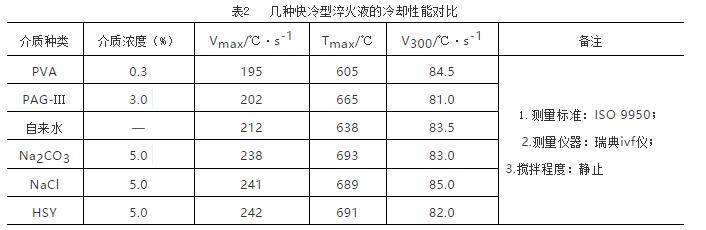

As shown in Table 2, from typical TMAX and VMAX values that characterize high temperature cooling performance of extinguished cooling environments, cooling performance of a 5.0% nacl saline solution are 5.0 % NA2CO3 aqueous solution and 5.0% HSY respectful of the environment respectful of the environment The salt -type cooling environments, and others the dip liquid cool slowly, while the caliber of the Na2co3 aqueous solution With a strong irritation of the operator’s skin, is the tasting of odors and has extremely bad environmental protection performance.
From Figure 3, from the hard work of the quench of the extinction cooling medium, its concentration of 5.0% of the HSY caliber cooling is very close to 5.0% of solution Saline NaCl. Temperature area.
2. Dureau of the surf
In the quenching tank illustrated in Figure 2, 5.0% of HSY environmental caliber salt liquid were prepared about 250 kg, and samples were induction, extinguished and cooled heating, and 5 parts were randomly extracted to polish the surface of the newspaper, and in Rockwell Hardness the results of hardness tested on the counter are presented in Table 3.
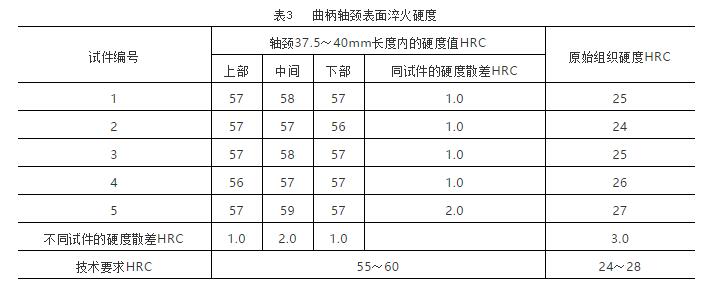
The results of the soaring hardness tests show that the expiration hardness value in the specified length of the Journal de la Piece can meet technical requirements. Different parts are not greater than 2.0hrc, which responds to JB / T9201-2007 “Induction hardening steel temperature meter 10: Rockwell Durness Deviation Range” requirements.
When high frequency induction heating is used, due to the effect of the skin, the surface temperature increases quickly to reach the austenitization temperature to form the austenite fabric, then cools quickly to transform into Martensite fabric. Cooling Performance Can cause Insufficient Cooling, Non-Martensite Causing Such As Turanite in the Tissue, Not Only has low Quenching Hardness and Unvenness, But also Shortes The Quenching Length (If Quenching and Cooling is used with 3.0%Pag-ⅲ that The neck of the part will be the length of the submise in place is less than 28 mm).
3. Evaluation of the metallographic microstructure
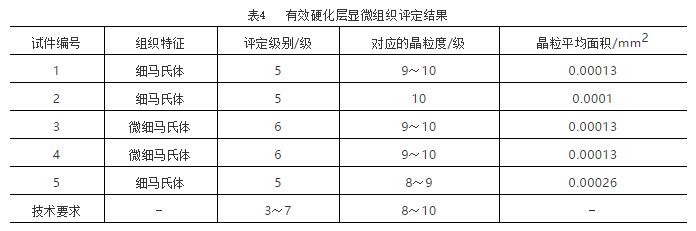
The results of the microstructure and metallographic evaluation are presented in Table 4. The sizes of martensite needles evaluated by the extinct metallographic microstructure of the parts are classes 4 to 6, and most are the fine 5th year martensite . When the raw materials, the size of the part and the original structure condition are certain, if the process parameters such as the induction heating time, the power, the caliber and the cooling are slightly modified, the microstructure can undergo a big change. Make the horse, the intensity is thick.
During production, special attention must be paid to the influence of the original structure on the thickness of the microstructure extended to the induction of the hammer. obtained from Martensite.
4. Effective depth of the hardening layer and transition zone width
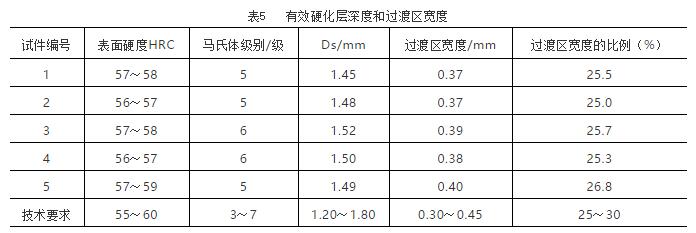
The results of the depth of the effective hardening layer (DS) of the parts and the width of the transition area obtained in the hardness distribution curve drawn by the hardness method are presented in Table 5, the two meet the requirements technical.
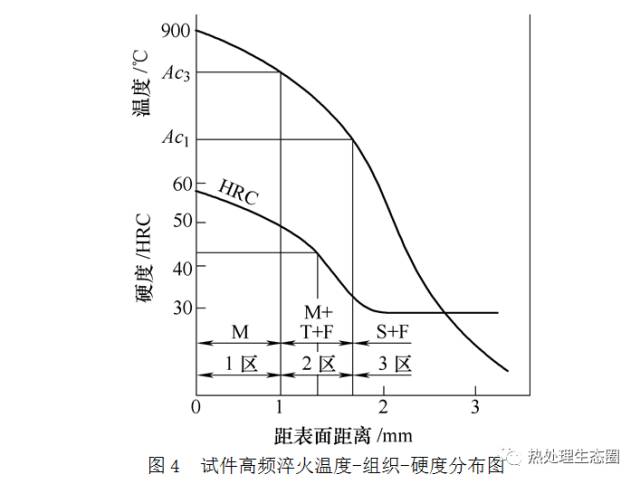
The distribution curve of the hardness change in different areas after the tightening of the sample induction is illustrated in Figure 4, the surface hardness is the highest, then the centripetal part decreases. This is due to the characteristics of the surface effect of the high frequency induction heating, which means that the temperature decreased the centripetal part of the steel surface during high frequency heating. As shown in Figure 4, the entire structure of the Martensite is obtained after surface extinction and the Martensite + Ferrite + Tronate is obtained in the underground layer. .
5. Comparison of the anti-uustal effects between HSY Media and NaCl Brine Media
Réfering to the Method of Evaluating The Anti-UrST Properties of Water-Soluble Quenching Cooling Media of Polymers, the situation where cast iron power Powder has a large surface area and is prone to rust under high humidity, and the two thatching liquids leaves of degrees of Road and color depth on filter paper. The results show that the anti -ist effect of the HSY solution at the same concentration is much better than that of the Saline NaCl solution.

The high frequency caliber trial parts cooled with a 5.0% HSY caliber liquid are used, then placed on the ground in the workshop after extinction. Appear with rust every 1 hour. , and he doesn’t rust for at least a week.
3. Characteristics, maintenance points and applications of HSY Medium of cooling based on environmentally friendly salt
1. Main characteristics of the cooling medium of the HSY caliber
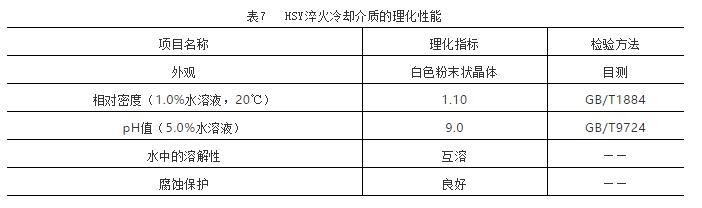
The main physical and chemical properties of the cooling medium for the extinction soluble in HSY water are presented in Table 7. The curves of cooling characteristics of the aqueous solution, tap water and 5.0% NaCl brine solution at different concentrations are presented in Figure 5.
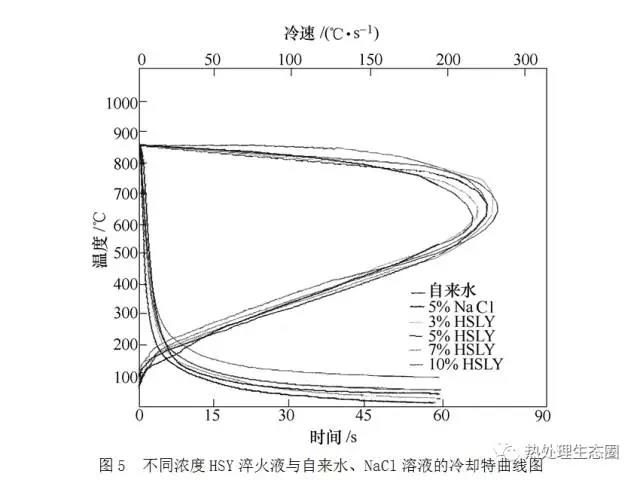
As shown in Figure 5, different quantities of tap water are added to the Hsy powdered soil cooling medium to prepare a caliber liquid of 3.0% to 10.0% and different concentrations. is slightly increased.
2. Key points for the use and maintenance of the HSY caliber liquid
(1) Liquid liquid temperature
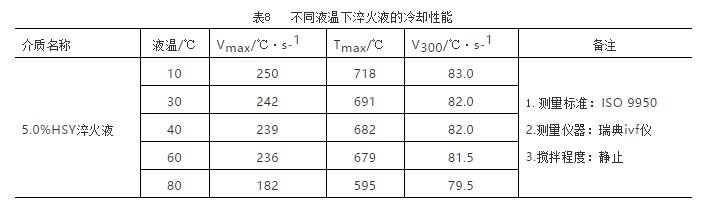
Compared to the other cooling environments of the caliber caliber, the greatest advantage of the Aqueous Mid -Cooling Hsy Cooling Solution in a certain temperature range is that the temperature change of the liquid during use has little Impact on the cooling performance of the caliber liquid, and its liquid temperature changes have a cooling effect on the caliber. It is recommended to use a cooling heat exchange system (such as cooling towers, plates heat exchangers, air coolers, etc.) in production and control the temperature of the caliber liquid in the beach of 10 to 60 ℃.
(2) Detection of the concentration of exinsisting liquid
For the HSY liquid production site, it is recommended to use a pomidometer to measure the concentration. be determined according to the following formula:
W = 1.0 × B0
Where: W is the concentration value of the soaring caliber liquid,%; B0 is the measured value of the pomidometer. Depending on the production situation, the concentration is generally measured every 1 to 3 days.
(3) Circulation and stir of exhaust liquid
The soil liquid is circulated and restless, which makes not only the soil of the soil hardness and the uniform hardening, but also contributes to prolonging the lifespan of the soil liquid.
(4) Anti -ist resistance and corrosion of the soil liquid
The HSY caliber liquid has a good anti -ist effect on parts and equipment.
(5) prevent pollution and clean regularly
In addition to preventing oil, dust and other pollutants to be mixed in the caliber liquid, the soap liquid must also be filtered every 2 to 4 months depending on the exit of the extinction, especially The dirt on the surface of the exinated parts should be avoided from being brought into the exinsisting liquid.
3. Mass production application
According to the results of process tests and multiple process checks, a certain concentration of the HSY extinction cooling medium can meet the quality requirements of high frequency induction of 45 steel motorcycles. Representation of the process of processing “cut → industrial frequency heating the furnace → matrix forging → quality conditioning heat treatment → shooting ficy → rough treatment → treatment of beautiful production A large number of applications are carried out On equipment.
4. Conclusions and suggestions
(1) The cooling performance of the cooling medium of the HSY environmental environmental brine at a certain concentration are better than tap water and is almost 5.0% of nacl brine solution. It can replace NaCl Brine Solution for Use in the Use of the Queching Cooling of the 45-Steel Motorcycle Crankshaft after High-Frequency Induction Heating, Its Quenching Hardness, Effective Hardening Layer Depth, Transition Layer Width, Metallographic Structure and Other Quality Indicators Technical requirements of product parts.
(2) The cooling medium of HSY water extinction has excellent rust resistance, and its rust prevention period is approximately a week. Process after extinction, simplifying the process of extinction The process of processing parts and reducing production costs.
(3) In a certain range of concentration of use and temperature of the liquid, concentration and temperature changes in the HSY caliber liquid are not sensitive to cooling performance and have good operability. The liquid temperature is controlled if it does not exceed 60 ℃, it can replace the Aqueous NaCl Salt solution and the alkaline aqueous solution Na2co3 or Naoh, and be used for the extinction and cooling of the carbon structure steel and Carbon tools with poor sustainability.
(4) During the production, not only should the raw materials of the extinguished parts be managed in the separation of the oven, but also pay particular attention to the original structure before induction caliber. The parts obtain excellent fabrics after extinction and induction performance.
(5) For parts that must be crushed after hardening by induction, it should be noted that the grinding volume cannot be important, so as not to damage the distribution of constraints to the surface of the room, thus reducing their Resistance to fatigue.
Daguang focuses on providing solutions such as precision CNC machining services (3-axis, 4-axis, 5-axis machining), CNC milling, 3D printing and rapid prototyping services.



















