
Advanced Bulk CNC Milling & Turning Solutions
This page explains what changes when a part moves from prototype to thousands of identical units. It is written for design engineers and sourcing engineers who must judge whether a supplier can hold tolerances, finish, and traceability at volume. Read it to compare process control, equipment mix, and inspection routines before you release a PO.
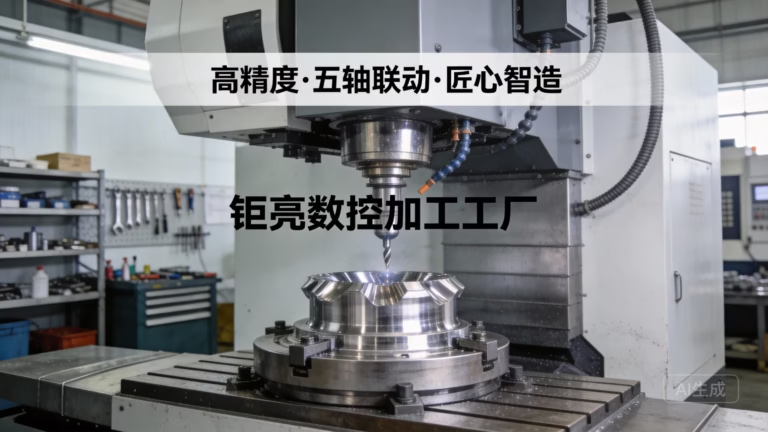
Volume machining is a process discipline
Producing 10,000 parts means the process must deliver the same result every shift.
Volume changes the problem, not just the quantity
A prototype can be brought into tolerance by a skilled machinist watching the cut and adjusting offsets by hand. Run that same part 10,000 times and manual skill is no longer enough. The process must be documented: fixed speeds and feeds, in-cycle probing, tool life tracking, and a scrap threshold that triggers a stop. Without those controls, drift starts on the second shift and nobody notices until inspection.
Bulk work also changes the cost structure. Setup time spreads across thousands of units, so cycle time and tool consumption dominate the piece price. A supplier with 16 mill-turn centers can finish a part in one operation instead of three. That single decision often saves more than a lower hourly rate from a shop running separate mills and lathes.
The parts that suit volume machining share traits: stable geometry, features reachable from a few directions, materials that cut predictably. Parts with thin walls under 0.5 mm, deep narrow slots, or hardness above 45 HRC need a different conversation. Not impossible, just slower and more expensive per unit.
What separates a capable bulk supplier from a busy one
Ask any shop whether they can run your part and the answer is always yes. Ask how they detect drift at unit 4,000 and the answers thin out. Statistical process control on critical dimensions, a first-article inspection that matches the drawing, and in-process probing on the machines themselves are the markers of a supplier set up for repeatability.
A 2% scrap rate sounds acceptable on a quote sheet. On a 5,000-part run it means 100 parts lost to material, machine time, re-inspection, and a possible reorder. Catching a 0.01 mm trend at unit 200 costs far less than sorting 5,000 finished parts by hand. Real-time data and automated inspection exist for that reason.
Tool management matters too. A cutter that has run 80% of its rated life behaves differently from a fresh one. Suppliers who track tool life per operation and replace on schedule get consistent surface finish. Suppliers who run until the tool breaks get a batch of parts with chatter marks and a gouge somewhere in the middle.
The machine mix that makes volume turning and milling work
Volume production is rarely one machine type. A part with turned bores and milled faces needs either a mill-turn center or two operations with a good fixture. GreatLight runs 127 high-precision CNC machines across three plants, including 16 simultaneous 5-axis centers, 16 mill-turn centers, 12 four-axis mills, and 27 three-axis machines. The mix lets us route a job to the machine that finishes it in the fewest setups.
Size decides the route. Maximum processing size reaches 4,000 mm, with travel options of 4,000 × 400 × 150 mm for long parts, 750 × 1,150 × 550 mm and 600 × 600 × 600 mm for mid-size housings, and 500 × 500 × 450 mm or 500 × 310 × 200 mm for compact work. A Ø400 mm rotary table handles indexed features on round parts without re-fixturing.
For high-volume runs, the constraint is often the fixture, not the spindle. A well-designed tombstone or hydraulic clamp cuts load-unload time and holds position repeatably. We design fixtures alongside the process, so the tenth part is set up the same way as the first.
Matching part features to the right machine
A quick reference for routing decisions before quoting.
| Part feature | Best route | Why |
|---|---|---|
| Turned bore + milled faces | Mill-turn center | One setup, one datum, no re-chuck error |
| 5-sided pockets, contoured surfaces | Simultaneous 5-axis | Shorter cycle, fewer fixtures |
| Long shaft, Ø under 150 mm | 4,000 mm travel lathe | Single pass, no joining |
| Prismatic housing, 600 mm cube | 3-axis + rotary table | Rigid setup, simple programming |
| Thin wall under 0.5 mm | 5-axis, light cuts | Lower radial force, less deflection |
| Hardened steel above 45 HRC | 3-axis + grinding | Milling alone wears tools too fast |
Inspection and traceability at volume
Every part that leaves GreatLight is inspected before shipment. That covers raw material verification, in-process monitoring during the run, and final inspection against the drawing. Reports are available on request for dimensional results and material certificates. For regulated industries, that paper trail is not optional.
Tolerance capability sits at ±0.005 mm (±0.0002 in) on qualified features. Surface finish ranges from Ra 0.2–0.8 μm for fine finishes down to Ra 1.6–3.2 μm as-machined. Which one you get depends on the feature and the material, so we agree on the callout per surface before the program is written.
The four certifications that matter for bulk work are ISO 9001:2015, IATF 16949:2016 for automotive, ISO 13485:2016 for medical devices, and ISO 27001:2022 for information security. They cover process control, traceability, and the handling of your drawings and CAD files.
What to check before you release a bulk PO
Send a drawing with a realistic tolerance callout. A ±0.005 mm callout on every dimension raises cost without adding function. Mark only the features that need it. Suppliers quote what you specify, so an over-toleranced drawing gets an inflated price.
Ask how secondary operations are handled. Anodizing, plating, laser marking, and heat treatment done in-house or under one roof avoid the delays and lost parts that come with shipping between subcontractors. GreatLight covers anodizing, electroless nickel, zinc, silver and gold plating, powder coating, black oxide, bead blasting, tumbling, brushing, polishing, and laser marking with minimum character height of 1.5 mm.
Confirm lead time expectations early. Quotation and DFM analysis come back within 12 hours, production can start within 24 hours, and parts ship in 3–5 days for standard jobs. Historical late-delivery probability sits below 2%. For a first bulk order, ask for a pilot run of 50–100 parts first. It costs little and reveals the real process capability.
Questions engineers ask about bulk CNC work
How many parts count as a bulk run?
There is no fixed threshold. Volume effects start when setup time spreads over enough units that process control matters more than machining skill. In practice that is anywhere from a few hundred to tens of thousands of parts.
GreatLight has no minimum order quantity. We run one prototype or 10,000+ part runs on the same equipment, so you can scale without changing suppliers.
Can you hold ±0.005 mm across a full production run?
Yes, on qualified features and stable materials. The tolerance is achievable when the fixture is rigid, the machine is thermally stable, and in-process probing monitors the critical dimensions.
For features where ±0.005 mm is not practical, such as thin walls or deep slots, we flag it during DFM review and propose an alternative callout.
Which materials are available for volume milling and turning?
Aluminum grades include 6061, 6061-T6, 2024, 5052, 5083, 6063, 6082, 7075, and ADC12. Stainless covers 303, 304, 316, 316L, 420, 430, 431, 440C, and 17-4PH.
Steel options run from 1018 and 1045 to 4130, 4140, 4340, A36, and tool steel. Copper, brass, titanium, Inconel, magnesium, and engineering plastics such as POM, PEEK, and carbon fibre are also available.
How do you prevent scrap on a large run?
Scrap is caught early, not sorted late. We monitor critical dimensions in-process and stop the run if a trend appears before it becomes a defect. A 2% scrap rate on 5,000 parts is 100 lost units, so early detection is cheaper than final sorting.
Tool life is tracked per operation. Cutters are replaced on schedule, not on failure, which keeps surface finish consistent across the batch.
What post-processing can be done without subcontracting?
Anodizing in clear, colour, hardcoat, and conductive types; electroless nickel, zinc, silver, and gold plating; powder coating and black oxide; bead blasting, tumbling, brushing, and polishing; and laser marking or engraving with a minimum character height of 1.5 mm.
Keeping these steps in-house reduces handling, transit damage, and the scheduling gaps that come from moving parts between suppliers.
How is confidentiality handled for bulk orders?
Uploads are secure and confidential. We hold ISO 27001:2022 for information security, and an NDA is available on request before you share drawings.
Your CAD files and process data stay within the project team.
Send a drawing and get a bulk quote with DFM feedback
Upload your files and an engineer will review the process route, tolerance callouts, and fixture plan before quoting.
12-hour quote100% inspectionNo MOQNDA on request









