
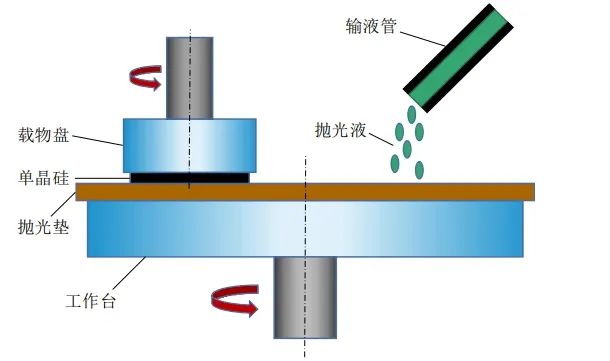
Chemical mechanical polishing (CMP) is an ultra-precision surface treatment technology that uses the dual coupling effect of chemical corrosion and mechanical grinding to achieve local or global nanoscale planarization of the surface. of the room. In the CMP process, abrasives play a very critical role as direct performers and transmitters of mechanical and chemical effects. Their hardness, particle size, shape, dosage and other parameters will affect the specific polishing effect. Below, the editor will introduce you in detail to several abrasives currently commonly used in CMP.
Schematic diagram of CMP processing of monocrystalline silicon (Source: Document 1)
Silica sol SiO2
Silica sol is one of the most widely used abrasives in the CMP process and is a mild abrasive. After SiO2 is dissolved in water, it will contact the water to form Si-OH bonds, causing it to adhere to a large number of hydroxyl groups to form a silica sol. Silica sol is a milky white colloidal liquid. Its interior is a three-dimensional network structure formed of Si-O-Si bonds. The exterior is enveloped in negatively charged hydroxyl groups. The water molecules in the silica sol dissociate to form H3O+. action of static electricity. It is adsorbed on the adsorption layer and the diffusion layer to form a double electron layer structure, and its thickness plays a key role in the stability of the dispersion of silica sol in the polishing fluid. The diameter of nanoparticles in silica sol can be controlled between 10 and 150 nm. Silica sol with different particle sizes will produce different removal rates, and effective selection can meet the needs of different processes, it has moderate mechanical wear performance, good selectivity and good dispersion; causing minimal damage to the surface of the workpiece during the polishing process, and the hardness is close to that of elemental silicon, so it is often used for polishing silicon, soft metals and other materials.
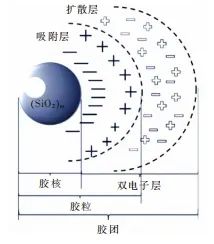
Schematic diagram of the electronic double layer of silica sol (Source: Document 2)
Alumina Al2O3
Aluminum oxide is an abrasive with high hardness and good grinding performance. It has many homogeneous and heterogeneous phases in nature, α-Al2O3 has many excellent properties such as high strength, high hardness and high resistivity. abrasives, semiconductors and other fields. Aluminum oxide has a fine surface and hard texture, with a Mohs hardness of around 9, second only to diamond. It can effectively remove protruding parts from the surface of hard materials to achieve high material removal rate, it is relatively chemically stable and. is not easily combined with large materials. Most of the chemicals react, so the life of the polishing fluid can be maintained during the CMP process. Compared with other advanced abrasives, the cost of alumina is relatively low, so it has more advantages. advantages in industrial applications. However, because the surface of alumina abrasives readily becomes charged with positive or negative charges, resulting in intermolecular forces such as electrostatic attraction and Van der Waals forces, agglomeration is more likely to occur. produce in the polishing fluid, due to its high hardness. , in the CMP process. Improper operation can easily lead to uneven material removal rates and cause mechanical damage to the material surface, so you should be careful when using it.
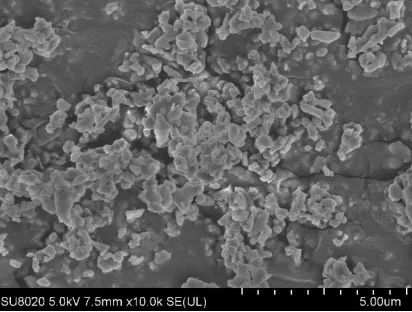
SEM image of alumina (Source: Document 3)
Cerium oxide CeO2
Cerium oxide is an abrasive with excellent polishing properties. It features strong cutting force, short polishing time, long service life and high polishing precision. It is often used in polishing optical glass devices, television picture tubes, semiconductor wafers and other devices. Cerium oxide has good chemical stability during the polishing process and is not prone to adverse reactions with other components of the polishing fluid, which is beneficial for maintaining the stability and life of the fluid polishing. Compared to some other abrasives, it has less impact. on the environment. Meets current requirements for green chemistry and sustainable development. The Mohs hardness of cerium oxide is approximately 7, which is similar to the hardness of glass. It has excellent polishing performance for SiO2 materials, that is, it can have a high cutting rate while considering the surface quality.
*Principle of action: under pressure, the water molecules contained in the polishing fluid will hydroxylate the surface of the SiO2 wafer and CeO2 will form Ce-O-Si bonds with SiO2. Since the glass surface is easily hydrolyzed, Ce-O-Si(OH. )3 bond, the mechanical force generated between CeO2 and the polishing platform promotes the Si-O-Si bond to break and SiO2 will be rejected by CeO2 in the form of blocks. In this process, the formation of the Ce-O-Si bond is the reaction control step. Its formation increases the polishing shear. stress and the whole polishing process. The speed is affected by the formation of Ce—O—Si bonds and the breakage rate of Si—O—Si bonds.
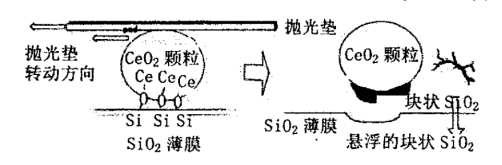
Cerium oxide particle polishing mechanism
Additionally, ceria is also a semiconductor photocatalyst with varying valence states (Ce4+, Ce3+) and many oxygen vacancies. It combines tribochemical capabilities and photochemical oxidation activity and can be used in photocatalytic-assisted polishing.
In addition to the common abrasives mentioned above, other types of abrasives can also be used in CMP polishing, such as iron oxide, silicon carbide, etc. These abrasives may have advantages in certain specific applications or in polishing specific materials. In practical applications, the impact of factors such as particle size and concentration of abrasive particles on the polishing effect must be considered. Through the reasonable selection and use of abrasive grains, an efficient and high-precision CMP polishing process can be achieved to meet the needs of various precision machining applications.
Daguang focuses on providing solutions such as precision CNC machining services (3-axis, 4-axis, 5-axis machining), CNC milling, 3D printing and rapid prototyping services.



















