01
Preface
The rapid development of China’s manufacturing industry has generated enormous economic benefits for our country and even the world. As market competition becomes more and more fierce, cost reduction and efficiency improvement have become problems that every enterprise must face. In order to effectively reduce costs and increase efficiency, it is necessary to analyze the composition of production costs. Production cost consists of three parts: direct materials, direct labor, and manufacturing overhead. Direct materials refer to labor objects in the production process, which are transformed into semi-finished products or finished products, and their use value then becomes another use value. Direct labor refers to human resources consumed in the production process, which can be calculated by wages, social expenditures, etc. Manufacturing expenses refer to facilities such as factories, machinery, vehicles and equipment, materials and auxiliary materials used in the production process. Part of their consumption is included in the cost through depreciation, and the other part through maintenance, fixed expenses, machine material. consumption and consumption of auxiliary materials are included in the price. This paper optimizes several tool usage methods to reduce tool consumption costs and improve processing efficiency, thereby achieving the effect of reducing machine tool usage costs.
02
Change the tool material to improve processing efficiency
Commonly used tool materials include: high speed steel, carbide, ceramic, CBN and PCD. CBN and PCD have higher hardness, highest wear resistance, and their materials are relatively brittle. High speed steel has the best toughness, but its hardness is very low and its wear resistance is poor.
High speed steel is a high carbon alloy steel. The main alloy elements are tungsten, chromium, molybdenum, cobalt, vanadium and aluminum, etc., and contain a large amount of carbides. High speed steel cutting tools have high toughness and relatively low hardness. The advantages are that they are cheap, have high plasticity and can process almost any material. They were the main materials used in early cutting tools. higher requirements for operators and require manual labor for sharpening, and the cutting speed that high speed steel materials can withstand is very low. For example, the workpiece material is 45 steel, the hardness is 250HBW, the cutting speed is 30-60m/min, and the cutting efficiency is low.
At present, the most commonly used tool material is coated carbide. The hardness and heat resistance of coated carbide tools are better than those of high speed steel tools. Can withstand higher cutting speed, cutting speed is 100~300m/min[1]。
Taking the outer circle of turning steel parts as an example, if carbide turning tools are used to replace high-speed steel turning tools, the cutting speed can be increased from 50m/min to 180m /min, and the efficiency is increased by more than 3 times, and carbide tools also have a higher service life. Carbide turning tools with replaceable blades do not need sharpening, simply replace the blade and the operator does not need sharpening skills.
Besides high speed steel and carbide cutting tools, there are also ceramic, CBN and PCD. These three materials have higher cutting speeds – above 1000 m/min, but their application range is limited. Ceramic and CBN are generally used to process cast iron parts and steel parts with high hardness above 50HRC. PCD is generally used to process aluminum, plastic, wood and carbide, but cannot process cast iron parts.[2]。
Taking aluminum alloy cutters as an example, the cutting speed of high speed steel cutters is 120~300m/min. The recommended cutting speed of Mapal brand carbide cutters made of HP615 material is 700 m/min, while cutters made of PCD material. can be used. The cutting speed is 1500 ~ 2000 m/min.
03
Effect of cutting parameters on tool life and production efficiency
In order to improve machining efficiency and tool life, it is necessary to determine whether the cutting parameters are reasonable and analyze the impact of each cutting parameter on tool life. and the effectiveness of the tool. The cutting parameters include cutting speed (linear speed), feed speed and reverse cutting amount, also known as the three cutting elements.
3.1 Cutting speed vc
The relationship between cutting speed vc and spindle speed is vc=πDn/1000, where D is the effective diameter of the tool/workpiece (unit: mm) and n is the speed of the machine tool ( unit: r/min). When the cutting speed is too high, flank wear increases and the surface quality of the part deteriorates. When the cutting speed is extremely high, the insert also undergoes plastic deformation. The influence curve of cutting speed on tool life is shown in Figure 1.
Figure 1 Curve of effect of cutting speed on tool life
3.2 Feed speed vf
The feed rate calculation formula is vf=fZZnn, fZ is the tool feed (the unit is mm/z), Zn is the number of effective cutting edges (the unit is l ‘unit), n is the speed of the machine tool (the unit is r/min). ). If the feed speed is too high, the chips will be uncontrolled and the quality of the machined surface will deteriorate. The cutting power is high and the chips will impact the tool or the machined surface. The influence curve of the feed speed on the tool life is shown in Figure 2.

Figure 2 Effect curve of feed rate on tool life
3.3 The quantity of rear knife ap
The amount of undercut refers to the difference between the uncut surface and the cut surface. The influence curve of the amount of backcut on the tool life is shown in Figure 3.

Figure 3 Influence curve of the amount of recoil on the tool life
Of the three cutting factors, cutting speed, feed rate, and degree of back engagement all impact tool life. The impact of back cut amount is the smallest, feed speed has a greater impact than back cut amount, and cutting speed has the greatest impact on blade life.
In order to obtain the highest tool life, the direction of optimization parameters is: maximize the back engagement to reduce the number of tool passes; maximize feed speed to shorten cutting time;
To improve roughing efficiency, you can start by optimizing the undercut amount, reducing the cutting speed, and improving the undercut amount. Tool life, increases feeding speed and ensures processing efficiency.
3.4 Application examples
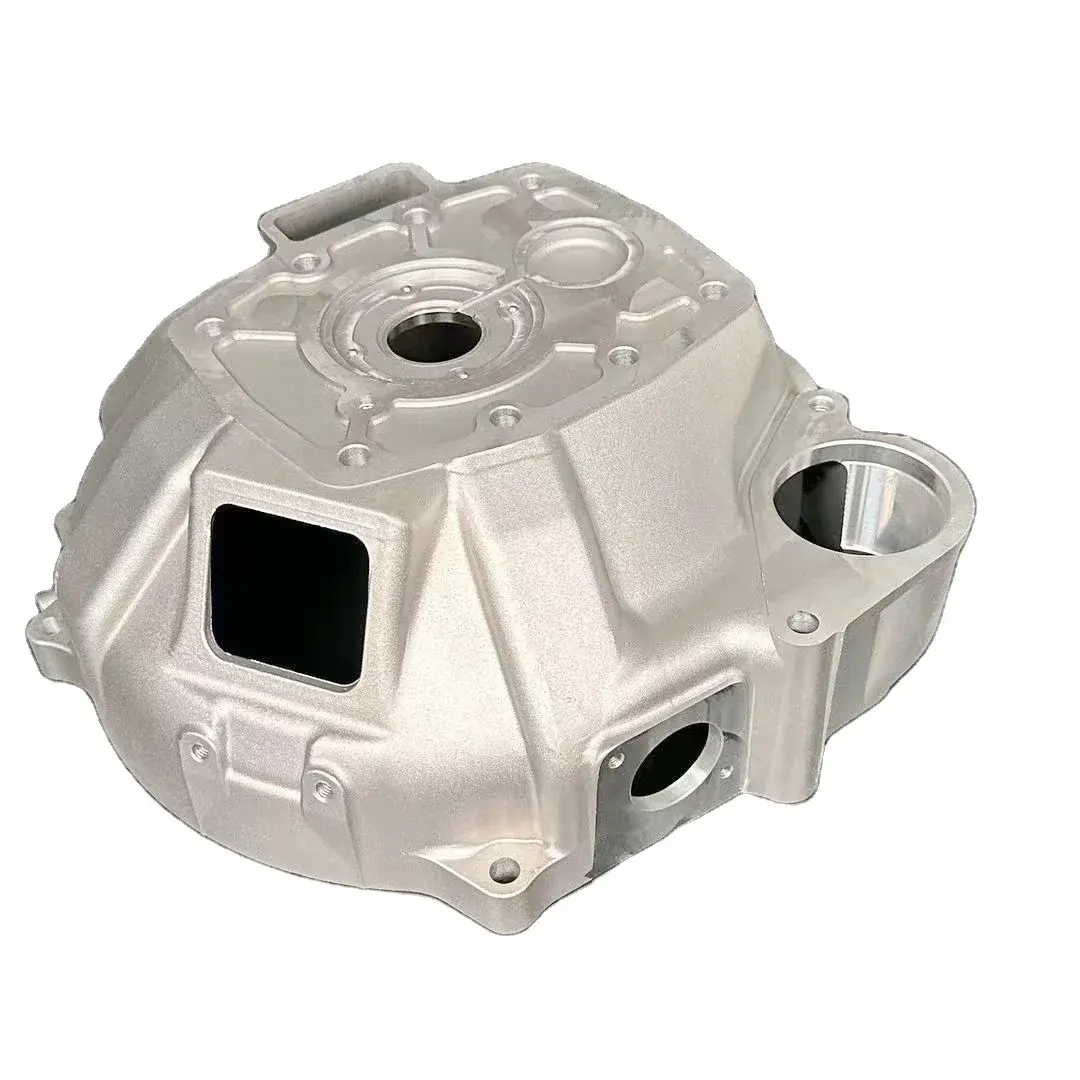
The flange produced by an automobile parts processing plant is shown in Figure 4. The existing processing solution is inefficient, and various cutting parameters need to be optimized to improve tool life and production efficiency .

Figure 4 Flange
Optimize the machining plane by increasing the amount of backcut, reducing tool paths and reducing cutting speed. Before optimization, the tool paths were numerous and chaotic, but after optimization, the tool paths were clear, as shown in Figures 5 and 6. The parameters before and after optimization are shown in the table 1. After optimization, the tool life increased from 15 parts to 31 parts.

Figure 5 Front tool path optimization

Figure 6 Optimized toolpath
Table 1 Parameters before and after optimization

The factor that measures the cutting performance of the blade is the cutting speed. The CNC system reads the spindle speed. Many programmers only consider speed when designing programs and ignore the diameter factor. However, in actual machining, the diameter factor also has an effect. greater impact. Taking turning as an example, when the workpiece diameter D is 50 mm and the machine tool speed n is 1000 rpm, the linear speed vc = 157 m/min. When the diameter of the workpiece D is 100 mm and the machine tool speed n is 1000 rpm, the linear speed vc = 314 m/min.
According to the tool sample, the cutting speed of 314 m/min is very high, close to the limit that the carbide blade can withstand. High cutting speed can accelerate the tool wear process and reduce tool life.
It can be seen from this that for the same machine tool speed, different workpiece diameters and tool cutting speeds, when the tool life is too low, you can check whether it is caused by high speed cut too high.
04
The influence of the scraper edge on cutting efficiency
The wiper blade has a tip angle consisting of 3-9 arcs with different radii, and the arc radius can reach more than 900mm. The relationship between tool tip fillet, feed quantity and surface quality is
Rmax=fn²/8r(1)
Rmax (wiping edge) = Rmax/² (2)
In the formula, fn is the amount of feed (mm/r); r is the fillet radius of the tool tip (mm); Rmax is the height difference between the top and bottom of the cutting surface (mm).
This method is suitable for finishing turning or boring. The wiper tool itself does not have a fast forward function. However, according to the previous formula, it can be inferred that the characteristics of the wiper tool are as follows: When the processing parameters are the same, the surface quality of the wiper tool can be increased by 1 time when the surface quality is the same; , the advance speed of the wiper tool can be increased by 1 time.
When the same surface quality is required, higher feed rates can be used when using wiping tools.
Taking the processing of the end face of the outlet shell as an example of efficiency improvement, the workpiece material is QT500, and the surface roughness value Ra≤1.6μm is required. In order to improve the cycle time, a wiper blade was used in order to meet the same surface roughness requirements, the feed speed was increased from 0.36 mm/r to 0, 5mm/r. The measured surface roughness value Ra=1.33 μm. , and the blade life was the same. The different processing parameters using ordinary turning inserts and wiper inserts are shown in Table 2. The end face of the output shell after optimization is shown in Figure 7.
Table 2 Various processing parameters of ordinary turning inserts and wiper inserts


Figure 7 Optimized outlet shell end face
05
Effect of main deflection angle on cutting efficiency
Feed per tooth was mentioned in the previous brief introduction to the concept of feed rate. Some tool sample brands recommend hex maximum chip thickness as the cutting parameter instead of feed per tooth. Because what determines the amount of feed is the maximum chip thickness hex and the attack angle Kr of the tool. The conversion formula is hex=fzsinKr.
When the main deviation angle is 90°, fz=hex, the maximum chip thickness of the tool is the same as the feed per tooth. As the main deviation angle decreases, the feed rate can be increased.
Taking the square shoulder milling cutter (see Figure 8) as an example, the number of teeth ZN of the 90° square shoulder milling cutter is 5 flutes, n=1000r/min, hex=0.2mm, fz=0, 2mm/z, machine tool feed speed vf =0.2×5×1000=1000 (mm/min).

a) Structure diagram of square shoulder milling cutter

b) Physical objects
Figure 8 90° square shoulder milling cutter
Face milling cutter with 45° lead angle (see Figure 9) ZN has 5 flutes, n=1000r/min, hex=0.2mm, fz=hex/sin45°=0.282mm/z, then the speed of machine tool feed vf=0.282× 5×1000=1410 (mm/min).

a) Structure diagram of the face milling cutter

b) Physical objects
Figure 9 45° square shoulder milling cutter
Face milling cutter with an attack angle of 10° (see Figure 10) ZN has 5 edges, n=1000r/min, hex=0.2mm, fz= hex/sin10°=1.156mm/z, then the speed of machine tool feed vf=1.156×5×1000=5780 (mm/min).

a) Signaling

b) Physical objects
Figure 10 10° square shoulder milling cutter
In summary, at the same rotation speed and for the same type of blade, the smaller the main deflection angle, the higher the usable feed speed. It should be noted that the 90° square shoulder milling cutter mainly bears the radial force, and the axial force approaches zero, as the main deviation angle decreases, taking the main deviation angle milling cutter as an example of 10°, it mainly supports the axial force. The radial force is very weak. The smaller the main deviation angle, the greater the tendency to vibration and the higher the power consumed.
06
The influence of processing methods on cutting efficiency
The path of the cutting tool also has a significant impact on machining efficiency. For example, a recently popular dynamic milling method is an efficient trochoidal milling method with a large amount of back cut and a small cutting width. The difference with conventional trochoidal milling is that the dynamic milling process strictly adheres to constant chip thickness. metal removal rate. Since dynamic milling can ensure constant cutting force during tool cutting, the processing speed is fast and stable.
Taking the milling of the outer contour of the valve body as an example to illustrate the impact of processing methods on cutting efficiency, the part is made of stainless steel. The difficulty is that the length/diameter ratio of the tool reaches 4 times the diameter. which causes vibration during processing. The initial plan used square shoulder cutters with replaceable inserts, which resulted in significant cutting vibrations due to the high aspect ratio. Unable to process normally. Optimized to use carbide cutters, large back cutting capacity, small cutting width and dynamic milling method. The dynamic simulation of the milling tool path is shown in Figure 11 and the comparison parameters are shown in Table 3.

Figure 11 Dynamic simulation of the milling tool path
Table 3 Comparison of parameters

07
Improve machining efficiency with composite tools
For large volume products, composite tools are usually used to improve production efficiency, such as countersink drills, composite boring tools (see Figure 12), etc.

Figure 12 Compound boring tool
Composite tools use a single tool to process multiple work steps, which improves processing efficiency and saves the tool changing time of multiple tools. Composite cutting tools also have many disadvantages. The biggest drawback is that they are not universal. Cutting tools are only designed for a certain workpiece and cannot be used universally with other workpieces.[3]。
08
Conclusion
This article offers six ways to optimize cutting tools, which can provide guidance for improving production efficiency and reducing costs. The tool optimization method should be flexible and should be applied on a practical basis. Before optimization, it is necessary to analyze the bottleneck process, optimize the tool in a targeted manner and grasp the key points to solve the problem according to the specific production conditions.
Daguang focuses on providing solutions such as precision CNC machining services (3-axis, 4-axis, 5-axis machining), CNC milling, 3D printing and rapid prototyping services.