
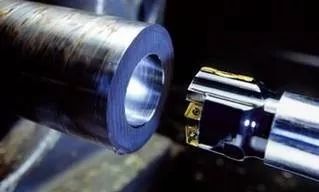
Complex treatment in deep holes is becoming more and more difficult. Parts often require additional characteristics, such as very small holes, inner room, change of pore diameter, outline, grooves, threads and changes. To obtain holes with small tolerances effectively, not only requires rich experience and research and development resources, but also requires engineering capacities, application facilities and important customers to participate.
Treatment of deep holes (DHM)
This is a type of treatment field dominated by tools designed for existing applications. Many different industries involve a deep holes treatment, but the most used is the energy and aerospace industry. At the beginning, certain parts in deep holes were often unable to train, but in addition to solving process problems, non -standard knife solutions designed by experts can also ensure that they are executed to a certain extent with great efficiency and errors.
The demand for complex holes increases and the treatment time must be shortened, which has favored the development of the technology of treatment of modern deep holes. For decades, drilling in a deep hole was a high effectiveness method of using hard alloy knives, but the bottom of pores as the bottleneck began to appear.
From now on, the successful treatment field is generally based on mixed use standards and special tool components. These tools are equipped with a high -elongated high -precision knife handle, and have integrated support and recruits, combined with the latest groove -shaped material and cut blade, and effective control of the effective control Cooling fluid and chips, which can be at the highest penetration rate and obtain the high quality results required under the safety of treatment.
Figure 1
Figure 1 The parts that first stop the treatment of the depth hole first require a very deep hole, then often a variety of complex functional treatments. The treatment of deep holes is generally based on the specifications of the hybrid application and public knives. These non-standard tools based on the T-Max 424.10 drill head are one of the offices used by unique pipes.
Small diameter holes below 1 mm in the drilling of the deep holes are treated with a hard semi-final forest, but for the 15 mm holes and above, the welded blade shapes are generally used. The technology and the drilling system for modern transposition blades also offer new possibilities for dedicated tools for the treatment of deep holes.
When the depth of the hole is more than 10 times the diameter of the pores, the treatment holes are generally considered to be deep. Special technology is required when the depth of the hole is 300 times the diameter, and a single tube or a double tube system can be used to drill. During the long processing process at the bottom of these holes, special sports mechanisms, tool configurations and correct cutting blades are necessary to complete the treatment of the inner room, grooves, wires and cavity. Another important area, which is also vital for deep hole drill, is also vital. This includes qualified tools adapted to the provision of higher performance in this area.
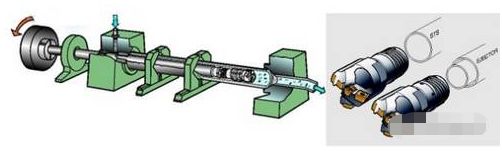
Figure 2
Figure 2 In the treatment of deep holes, the small diameter holes below 1 mm are treated by drilling the hard alloy gun, but about 15 mm and above the holes, the welded blade drills are generally used, And the 25 mm and above holes are used to transfer can be transferred. The drilling bites can only be performed very effectively in the single tube system and the double tube ejector system. The World Center for Shantevik Cola MANCHONG can provide development, design and test resources for the development of parts in the industry. In addition to small prizes, the center has also collaborated with many industries.
Craftsmanship
The current manufacturing requirements must be completely different from drilling in deep holes (cutting process with a single element and in-depth treatment solutions which are generally implemented on other machine tools). Even on multi-tamed machine tools, a single clip requires this method. For example, the pores of a few meters of machining have a diameter of pores of about 100 mm. Generally, when the borehole is finished, after moving the parts to the tower, these characteristics are added to the hole through the cutting process. Treatment of deep holes is now combined with a knife to carry out the capacity of the follow-up process, and there is no restriction on the adjustment of machine-tools. This new knife technology has expanded its operating capacity, so that these demanding features can be mobilized more effectively in a smaller restriction range.
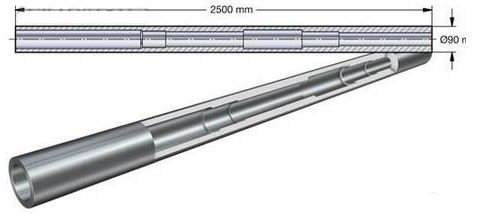
An example of the use of deep holes treatment technology for effective treatment of functionalities is oil exploration parts. These parts are approximately 2.5 m long, with complex characteristics and small tolerances. To obtain small tolerances and excellent surface sweetness, the tool solution first involves a hole with a diameter of 90 mm, then uses a floating re-blade for refined treatment. Then reach a depth of 1.5 m, widen the holes and hinges of holes with a diameter of 115 mm. The other separates into the holes in the middle, then widens the holes and hinges, and the treatment is finished through the rear angle. Finally, two interior rooms with hinge and expansion form two chamfers (also articulated with finished sizes).
Deep processing global treatment The tools for processing deep holes provide an non -standard elimination scheme adapted to these parts in the energy industry. The cutting time has been extended from more than 30 hours to 7 am and a half. This non -benchmarking adjustment scheme can provide the small public difference and the brightness of appearance light required in the relatively complex holes. The process includes drilling deep holes and the use of the floating heater to stop refined treatment. Then reach the depth of 1.5 m, stop the pores and hinges of the holes with a diameter of 115 mm. Then stop the expansion and hinge of short components in another deep hole and form a chamfer. Finally, stop the cut and expansion of the pores which constitute two interior parts with the chamfer (also articulated at the finished size).
During conventional treatment, the time to finish this part on the tool machine is more than 30 hours. The deep holes treatment solution with a special tool can shorten time at 7.5 hours.
Improvement of efficiency
It is completely different from the multi-operative light. It is not surprising to shorten the cutting time of 80%. An example that can prove the capacity is that the technology ownership of the tools and the design of the blades can maximize the safety of the cutting blades. Make a charge and optimizing cutting effects on the best quantity of blade can allow higher penetration to shorten the treatment time. In terms of precision, small tolerances are the expertise in the treatment of deep holes.
Deep holes that go away from the central line
Another example of high technical requirements for knives and techniques that are owned by the hole is the very deep hole in the generator station processor. In this case, GenerPro, an expert in the electricity production industry, must process 90 tonnes of steel parts forged in an asymmetrical manner in the central line of the axis. Over 100 mm. These deep holes must be deviated from a certain angle, and the position tolerance must be within 8 mm at the exit.
Drilling direction, dandruff and broken chips, and the application of absolutely non-dropping product is essential for this. The tool solution includes a dedicated drill and a new support card. Drilling tests are necessary before applying the tree, and the results are confirmed as more effective and reliable – and the output position is less than 2.5 mm from the target.
In many cases, the use of modern holes machining technology has shown that the processing time is considerably shortened from several hours to less than 1 hour – and many complex characteristics are also transformable.
Daguang focuses on providing solutions such as precision CNC machining services (3-axis, 4-axis, 5-axis machining), CNC milling, 3D printing and rapid prototyping services.



















