
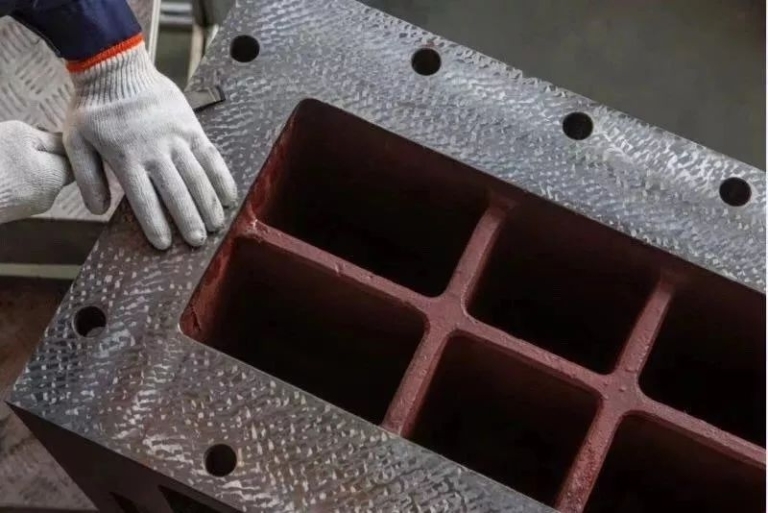
When you pass in front of a machine-tool manufacturing plant and see the technicians scratching and milling by hand, you can’t help but ask yourself: “Can they really improve the surfaces treated by current machine by scratching and fueling (Will people do it more?) Powerful than a machine?) “
If you only refer to its appearance, then our answer is “no”, we will not make it more beautiful, but why ray it? There are of course reasons for this, and one of them is the human factor: the purpose of a machine tool is to make other machine tools, but it can never reproduce a product with more of precision than the original. Therefore, if we want to create a more precise machine than the original machine, we must have a new starting point, that is to say that we must start with human efforts. In this case, human efforts refer to scratching and grinding. hand.
Scratching and grinding are not a “hand -free” or “hand -raised” operation. It is in fact a copy method which almost perfectly reproduces the matrix. This matrix is a standard plan and is also made by hand.
Although scratching and grinding are hard and laborious, it is a skill (an artistic level technique); It can be more difficult to form a scratch and grinding master than to form a master in wood sculpture. There are not many books on the market that describe it. discuss this subject. In particular, there is less information on “why scraping is necessary”. This may be why scratching is considered an art.
1
Where to start?
If a manufacturer decides to grind with a grinder instead of scratching, the rails of his “parent” grinder must be more precise than on a new grinder.
So where does the precision of the first machines come from?
It must come from a more precise machine, or rely on another method to produce a really flat surface, or perhaps be copied from a flat surface already well made.
We can use three methods of drawing circles to illustrate the process of creating surfaces (although the circles are lines and not surfaces, they can be cited to illustrate the concept). A craftsman can trace a perfect circle with an ordinary compass; If he draws with a pencil along a hole in a plastic template, he will reproduce all the inaccuracies of the hole if he draws it by hand. As for the circle, the accuracy of the hole; The circle depends on its limited skills.
In theory, a perfectly flat surface can be obtained by alternating friction (running) of three surfaces. For the sake of simplicity, let’s illustrate with three rocks, each with a fairly flat surface. If you rub these three surfaces alternately in a random order, you will move them more and more gently. If you only rub two stones together, you will get a pair of couplings of a bump and a bump. In practice, in addition to using scratching instead of running (lapping), a clear pairing sequence will also be followed. The scratch masters generally use this rule to make the standard template (right gauge or flat plate) that they want to use.
When using it, the Master Gratoir will first apply the color revealer to the standard template, then will drag it to the surface of the room to reveal the areas that must be scratched. It continues to repeat this action, and the surface of the part is closer and closer to the standard size, and finally it can perfectly copy the work which is the same as the standard template.
The scratch molded parts are generally strawberry a few thousandths more than the final size, then sent to thermal treatment to release the residual pressure, then returned for surface finishing grinding before scraping. Although scratching takes a long time and causes high labor costs, scratching can replace the process that requires high equipment costs. If you do not want to replace it with scratching, the machine must be finished with a very high precision repair machine. treatment.
In addition to involving expensive equipment in the final phase of the finishing treatment, there is another factor to take into account: when processing parts, in particular large molded parts, certain gravity tightening actions are gravity are Often necessary when the treatment reaches a few thousandths and when precision is reached. Raised, the tightening force often causes a distortion of the part, endangering the precision of the part after having released the tightening force, the heat generated during the treatment can also cause a distortion of the room.
It is one of the many advantages of scratching. There is no tightening force and the heat generated by scratching is almost zero. The large parts are supported in three points to ensure that they do not deform under the effect of their own weight.
When the machine-tool scraping track is used, it can be corrected again by scraping again. It is a great advantage compared to the rebelling of the machine or its sending to the factory for disassembly and reprocessing.
When the trace of a machine tool must be scratched and rectified, this work can be done by the factory maintenance staff, but we can also find staff on site to carry out scratching and grinding work.
In some cases, manual scratching and mechanical scratch can be used to obtain the required final geometric accuracy. If the traces of a set of work tables and stools have been scratched and the precision has responded to the requirements, but that the parallelism of the work table in the main axis is inconsistent (this requires a lot of efforts to correct it), can you imagine using a single scraper? What level of competence does it take to remove the right amount of metal in the right place without losing in flatness and correctly correcting alignment errors?
This is of course not the initial objective of scratching, and it should also not be used as a method to correct important alignment errors. However, an experienced scratch master can make this type of correction in surprisingly short time. Although this method requires qualified technology, it is more profitable than the treatment of a large number of parts to be very precise, or that the realization of reliable or adjustable conceptions to avoid alignment errors.
2
Lubrication improvement
Practical experience has proven that raciler rails can reduce friction thanks to better quality lubrication, but there is no consensus on reason. The most widespread opinion is that the low -scratched low points (or more precisely, the dug dug, the additional oil pockets for lubrication) provide many small pockets of oil, which are absorbed by the many small high points surrounding surrounding .
Another way of saying it logically is that it allows you to permanently maintain a film of oil on which the mobile parts float, which is the purpose of any lubrication. The main reason why this is that these irregular oil pockets form a lot of space for oil to remain, which makes it difficult to escape easy. The ideal situation for lubrication is to maintain a film of oil between two perfectly smooth surfaces, but you must then take care to prevent oil from escaping or having to put it back as quickly as possible. (Whether or not there are scrapers on the surface of the track, oil grooves are generally practiced to facilitate the distribution of the oil).
Such a statement would lead people to question the effect of the contact zone. The scratch reduces the contact zone but creates a uniform distribution, and the distribution is the important thing. The more flat the two corresponding surfaces, the more uniformly the contact areas. But there is a mechanical principle that “friction has nothing to do with the surface”. This sentence means that the contact surface is 10 or 100 square inches, the same force is necessary to move the established. (Wear is another matter. The smaller the area subject to the same load, the faster the wear.)
What I want to emphasize is that what we are looking for is better lubrication, no more or less contact zone. If the lubrication is perfect, the surface of the track will never wear out. If a table is struggling to move because of its wear, it can be linked to lubrication and not to the contact zone.
3
How is scratching?
Before locating the high points that must be scratched, first apply the color revealing to the standard template (flat plate or right template when scratching V rails), then place the color revealing on the standard template by rubbing On the track. Surface to be shovel, the revealer of color will be transferred to the salient points of the track surface, then a special scratch tool is used to eliminate the salient points of color development. This action must be repeated until the surface of the track has a uniform transfer.
Of course, a master of scraping must know various techniques. I will first talk about two of them here.
First, before proceeding with the development of the color, we generally use an blunt file to gently rub the surface of the room in order to eliminate the burrs.
Second, wipe the surface with a brush or with your hands, never with a cloth. If you use a cloth to wipe, the fine lines left by the cloth will cause misleading marks the next time you make high color development.
The master scraper itself will check its work by comparing it with the standard template and the surface of the track. The inspector only has to indicate to the master scratch when stopping work, and there is no need to worry about the scratch process. (The master scraper can be responsible for the quality of his own work)
We previously had a set of standards that dictated the number of high points per square inch and the percentage of the total surface which was to be in contact, but we found that it was almost impossible to check the contact zone, and now everything is done; By scraping the main crusher determines the number of points per square inch. In short, the masters of scraping usually strive to reach a standard of 20 to 30 points per square inch.
In the current scraping process, electric rackers are used for certain leveling operations. It is also a type of manual scratch, but they can eliminate certain painful work and make the scratching work less tiring. Nothing replaces the feeling of scratching of the hands when you do the most delicate assembly work.
4
scraped pattern
There are many types of patterns. Here we present some of the most common types, such as arc patterns, square patterns, wavy patterns and fan -shaped patterns. Arc patterns mainly include moon -shaped patterns and swallow -shaped patterns.
1. Arc model and scratch method
First, use the left side of the edge of the scraper to scratch, then scratch diagonally from left to right (as shown in figure A below). At the same time, turn your left wrist to oscillate the blade in the arc from left to left. to the right (see Figure B below). (illustrated in the figure), the scratching of the edge goes from the left to the right. The longitudinal length of the blade brand is generally about 10 mm. The entire scraping process is completed instantly, therefore. that various arc models can be scratched. You can also scratch diagonally from right to left. You can use your left wrist to press hard while turning your right wrist to make the blade oscillate in arc from right to left, so that the scratching of the cutting edge of the right. Left.
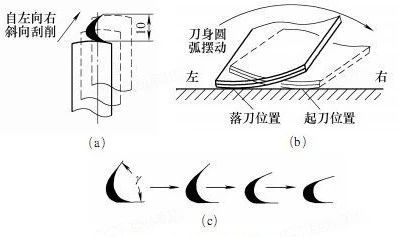
Basic scratch method for arc pattern
Tips for scratching the arc -shaped patterns: due to the different scraping conditions and operating methods, the shape, size and angle of scratched arc -shaped patterns also vary considerably. First of all, pay attention to the choice of an appropriate scraper, because the width and thickness of the cutting head, the radius of the arc of the blade and the size of the corner of the area all have a certain Impact on the shape of the arc pattern. Second, you must; be able to control the wrist torsion during scratching. The amplitude and length of the scratch stroke; The third is to use the elastic effect of the cutting head. In general, the greater the amplitude of the wrist torsion action and the shorter it is. The larger the scratching race, the smaller the angle of the scratched arc pattern, the smaller the shape, as shown in Figure C above.
(1) Lunar motif and scratch method
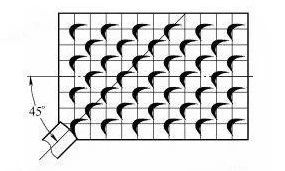
Before scraping, use a pencil to draw a square grid at a certain distance on the surface of the room.
During scratching, a precision scraper with arched edges is used. The central line of the plan of the blade forms an angle of 45 ° with the longitudinal central line of the surface of the room. The scratch is carried out from front to the back of the room.
(2) Hirondelle model and scratch method
The motive of the swallow is shown in the image below. Before scraping, use a pencil to draw a square grid at a certain distance on the surface of the room. During scratching, a precision scraper with arched edges is used. The central line of the plan of the blade forms an angle of 45 ° with the longitudinal central line of the surface of the room. The scratch is carried out from front to the back of the room. Current scratch methods are:
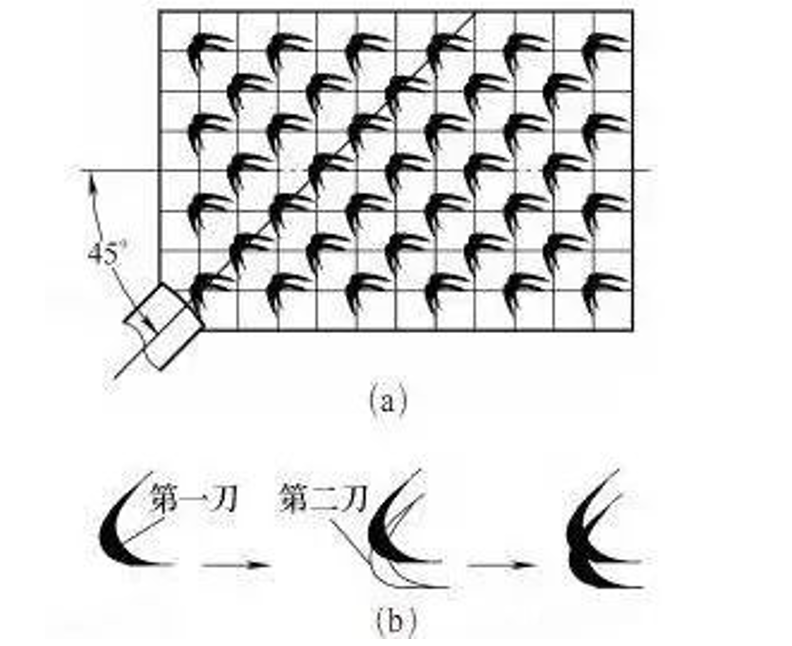
First of all, scrape an arc -shaped pattern with the first knife, then scrape a second arc -shaped pattern slightly below the first arc -shaped pattern, so a pattern similar to a swallow May be scratched, as shown in the figure. B above.
2. Square pattern and scratch method
The square pattern is illustrated below. Before scraping, use a pencil to draw a square grid at a certain distance on the surface of the room. During scratching, the central line of the plan of the blade forms an angle of 45 ° with the longitudinal central line of the surface of the room, and the scraper is carried out from front to the back of the room. The basic scraping method is as follows: Use a narrow scraper with a straight blade (or with a large -radius arc blade) to scrape over a short distance. After scraping the first square, you have to leave a square from a distance, then scrape the second square.

3. Wave model and scratch method
The wavy pattern is illustrated in figure A below. Before scraping, use a pencil to draw a square grid at a certain distance on the surface of the room. During scratching, the central line of the blade plane must be parallel to the longitudinal central line of the room surface, and the scraper must be made from the back to the front of the room. The basic scraping method is as follows: Use a scratch scrape to scratch, select the position where the knife falls (generally choose the intersection), then move the knife diagonally to the left to push and scrape when it reaches A certain length (generally choose). the intersection), then move to the left. Move the scraper diagonally on the right side to a certain position, then start the knife, as shown in Figure B below.
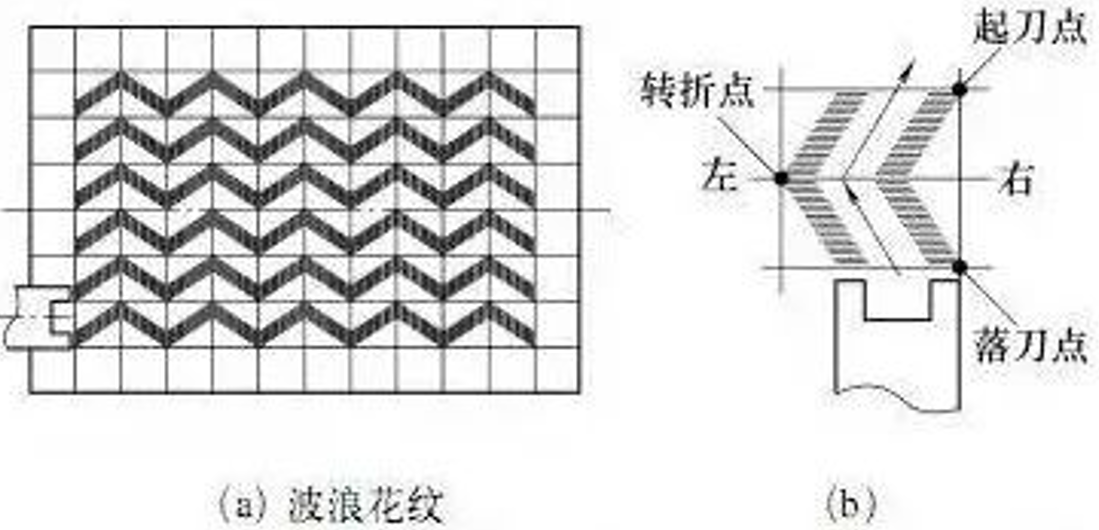
4. Fan -shaped pattern and scratch method
The fan-shaped pattern is illustrated in figure A below. Before scraping, use a pencil to draw squares and corner lines at certain intervals on the surface of the room. To scrape the fan-shaped pattern, use a crochet-shaped scraper (as illustrated in Figure B below). The right end of the blade must be sharpened, the left end must be slightly blunt and the line of the blade must be straight. The basic scratch method is as follows:
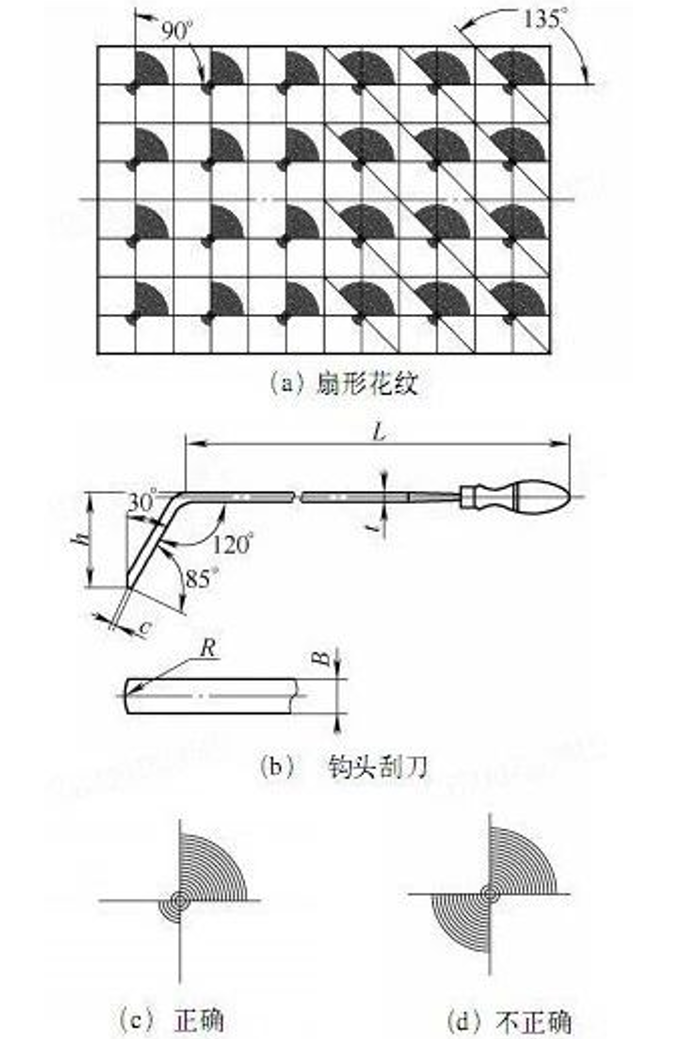
Choose the position where the knife falls (generally at the intersection), hold it 50 mm from the head of the knife with your left hand, press hard to the left, take the left end of the knife blade as the center of the center Circle, and turn in the direction of the needles of a watch with your right hand. The rotation angles are generally 90 ° and 135 °. The correct range in the shape of a fan is that illustrated in Figure C above. Due to an inappropriate force, it is easy to scrape the two ends at the same time, thus forming a pattern as illustrated in the figure D above. The pattern marks will be too superficial and the pattern will be incorrect.
Daguang focuses on providing solutions such as precision CNC machining services (3-axis, 4-axis, 5-axis machining), CNC milling, 3D printing and rapid prototyping services.



















