

The continuous generation grinding process is the main process used to improve the geometric accuracy and meshing performance of gear tooth surfaces. During the grinding process, most of the force of the chips is converted into heat. Depending on the process parameters, approximately 60-90% of the generated grinding heat will be transferred to the workpiece. Friction during grinding can result in high temperatures in the contact area, potentially causing burns during co-grinding.
In order to better understand and control the heat transferred to the workpiece during grinding generation, it is first necessary to clarify the grinding energy distribution. After Hahn’s work, a material removal model based on three different forms of mechanical motion was established: friction, plowing, and shearing. Each material removal model is capable of explaining part of the energy transfer mechanism in the part.
The abrasive energy generated during the three stages of material removal depends on the micro-interaction characteristics of the abrasive particles with the workpiece, such as the contact length of the abrasive particles, the penetration depth of the abrasive particles, and the cross-sectional area. abrasive particles. These micro-interaction characteristics are significantly affected by wear particle morphology and wear particle-material interaction. Then, the interaction between the tiny abrasive grains of the grinding wheel and the gear was characterized based on the kinematics and process parameters. In order to study the appropriate grinding energy calculation model that generates the gear grinding process, it is necessary to consider how each grain interacts in the contact area based on the submitted process parameters.
In this study, an existing simulation model of the gear grinding process generated based on the penetration calculation method was adopted. Furthermore, an extension of the model is proposed, taking into account the actual topography model of the dental surface of the grinding wheel and the macroscopic movement of the grinding wheel during the process. The simulation results show the micro-interaction characteristics of the gear tooth surface during the whole grinding process. Finally, the micro-interaction properties obtained are applied to the calculation of the forces and energies generated during gear grinding.
Description of the current situation
The gear generation grinding process is one of the most efficient processes for finishing hardened gear surfaces after heating. In this process, the cylindrical worm grinding wheel, whose tooth profile is equivalent to the rack profile on the cross section, forms a meshing relationship with the gear to be grinded. The involute of the gear is produced by the continuous generative motion of the worm wheel and the workpiece. As shown in Figure 1, a special feature of this process is that during the rotation of the grinding wheel, the contact point between the worm wheel and the gear to be ground continuously changes during the grinding process.
Figure 1 Gear generation grinding process
Depending on the grinding wheel profile, process parameters and process movement, the micro-interaction characteristics of each abrasive grain are different. Ultimately, these differences affect the forces and energies within the grinding contact area. In order to predict the forces and energies of this process, simulation models have been built in recent years taking into account the complex kinematics and microfriction characteristics of the generated gear grinding. In the next section, one of the simulation models is examined. Additionally, microinteraction properties currently considered in software are reviewed. In addition, the calculation method of the generated gear grinding energy is also introduced based on the micro-interaction characteristics.
Gear Generation Grinding Model
Modeling the manufacturing process can be carried out using a penetration calculation approach. In penetration calculations, process characteristic values can be calculated taking into account the kinematics and geometry of the part and tool. Use section planes to simplify the 3D model into a 2D model. In the work of Brecher et al., a simulation model is described, as shown in Figure 2.
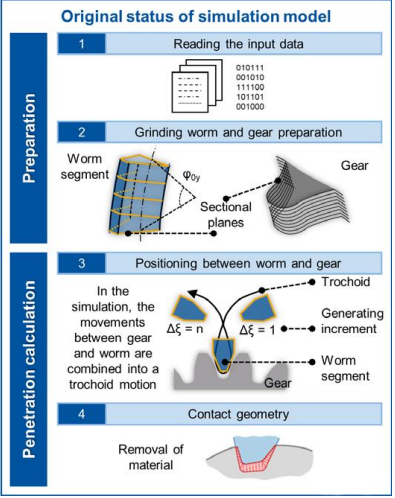
Figure 2 Model analysis process
The simulation work is carried out in several stages. In the first step, relevant data is entered, such as the shape of the gear train and the geometric and process parameters of the tool. Then, models of the worm and cutting gear based on the cutting plane are generated. The cross-sectional plane of the auger represents the contour of the tool. In order to keep the computational workload as low as possible, only a section of the actual worm is considered for the simulation, which is defined as ψ0y by the starting angle in the middle of Figure 2.
In the next step, a simplification of the actual cutting kinematics was introduced into the simulation model to reduce the modeling complexity. In kinematics, the grinding worm segment is positioned relative to the gear and rotates in a curve. The rotational motion of the worm in the simulation model represents the combination of gear and tool motion that occurs during the actual machining process. Despite the kinematic simplification, the same complete conditions and material removal scenario are obtained at the end of the simulation. By processing with a defined generation increment △$, the transverse plane of the tooth groove can be completely processed between the first and last generation penetration △$. In the lower middle part of Figure 2, the contact geometry between the grinding worm segment and the gear is calculated for all power generation positions.
From now on, the simulation model only takes into account the macroscopic interactions between the cutter and the gear. However, for the calculation of energy rates and forces, the micro-interactions between the worm and the gear are also of great importance. The simplification of process kinematics used in simulation models makes it impossible to model micro-interactions without an accurate correlation between tool rotation and cutting speed. The rotational movement of the tool surface has a significant influence on the interaction of the grinding bar with the material. During this process, rotational motion is essential for the generation of contact paths between grinding particles and gears, and its role in simulation cannot be ignored if microscopic gaps are to be analyzed.
Micro-interaction characteristics during the gear generation and grinding process
In Hubner’s work, the study of normal force calculation was implemented (see section “Modeling of the gear generation grinding process”). His work resulted in the successful application of the normal force model developed by Werner to the grinding of spun gears, see the formula shown at the top of Figure 3. With the exception of the force k determined, all variables are calculated in the simulation model. In Hubner’s work, the top profile of a grinding auger was simulated by measuring the two-dimensional profile of individual particles. These individual grains are quickly mapped onto the grinding wheel by manual setup.
Although this method is suitable for single-layer grinding wheels, it cannot accurately reflect the uneven distribution of grinding particles in actual grinding wheels. Therefore, the method adopted by Hubner did not take into account two important factors in the morphology of the worm wheel. The first factor is the different degree of particle protrusion from the grinding wheel topography, which results in a situation where not all particles in the grinding wheel topography are in contact with the workpiece. The second factor is the shadow effect when the workpiece comes into contact with the grinding auger. Shading describes the effect of the first abrasive in contact with the workpiece on the mating of abrasive particles that immediately contact the workpiece.
The process energy Ew is the energy required to remove material and is generally assumed to be equal to the spindle energy. In Teixeira’s earlier work, an energy model was proposed that accounted for the involvement of individual abrasive particles in the chip formation process that produces grinding. The model is based on the work of Linke and its main content is to assume that the energy required for each chip formation process is different, taking into account specific aspects of the surface grinding process. In the Teixeira model, Linke’s work was extended to generate the gear grinding process, as shown in the upper right corner of Figure 3, and experiments with a single abrasive grain were carried out. A more detailed description of the energy calculation method for each chip formation mechanism is provided in the relevant references.
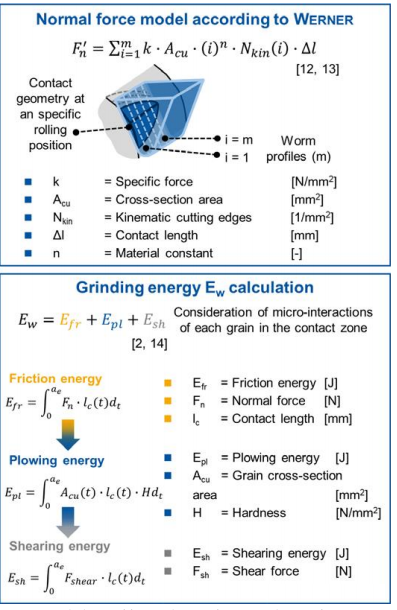
Figure 3 Associated calculation and analysis process
In order to calculate the energy required for each chip formation process, information on the micro-interaction characteristics of the grains is needed, such as the contact length l, the cross section A of the abrasive grains and the chip thickness . Finally, the process energy Ew is calculated as the sum of all energies of each iron chip formation process, i.e. of all abrasive particles involved in material removal, see corner upper right of Figure 3. Although different studies have been carried out on force and energy simulation models for gear grinding, a more realistic study of micro-interaction characteristics is used by considering the complex motion of the rotational process and movement of the tool. By considering the topography of the grinding wheel and the rotation of the grinding spindle, the energy of the gear grinding process can be calculated in more detail.
Research objectives and research methods
The objectives of this work are defined based on the differences in the simulation model regarding the worm morphology and the rotational motion of the grinding wheel spindle explained in the “Description of the current situation”. The aim of this work is to establish a force and energy model that takes into account the kinematics of the generated gear grinding process and the morphology of worm gears as well as the micro-interactions of the gears.
Extension of simulation model based on grinding wheel tooth surface topography
In this section, we describe the extensions implemented in the simulation model. There are two different types of tests: (1) worm wheel topography and (2) worm rotational motion. First, the implementation of the worm morphology in the simulation model is described, as shown in Figure 4.
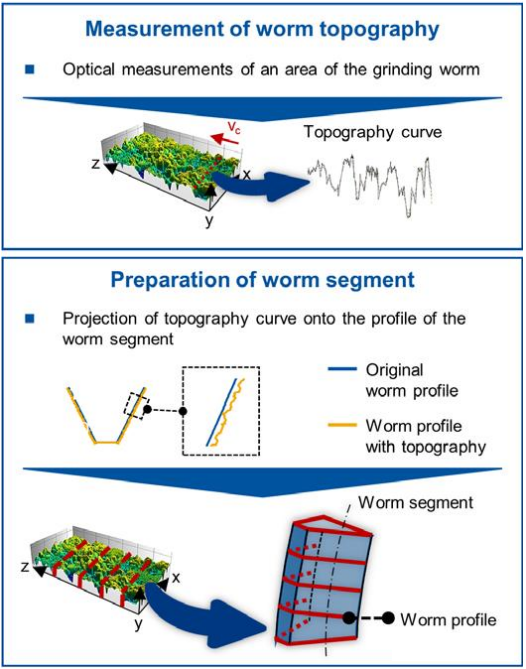
Figure 4 Extension of the simulation model concerning the topography of the worm screw
The first step involves making optical measurements of the morphology of the chewing worm using a laser scanning microscope. Measurements are made at 20x resolution over an area large enough to select samples representative of the total size of the grinding rod. Optical measurements are analyzed using mapping software. In the software, the topographic curves are extracted at several positions along the Z axis, as shown in Figure 4. Then, the topographic curve is fed to the auger. The endless screw shown at the bottom of Figure 4 is made up of several faces called tool profiles. Each topographic curve of the real earthworm is projected onto a different tool profile. Finally, the real topography will replace the theoretical topography in the model and will be used for analysis.
The second extension required in the simulation model concerns the rotational movement of the worm grinding spindle relative to the gear position. . In the original version of the simulation model, the position of the worm varied along the simulated position, but the worm itself did not change or rotate. Additionally, all tool profiles for worm gears are identical. In the extended simulation model, each tool profile of the grinding auger has a different topographic curve. The rotational movement of the grinding auger is achieved by changing the position of each tool profile during the simulation, see Figure 5.
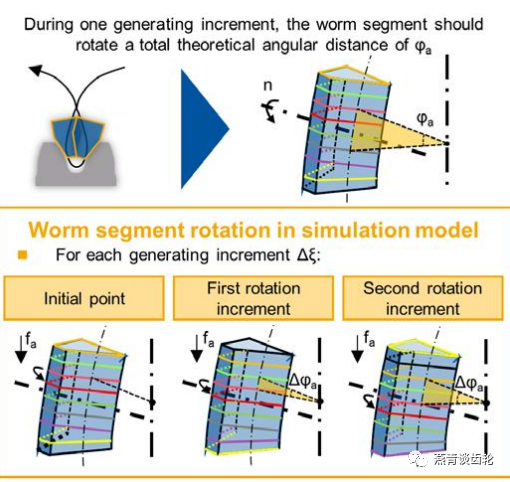
Figure 5 Extension of the simulation model concerning the rotational movement of the worm wheel
The change in tool profile position is related to the process parameters and the generated feedrate Δξ. When expanding in increments △ξ, the theoretical angular displacement that the worm wheel must rotate is. Depending on the angular displacement, the number of times the position of the tool profile should be changed is defined. The change in position of the tool contour is carried out by a single rotational advance until the theoretical angular displacement is reached. After reaching the set angular travel distance, the simulation continues with the next generation feedrate Δ&, and the process of changing the tool contour position is repeated in the next generation feedrate. Based on this, the simulation model and practical considerations of rotational motion are extended.
Discussion of results
In this section, the calculation of the forces and energies generated in the gear grinding process, based on the micro-interaction properties of the abrasive particles combined with the gear material, is carried out and discussed.
Checking the scalability of the simulation model
By extending the simulation model, the micro-interaction characteristics of all abrasive particles contacting the gear during the simulation process are obtained. Based on the micro-interaction characteristics of the simulation model, the non-friction forces generating gear grinding were calculated according to the Werner model (see Figure 3). In order to check whether the micro-interaction characteristics used for the force calculations are suitable, we compared the normal force Fn calculated in this article with the results of the model developed by Hubner, which was verified experimentally. The simulations were carried out using an extended simulation model with the same parameters as Hubner’s work. The bottom plot of Figure 6 shows the normal force Fn calculated in Hubner’s work, the upper part of the plot and the normal force Fn calculated using the model in the current work.

Figure 6 Calculation and analysis of normal force during gear grinding generated
In simulation models, a simulation method called rapid analysis is possible. In this type of simulation, only a region located in the middle of the gear tooth surface is considered, which constitutes the complete contact between the tool and the gear. The simulation represents only one axial position of the gear gap and only the maximum value of the process characteristic value is calculated. In his work, Hubner was able to verify the normal force Fn calculated from three experiments. The figure shows the normal force Fn calculated by Hubner when grinding the entire tooth gap. The figure below shows the normal force Fn calculated in the present work for grinding the tooth gap in the axial position.
The normal force obtained from the extended simulation model was compared with the model designed by Hubner and good consistency was obtained. It can be assumed that the microinteraction characteristics obtained through the extended simulation model are consistent with the real process.
Energy calculation method for generated gear grinding process
The process energy Ew is calculated based on the sum of the energy generated during the contact process with the abrasive grains in the three iron chip generation grinding processes (see Figure 3). The process energy Ew can be simulated using a calculated result for analysis. The gears, grinding wheels and process parameters used in the simulation are the same as the simulation parameters used in the “Extended Simulation Model Validation”. At the top of Figure 7, the process energy Ew obtained from the simulation is shown.
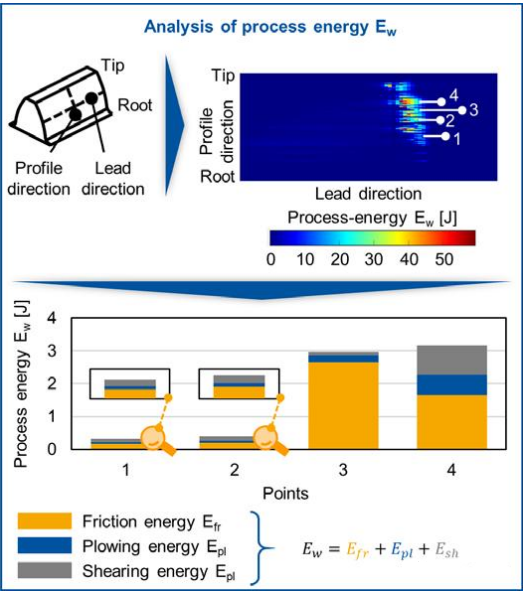
Figure 7: Energy calculation analysis of spun gear grinding process
In the process energy image Ew of the formation of the gear tooth surface, in the upper part of Figure 7, four points are randomly selected in the contact area between the gear and the tool. In these four points, we carry out a more in-depth analysis of energy. In this figure we can see the contribution of each individual energy of each iron filing formation process to the process energy E. For points 1 and 2, similar energies and process contributions are obtained. For points 3 and 4, the process energy Ew is also very similar, but the contribution of each individual energy of each iron filing process is different. It is analyzed that the friction energy Efr at the four points contributes the most to the process energy Ew. With the exception of point 3, the contributions of all points are slightly lower than both friction and shear energies Esh. For the third point, the plowing energy Epl is greater than the shear energy Esh.
Each chip formation process contributes differently to the heat transferred into the gear. Almost all the friction energy Efr is transferred to the workpiece in the form of heat, while for the plowing energy Epl and the shear energy Esh this proportion is lower. The thermal energy of the part due to shear is the lowest of the three processes. Therefore, most of the energy is used to remove iron filings rather than heating the workpiece. If most of the process energy is not converted into heat, the risk of burns when grinding during the process is reduced.
Therefore, even though points 3 and 4 have similar process energies Ew, the contribution of each individual energy from each chip formation process to each point is different, resulting in different amounts of heat being transferred to the workpiece .
in conclusion
In order to achieve the defined objectives, this article extends a simulation model focused on realizing the morphology of the worm screw and its rotational movement. Based on the micro-interaction characteristics calculated in the extended simulation, the normal force of the process was calculated and the results showed good agreement with the literature search results. Therefore, the consistency of the extended model with the experimentally verified model is verified.
The process energy Ew is calculated as the sum of all energies of each chip formation process, for all abrasive particles participating in the material. The energy of each chip formation process contributes differently to the total energy distribution and heat conduction to the workpiece. The extended simulation model therefore allows us to understand how much energy generated during this process can be transferred to the part in the form of heat. Ultimately, this can be used to prevent grinding burns in the process that produces gear grinding.
In future work, we plan to verify it by grinding experiments. It is necessary to determine the critical value of the process energy Ew and the impact of each energy of the iron chip formation process on the combustion performance of grinding. Additionally, in order to avoid the time-limited task of optically measuring the topography of the grinding auger, a routine to generate a generic random topography of the grinding auger as simulation input will soon be implemented. implemented.
Funded by the Deutsche Forschungsgemeinschaft (DFG, German Research Foundation) as part of Germany’s Excellence Strategy – EXC-2023 Production Internet – 390621612.
Daguang focuses on providing solutions such as precision CNC machining services (3-axis, 4-axis, 5-axis machining), CNC milling, 3D printing and rapid prototyping services.



















