
Hob sharpening plays an important role in maintaining the precision and performance of the cutting workpiece during gear hobbing. How to judge the timing of sharpening has naturally become a top priority.
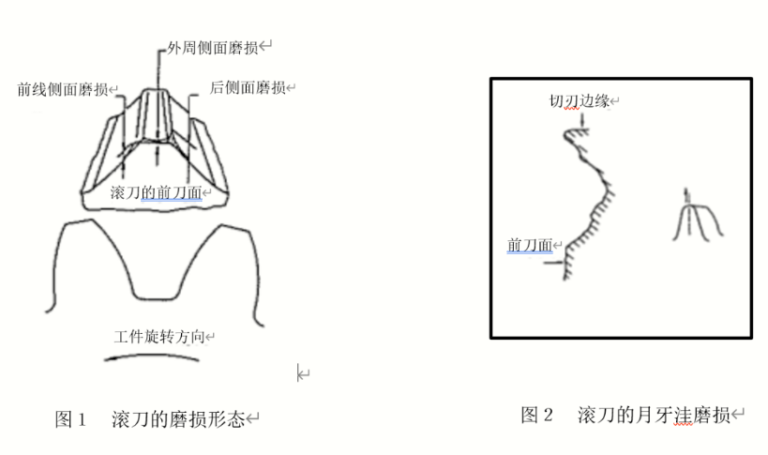
When the hob blade is worn or the hob is damaged for other reasons, the tool precision and cutting efficiency will be reduced, and the hob sharpening should be performed when conditions affecting the hobbing process occur. The timing of sharpening can be based on a variety of reasons, but is generally judged by observing the wear of the edge flanks. (As shown in Figure 1)
If it is a hob with a coating on the rake surface, rapid detection and sharpening when the degree of wear on the sidewall surface is about 0.1-0.2mm can avoid a large amount of shovel grinding and effectively control the sharpening cost. When the degree of wear exceeds 0.3mm, the cooktop will experience a sharp increase in the degree of wear. The degree of wear must be observed and honed over time.
In addition, depending on the wear situation, it is also necessary to observe crater wear at the same time (Figure 2). When the crater wear of the cooktop appears between 0.03 and 0.04 mm near the tip of the blade and between 0.05 and 0.08 mm at the far end of the blade, it should be sharpened in time. If you forget to observe the crater wear and only observe the flank surface, even if the flank surface wear is very small, there may be edge chipping caused by the crater wear. Therefore, when we evaluate the sharpening time, we must observe the wear conditions in various places and make a comprehensive judgment.
Daguang focuses on providing solutions such as precision CNC machining services (3-axis, 4-axis, 5-axis machining), CNC milling, 3D printing and rapid prototyping services.



















