

For machines and units to be designed, designers must meet different requirements in terms of functionality, economics, processing, transportation, maintenance and operation, as well as other aspects during the process of design. Although the different requirements are very different in terms of content, some general design principles can be summarized for design work. They are the prerequisites for solving a design problem in the most optimal way possible. Designers should follow the following basic principles and add other requirements for specific issues.
Functionality: The main requirement imposed on a technical device (machine, instrument, part, component, etc.) is the ability to perform a given task (function). The following other basic principles are based on meeting functional requirements.
Safety: Safety refers to the protection of personnel and machinery from harm due to misuse, overloading, etc. Besides functionality (i.e. reliability in performing the overall function), safety is also a major requirement for the design. By taking corresponding preventive measures (robustness-oriented design, overload protection through the introduction of overload destruction devices, control parts in accordance with ergonomic design, etc.), machine dangers can be avoided effectively.
Economy: Besides functionality and safety, economy is the most important requirement. Many factors affect the success of a product, but profitability is a deciding factor in terms of value. Application of semi-finished products, such as rods, plates, special-shaped pipes, etc.
In addition to standard and basic parts, you can reduce production costs. As shown in Figure 1-5, it is necessary to avoid excessively increasing the level of finish, because the resulting increase in use value is very limited compared to the increase in cost.
Material selection: The technical properties (strength, density, elasticity, hardness, etc.) of different materials are very different, forcing designers to make wise choices. Less strong materials will inevitably lead to larger cross sections, which, in addition to size, will also increase the mass of the entire machine. By selecting high strength materials, even if the cross section of the product can be reduced, the total material cost will be doubled (see TB1-1 “Relative Material Cost”). Whether high wear resistance, good weldability, high elasticity, strong corrosion resistance, excellent vibration damping, etc. are necessary, attention should be paid to the selection of appropriate materials.
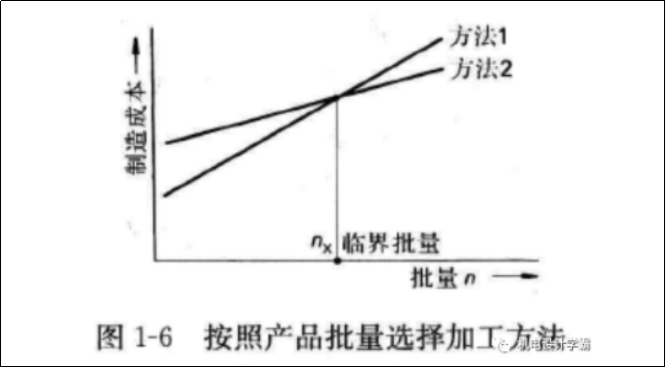
Processing methods: various processing methods (such as casting, forging, welding, bonding) and their advantages and disadvantages have a decisive impact on the structural design of parts, and designers should consider and select them carefully during the design process. This requires that designers are familiar with the different processing methods existing in the company and maintain close cooperation with the processing units. The batch size of the product (single piece, serial or batch processing) is also critical in the choice of processing method. It can be seen from Figure 1-6 that when the critical size of batch nx is less than or equal to the critical size of batch nx, the cost of treatment process 1 is low. When n>nx, the cost of treatment method 2 is low. .
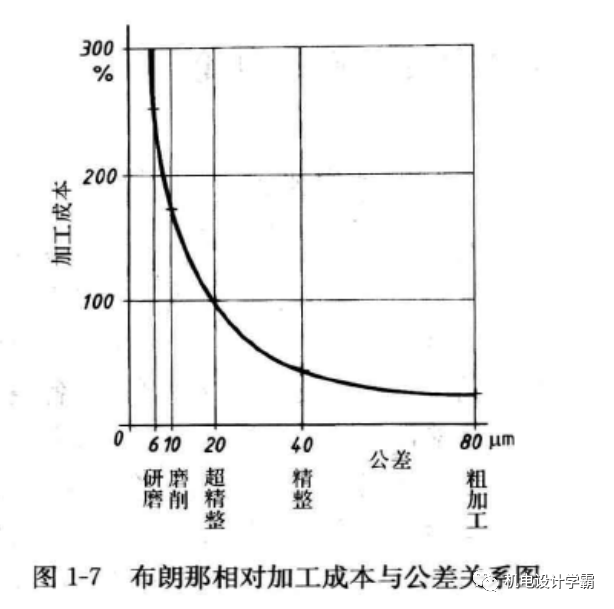
Precision selection: First of all, we need to determine whether the surface of parts such as castings can maintain a rough surface or whether it should be processed according to the functional requirements, as well as what surface quality to obtain and how to achieve it. ‘get. he. It is often possible to make minor changes to the design, reducing previously excessive requirements for surface quality and reducing overall costs. The same goes for determining the necessary tolerances. The principle to follow is “As coarse as possible, as fine as necessary,” because improving precision will result in a sharp increase in processing costs (see Figure 1-7).
Style: Nowadays, people increasingly demand that a technical product has a beautiful shape while fulfilling its technical functions. This requires designed products to have good appearance and color coordination, which is especially important for consumer products. Additionally, good modeling also requires structural design of the casting to avoid stress concentration.
Assembly: All parts must meet the requirement for simple assembly to reduce costs. If, in certain circumstances, assembly can only be carried out in a specific order, the designer must indicate this in the form of an assembly plan. During mass production, assembly should be automated as much as possible. Wearing parts should be easily replaced to reduce time and costs. Safety parts must be easily replaceable.
Maritime transport: There are many modes of transport: rail transport, automobile, freight, maritime transport (loading contour, authorized dimensions, authorized height when passing through tunnels or viaducts during transport). Do not make the product oversized or overweight, otherwise the product must be separated and packaged in a space-saving manner, especially when shipping (there is a charge for total tonnage and space size). Structures such as heterocyclic rings must be designed for transport.
Operation: The operation of technical devices must be as simple and explicit as possible. All means of operation must be easy to use and, if necessary, represented by corresponding logical symbols. Devices to protect against misuse must be provided. The operator’s working position must be optimized according to ergonomics, because the quality of operating performance represents the level of the equipment!
Maintenance: In most cases, maintaining equipment also means temporarily stopping production. Forced interruptions in production must be minimized to reduce losses. It is therefore necessary to be able to quickly identify areas of the equipment that require maintenance and quickly replace damaged parts. Good accessibility also ensures that locations requiring maintenance can be easily observed (lubrication locations that are not easily accessible can easily be “overlooked”). Preventive maintenance allows you to be aware of equipment production interruptions.
Environmental protection: The design of a product must ensure that it will not harm humans and nature (environment), and allow as many parts as possible to be reused (recycling oriented) or benefit from environmental protection.
Since the shop produces based on design information (machining drawings and parts lists), the cost of the product is determined during the design phase. Figure 1-8 shows the main factors affecting costs during the product development and planning stages.
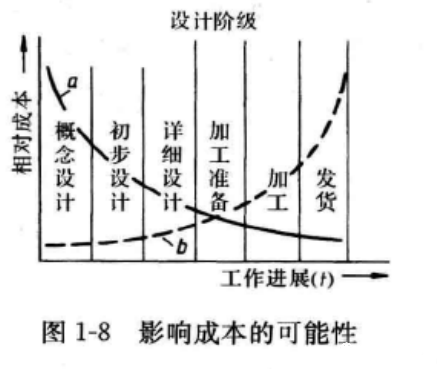
The impact on manufacturing costs is greatest at the start of the design process, with the impact on costs becoming lower and lower as the work progresses (curve a, unlike machining stage, modifications made during the design phase can be carried out without problem); significant increase in costs (curve b).
Daguang focuses on providing solutions such as precision CNC machining services (3-axis, 4-axis, 5-axis machining), CNC milling, 3D printing and rapid prototyping services.



















