
When you’re seeking the Best CNC Machine Company: 7 Insider Secrets to Guarantee Quality and Slash Costs, the real challenge isn’t finding a supplier—it’s telling the difference between marketing hype and measurable manufacturing excellence. After more than a decade on the shop floor, managing projects for aerospace, medical, and automotive clients, I’ve learned that genuine quality and cost efficiency come from transparency, not just promises. In this article, I’ll share seven insider secrets that separate top-tier CNC machining partners from the rest, using real-world criteria and concrete examples. Whether you’re prototyping a complex robot joint or scaling production of engine components, these insights will help you reduce risk, avoid hidden costs, and secure parts that meet your exact specifications—every single time.
Best CNC Machine Company: 7 Insider Secrets to Guarantee Quality and Slash Costs
The global CNC machining market brims with choices: from digital-first platforms like Xometry and Protolabs Network to specialized engineers like GreatLight Metal, Owens Industries, and RapidDirect. But the “best” CNC machine company isn’t just about who has the most machines or the lowest online quote. It’s about who can consistently translate your CAD file into a physical part that performs flawlessly—while still respecting your budget and timeline. Below, I’ve distilled the seven most impactful factors you should evaluate before issuing a purchase order.
1. Demystify the “Precision Trap”: True Geometric Capability vs. Advertised Tolerances
Many suppliers claim ±0.001mm accuracy, but few can maintain it across a production run on complex geometries. The first insider secret: always ask for a capability study specific to your part’s feature types, not a generic sales brochure.
True precision isn’t a single number; it’s a matrix of machine tool volumetric accuracy, thermal stability, tool condition, and fixturing strategy. For example, a 5-axis machining center from manufacturers like DMG Mori or Beijing Jingdiao can hold tight geometric tolerances on contoured surfaces, but only if calibrated and operated within strict environmental controls. Ask potential partners these questions:
What is the dynamic accuracy during 5-axis simultaneous motion, not just static positioning?
Do they perform regular ballbar and laser interferometry checks?
Will they share in-process measurement data (probing logs) with you?
A reputable CNC machine company will openly discuss their measurement capabilities. Look for those that own high-end coordinate measuring machines (CMMs) and offer first-article inspection reports as a standard deliverable, not an extra-cost item. At GreatLight Metal, for instance, in-house Zeiss CMM and automated probing on 5-axis centers form a closed-loop quality system that verifies every critical feature before the part ever leaves the fixture. This approach eliminates the “precision black hole” where quoted tolerance and shipped reality diverge.
2. Look Beyond the Machine List: Evaluate the Full Process Chain
Owning a fleet of machines doesn’t guarantee cost-effective quality. The second secret: the best CNC machine company functions as a single-source process integrator, not just a cutting service.
Your part may require turning, milling, wire EDM, cylindrical grinding, and surface treatment. Every time a part moves to a different subcontractor, you risk dimensional stack-up errors, extended lead times, and margin stacking that inflates costs. By contrast, a partner with an in-house full process chain—from raw material stock and CNC machining to post-processing like anodizing, passivation, or powder coating—can control tolerances holistically and compress lead times.
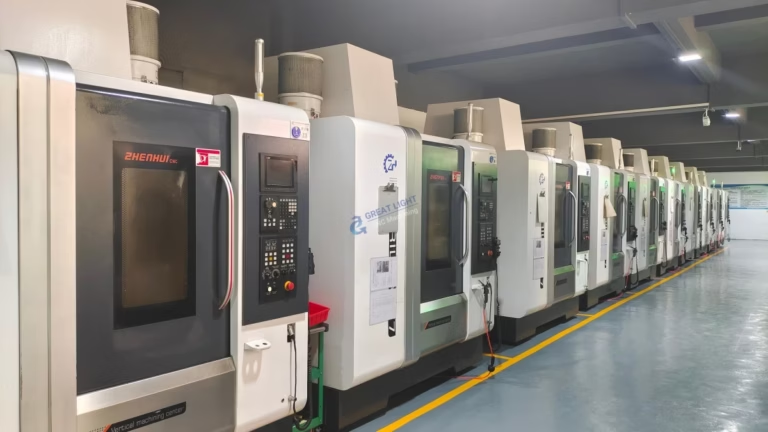
GreatLight’s 76,000 sq. ft. facility in Dongguan, adjacent to Shenzhen, houses more than 127 precision equipment units: large-format 5-axis centers, mill-turn machines, wire and sinker EDM, surface grinders, and even in-house 3D printing (SLM, SLA, SLS). This vertical integration allows a part that demands subtractive machining plus additive features to be produced under one quality management system, avoiding the finger-pointing that often occurs when two separate vendors are involved.
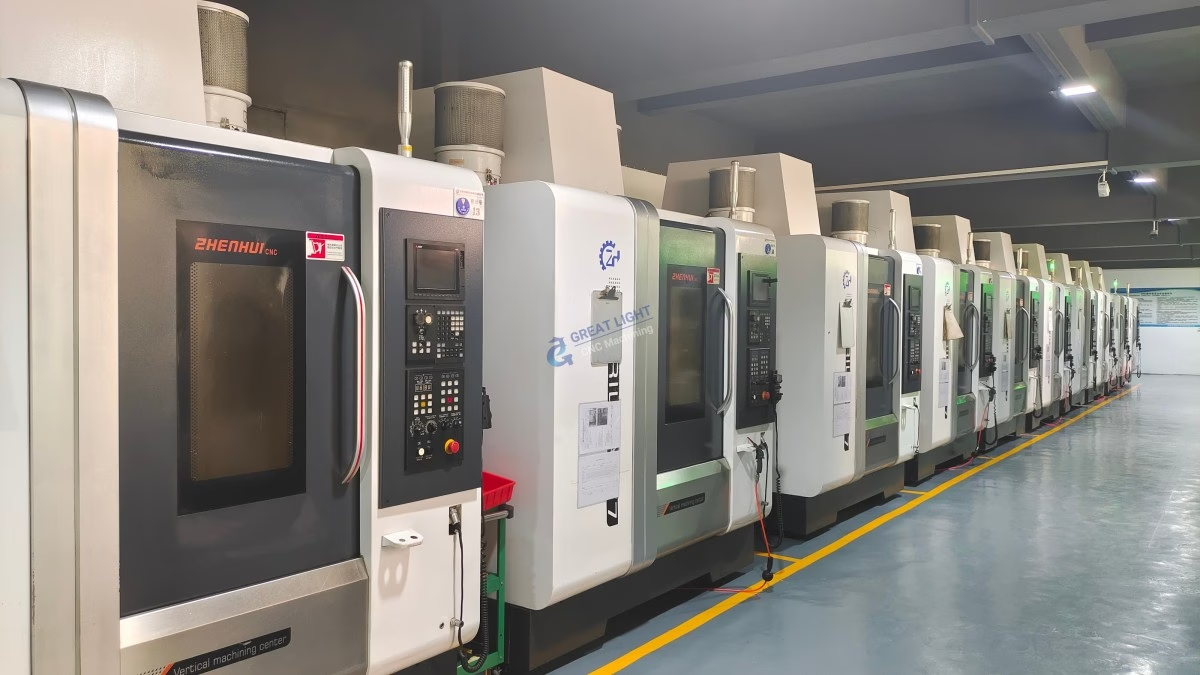
Compare this with pure-play platforms that outsource manufacturing to a scattered network. While those platforms can aggregate capacity, the process fragmentation often results in longer supply chains and less direct engineering oversight.
3. Certifications: The Trust Translation Layer You Cannot Skip
The third insider secret: certifications are not just wall decoration; they are the tangible language of trust. However, not all certificates are created equal. A best-in-class CNC machine company will hold certifications relevant to your industry’s risk profile.
ISO 9001:2015 is the foundational quality management standard. It ensures documented processes, consistent training, and a culture of continuous improvement. Almost every credible supplier has it.
ISO 13485 is necessary for medical device component manufacturing. It extends ISO 9001 with strict requirements for risk management, traceability, and cleanliness—critical for surgical instruments or implant components.
IATF 16949 is the automotive industry’s gold standard. It mandates defect prevention, supply chain risk management, and process capability analysis (Cpk/Ppk). If you manufacture engine, transmission, or electric vehicle (EV) components, this certification is a powerful signal of manufacturing rigor.
ISO 27001 counts when intellectual property (IP) protection is paramount. This information security certification ensures that your 3D models and proprietary drawings remain confidential and are handled in secure digital environments.
GreatLight Metal holds ISO 9001, ISO 13485, and IATF 16949 certifications, and operates an ISO 27001-compliant data security framework for IP-sensitive projects. Before engaging any supplier, verify the scope of their certifications—not just the presence of logos. Ask: Does the IATF 16949 certificate cover the specific site and processes (machining, assembly) that will handle my parts? A trustworthy partner will provide their certificate number for independent verification.
4. Unlock Cost Reduction Through Design for Manufacturability (DFM) Collaboration
Price-per-hour comparisons are nearly useless if a part design is inherently expensive to machine. The fourth secret to slashing costs: choose a CNC machine company that provides rigorous, proactive DFM feedback before cutting metal.
An experienced manufacturing engineer reads a drawing not just for dimensions, but for cost drivers: internal sharp corners requiring EDM, deep pockets with tight radii that demand tiny tools and slow speeds, extreme aspect ratios that cause chatter, or unnecessarily tight tolerances on non-functional surfaces. A partner who simply quotes a drawing without suggesting modifications may be optimizing their own revenue, not your program cost.
GreatLight’s engineers routinely review 3D models and 2D drawings to identify opportunities:
Suggesting standard tooling sizes to avoid special custom tools.
Relaxing non-critical tolerances to reduce setup time.
Recommending part splitting or additive combination to avoid challenging undercuts.
Proposing alternative materials with equivalent strength but better machinability.
This collaborative engineering approach often yields 20-40% cost savings while maintaining functional performance. Some digital quoting platforms provide automated DFM checks, but a human engineer’s experience—especially with complex 5-axis parts—remains irreplaceable. When you test a supplier, send a conceptual model and see if they respond with thoughtful questions or just a price.
5. Demand “One-Stop” Finishing for True Cost Certainty
The fifth secret addresses a frequent hidden cost: post-processing and finishing. A machined component is rarely ready to install; it often needs anodizing, electroplating, painting, laser marking, or heat treatment. Sourcing finishing from a separate vendor not only adds lead time but introduces logistics chaos and quality gaps—parts can get scratched, mixed, or treated incorrectly.
The best CNC machine company will offer an integrated finishing ecosystem. This means their quality system extends to pretreatment, coating thickness measurement, salt spray testing, and cosmetic inspection. GreatLight’s one-stop service package includes in-house surface finishing lines and long-established partnerships with certified plating and painting houses, all managed under a single work order and production schedule. The result: one responsible party, one delivery date, and eliminated finger-pointing when a finished part doesn’t meet spec.
When comparing quotes, ask explicitly: Is finishing managed in-house or subcontracted? If subcontracted, are the subcontractors audited under your ISO system, and how do you ensure traceability throughout the finishing process? The answer reveals a lot about operational maturity.
6. Verify Scalability with Metrics, Not Promises
Rapid prototyping is one thing; scaling to 1,000 or 10,000 pieces per month without quality drift is entirely another. The sixth secret: the best CNC machine company can demonstrate statistical process control (SPC) data and capacity planning transparency.
Look for evidence of:
Process capability indices (Cpk ≥ 1.33 or higher) on critical features sustained over multiple production runs.
Machine-level OEE (Overall Equipment Effectiveness) monitoring and dashboards that show capacity loading.
A documented quality plan for each part number, including frequency of in-process inspection, tool wear management, and change-over procedures.
GreatLight’s approach includes real-time production monitoring across its 127+ machines, automated tool life management, and a dedicated quality team separate from production—ensuring independence. The company’s engineers routinely share production run charts and Cpk data for critical dimensions, giving clients visibility into process health.
In contrast, some fully decentralized platforms can struggle to maintain consistent process parameters across hundreds of small shops, each with different machine models and quality cultures. If you anticipate scaling, select a manufacturing partner with deep, direct control over its production assets.
7. Leverage a Partner with Deep Industry-Specific Experience
Your final insider insight: generic capability is not enough; the best CNC machine company brings domain-specific application knowledge that can save you from costly mistakes.
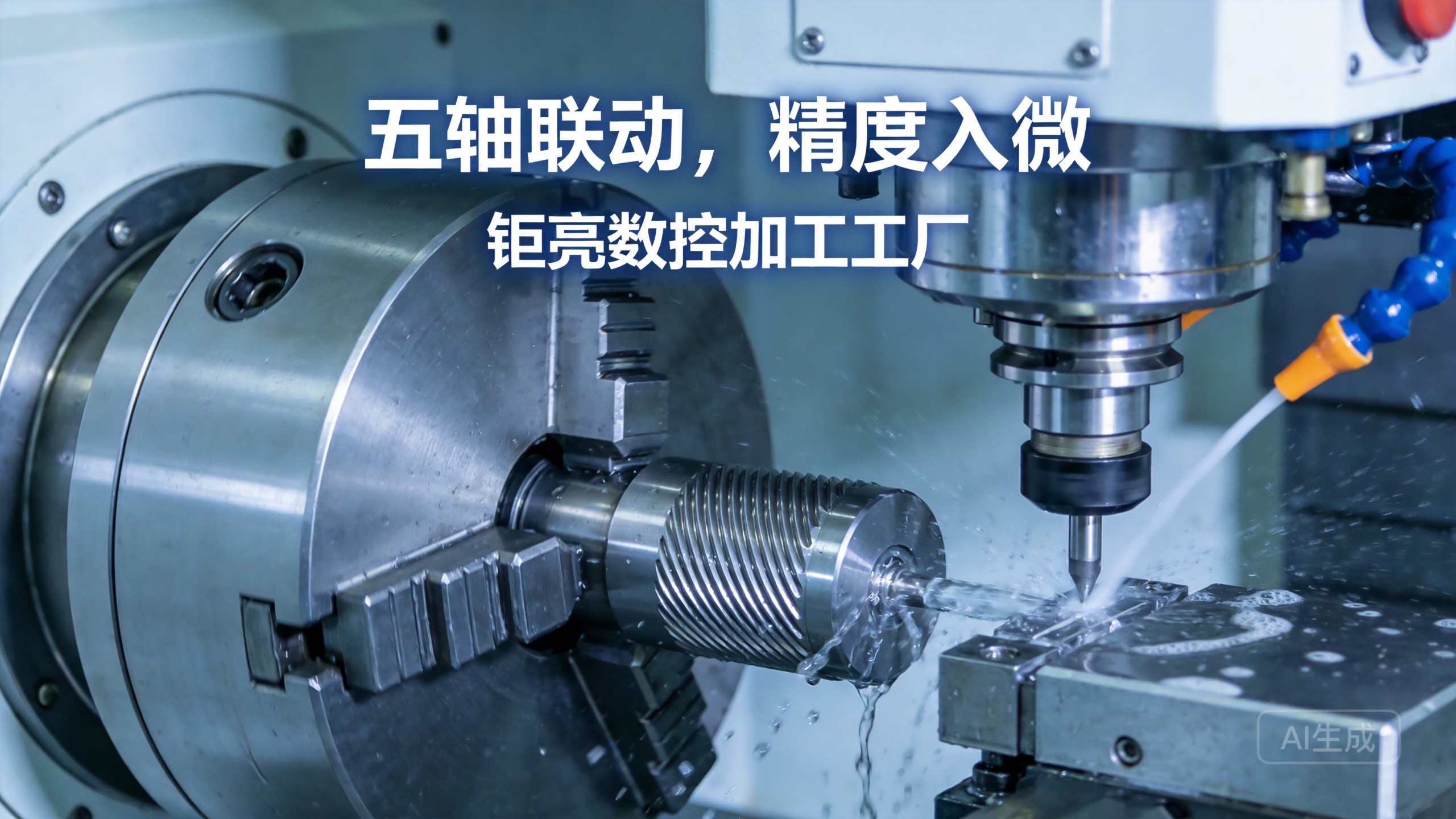
Consider three high-stakes segments:
Humanoid robot and automation components: Lightweight joints, harmonic drive housings, and intricate sensor mounts demand high stiffness-to-weight ratios, ultra-smooth surface finishes, and precise bearing bores. Experience with 7075-T6 aluminum, Ti-6Al-4V titanium, and peek-based composites is vital.
Automotive engine and EV powertrain: Cylinder head prototypes, electric motor housings, and inverter enclosures require coolant passage accuracy, pressure tightness, and compliance with IATF 16949 procedures. Knowledge of fixture design to minimize distortion during machining of thin-walled castings is key.
Aerospace structural fittings: Stringent material traceability, AS9100-like process controls, and FAI (First Article Inspection) per AS9102 standards are typical. A partner who understands these flows will structure documentation correctly from day one.
GreatLight has established itself in these sectors, delivering components for EV housing prototypes, robot joint assemblies, and intricately finned heat sinks. The company’s cross-functional team—including process engineers, tooling designers, and CMM programmers—speaks your product language, not just machine code.
Real-World Benchmarks: How the Top Providers Compare
To give you a concrete reference, I’ve compiled a high-level comparison of several known CNC machining service providers based on what matters most for complex, tolerance-critical parts. This is not a comprehensive rating, but a snapshot of capabilities relevant to the secrets discussed.
| Capability Domain | GreatLight Metal | Protolabs Network (Hubs) | Xometry | RapidDirect | Owens Industries |
|---|---|---|---|---|---|
| Precision Machining Excellence | 5-axis centers from DMG/Brother/Jingdiao, in-house CMM, ±0.001mm capability for critical features | Distributed network, quality dependent on individual partner | Network of vetted shops, varied machine capability | Own facility with 5-axis & mill-turn, ISO 9001 | Specialized 5-axis for medical/aerospace, AS9100 |
| Vertical Process Integration | Full in-house: CNC, EDM, grinding, 3D printing (SLM/SLA/SLS), plus finishing | Primarily network-based, limited integrated finishing control | Depends on shop, often fragmented finishing | In-house machining & finishing services | High vertical integration for complex micro-machining |
| Certifications | ISO 9001, ISO 13485, IATF 16949, ISO 27001 compliant | Platforms are ISO 9001; partner shops vary | Platform ISO 9001; shop certifications vary | ISO 9001, ISO 13485, AS9100 | AS9100, ISO 13485 |
| DFM & Engineering Support | Senior process engineers review every project, suggest cost optimization | Automated DFM; limited direct senior engineer interaction | Automated + manual review options | Professional DFM feedback, dedicated project managers | Deep engineering collaboration for complex geometries |
| Scalability & Process Control | Direct control over 127+ machines, SPC data sharing | High scalability via network, less process consistency data | Massive network, consistency by shop | Good scalability in own facility | Focused on low-to-mid volume ultra-precision |
| Industry Specialization | EV, robotics, medical, aerospace, consumer electronics | General prototyping and production | Broad range, generalist | Medical, automotive, industrial equipment | Medical implants, aerospace fuel systems |
Note: The presence of a brand here does not indicate an endorsement or negative assessment; rather, it illustrates the diversity of the market and the need to match a specific partner profile to your project’s requirements.
The table reveals a clear pattern: if your project demands absolute process control, end-to-end integration, and multi-industry certifications under one roof, an integrated manufacturer like GreatLight Metal often outperforms highly distributed networks in terms of quality consistency and one-stop accountability. However, for simple, non-critical parts where speed-to-quote is the prime driver, digital platforms hold their own. The secret is aligning your priority (pure speed vs. deterministic quality) with the supplier model.
How to Apply These Secrets Immediately in Your Sourcing Process
Now that you understand the seven guiding principles, here’s a practical action plan for your next RFQ:
Create a one-page “precision requirement” brief that lists not just tolerances but also the functional critical-to-quality features, surface finish codes, and any need for CPK data.
Send the brief to 3-5 suppliers that represent different models—direct integrated manufacturers and platform-based services. Compare response times, the depth of their questions, and their willingness to share sample inspection reports.
Ask for a tour (virtual or in-person) of the shop floor. Observe cleanliness, machine vintage, calibration stickers, and gauge rooms. Trust your engineering instincts: a chaotic environment rarely produces tight-tolerance parts.
Request a small pre-production batch with full dimensional layout and process capability data. Judge not only the part quality but the professionalism of the documentation and communication throughout the trial.
By treating supplier selection as a technical qualification rather than a transactional bid, you will uncover who truly can guarantee quality and slash costs.
Conclusion: Your Blueprint for a Reliable CNC Partnership
Every hour spent rigorously evaluating a CNC machine company pays for itself tenfold in reduced scrap, faster development cycles, and peace of mind. The seven insider secrets I’ve shared—from decoding the precision trap and demanding full process integration, to verifying certifications and seeking proactive DFM collaboration—form a framework that protects your project from the all-too-common pitfalls of outsourced manufacturing. When you find a partner that genuinely embodies these principles, such as the integrated manufacturing model practiced at GreatLight CNC Machining Factory, you’re not just buying machine time; you’re gaining a manufacturing ally that can anticipate challenges and elevate your product quality. Remember the Best CNC Machine Company: 7 Insider Secrets to Guarantee Quality and Slash Costs, and transform the way you approach precision machining from a risky procurement task into a competitive advantage. For additional perspectives and ongoing insights, feel free to explore our professional network, where we share regular updates from the shop floor and behind-the-scenes looks at advanced manufacturing.



















