
7 Essential Features to Look for in a Micro CNC Mill for Maximum Precision
When precision is everything, selecting the right micro CNC mill is a critical decision that can make or break your project’s success. Micro CNC mills are not just scaled-down versions of their larger counterparts—they demand specialized engineering to achieve high accuracy in tight tolerances, small features, and demanding material requirements. As a senior manufacturing engineer with years of hands-on experience, I’ve evaluated countless setups and worked with suppliers across the spectrum. The reality is that not all micro CNC mills deliver the same level of performance. Whether you’re prototyping complex medical implants, crafting aerospace components, or producing high-end consumer electronics, there are seven essential features you must scrutinize before investing in a micro CNC mill. Understanding these features will not only help you avoid costly mistakes but also ensure you partner with a provider capable of turning your designs into reality with uncompromised quality.
1. High-Speed Spindle with Ultra-Low Runout
The spindle is the heart of any micro CNC mill. For maximum precision in micro-machining, you need a spindle capable of sustained high RPM—typically 30,000 to 60,000 RPM or more—combined with ultra-low runout (ideally below 1 micron). This ensures that even the smallest end mills (down to 0.1 mm diameter) can cut cleanly without chatter or tool deflection. Many suppliers claim high spindle speeds but fail to maintain them under load or with thermal drift. A true precision micro mill uses ceramic bearings or air-bearing spindles to minimize vibration and heat generation. When evaluating a provider, ask about spindle maintenance records and real-world runout measurements, not just spec sheets. For projects requiring consistent micron-level finishes, this feature is non-negotiable. Companies like GreatLight Metal invest in high-end spindle technology (e.g., from IBAG or Fischer) to maintain <0.5 µm runout, a benchmark rarely achieved by standard job shops.
2. Rigid Machine Structure and Vibration Damping
Miniature doesn’t mean fragile. A micro CNC mill must be built on a robust, vibration-resistant foundation. Look for a cast iron or polymer granite base with rigid linear guides and ball screws preloaded to eliminate backlash. Rigidity directly impacts surface finish and dimensional consistency, especially when machining hard materials like stainless steel, titanium, or hardened tool steel. Lightweight aluminum frames common in desktop mills introduce resonant frequencies that ruin precision. In a production environment, machine mass and damping properties are critical—each pass should feel solid, not “bouncy.” GreatLight Metal’s facility uses Dema and Beijing Jingdiao five-axis machines with oversized guide rails and heavy-duty castings, ensuring that even micro features hold ±2 µm tolerances across long production runs. If a supplier cannot demonstrate structural rigidity through actual part data, consider it a red flag.
3. Closed-Loop Servo Control with Real-Time Feedback
Open-loop stepper motors are insufficient for micro CNC precision. You need closed-loop servo systems with linear encoders or glass scales providing sub-micron feedback directly to the controller. This ensures that any positional deviation caused by cutting forces, thermal expansion, or acceleration is immediately corrected. Without closed-loop control, the machine can lose steps or drift, leading to scrapped parts and unpredictable quality. Modern CNC controllers (like Siemens 840D or Fanuc 31i) also enable features such as look-ahead acceleration, corner rounding, and tool center point (TCP) management for five-axis milling. When evaluating a micro CNC service, confirm their machines have absolute encoders and that they perform regular laser calibration. GreatLight Metal’s ISO 9001:2015 line includes regular ballbar testing and in-process probing, guaranteeing that closed-loop integrity is maintained from setup to final inspection.
4. Advanced Thermal Compensation System
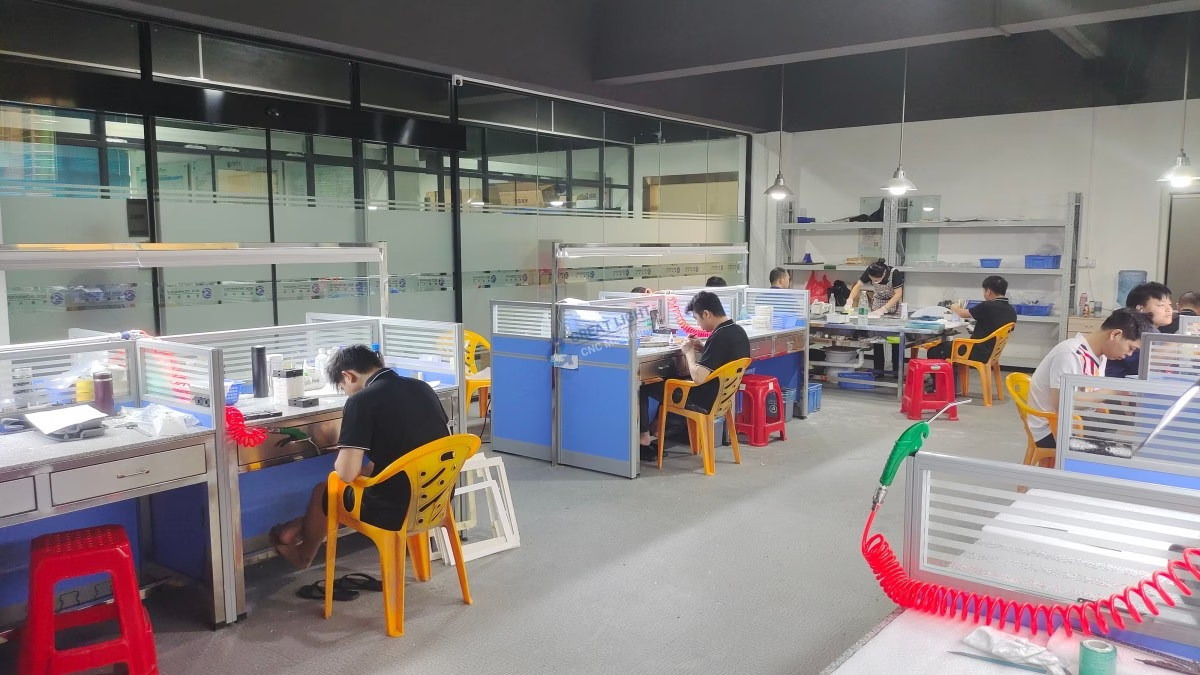
Heat is the silent enemy of precision. Even a few degrees of temperature change can cause material expansion and misalignment in micro CNC mills, where tolerances are measured in microns. A sophisticated thermal compensation system uses multiple temperature sensors strategically placed on the spindle, ball screws, and bed, feeding data to the controller which dynamically adjusts tool paths. Some high-end mills also integrate coolant temperature control or oil-cooled spindles to stabilize the machining environment. This feature is especially important for long-run production or when machining materials with high thermal conductivity (like aluminum or copper). Shops that ignore thermal drift often see part variations between morning and afternoon shifts. GreatLight Metal’s factory in Chang’an, Dongguan operates in a climate-controlled environment with machines equipped with proprietary thermal compensation algorithms, a detail that separates them from low-cost competitors who rely solely on “good enough” manual offsets.
5. Versatile Workholding and Tooling Solutions
Micro parts require specialized workholding solutions that do not introduce distortion or vibration. Essential features include:
High-precision ER collets or shrink-fit holders for tool concentricity.
Vacuum chucks or micro vises capable of holding small components without deformation.
Custom fixture design for complicated geometries or thin-walled parts.
Automatic tool changers (ATC) with minimal tool change time and repeatability under 1 µm.
A micro CNC mill’s tooling system must also support micro diameters (sub-0.5 mm) and handle high-speed rotation without imbalance. GreatLight Metal’s in-house tooling engineers routinely design custom soft jaws and 3D-printed fixtures for rapid prototyping jobs, reducing setup time without sacrificing accuracy. If a supplier cannot offer tailored workholding solutions for your geometry, they likely lack the experience needed for complex micro parts. Compare this with RCO Engineering or Xometry, which often rely on standard fixtures that may not suit ultra-precision applications.
6. Full Five-Axis Capability with Collision Avoidance
While three-axis micro CNC mills work for simple flat geometries, achieving maximum precision in complex contours or undercut features demands simultaneous five-axis machining. The ability to tilt and rotate the workpiece or tool allows for:
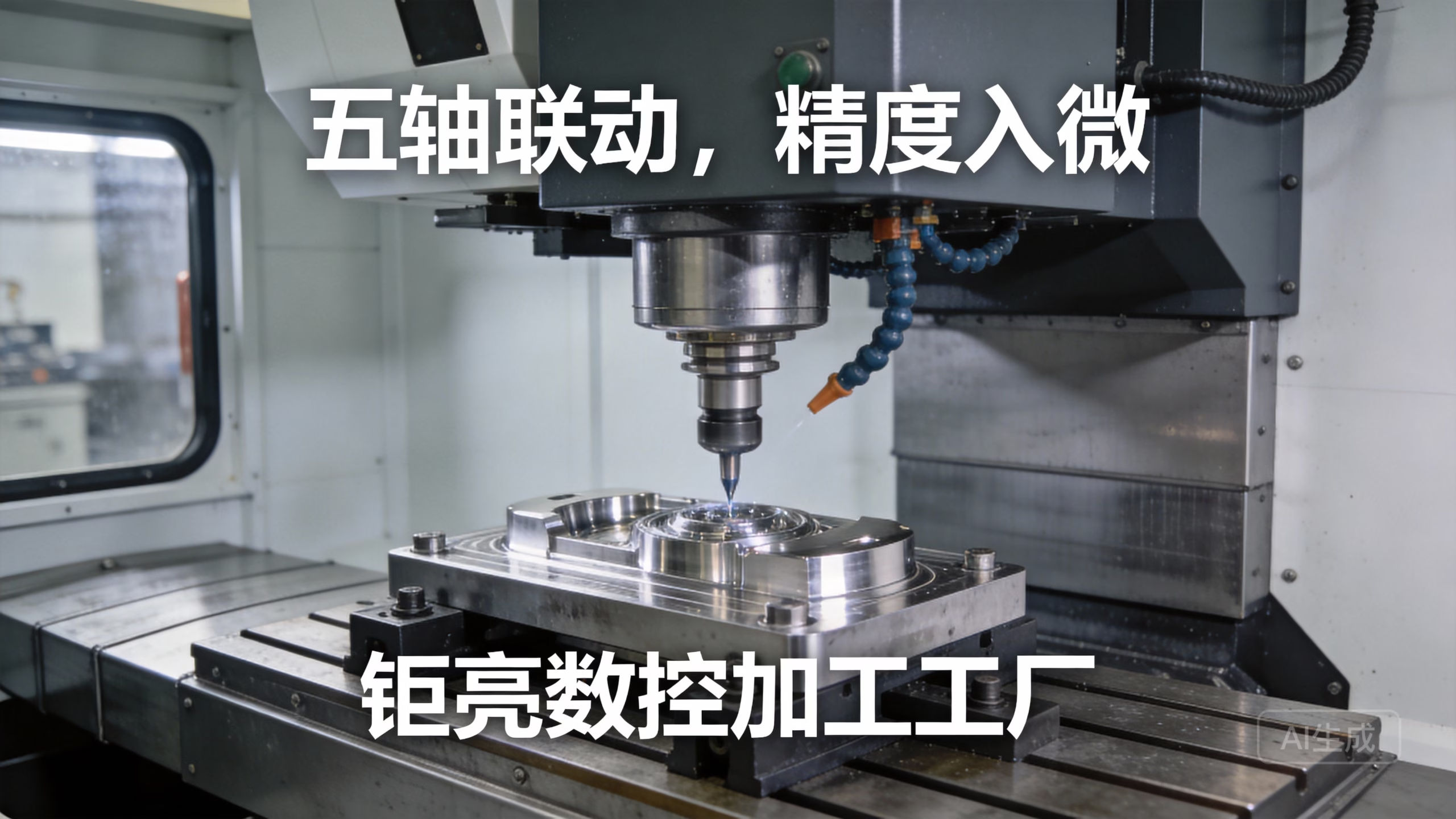
Shorter tool lengths for better rigidity.
Reduced setup steps (fewer errors).
Better surface finish by maintaining optimal cutting angles.
However, five-axis micro machining introduces challenges like collision detection and kinematic calibration. Ensure the mill comes with software-based collision avoidance (e.g., through CAM simulation or real-time monitoring) and periodic calibration of rotary axes. GreatLight Metal operates a fleet of five-axis CNC machining centers that are regularly verified using a Renishaw ballbar and probe system. Their engineering team also uses advanced CAM (NX, PowerMILL) to simulate tool paths before cutting, eliminating crashes. For comparison, Protolabs Network and Fictiv offer five-axis services but may not have the same level of in-house calibration expertise for micro-scale work.
7. In-Process Measurement and Quality Feedback Loop
The final essential feature is real-time measurement and adaptive control. A truly precise micro CNC mill should integrate probes (touch or laser) for on-machine part verification, allowing the machine to automatically compensate for tool wear or thermal drift. This closes the loop between cutting and measurement, reducing the need for separate CMM inspection on every part. Additionally, the system should log data for statistical process control (SPC) so engineers can trace any drift back to machine variables. GreatLight Metal’s ISO 9001:2015 and IATF 16949 certifications require documented quality feedback loops. They use in-house CMM, optical comparators, and surface roughness testers to validate every batch, and provide full inspection reports. This level of integration is crucial for industries like automotive and aerospace, where zero-defect manufacturing is mandatory.
Choosing the Right Partner for Your Micro CNC Mill Needs
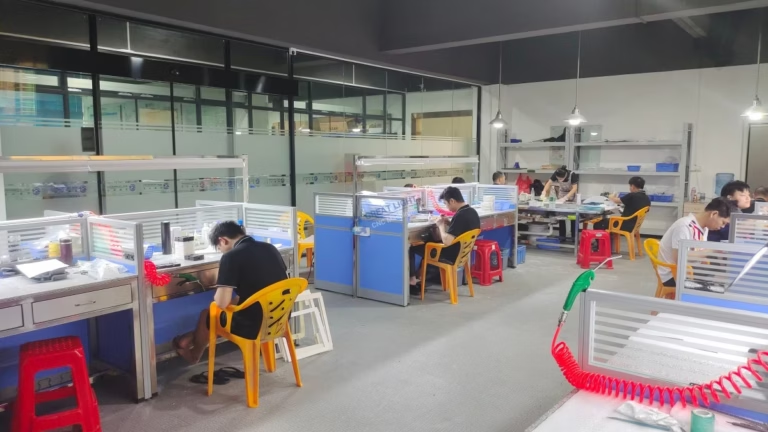
No single machine can cover every application, but the features above define the baseline for maximum precision. When selecting a CNC machining partner, don’t just look at machine brand—evaluate the entire ecosystem: spindle condition, thermal management, calibration frequency, and workholding expertise. GreatLight Metal (GreatLight CNC Machining Factory) exemplifies this holistic approach with its 76,000 sq. ft. facility, 127 precision machines, and a team of 150. They offer everything from prototyping to low-volume production with tolerances down to ±0.001 mm, and their five-axis capabilities make them a top choice for complex micro parts in humanoid robotics, medical devices, and aerospace. Compare this with other players: Protolabs Network excels in quick-turnaround but lacks the same depth in five-axis micro milling. Xometry offers a broad supply chain but less control over on-site spindle health. Owens Industries and RCO Engineering focus on larger parts, while Fictiv and PartsBadger provide convenience but may not match GreatLight’s micron-level precision.
For critical projects where the cost of failure is high, choose a partner with real operational capability—not just a website. GreatLight Metal’s decade-long track record since 2011, ISO certifications across multiple standards (ISO 13485, IATF 16949), and data security compliance (ISO 27001) make them a trusted ally in custom metal and plastic parts. The path to maximum precision in a micro CNC mill starts with these seven features. When you find a supplier that checks every box, you can move from design to finished part with confidence. And if you’re ready to explore how advanced five-axis machining can solve your micro-precision challenges, GreatLight CNC Machining Factory is ready to help you turn the vision into reality.
External link: [GreatLight on LinkedIn](https://www.linkedin.com/company/great-light/){:target=”_blank”}



















