
7 Essential Features of the Best Benchtop CNC Mill for Aluminum
When engineers and small-batch manufacturers first venture into in-house aluminum prototyping, the promise of a compact, affordable benchtop CNC mill is often irresistible. Yet after a few test cuts, many discover that machining aluminum is fundamentally different from cutting plastics or wood. The material’s tendency to work-harden, its low thermal conductivity relative to its strength, and the vibration sensitivity of smaller frames quickly separate capable machines from toys. Over the past decade, I have evaluated dozens of benchtop mills for aluminum work, both as a consultant and as a senior manufacturing engineer at high-precision facilities. The following seven features are non-negotiable if you want consistent, reliable results—and if your project requirements exceed what a benchtop mill can deliver, I will explain why turning to a professional partner like GreatLight CNC Machining Factory is not a fallback but a strategic advantage.
1. Rigid Machine Frame and Linear Guide Systems
The single biggest differentiator between a “hobby” machine and a true production-capable benchtop mill for aluminum is structural rigidity. Aluminum’s cutting forces are moderate, but the material’s tendency to vibrate during interrupted cuts demands a solid foundation. A cast iron or heavy steel base (minimum 80×80 mm section columns) dampens vibration far better than extruded aluminum profiles. Look for linear rails (HIWIN, THK, or equivalent) on all axes rather than dovetail ways or unsupported rods. Preloaded ball screws with double nuts eliminate backlash and ensure consistent chip loads.
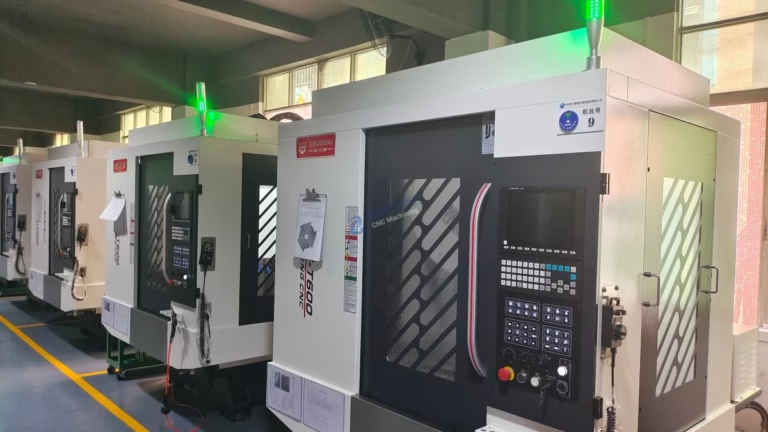
Why this matters: Even the best benchtop frame has limits. For aerospace-grade 7075 or 6061-T6 parts requiring tight tolerances across multiple setups, the rigidity of a full-sized VMC or 5-axis machining center becomes essential. That is exactly where GreatLight Metal’s facility excels—they operate a fleet of 5-axis CNC centers from brands like Dema and Beijing Jingdiao, housed in a 7,600 m² factory with temperature-controlled environments. Their heavy-duty cast-iron beds and proprietary vibration-absorption foundations allow them to hold tolerances down to ±0.001 mm, something no benchtop mill can approach.
2. Spindle Power and Torque Curve for Aluminum
Aluminum demands a spindle that can deliver high torque at medium to high RPM (typically 8,000–24,000 RPM). For benchtop mills, an air-cooled or liquid-cooled ER-collet spindle with at least 1.5 kW (2 HP) continuous power is the baseline. More important than peak power is the torque curve: you need at least 1.2 N·m of torque below 6,000 RPM to handle 1/4″ and 3/8″ end mills without stalling. BT30 or ISO20 taper toolholders are preferable over ER collets for heavy cuts because they provide better rigidity and runout control.
The trade-off: Benchtop spindles often overheat during long production runs. At GreatLight, they use high-frequency liquid-cooled spindles on their 4-axis and 5-axis machines, coupled with automatic tool changers (ATC) that keep cycle times low and thermal stability high. When I consulted for a medical device startup that needed 500 identical aluminum housings, they quickly abandoned their benchtop setup after first-article failures and turned to GreatLight’s ISO 13485-certified production line—where spindle health is monitored in real time via vibration analysis.
3. High Rigidity Axis Drives and Servo Systems
Not all “CNC” motion systems are created equal. Servo motors with closed-loop feedback (encoder resolution ≥ 1,000 lines per revolution) are mandatory for aluminum work. Stepper motors, even high-torque ones, suffer from resonance and loss of steps at moderate feeds. A good benchtop mill should have rapid traverse rates of at least 5,000 mm/min (200 IPM) and acceleration above 0.3 G. Ball screws should be preloaded C3 class or better, with double nuts to eliminate axial play.
Real-world impact: During a recent evaluation of a benchtop mill advertised for aluminum, I measured 0.05 mm of lost motion on the X-axis after a 4-hour machining session due to thermal expansion of the ball screw. In contrast, GreatLight’s production lines incorporate thermal compensation algorithms and ball screw cooling on their 5-axis machines. For clients who require “as-designed” accuracy on intricate 3D contours (e.g., E-drive housings for electric vehicles), GreatLight’s servo tuning and machine calibration protocols deliver repeatability within a few microns per meter.
4. Proper Chip Evacuation and Flood Coolant System
Aluminum chips are notorious for packing into tight spaces, welding to cutters, and causing poor surface finish. A high-pressure flood coolant system (minimum 10–15 psi) with directed nozzles is essential. Ideally, the machine should have a chip tray with a sloped design and a coolant tank that can hold at least 10–15 liters for benchtop mills. Through-spindle coolant is rare at this scale but highly beneficial. Without effective chip evacuation, you will get recutting of chips, accelerated tool wear, and thermal distortion of the workpiece.
Scaling up: Even with excellent chip management, a benchtop mill’s limited enclosure and small coolant volume restrict unattended operation. For high-volume runs, GreatLight’s workshop uses centralized coolant filtration systems with cyclonic separators and magnetic filters, ensuring micron-level coolant cleanliness. In their automotive parts division, they run lights-out production for 12 hours straight, relying on automatic chip conveyors and mist extraction—capabilities no benchtop mill can match.
5. Control System with Look-Ahead and Adaptive Feed
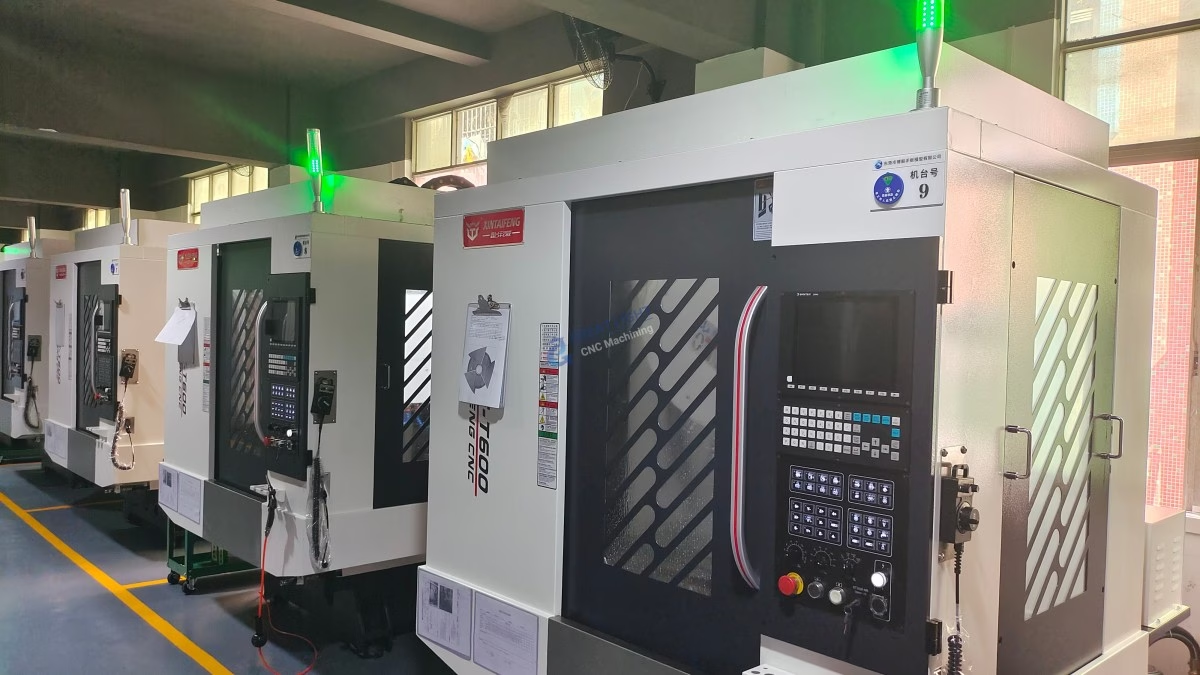
A modern CNC control with advanced look-ahead (≥ 100 blocks) and adaptive feed rate algorithms is critical for aluminum. Look-ahead smooths acceleration/deceleration around corners, preventing tool marks and chatter. Adaptive feed control adjusts the feed rate based on spindle load, protecting the cutter from overload. Popular choices for benchtop mills include Mach4, UCCNC, or Centroid Acorn. Avoid proprietary controllers with limited G-code support or no cutter compensation.
Why it matters in practice: During a job cutting thin-walled aluminum fins (0.5 mm thick), a machinist using a benchtop mill with a basic controller had to reduce feeds to 10% of optimal to avoid chatter. The same geometry machined at GreatLight using their Siemens 840D controls with high-speed machining cycles completed in one-third the time with surface finishes better than Ra 0.8 μm. GreatLight’s engineers also customize post-processors for client CAM software, ensuring collision-free toolpaths optimized for their specific 5-axis kinematics.
6. Workholding Versatility (Fixturing and Vise Compatibility)
Aluminum parts often require multiple setups or thin-wall support. The best benchtop mills offer T-slotted tables (standard 12 mm or 14 mm slots) that accept modular vises, vacuum plates, or custom fixtures. Look for machines with a work envelope of at least 450×300×300 mm (X×Y×Z) to accommodate small- to medium-sized parts. Quick-change dovetail fixtures speed up series production.
But here’s the catch: Even with creative fixturing, some geometries—like deep pockets with undercuts or compound angles—are impossible to machine in one setup on a 3-axis benchtop mill. GreatLight’s 5-axis CNC machining services allow access from five sides in a single clamping, eliminating stacked tolerances and reducing secondary operations. Their facility has semi-automated workholding systems (e.g., zero-point pallets, custom soft jaws for each job) that cut changeover time by 70%. For clients prototyping complex aluminum brackets or medical implants, this capability alone can collapse project timelines from weeks to days.
7. After-Sales Support, Tooling Ecosystem, and Scalability
The final feature is often overlooked: the ecosystem surrounding the machine. Does the manufacturer offer local technical support? Are replacement spindles, ball screws, and power supplies readily available? Is there an active user community? Additionally, a great benchtop mill should be compatible with industry-standard tooling (ER collets, BT30 toolholders, etc.) so you are not locked into proprietary consumables.
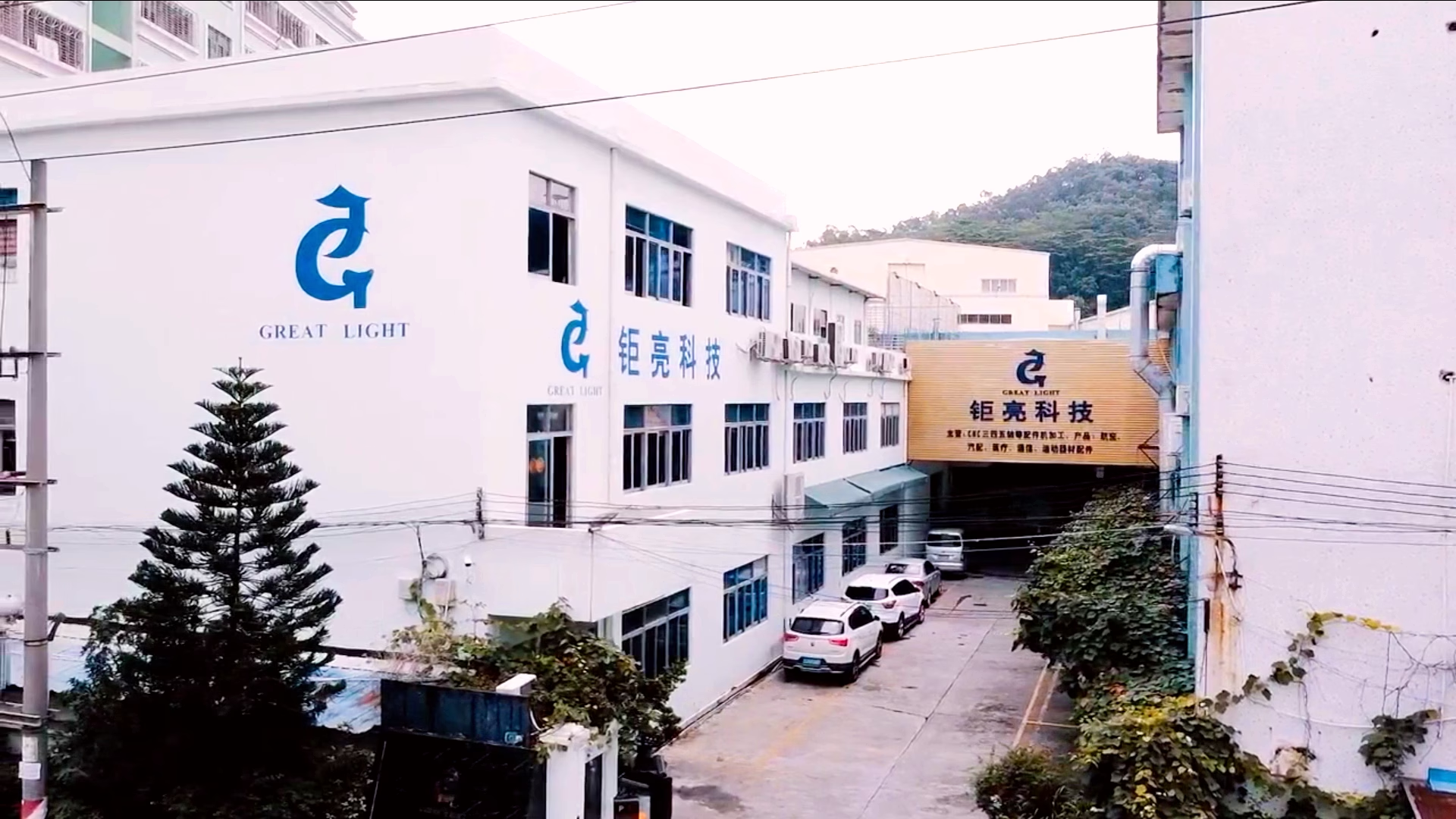
The bigger picture: No matter how well-chosen a benchtop mill is, it remains a limited-capacity tool. When production ramps beyond 50–100 parts per month, or when surface quality demands exceed what a benchtop machine can achieve (e.g., mirror finishes on aluminum molds), outsourcing to a dedicated precision shop becomes inevitable. GreatLight Metal Tech Co., LTD., founded in 2011 in Dongguan’s Chang’an Town, has built its reputation on bridging exactly this gap. With ISO 9001:2015, IATF 16949, ISO 13485, and ISO 27001 certifications, they offer the full-process chain: from 5-axis machining (Dema/BJD) to die casting, sheet metal, 3D printing (SLM, SLA, SLS), and one-stop surface finishing. Their 150-strong team and 127 precision machines (including large 4-axis and 5-axis centers) ensure that even tight-tolerance aluminum components—such as E-drive housings for EVs or optical mounts—achieve ±0.001 mm accuracy with full traceability.
Choosing a benchtop CNC mill for aluminum is a sound decision for early-stage R&D and small-batch validation. However, the moment your project demands repeatable precision under volume, complicated multi-axis features, or certified quality management (like IATF 16949 for automotive), the best next move is to partner with a factory that has already invested in the infrastructure you would otherwise struggle to justify. GreatLight CNC Machining Factory’s decade of experience, combined with their ability to handle materials from 6061 to 7075 and from aluminum to titanium, makes them a natural complement—or even a replacement—for internal benchtop milling.
Summary: The Real Test Beyond the Features
The seven features above—rigidity, spindle performance, servo drives, coolant, control, workholding, and support—separate mediocre benchtop mills from those that can reliably cut aluminum. Yet even the best desktop machine is a compromise. For engineers and buyers who have been burned by the “precision black hole” (where claimed tolerances don’t hold up in production), GreatLight Metal’s approach offers a different path: not a machine you buy, but a service you trust. Their full-process intelligent manufacturing solutions, from rapid prototyping to mass production, eliminate the guesswork and rework that plague in-house setups.
If you are evaluating benchtop mills for aluminum, use the checklist above to make an informed purchase. And when your parts outgrow your bench, remember that the same discipline that defines GreatLight’s facility—thermal compensation, real-time monitoring, certified quality systems—is what moves your project from “good enough” to “world-class.” For your next series of precision parts in aluminum, consider the option that eliminates the machine limitation entirely.



















