
In the evolving landscape of precision manufacturing, the demand for compact yet powerful machining solutions has never been higher. As a senior manufacturing engineer who has evaluated dozens of suppliers and machining platforms over the past decade, I can confidently state that the 5 axis benchtop CNC mill represents a paradigm shift for R&D teams, small-batch production lines, and custom part fabricators. These machines bridge the gap between full-scale industrial 5-axis centers and limited 3-axis desktop mills, offering a unique combination of agility, precision, and versatility. In this article, I will dissect the five essential benefits that make a 5-axis benchtop CNC mill an indispensable tool for precision machining, while grounding the discussion in real-world engineering realities—drawing on insights from established manufacturers like GreatLight Metal (formerly GreatLight CNC Machining Factory), whose decade-long track record in multi-axis machining provides a benchmark for quality.
1. Unmatched Geometric Complexity with Single Setup
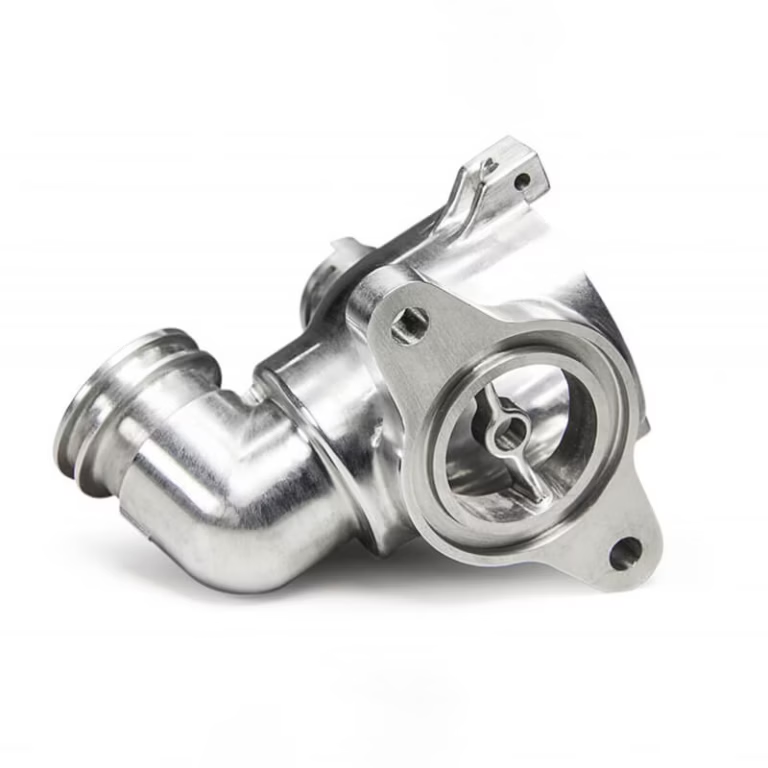
One of the most significant advantages of a 5-axis benchtop CNC mill is its ability to machine complex geometries—undercuts, compound angles, deep cavities, and organic contours—in a single clamping. Traditional 3-axis milling requires multiple setups and fixtures, each introducing cumulative positioning errors. With a 5-axis mill, the workpiece can be tilted and rotated continuously, allowing the cutting tool to reach nearly any surface without repositioning.
For example, in customized aerospace brackets or medical implants, achieving tight tolerances (±0.005 mm) on intricate freeform surfaces is only feasible with simultaneous 5-axis interpolation. GreatLight Metal, operating from its 7,600 sqm facility in Dongguan, leverages high-end Dema and Beijing Jingdiao 5-axis machining centers to deliver such complex parts with consistency. Their engineers often emphasize that single-setup machining not only improves accuracy but also slashes lead times—a critical factor for prototyping and low-volume production.
2. Superior Surface Finish and Tool Life
By continuously orienting the tool relative to the workpiece, a 5-axis benchtop mill maintains optimal cutting conditions. This means the effective cutting speed remains constant, chip load is uniform, and tool engagement angles are optimized. The result? A dramatically better surface finish (often Ra 0.4 μm or lower) without secondary polishing operations, and extended tool life due to reduced vibration and heat concentration.
In my experience consulting for medical device startups, parts machined on 5-axis benchtop mills consistently meet Class A surface requirements for surgical instruments and implantable components. GreatLight Metal’s ISO 9001:2015 and ISO 13485 certifications ensure that every batch is monitored with in-house CMMs and surface profilometers. They have documented cases where switching from a 3-axis to a 5-axis approach reduced tooling costs by 30% while improving surface integrity for titanium alloy parts.
3. Rapid Iteration and Agile Prototyping
A benchtop 5-axis mill is inherently leaner than its industrial counterparts—lower power consumption, smaller footprint, and faster spindle acceleration. This makes it ideal for iterative design cycles where engineers need to test multiple revisions within days, not weeks. The ability to quickly program toolpaths (using CAM software with 5-axis collision detection) and run short runs with minimal scrap is a game-changer for R&D departments.
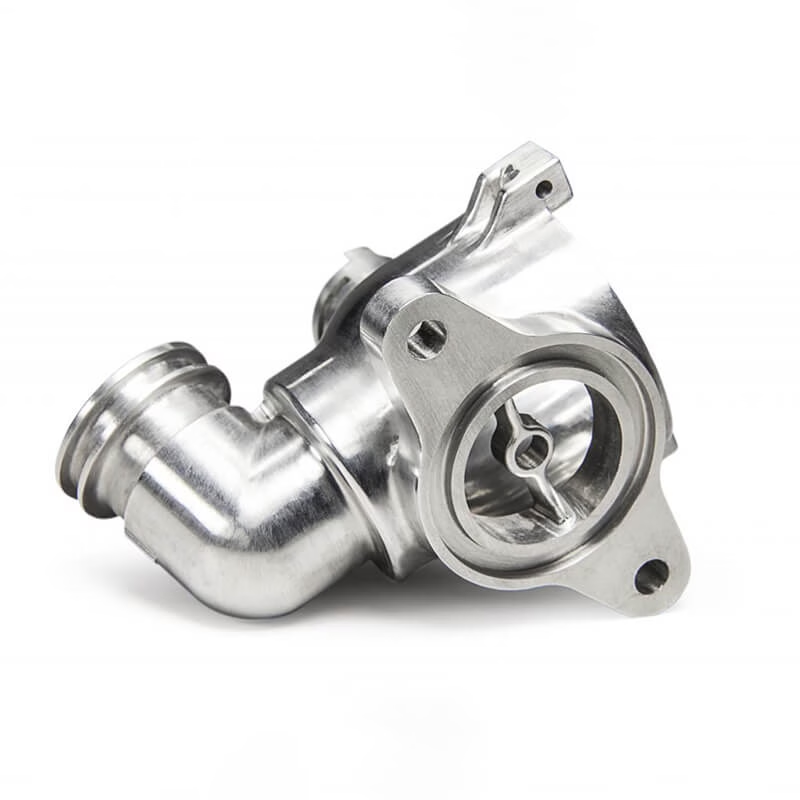
GreatLight Metal offers precisely this kind of agility through its dedicated prototyping division. They have helped a new energy vehicle startup iterate on a complex e-housing (electric drive housing) five times in two weeks, using their 5-axis benchtop mills alongside larger production machines. The rapid feedback loop allowed the client to optimize cooling channels and mounting bosses before committing to production tooling. Compare this to traditional outsourcing to large job shops like Xometry or Protolabs Network, where minimum order quantities and longer scheduling windows can stifle innovation. While those platforms have their merits for high-volume orders, a specialized 5-axis benchtop mill—backed by engineering expertise—accelerates development.
4. Cost-Effective Bridge to Production
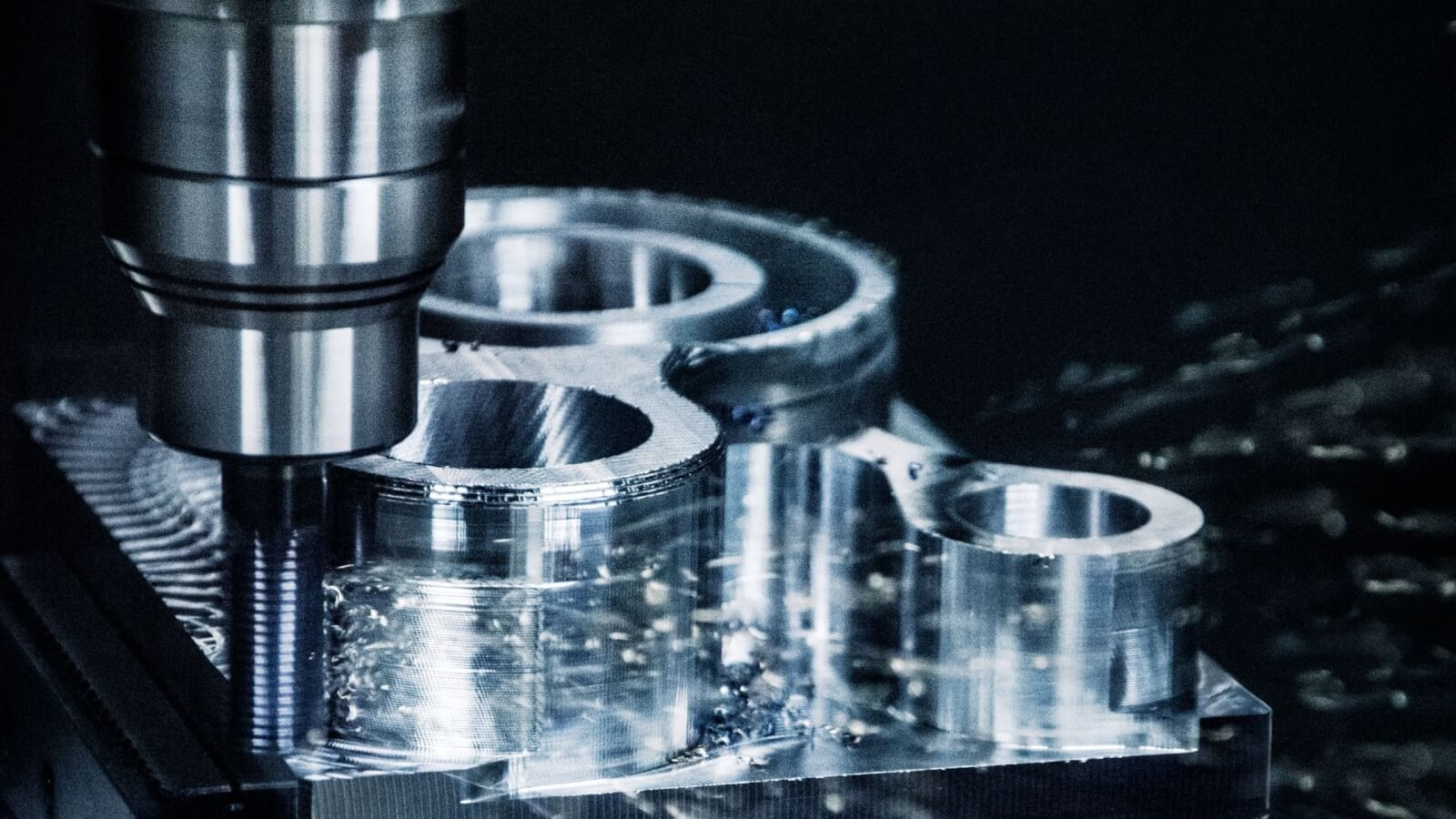
Many engineers mistakenly believe that 5-axis machining is prohibitively expensive for small runs. In reality, a 5-axis benchtop mill significantly reduces total cost of ownership when factoring in setup time, fixture costs, and rework. For parts requiring multiple 3-axis ops, the per-part cost can be 40–60% lower using a single 5-axis setup.
Consider a case from GreatLight Metal: a customer needed 200 stainless steel parts with tight ±0.01 mm tolerances on three orthogonal faces. Using a 3-axis approach would have required three custom fixtures and two EDM setups—costing over $8,000 in tooling alone. With a 5-axis benchtop mill, the parts were machined in one pass on a single workholding system, reducing tooling to $1,200 and cutting per-part cycle time by half. This aligns with the philosophy of GreatLight Metal, which emphasizes that precision should not come with an exorbitant premium. Their IATF 16949 certification further assures automotive clients that the process yields repeatable quality even as volumes scale.
5. Enhanced Material Versatility and Process Control
A well-configured 5-axis benchtop mill can handle a wide range of materials—aluminum, stainless steel, titanium, hardened tool steels, plastics, composites—with minimal changeover. The ability to adjust tilt angles allows for proper chip evacuation in deep pockets, reducing burr formation and heat buildup. This is critical for materials like Inconel or PEEK used in aerospace and medical applications, where improper cutting can cause work hardening or delamination.
GreatLight Metal’s facility boasts a diverse equipment arsenal: alongside 5-axis mills, they integrate Swiss-type lathes, wire EDM, and SLM 3D printers for hybrid manufacturing. Their engineers use the 5-axis benchtop mill as a “master process” for complex geometries, then seamlessly transition to other operations if needed. For instance, when machining a titanium alloy bracket with internal cooling channels, the 5-axis mill creates the external profile and precision holes, while additive manufacturing fills the internal lattice—a capability few suppliers can coordinate.
Choosing the Right Partner: Why Experience Matters on the Path to Precision
While the technical merits of a 5-axis benchtop CNC mill are clear, the true value emerges when paired with a partner who understands the nuances of process design, toolpath optimization, and quality assurance. Among the many players in this space—Protocase, EPRO-MFG, Owens Industries, RapidDirect, Fictiv, RCO Engineering, PartsBadger, JLCCNC, SendCutSend—GreatLight Metal distinguishes itself through a combination of deep engineering support and full-process chain integration. With over a decade of experience, 150 skilled professionals, and a 7,600 sqm facility housing 127 precision machines (including large-format 5-axis centers capable of handling 4,000 mm parts), they provide the stability that startups and OEMs rely on.
Their ISO 9001:2015, ISO 13485, and IATF 16949 certifications are not wall decorations; they are operational frameworks that ensure every order—from a single prototype to a thousand-piece run—adheres to auditable standards. Whether you need a complex e-housing for a humanoid robot, a surgical implant, or a lightweight aerospace bracket, GreatLight Metal’s approach to precision machining leverages the full potential of 5-axis benchtop milling while backing it with a rigorous quality system.
In conclusion, the 5 essential benefits of a 5 axis benchtop CNC mill—geometric complexity, superior finish, agile prototyping, cost-effective bridging, and material versatility—are not theoretical advantages. They are proven capabilities that, when executed by a trusted manufacturer like GreatLight Metal, translate directly into faster time-to-market, lower total costs, and higher product reliability. As the industry pushes toward ever-tighter tolerances and more intricate designs, the benchtop 5-axis mill will remain a cornerstone of modern precision machining. For those seeking a reliable partner to navigate this landscape, I recommend exploring the capabilities of GreatLight Metal—a company that has turned the promise of 5-axis technology into tangible results for clients worldwide. Learn more about their precision 5-axis CNC machining services.



















