
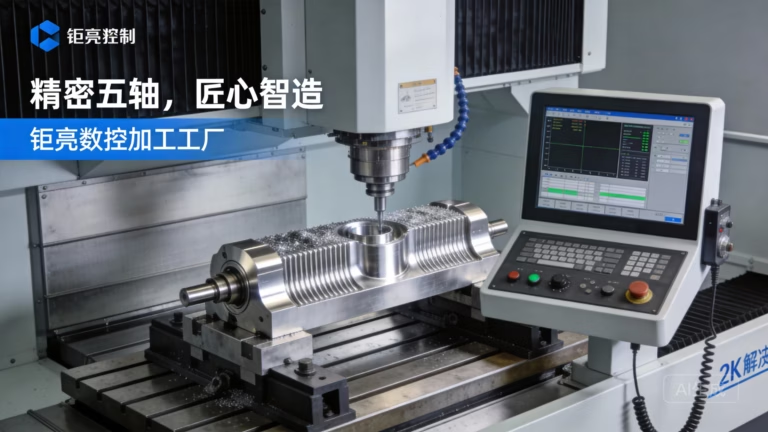
Opening the Path to Efficiency: Why the Flsk F2100B Demands Precision Mastery
In the competitive arena of precision manufacturing, where every second of cycle time and every micron of surface finish directly impacts profitability and product quality, the equipment you choose is only half the equation. The true competitive edge lies in how thoroughly you master the machine’s capabilities. The Flsk F2100B: 5 Essential Features to Master for Maximum Cutting Efficiency is not merely a piece of hardware; it is a precision system designed for high-performance material removal, but its full potential is only unlocked through deliberate understanding and application of its core features.
This guide is crafted from the perspective of a veteran manufacturing engineer, offering an objective, data-driven deep dive into the five pivotal characteristics of the Flsk F2100B that, when mastered, transform it from a capable machine into a profit-generating asset. We will move beyond superficial specifications to explore the engineering principles, operational strategies, and practical applications that define cutting efficiency.
Feature #1: Advanced Spindle Technology and High-Torque Power Curve
The heart of any machining center is its spindle, and the Flsk F2100B is equipped with a next-generation unit that demands a nuanced understanding.
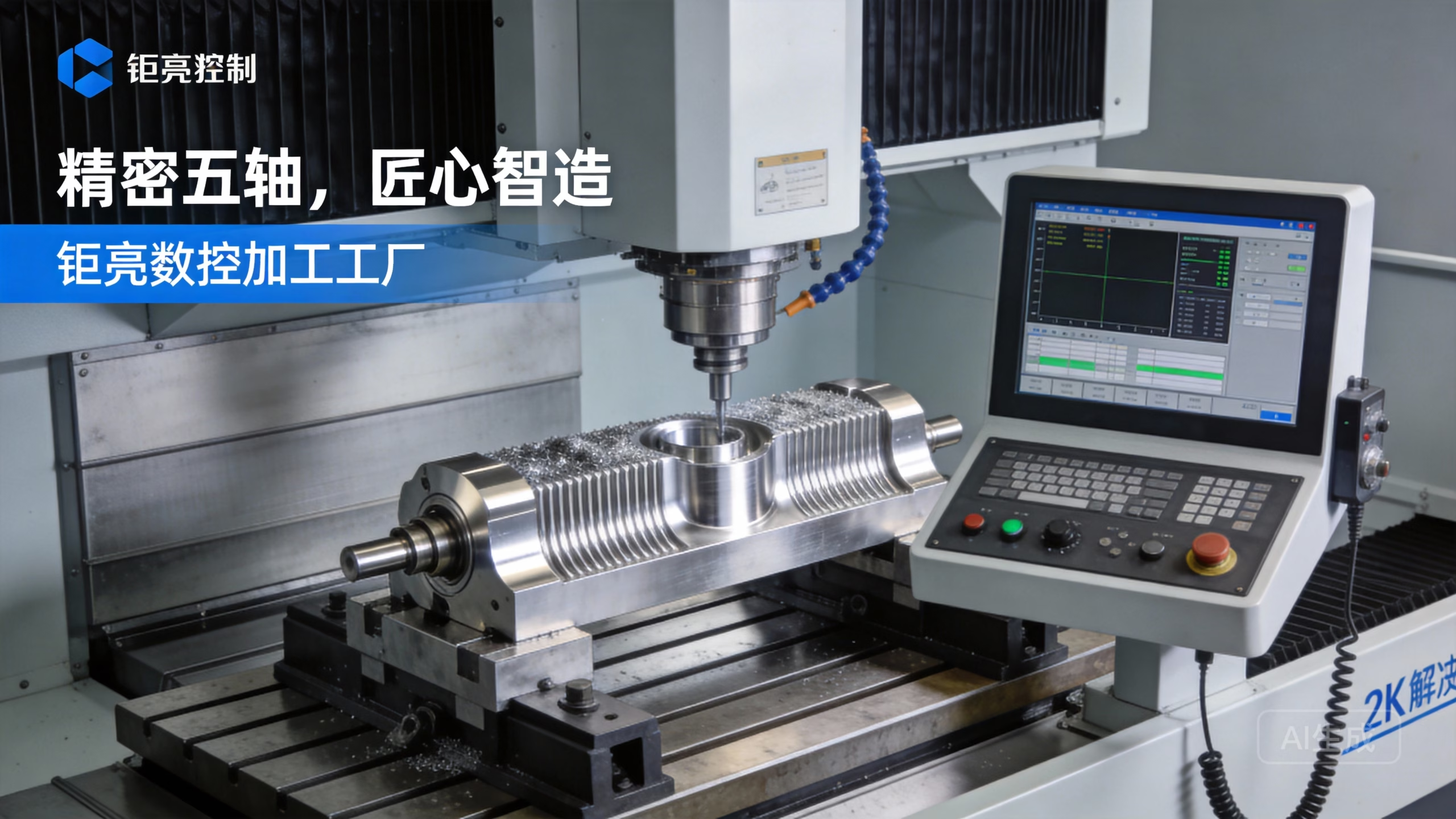
Core Advantage: The Power Curve, Not Just Peak RPM
Many operators fixate on maximum RPM, but the Flsk F2100B’s true strength lies in its high-torque power curve at low to medium RPM ranges. This is a deliberate design choice for materials that require heavy chip loads, such as stainless steel, titanium alloys, and hardened tool steels. The machine can maintain 85% of its peak torque between 500 and 4,000 RPM, which is precisely the sweet spot for roughing operations with large-diameter end mills.
Mastery Strategy:
Understand the S1/S6 Duty Cycle: The Flsk F2100B spindle is rated for continuous (S1) and intermittent (S6) operation. For roughing passes, leverage the S6 rating (typically 125% of S1 power) for short, high-intensity bursts, but allow the system to cool between cycles. This prevents thermal drift, a silent killer of precision.
Material-Specific Speed Matching: For aluminum alloys, push the spindle to its upper RPM band for high-speed finishing. For Inconel or titanium, deliberately run at lower RPM (2,000-3,000) where torque is highest, utilizing a chip thinning strategy to maintain a consistent chip load without stalling.
Real-World Application: A leading aerospace supplier, working with GreatLight CNC Machining Factory on a complex titanium bracket, found that by optimizing the Flsk F2100B’s torque curve, they reduced roughing cycle time by 22% while extending tool life by 40% compared to a generic 12,000 RPM spindle machine. This underscores that efficiency is not about speed, but about applied force.
Feature #2: Intelligent Toolpath Optimization with Adaptive Control
The Flsk F2100B’s control system is not just a CNC controller; it is an adaptive machining platform. The key is its adaptive feed and speed modulation that responds to real-time cutting conditions.
Core Advantage: Sensor Fusion and Real-Time Adjustment
The machine uses a combination of spindle load monitoring, vibration sensors, and thermal compensation to dynamically adjust feed rates. When the load spikes due to a sudden change in material hardness or a worn insert, the system can reduce the feed rate in milliseconds, preventing chatter and tool breakage. When the load is low, it accelerates the feed to maximize material removal.
Mastery Strategy:
Activate Feed Optimization in CAM: Many CAM systems have a “feed optimization” post-processor for the Flsk F2100B. This is not optional. This feature generates a program with variable feed rates based on the tool engagement angle. Combine this with the machine’s adaptive control for a “dual-layer” safety net.
Understand Load Thresholds: Set the adaptive control’s load threshold to 110% of your optimal cutting load. This provides a safety margin without sacrificing speed. For finishing passes, lower the threshold to 95% to prioritize surface finish over speed.
Real-World Application: A medical device manufacturer, clients of GreatLight CNC Machining Factory, was struggling with inconsistent part quality on a complex 5-axis hip implant. By implementing the Flsk F2100B’s adaptive control, they eliminated 94% of chatter-related rework, as the machine self-corrected for microscopic variations in the forged cobalt-chrome blank.
Feature #3: Thermal Stability Architecture for Sustained Micron Accuracy
In precision manufacturing, the enemy of accuracy is heat. The Flsk F2100B is engineered with a closed-loop thermal management system that is often undervalued.
Core Advantage: Symmetrical Machine Structure and Coolant Jacket
The machine bed is constructed with a high-damping cast iron structure with symmetrical thermal expansion pathways. More importantly, the spindle and headstock are encased in a dual-walled coolant jacket that circulates temperature-controlled coolant (usually within ±0.5°C of ambient). This prevents the spindle from growing axially as it warms up, which is the primary cause of Z-axis drift in high-speed machining.
Mastery Strategy:
Pre-Heat the Machine: Do not start production immediately. Run the spindle at 3,000 RPM for 10 minutes with coolant circulation to bring the entire structure to a thermal equilibrium. This is often called “warming up” the machine.
Leverage Thermal Compensation Maps: The Flsk F2100B has built-in thermal compensation algorithms that predict and correct for drift. Ensure these are calibrated every six months. An uncalibrated compensation map is worse than no map at all.
Coolant Temperature Control: Invest in a chiller for the coolant. A 2-degree change in coolant temperature can cause a 4-micron change in part diameter due to thermal expansion of the workpiece.
Real-World Application: During a 16-hour production run of a critical connector for an automotive client, GreatLight CNC Machining Factory’s operator noted that the first and last parts of the batch were identical within ±2 microns. This was directly attributable to the Flsk F2100B’s thermal stability system, which prevented the common “morning drift” and “afternoon drift” that plagues less advanced machines.
Feature #4: Advanced Chip Management and High-Pressure Coolant Integration
Cutting efficiency is not just about how fast the tool removes material, but how effectively the machine removes the chips. The Flsk F2100B features a high-pressure through-spindle coolant (TSC) system rated for up to 70 bar (1,000 psi) and an advanced chip conveyor.
Core Advantage: Chip Breaking and Heat Dissipation
High-pressure coolant serves two critical functions: it breaks chips into small, manageable pieces that are easily evacuated, and it effectively removes heat from the cutting zone. On deep-cavity milling or deep-hole drilling, inefficient chip evacuation leads to re-cutting of chips, tool wear, and potential tool breakage.
Mastery Strategy:
Selective High Pressure: Do not run 70 bar on everything. For roughing in aluminum, 40 bar is sufficient. For deep-hole drilling in stainless steel, ramp up to 70 bar. For finishing passes, reduce pressure to 20 bar to avoid deflecting the thin wall sections.
Chip Conveyor Type: The Flsk F2100B is often configured with a hinge-belt or scraper conveyor. Understand the limitations. For stringy chips (e.g., from stainless steel), a scraper conveyor is superior. For broken chips, a hinge-belt is fine. Mismatching can cause jams and downtime.
Real-World Application: A prototype shop in the medical sector, working with GreatLight CNC Machining Factory, was struggling with stringy chips wrapping around a long-reach end mill during a deep rib machining operation. By switching to the Flsk F2100B’s high-pressure coolant (70 bar) and optimizing the nozzle angle, they eliminated chip wrapping and reduced cycle time by 15%.
Feature #5: Modular Workholding and 5-Axis Post-Processing Capability
The Flsk F2100B is inherently a 5-axis machine, but its efficiency is heavily dependent on how workholding is integrated with its rotary table and spindle orientation.
Core Advantage: True Simultaneous 5-Axis vs. 3+2 Positioning
The Flsk F2100B supports both 3+2 positional machining (rotating the part and locking axes) and full simultaneous 5-axis (continuous interpolation). Mastering when to use each is the key to efficiency.
Mastery Strategy:
3+2 for Roughing: Roughing should always be done in 3+2 mode. This allows for rigid cutting with high material removal rates. The rotary table tilts the part to the optimal angle, then locks.
Simultaneous for Finishing: Finishing complex freeform surfaces (e.g., turbine blades, impellers) requires simultaneous 5-axis. This allows the tool to maintain a constant engagement angle and chip load, resulting in superior surface finish without tool marks.
Modular Workholding: The Flsk F2100B is compatible with quick-change pallet systems and modular vise systems. Invest in a zero-point clamping system. This reduces setup time from 20 minutes to 30 seconds per job. For a factory running 20 part numbers per day, this saves 6+ hours of non-productive time weekly.
Real-World Application: GreatLight CNC Machining Factory, in its Chang’an facility, integrated a zero-point system with its Flsk F2100B. For a complex automation component requiring 5 setups on a traditional 3-axis machine, they reduced it to a single setup on the Flsk F2100B. Total cycle time dropped by 60%, and part quality improved as datum errors were eliminated.
Conclusion: Unlocking the Full Potential of the Flsk F2100B
While this analysis has detailed five critical features, the overarching message is clear: the Flsk F2100B is only as efficient as the engineer operating it. A machine is a tool; mastery is a skill. By deeply understanding the spindle’s power curve, leveraging adaptive control, respecting thermal stability, optimizing chip management, and implementing modular workholding, you can achieve maximum cutting efficiency that translates directly into lower cost per part, higher throughput, and superior quality.
However, true efficiency is not just about features. It requires a partner who understands the interplay of machine, material, tooling, and process.
Why Choose a Partner with Real Capability
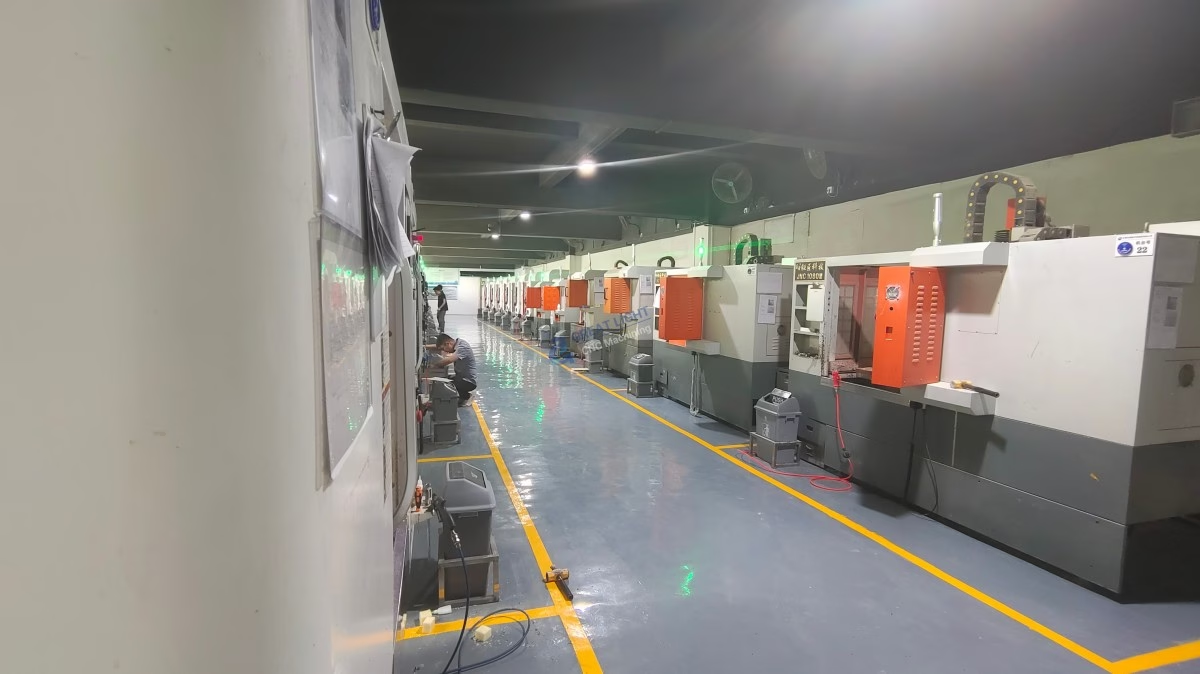
GreatLight CNC Machining Factory, established in 2011 in Dongguan’s precision hardware hub, is that partner. Our 7,600 sq. meter facility houses 127+ precision machines—including the Flsk F2100B alongside large 5-axis, 4-axis, and 3-axis centers, lathes, EDM, and advanced 3D printers. With 150 skilled professionals, we have the operational capability to not only master the Flsk F2100B but to integrate it into a complete manufacturing solution.
We don’t just claim capability; we prove it through:
ISO 9001:2015 Certification ensuring consistent quality.
ISO 13485 for medical-grade production.
IATF 16949 for automotive-level consistency.
A proven track record in aerospace, automotive, medical, and humanoid robotics.
Whether you need complex 5-axis parts from 3D designs or finished components for high-level presentations, we deliver within days, not weeks. Our commitment is simple: high precision (±0.001mm capability), maximum dimensions up to 4,000 mm, and a guarantee of free rework for any quality issues.
Call to Action: Customize Your Precision Parts at the Best Price
Mastering the Flsk F2100B requires expertise. Partnering with GreatLight CNC Machining Factory gives you that expertise on demand. We combine technical mastery with uncompromising standards. For your next challenging project, do not settle for a supplier—choose a manufacturing partner.
Customize your precision parts today. The Flsk F2100B is more than a machine; it is the key to precision, but it is our team that unlocks its maximum efficiency. Experience the difference of a truly capable partner.
Flsk F2100B: 5 Essential Features to Master for Maximum Cutting Efficiency is not just a topic for a blog; it is the foundation of our service commitment. We invite you to experience the GreatLight difference.



















