
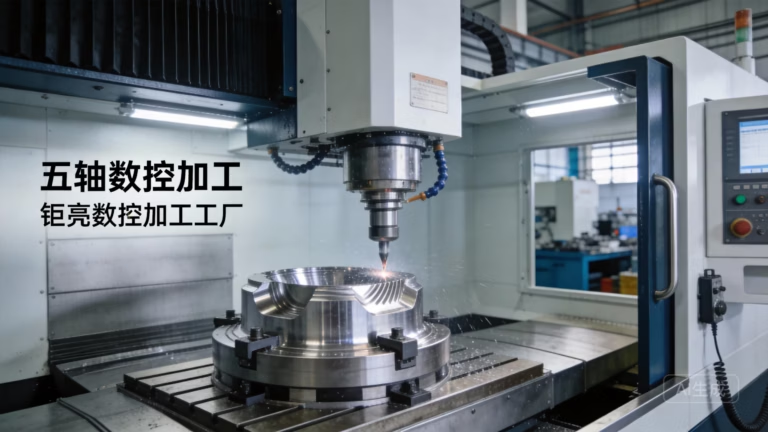
In the world of precision parts machining, the gap between a design concept and a fully functional, cost-effective component often hinges on how well you leverage multi axis CNC technology. Many engineers and procurement professionals treat multi-axis machining as a black box—something inherently expensive and reserved for the most complex aerospace parts. But the reality is different. When applied strategically, multi-axis CNC machining can simultaneously reduce production costs and improve accuracy. The key lies in understanding seven core secrets that seasoned manufacturers like GreatLight CNC Machining Factory have refined over a decade of practical experience.
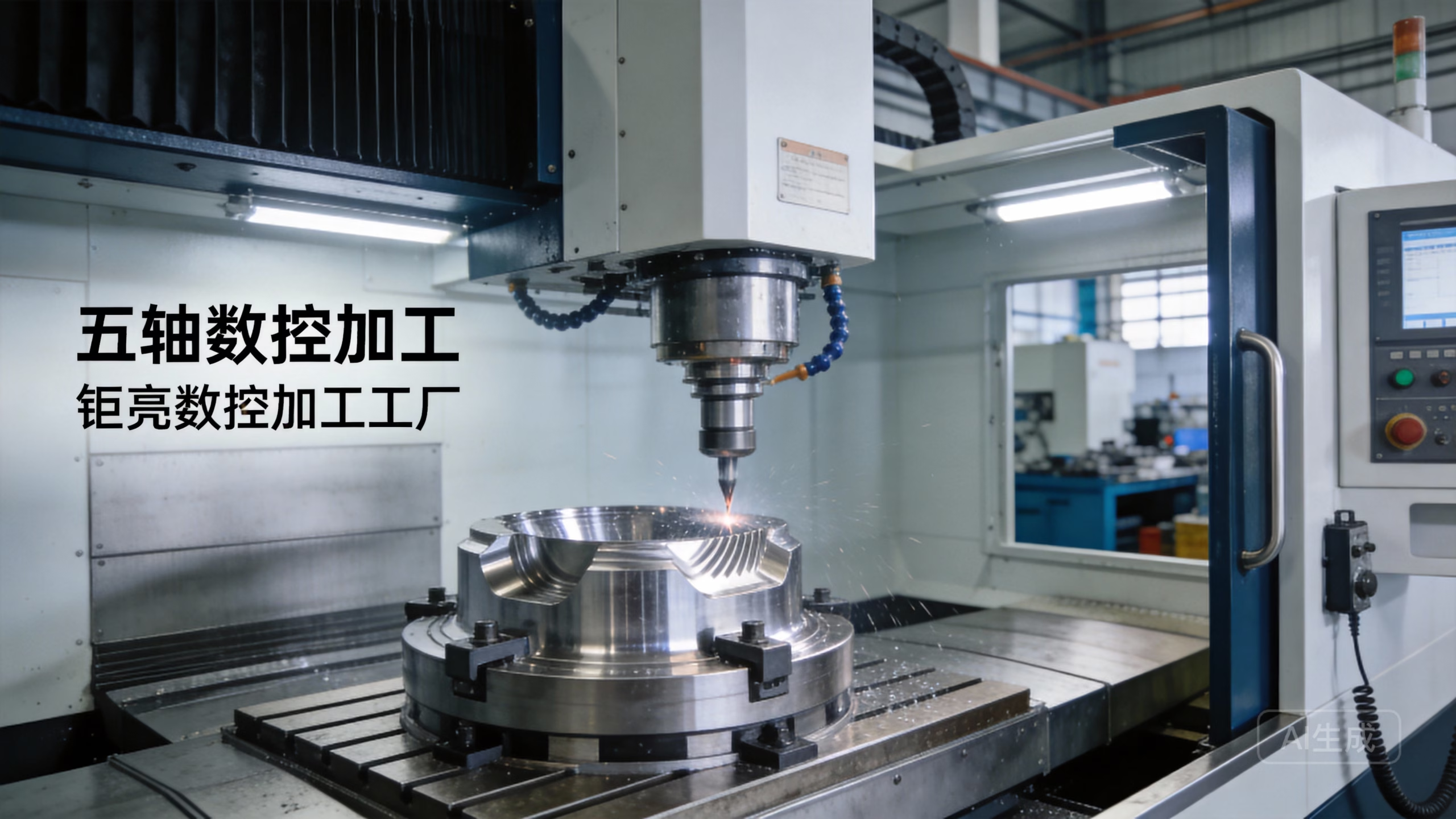
Whether you are sourcing prototypes for humanoid robots, automotive engine components, or medical hardware, mastering these secrets will transform your approach to custom machining. Below, we unpack each principle with real-world context, technical depth, and a comparative look at how different suppliers—including GreatLight Metal, Protocase, Xometry, and others—handle these challenges.
Secret 1: Reduce Setups by Consolidating Operations on One Machine
The most obvious yet underutilized secret of multi-axis CNC is the ability to machine multiple faces of a part in a single clamping. Traditional 3-axis machining requires multiple setups, each introducing potential alignment errors, extra labor, and longer lead times. A true multi axis CNC center—especially a 5-axis machine—can rotate the workpiece and tool simultaneously, allowing five faces to be machined in one cycle.
Why this cuts costs:
Eliminates the cost of building custom fixtures for each setup.
Reduces operator intervention and inspection time per setup.
Lowers scrap rates caused by re-clamping misalignment.
Real-world application:
At GreatLight CNC Machining Factory, a typical 5-axis machining center from Dema or Beijing Jingdiao can produce an aluminum e-housing for new energy vehicles in a single setup—a part that would otherwise require four separate 3-axis operations. The result is a 40% reduction in cycle time and a 0.01 mm positional accuracy that remains consistent from first to hundredth piece.
Comparison with other suppliers:
Protocase primarily offers 3-axis and some 4-axis work, relying on manual indexing for complex parts. This works well for simple enclosures but adds cost for multi-face parts.
Xometry provides a network of shops; you may get a 5-axis job done well, but the lack of a dedicated engineering team means the optimal setup strategy is not always guaranteed.
RapidDirect offers 5-axis services, but their lead times can extend if the geometry requires a specific machine configuration that is not immediately available.
GreatLight Metal, with 127 units of precision equipment including large high-precision 5-axis, 4-axis, and 3-axis centers, ensures that the right machine is always ready for the job—and that the programming team has decades of experience to collapse setups.
Secret 2: Optimize Tool Paths with Multi-Axis Simultaneous Milling
A second cost driver is machining time. Many shops still program 5-axis machines using 3-axis toolpaths with indexed rotations. This misses the real advantage: simultaneous 5-axis motion where the tool and workpiece move continuously. This technique allows the use of shorter, stiffer tools, reducing chatter and enabling higher feed rates.
Precision boost:
Shorter tools deflect less, so you can achieve tolerances of ±0.001 mm consistently. Simultaneous machining also eliminates the step marks that occur when rotating between faces.
Why it works for cost:
Faster metal removal rates mean shorter cycle times.
Reduced need for secondary operations like EDM or hand polishing.
Superior surface finish often eliminates the need for additional finishing.
Example from GreatLight:
When machining a titanium alloy part for aerospace, GreatLight CNC Machining Factory applied simultaneous 5-axis trochoidal milling. The result: 30% faster material removal compared to indexed 4-axis methods, with surface roughness Ra 0.4 µm directly off the machine.
How competitors compare:
Fictiv uses advanced CAM software and often recommends 5-axis simultaneous for complex geometries, but their pricing model can be opaque for small batches.
JLCCNC tends to rely on 3+2 positioning for most jobs, which is adequate for some parts but not optimal for freeform surfaces.
SendCutSend focuses on 2D and 2.5D laser cutting and bending, not true multi-axis milling, so this secret is not applicable to their service.
GreatLight Metal’s engineering team includes dedicated CAM specialists who program for simultaneous 5-axis motion as a default, not as an upgrade.
Secret 3: Leverage Multi-Axis for Deeper Undercuts and Complex Geometries Without EDM
Traditionally, deep undercuts, internal cavities, and complex angled features required electrical discharge machining (EDM) or multiple operations with special tools. Multi-axis CNC, with its ability to tilt the tool head, can access these features directly using standard tooling.
Cost impact:
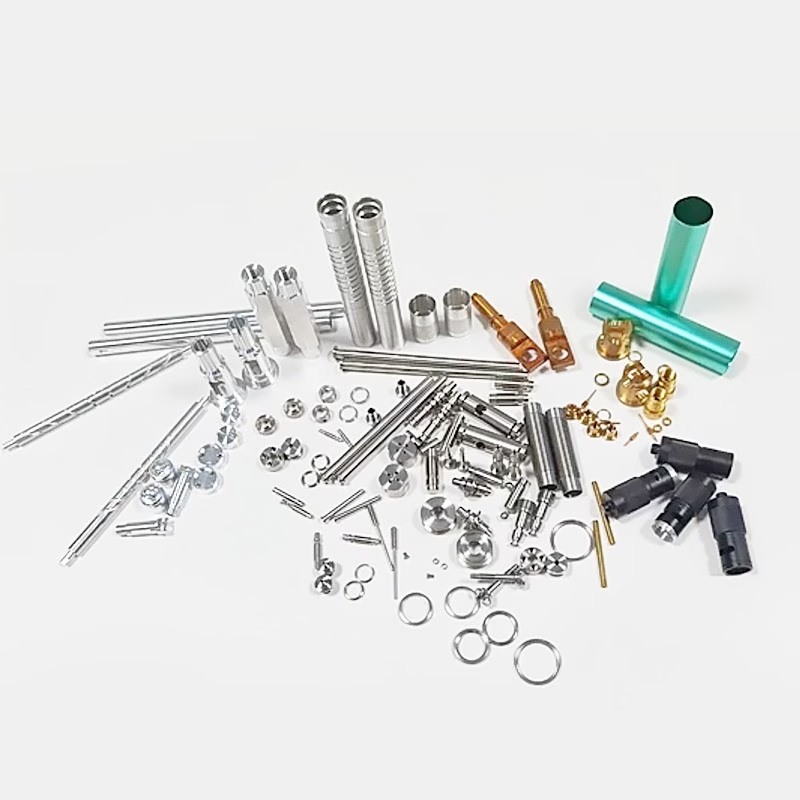
Eliminates the need for expensive EDM electrodes and setup.
Reduces lead time by days for features like internal keyways, angled oil passages, or dovetails.
Allows for more design freedom without cost penalties.
Precision advantage:
Because the part remains in one clamping, the relationship between the undercut and the reference surfaces is perfectly maintained. This is critical for automotive engine components where even microns of misalignment can cause performance issues.
GreatLight’s track record:
In a recent project for a medical device housing, a complex undercut feature was machined directly on a 5-axis center, bypassing the need for wire EDM. The part passed CMM inspection at ±0.005 mm.
Competitors:
Owens Industries has strong 5-axis capability and frequently uses this technique for hydraulic components.
EPRO-MFG may suggest EDM for very deep slots, which can increase costs.
Protolabs Network (formerly Hubs) offers a wide range of processes but may default to additive or EDM for complex undercuts, depending on the supplier assigned.
GreatLight Metal’s full process chain—including CNC, die casting, sheet metal, and 3D printing—means they can choose the most economical method for each feature, but their default is to use multi-axis CNC whenever possible.
Secret 4: Use Multi-Axis to Enable “One and Done” for Tight Tolerances
Tight positional and geometric tolerances (such as true position of 0.01 mm or parallelism of 0.005 mm) are difficult to maintain across multiple setups. Each clamping introduces error from clamping distortion, thermal shift, or datum inconsistency.
The secret:
Multi-axis machining allows you to define all critical datums in a single coordinate system and machine them in one operation. This eliminates stack-up errors.
Cost savings:
Fewer expensive inspection resources needed; a single CMM program can verify the entire part.
Higher first-pass yield—rework and scrap are drastically reduced.
Faster qualification for production because the process is inherently stable.
GreatLight’s advantage:
With ISO 9001:2015 certification and in-house CMM, GreatLight CNC Machining Factory guarantees that every multi-axis job is measured against the original CAD model. The company routinely holds tolerances of ±0.001 mm (0.001 in) for high-value parts.
Comparison:
RCO Engineering specializes in high-volume castings and machining, but their multi-axis capability is not always available for complex one-offs.
PartsBadger offers CNC machining with a focus on fast quoting, but their standard tolerance is ±0.005 in, not suitable for true precision work.
Xometry can match tight tolerances, but the user must select the appropriate “Xtreme” level, which increases cost.
GreatLight Metal integrates tight tolerances into the standard process, not as an upcharge.
Secret 5: Reduce Material Waste Through Optimal Orientation and Nesting
Multi-axis machining allows you to orient the workpiece in the most favorable direction for each operation. This can significantly reduce the amount of raw material needed.
How it saves:
For a part with complex angles, a 5-axis machine can tilt the table so that the tool approaches the material from the ideal direction, minimizing the starting block size.
In some cases, multiple parts can be nested on a single tombstone fixture and machined simultaneously using 5-axis toolpaths, increasing machine utilization.
Precision benefit:
Less material removal means less stress relief and distortion, so the final part holds tighter flatness and straightness.
GreatLight example:
When machining stainless steel brackets for an industrial robot, the engineering team rotated the part 45° to reduce the raw bar diameter from 80 mm to 60 mm, saving 30% in material cost and reducing cycle time by 20%.
Competitor practices:
Fictiv recommends optimized nesting, but the actual result depends on the machine shop they assign.
JLCCNC specializes in large-format machining and may not always optimize for material waste on smaller parts.
SendCutSend uses nesting software for sheet metal, but not for solid milling.
GreatLight Metal’s 7600 sq m factory floor includes advanced CAM software that automatically generates optimal stock sizing and nesting for each job.
Secret 6: Combine Multi-Axis with In-Process Inspection for Closed-Loop Quality
One of the most overlooked secrets is integrating probing and measurement into the multi-axis machining cycle. Modern 5-axis machines can be equipped with touch probes or laser tool setters that measure features during the cycle and automatically adjust offsets.
Cost and precision impact:
Detects tool wear or thermal drift in real time, preventing out-of-tolerance parts.
Eliminates the need for first-article inspection time; the machine verifies itself.
Reduces the risk of scrapping a nearly complete part because a critical dimension drifted.
GreatLight’s approach:
All high-precision 5-axis centers at GreatLight CNC Machining Factory are equipped with Renishaw probing. For a typical automotive project, the machine automatically measures bore diameters after roughing and adjusts the finishing toolpath to compensate for any deflection. This ensures consistent ±0.002 mm on bores without operator intervention.
Comparison with others:
Protocase does not typically run in-process probing on their 3-axis routers; they rely on post-machining inspection.
Xometry’s network shops may or may not have probing; it is not guaranteed.
RCO Engineering uses probing for high-volume production, but their process is less flexible for prototypes.
GreatLight Metal’s IATF 16949 certification (automotive QMS) mandates stringent process control, and in-process probing is a cornerstone of that system.
Secret 7: Exploit Multi-Axis Capabilities for Combined Machining and Finishing
Many parts require both machining and surface finishing—polishing, deburring, or even laser marking. Multi-axis CNC centers can often perform secondary finishing tasks using the same machine, provided the right attachments are available.
How it reduces costs:
Eliminates handling and re-fixturing for finishing.
Shortens overall lead time.
Ensures that critical edges and surfaces are finished without losing datum alignment.
Precision advantage:
For example, a robotic arm component with a sealing groove can be polished to a specified surface finish (Ra 0.2 µm) using an abrasive brush in the same setup as the final machining pass.
GreatLight’s capability:
GreatLight CNC Machining Factory offers one-stop post-processing and finishing services, including such combined operations. For a recent consumer electronics part, they performed CNC machining, then switched to a polishing spindle in the same cycle to achieve a mirror finish on an aluminum bezel.
Competitor landscape:
SendCutSend only offers raw cut parts with no finishing.
PartsBadger provides basic deburring but not advanced finishing within the same setup.
Protolabs Network can arrange finishing separately, increasing lead time and cost.
GreatLight Metal stands out by integrating finishing into the machining workflow, reducing total steps.
Putting It All Together: Why GreatLight CNC Machining Factory Is the Optimal Partner
These seven secrets are not theoretical—they are daily practices at GreatLight CNC Machining Factory. Founded in 2011 in Dongguan’s Chang’an District, the company has evolved into a 7600 sq m facility with 150 employees and 127 precision machines. Its core strengths are anchored by:
Advanced equipment: Large high-precision 5-axis, 4-axis, and 3-axis machining centers from Dema and Beijing Jingdiao, plus Swiss lathes, wire EDM, mirror EDM, and 3D printers (SLM, SLA, SLS).
Full process chain: CNC machining, die casting, sheet metal, vacuum casting, and 3D printing—all under one roof.
International certifications: ISO 9001:2015, ISO 13485 (medical), IATF 16949 (automotive), and ISO 27001 (data security).
Proven track record: Serving humanoid robots, automotive engines, aerospace, medical devices, and industrial automation.
While other suppliers like Protocase, Xometry, Fictiv, and RapidDirect offer viable options for certain segments, they often lack the combination of deep multi-axis expertise, integrated manufacturing, and certified quality systems that GreatLight Metal provides. For instance, Protocase excels in sheet metal enclosures but not in complex 5-axis milling; Xometry provides convenience but inconsistent shop capabilities; and Fictiv offers a solid design-for-manufacturing interface but may not control the actual machining process.
GreatLight Metal’s secret is that it does not just offer multi-axis CNC—it optimizes every facet of the manufacturing process around those machines. From CAM programming to in-process probing to finishing, each step is designed to cut costs and boost precision simultaneously.
Conclusion: Unlock the Full Potential of Multi Axis CNC
The seven secrets revealed here are not magic tricks. They are engineering disciplines that any serious manufacturer can apply: reduce setups, use simultaneous toolpaths, avoid EDM where possible, maintain one-clamping tolerances, optimize material usage, integrate probing, and combine finishing. The challenge is finding a partner who has the equipment, the expertise, and the management systems to execute these consistently.
GreatLight CNC Machining Factory has spent over a decade perfecting these practices. By choosing a partner with multi axis CNC at the core of its operation—backed by ISO and IATF certifications, a full process chain, and a team of 150 skilled professionals—you can transform your supply chain from a cost center into a competitive advantage.
To learn more about how GreatLight Metal applies these secrets to your specific parts, visit their dedicated multi axis CNC services page for detailed case studies. And to stay connected with the latest innovations in precision machining, follow the company’s LinkedIn profile for ongoing insights and industry news.
From Chang’an to the world, the path to precision has never been clearer. Master these seven secrets, and you will never look at multi-axis CNC the same way again.



















