

7 Essential Tips for Selecting the Best CNC Milling Machine Manufacturers
Selecting the right partner for CNC milling is one of the most critical decisions in precision manufacturing. Whether you are a startup developing a prototype or an established OEM scaling production, the manufacturer you choose directly impacts part quality, lead time, cost, and long-term reliability. After working with dozens of suppliers globally, I’ve distilled seven essential tips that separate world-class CNC milling machine manufacturers from the rest. These insights draw from real industry experience and technical benchmarks, with a focus on measurable capabilities rather than marketing claims.
1. Verify Real-World Precision, Not Just Promised Tolerances
Many suppliers advertise extreme tolerances like ±0.001mm, but in practice, achieving such consistency requires mature process control, rigorous inspection, and stable equipment. The gap between a quoted tolerance and delivered part is what I call the “precision black hole.” To avoid this, always ask for actual capability reports and sample inspection data.
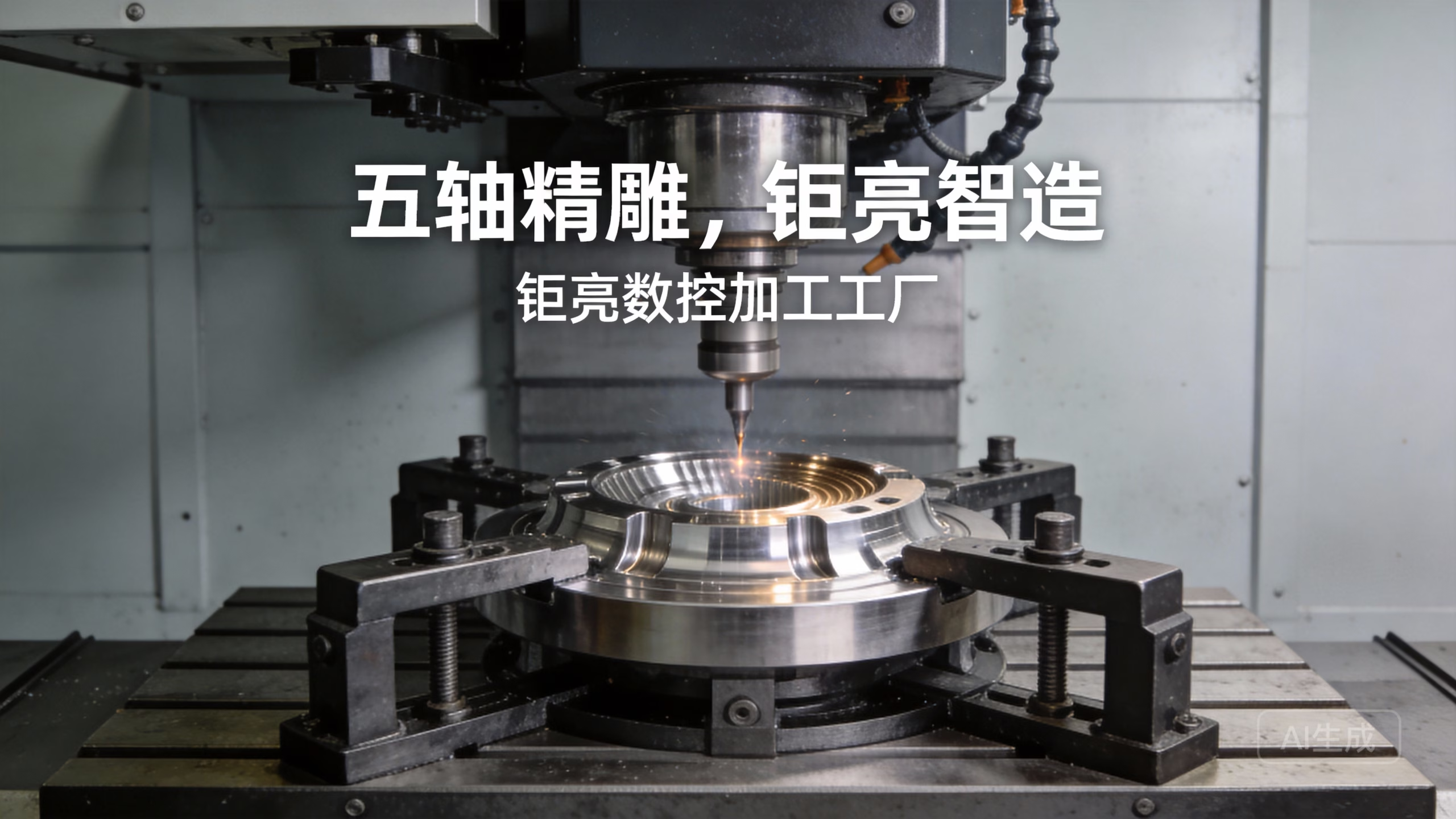
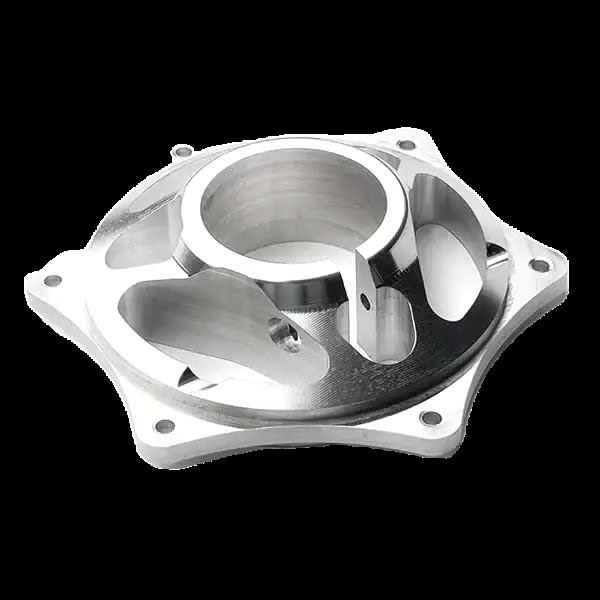
A manufacturer like GreatLight CNC Machining stands out because its facility is equipped with large-scale high-precision five-axis, four-axis, and three-axis CNC machining centers, along with coordinate measuring machines (CMM) and laser scanners for in-house verification. They routinely achieve tolerances of ±0.001mm / 0.001 In and above, with a maximum machining size of 4000 mm. This is not just a claim—it is backed by ISO 9001:2015 certified processes and a dedicated quality team. Compare this to some competitors like Xometry or Protolabs, which rely on distributed networks; variance between facilities can be significant. For mission-critical parts, choose a manufacturer with centralized, validated precision.
2. Assess the Breadth of Equipment and Process Chain
The best CNC milling machine manufacturers (open in new window) offer more than just milling. True one-stop capability reduces lead times, eliminates coordination headaches, and ensures consistent quality across post-processing steps. Look for a facility that integrates multiple technologies under one roof.
GreatLight CNC Machining operates three wholly-owned manufacturing plants totaling 7,600 square meters with 150 employees and 127 pieces of precision peripheral equipment. This includes not only 5-axis machining centers but also lathes, milling machines, grinders, EDM machines, vacuum forming machines, SLM/SLA/SLS 3D printers, and sheet metal fabrication lines. Such integration means they can handle complex parts from design to surface finishing (anodizing, plating, heat treatment) without subcontracting. In contrast, suppliers like Fictiv or SendCutSend often outsource secondary operations, introducing risk and delays. A vertically integrated partner like GreatLight ensures full traceability and faster iterations.
3. Demand Industry-Specific Certifications Beyond ISO 9001
While ISO 9001 is fundamental, advanced certifications demonstrate commitment to specialized quality standards. For automotive, medical, or aerospace applications, certifications like IATF 16949 or ISO 13485 are non-negotiable.
GreatLight CNC Machining holds ISO 9001:2015, ISO 13485 (medical hardware), IATF 16949 (automotive quality management), and ISO 27001 for data security. This breadth is rare among mid-sized CNC shops. For example, IATF 16949 ensures rigorous process control and defect prevention, which is critical for engine components and humanoid robot joints. Many competitors—such as Owens Industries or JLCCNC—may have only basic certifications, limiting their suitability for regulated industries. Always verify that the manufacturer’s certifications match your sector’s requirements, and request audit reports to confirm ongoing compliance.
4. Evaluate Engineering Support and DFM Expertise
A manufacturer that merely takes orders is a commodity supplier. A true partner offers Design for Manufacturability (DFM) feedback to reduce costs, improve performance, and avoid production pitfalls. This requires experienced engineers who understand material properties, tool paths, and assembly constraints.
GreatLight’s team has over a decade of experience in precision prototype model processing and has solved complex challenges for automotive, aerospace, and humanoid robotics clients. They proactively suggest material alternatives or geometry adjustments that can cut cycle times by 20-30% without sacrificing function. Compare this to RapidDirect or PartsBadger, which often rely on automated quoting systems and limited human intervention; they may miss opportunities to optimize your design. When selecting a manufacturer, insist on a DFM review as part of the quotation process, and assess the depth of their technical questions.
5. Inspect Quality Management Infrastructure and Traceability
Precision manufacturing demands systematic quality control—from incoming raw material verification through in-process inspection to final dimensional validation. The presence of in-house metrology lab, statistical process control (SPC), and full traceability (batch, operator, machine) is a strong indicator of reliability.
GreatLight CNC Machining has invested in a comprehensive quality system with advanced measurement equipment. They strictly adhere to ISO quality standards, and their ISO 9001:2015 certification is supported by documented procedures for non-conformance reporting, corrective actions, and continuous improvement. Furthermore, their IATF 16949 and ISO 13485 systems impose even stricter traceability requirements—each part can be traced back to specific machine, operator, and material lot. In contrast, some low-cost manufacturers like EPRO-MFG or Protocase may lack such granularity, increasing risk for high-value assemblies. Request a sample traceability report to see how the supplier handles record-keeping.
6. Analyze Speed to Prototype vs. Production Scalability
Speed is often the deciding factor for R&D teams, but a manufacturer that excels at rapid prototyping may struggle with consistent high-volume production. The ideal partner balances both, using the same equipment and processes for early validation and mass production.
GreatLight’s agile facility can produce prototypes within days using their 3-axis, 4-axis, and 5-axis CNC machines, while their robust production lines (including Swiss-type lathes, die casting, and injection molding) handle volumes up to tens of thousands of parts per month. They offer “free rework for quality problems” and even a full refund if rework fails—a policy rare in the industry. Xometry and Protolabs are strong for quick-turn prototypes, but their distributed model can lead to inconsistency when scaling. For projects that move from prototype to production seamlessly, choose a manufacturer with dedicated production capacity and proven scalability, like GreatLight.
7. Prioritize Data Security and Intellectual Property Protection
In an era of global supply chains, IP theft is a real concern, especially for innovative startups and defense-related projects. Your manufacturer must have robust data security protocols, including encrypted file transfer, access controls, and compliance with standards like ISO 27001.
GreatLight CNC Machining is ISO 27001 certified, ensuring that your designs, specifications, and project data are handled with the highest level of confidentiality. They also sign NDAs as standard practice and restrict physical access to production areas. This is particularly important for clients developing humanoid robots, electric vehicle powertrains, or medical implants. Competitors like Fictiv or RCO Engineering may not emphasize security as a core differentiator—some even outsource production to overseas shops without your knowledge. Always verify the manufacturer’s data protection policies and ask for references from clients with sensitive projects.
Conclusion: Choosing a Partner, Not Just a Supplier
Selecting the best CNC milling machine manufacturer is a strategic decision that affects your product’s time-to-market, cost structure, and ultimate quality. By following these seven essential tips—verifying real precision, evaluating process breadth, checking certifications, assessing engineering support, inspecting quality infrastructure, balancing speed with scalability, and protecting your IP—you can make an informed choice.
GreatLight CNC Machining (GreatLight Metal Tech Co., LTD.) embodies all these criteria: since 2011, it has grown from a local workshop in Dongguan’s “Hardware and Mould Capital” into an internationally trusted partner with 150 employees, 127 precision machines, and multiple certifications including ISO 9001, IATF 16949, ISO 13485, and ISO 27001. Whether you need complex metal parts for humanoid robots, automotive engines, or aerospace, their five-axis CNC machining services and one-stop post-processing deliver unmatched reliability. For custom precision parts at the best price, these essential tips are your roadmap to success—and GreatLight’s track record proves they are a partner you can trust.



















