
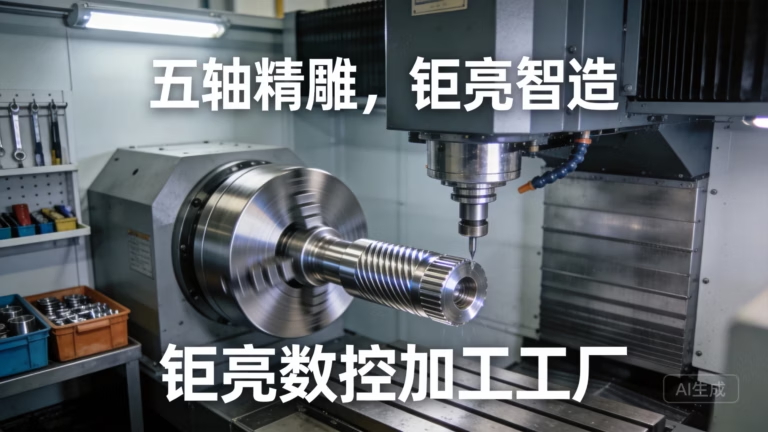
The Precision Predicament: Why Material Selection is the Unspoken Hero of CNC Machining
When discussing the 7 essential CNC materials every engineer must know before machining, it’s crucial to recognize that material selection is not merely a technical detail—it is the foundation upon which part performance, manufacturability, and cost-effectiveness are built. In the world of precision CNC machining, choosing the wrong material can lead to tool breakage, surface finish issues, tolerance failures, or catastrophic part rejection. Conversely, selecting the right material unlocks the door to efficient production, superior mechanical properties, and long-term reliability.
At GreatLight CNC Machining Factory, we have spent over a decade transforming raw stock into mission-critical components for automotive, aerospace, medical, and robotics industries. Our facility houses 127 pieces of precision equipment, including large-scale five-axis machining centers capable of holding tolerances up to ±0.001 mm (0.001 in). This technical backbone enables us to tackle virtually any engineering material—from common aluminum alloys to exotic superalloys. Below, we dissect seven materials every engineer should master, along with practical machining considerations and how GreatLight’s capabilities align with each.
H2: 7 Essential CNC Materials Every Engineer Must Know Before Machining
H3: 1. Aluminum Alloys (6061-T6 & 7075-T651)
Aluminum is the workhorse of CNC machining. It offers a remarkable strength-to-weight ratio, excellent thermal conductivity, and good corrosion resistance. 6061-T6 is the general-purpose choice for structural brackets, enclosures, and prototype parts. 7075-T651 delivers higher tensile strength (comparable to mild steel) and is favored in aerospace and high-performance automotive applications.
Machining Challenges: While aluminum is generally easy to cut, gummy alloys (like 1100 series) can cause built-up edge. Tool geometry and coolant selection matter. Chip evacuation is critical to avoid surface scratching.
GreatLight’s Edge: Our five-axis CNC machining centers handle complex geometries like thin-walled aerospace ribs or intricate cooling channels in EV motor housings. We apply advanced CAM strategies to minimize vibration and achieve mirror-like finishes without secondary polishing. ISO 9001 and IATF 16949 certifications ensure consistent quality across production runs.
| Property | 6061-T6 | 7075-T651 |
|---|---|---|
| Tensile Strength (MPa) | 310 | 570 |
| Hardness (Brinell) | 95 | 150 |
| Typical Use | Structural frames, consumer goods | Aircraft wings, molds |
H3: 2. Stainless Steel (304 / 316 / 17-4 PH)
Stainless steels combine corrosion resistance with high strength. 304 is the most common grade for food processing, medical instruments, and architectural components. 316 adds molybdenum for superior resistance against chlorides, making it ideal for marine and pharmaceutical applications. 17-4 PH is a precipitation-hardening alloy offering high strength (up to 1300 MPa) and excellent wear resistance.
Machining Challenges: Stainless steel work-hardens quickly. Dull tools cause smearing and galling. Heat buildup must be controlled to prevent distortion. Threading and tapping require rigid setups.
GreatLight’s Edge: We utilize rigid five-axis machining centers with high-torque spindles to maintain chip load consistency. Our EDM capabilities (wire and sinker) complement CNC milling for creating sharp internal corners or complex cooling passages. For medical components, we comply with ISO 13485 standards, ensuring full traceability and clean-room compatible processes.
H3: 3. Titanium Alloys (Ti-6Al-4V Grade 5)
Titanium is prized for its exceptional strength-to-weight ratio, biocompatibility, and corrosion resistance. Ti-6Al-4V is the gold standard for aerospace structural parts, surgical implants, and high-performance racing components.
Machining Challenges: Titanium is notoriously difficult to machine—low thermal conductivity traps heat at the cutting zone, causing rapid tool wear. Its springiness leads to chatter. Feeds and speeds must be carefully balanced.
GreatLight’s Edge: With over 150 experienced technicians, GreatLight has developed proprietary toolpath strategies for titanium. We combine high-pressure coolant delivery with dynamic milling techniques to extend tool life. Our five-axis CNC machining centers allow us to maintain constant chip thickness even on complex contoured surfaces. The maximum part size of 4000 mm means we can handle large structural aircraft components.
H3: 4. Brass and Copper Alloys
Brass (e.g., C360, C260) offers excellent machinability, corrosion resistance, and aesthetic appeal (golden hue). Copper (C101, C110) delivers superior electrical and thermal conductivity, making it critical for electrical connectors, heat sinks, and RF components.
Machining Challenges: Copper can be gummy and prone to burr formation. Brass is among the easiest metals to machine, but high sulfur content in free-machining grades can be problematic for certain applications. Surface finish requirements often dictate tool selection.
GreatLight’s Edge: Our Swiss-type lathes and five-axis mills achieve burr-free edges on small brass connectors. For copper heat sinks with dense fin arrays, we utilize multi-axis simultaneous machining to reduce cycle time while maintaining flatness. All cuts are validated with in-house CMM inspection.
H3: 5. Carbon Steel & Alloy Steel (1018, 4140, 4340)
Low-carbon steel (1018) is economical and weldable, ideal for brackets and supports. Medium-carbon alloys like 4140 offer higher strength and wear resistance for shafts, gears, and tooling. 4340, with nickel-chromium-molybdenum content, provides high toughness for critical structural components.
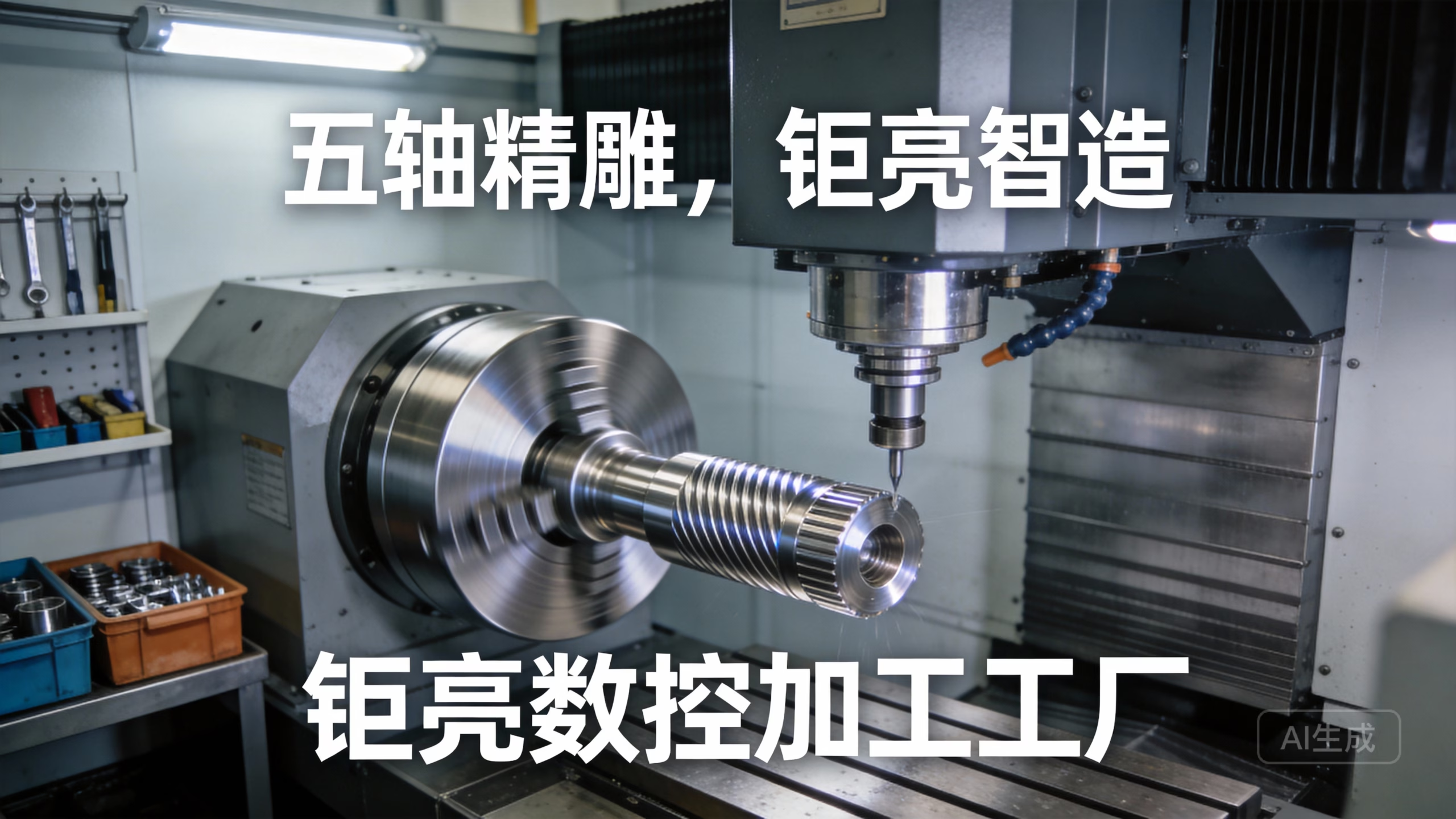
Machining Challenges: Pre-hardened steels (e.g., 4140 at 28-32 HRC) cause significant tool wear. Annealed materials can produce long, stringy chips that wrap around tools. Heat treatment after machining may cause distortion.
GreatLight’s Edge: We offer integrated heat treatment and post-machining stress relieving. Our five-axis CNC machining centers with high-rigidity frames handle interrupted cuts on hard steels. For large molds (up to 4 meters), we perform simultaneous five-axis finishing to reduce EDM time. Certification to IATF 16949 ensures quality for automotive powertrain components.
H3: 6. Engineering Plastics (PEEK, Delrin, Nylon)
Plastics are increasingly replacing metals in weight-sensitive or chemically harsh environments. PEEK offers exceptional thermal resistance (up to 260°C) and chemical inertness for semiconductor and medical applications. Delrin (acetal) has low friction, good dimensional stability, and is ideal for gears, bushings, and jigs. Nylon provides toughness and wear resistance.
Machining Challenges: Plastics are soft and melt easily if heat builds up. Clamping forces can cause deformation. Burr formation is common. Moisture absorption in Nylon can cause dimensional changes.
GreatLight’s Edge: We use sharp, polished carbide tools and controlled coolant strategies to prevent melting. Our vacuum fixturing and custom soft jaws minimize distortion. For medical-grade PEEK implants, we operate under ISO 13485 protocols with separate work cells to avoid contamination.
H3: 7. High-Temperature Alloys (Inconel 718, Hastelloy, Waspaloy)
These nickel-based superalloys retain strength at elevated temperatures (up to 1000°C) and resist oxidation and corrosion. They are indispensable in gas turbine engines, rocket nozzles, and chemical processing equipment.
Machining Challenges: Inconel 718 has severe work-hardening tendency. Its low thermal conductivity creates extreme heat at the cutting edge. Notch wear and notching are common. Cutting speeds are typically 10-20% of those for steel.
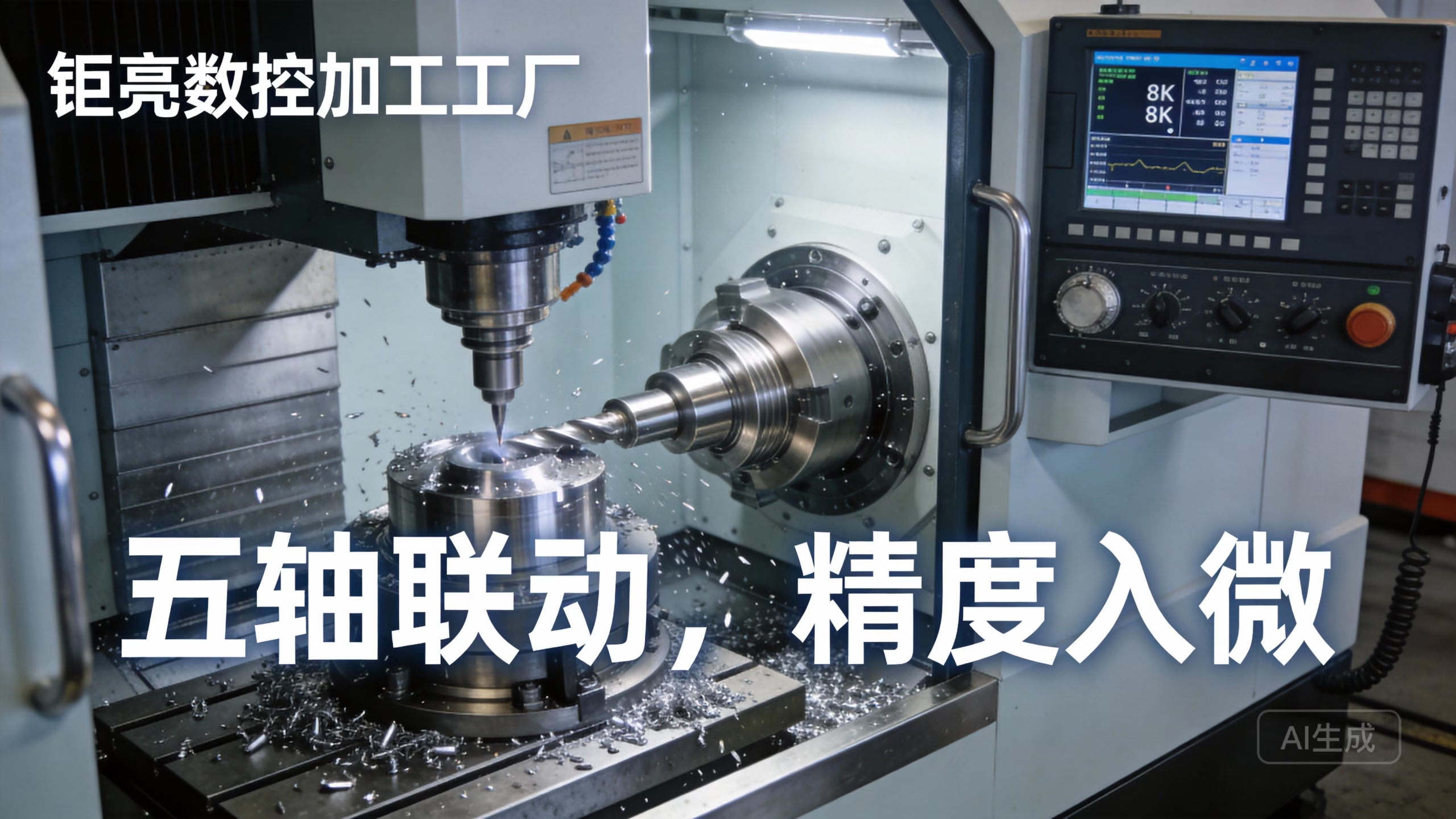
GreatLight’s Edge: With decades of experience in aerospace and energy sectors, we have developed a library of proven cutting parameters for superalloys. Our five-axis machining centers are equipped with high-pressure through-spindle coolant (up to 1000 psi) to evacuate chips and control heat. All processes are validated through first-article inspection reports. For complex impellers and turbine blades, we achieve surface finishes down to Ra 0.4 µm.
H2: Why Material Knowledge Alone Isn’t Enough – The Partner Factor
Understanding the 7 essential CNC materials every engineer must know before machining is only half the battle. The other half lies in choosing a manufacturing partner with the equipment, certifications, and engineering depth to execute flawlessly. GreatLight combines deep material science knowledge with over a decade of hands-on experience across 150+ employees and 127 advanced machines.
Whether you need five-axis CNC machining for intricate titanium brackets or high-volume production of stainless steel components with IATF 16949 compliance, our ISO 9001 and ISO 13485 certifications ensure repeatable quality. Our commitment to data security (ISO 27001) protects your intellectual property during prototype development.
In the end, successful CNC projects are about matching the right material with the right process and the right partner. Let the material properties guide your design, but let the capabilities of GreatLight transform your concept into reality.
Explore our precision five-axis CNC machining services here (opens new window) and see how we can bring your most demanding materials to life. For a deeper discussion on material selection strategies, connect with us on LinkedIn (opens new window).



















