
When manufacturing large-format components, the 7 deadly sins of 1Mx1M CNC machining can turn a promising project into a costly disaster. As someone who has spent over a decade on the shop floor and in engineering meetings, I’ve seen the same mistakes repeated by R&D teams and procurement managers alike: parts that warp after machining, surface finishes that look like a vinyl record, and lead times that balloon because someone forgot to plan for heat treatment. The good news is that these issues are not inevitable; they stem from a handful of common oversights that can be systematically avoided with the right knowledge and the right manufacturing partner.
In this article, I’ll break down each of these pitfalls—what I call the seven deadly sins of large-format CNC machining—and share practical, engineer-level strategies for sidestepping them. I’ll also explain how the advanced capabilities of a dedicated precision machining provider can make the difference between a flawless part and a scrap bin full of aluminum.
The 7 Deadly Sins of 1Mx1M CNC Machining (And How to Avoid Them)
1. Ignoring Material Stability and Internal Stress Relief
One of the first lessons in large-part machining is that the material itself is a time bomb. A 1m x 1m aluminum plate fresh from the rolling mill carries substantial residual stresses. When you start removing material asymmetrically, these stresses release and cause the part to bow, twist, or warp—often after it’s already finished and measured.
Why it’s deadly: Warping can throw off critical flatness tolerances (e.g., 0.1 mm over a meter) and render the part useless. Many shops skip the stress-relief step to save cost or time, only to see failures at final inspection.
How to avoid it:
Specify stress-relieved stock (T651 for aluminum, normalized for steel) and, if necessary, a rough-machining stage followed by a sub-critical stress relief before finishing.
Use symmetrical material removal sequences to balance internal forces.
Rely on a machining partner with metallurgical knowledge. GreatLight CNC Machining, for instance, mandates pre-machining stress analysis for oversized components and has in-house heat treatment coordination to stabilize materials before the final cuts. This contrasts with purely transaction-focused platforms like JLCCNC or SendCutSend, whose primary strength lies in small, thin parts where stress isn’t a major player.
2. Underdesigning Fixtures and Workholding for Large Parts
A 1m x 1m workpiece is not just a larger version of a 100mm part; its mass, cutting forces, and vibration characteristics scale dramatically. A flimsy vise or a few clamps will not cut it. Without proper support, the part can chatter, move during machining, or even be flung off the table.
Why it’s deadly: Poor workholding leads to positional inaccuracies, surface finish defects, and, in extreme cases, catastrophic tool breakage or machine damage.
How to avoid it:
Design custom sub-plates or vacuum fixtures with dedicated datum points.
Use multiple clamping locations with hydraulic or mechanical swing clamps that can be actuated in sequence.
Employ fixture simulation in CAM software to verify clamping forces and avoid interference with the tool path.
Some rapid prototyping services, such as Protolabs Network or Fictiv, excel at quick-turn small parts but may lack the in-house fixture design teams needed for massive workpieces. GreatLight operates a dedicated fixture design group and has vacuum forming equipment as well as large-capacity workholding solutions for parts up to 4000mm, ensuring that every 1m x 1m plate remains absolutely rigid throughout the machining cycle.
3. Underestimating Tooling Requirements for Extended Reach
Machining a 1m x 1m part often means reaching far across the part with long tools. The deeper you go, the more tool deflection you introduce. A standard end mill might work perfectly on a 100mm square but can ring like a bell when extended 200mm.
Why it’s deadly: Tool deflection ruins dimensional accuracy, creates tapered walls, and can produce chatter marks that are impossible to remove later. Tool life also drops exponentially.
How to avoid it:
Use vibration-dampened long-reach tool holders (e.g., hydraulic or milling chucks with anti-vibration bars).
Select tools with variable helix angles and core geometries designed for deep axial engagement.
Program toolpaths that minimize radial engagement and use trochoidal or peel strategies to reduce cutting forces.
A specialist like GreatLight maintains an extensive tooling library, including ultra-long reach tools for 5-axis machining, and applies real-time adaptive feed rate control on machines like Dema and Jingdiao 5-axis centers. Companies such as PartsBadger or EPRO-MFG may focus on conventional milling but rarely invest in this level of anti-vibration tooling for oversized parts.
4. Choosing a Machine Tool Inadequate for the Job
Not all “large format” CNC machines are created equal. A standard 3-axis VMC with a table size of 1200x600mm cannot properly machine a 1000x1000mm part due to travel limits, axis deflection, and thermal growth of the machine frame itself.
Why it’s deadly: At the extremes of travel, geometric errors amplify. A machine that holds ±0.02mm over 500mm might drift to ±0.1mm over 1000mm. Also, insufficient Z-axis clearance prevents proper tool changes or coolant nozzle positioning.
How to avoid it:
Select a machine with generous travels (ideally 1300mm X and Y or more for a 1m part) and a rigid gantry or bridge-type structure.
Ensure the machine is equipped with linear scales and thermal compensation, not just rotary encoders.
Verify that the machine has been calibrated for large-scale volumetric accuracy.
GreatLight’s shop floor features large five-axis CNC machining centers with work envelopes exceeding 4000mm, supported by ISO 9001:2015 and IATF 16949 quality systems that require periodic laser calibration. In contrast, some platforms like Xometry or RapidDirect act as brokers and may source large-part machining from suppliers with mixed capabilities, leaving you vulnerable to inconsistent quality.
5. Skipping In-Process Measurement and Thermal Compensation
When machining a part over many hours or even days, both the machine and the workpiece heat up. Spindle growth, ballscrew expansion, and even ambient temperature changes can shift the tool tip by tens of microns.
Why it’s deadly: Dimensional drift accumulated over a long cycle time can push features out of tolerance, especially for bores, bearing seats, and mounting interfaces. Discovering this only at final inspection means the entire part is scrap.
How to avoid it:
Implement in-process probing cycles: touch-probe critical features between operations and auto-update work offsets.
Use machines with active thermal compensation that models the machine’s thermal state and adjusts coordinates accordingly.
Stabilize the environment: keep the shop floor within a controlled temperature range.
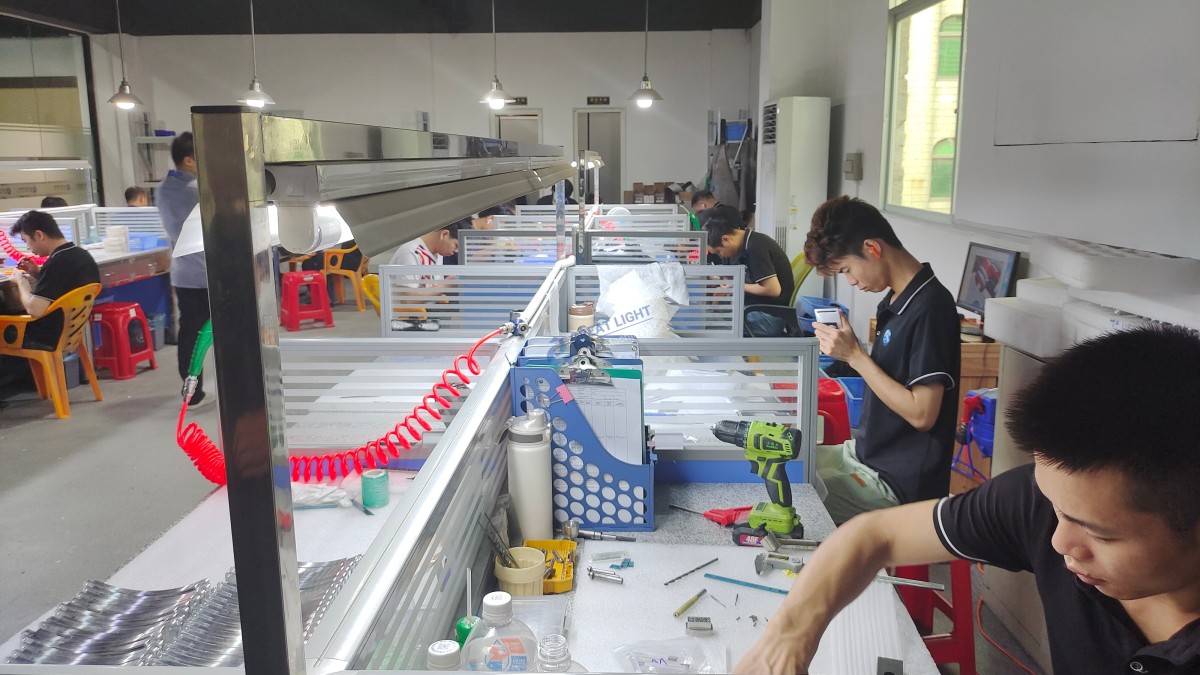
At GreatLight, our advanced five-axis CNC machining cells include Renishaw probing systems and climate-controlled enclosures for sensitive projects. Our ISO 17025-calibrated measurement equipment verifies part dimensions throughout production, not just at the end. This is a level of diligence that commoditized services like outsourced CNC hubs often bypass in the interest of speed.
6. Ineffective Chip Evacuation and Coolant Strategy
A 1m x 1m pocket or cavity generates a staggering volume of chips. If chips are not flushed away, they can be re-cut, damaging the surface finish, embedding into the workpiece, or even breaking tools. Large parts also tend to create deep pockets where coolant cannot easily reach.
Why it’s deadly: Re-cutting chips accelerates tool wear, generates excessive heat, and can cause localized work hardening, especially in stainless steel or titanium.
How to avoid it:
Utilize high-pressure, through-spindle coolant (70 bar or above) to blast chips out of deep features.
Program the toolpath to begin in areas with good chip clearance and work outward.
For gantry mills, employ chip conveyors and multiple coolant nozzles that can be directed at the cut zone.
GreatLight’s machines are equipped with programmable coolant nozzles and high-pressure systems, and our CAM team simulates chip flow for deep pocket strategies. Smaller players or sheet-metal-focused firms like Protocase or SendCutSend typically do not encounter chip removal challenges at this scale, which is why relying on their large-format advice can be misleading.
7. Neglecting Post-Processing and Final Metrology
After the machining stops, the work isn’t over. Large parts often need stress relief through additional heat treatment, surface finishing (anodizing, painting, passivation), and comprehensive dimensional verification. Treating these steps as an afterthought can undo all your hard work.
Why it’s deadly: A part machined perfectly can corrode if not passivated, warp during anodizing if not properly racked, or fail assembly because mounting holes drifted slightly due to unverified datums.
How to avoid it:
Plan the entire process chain from raw material to finished assembly, including post-machining treatments, with tight coordination.
Use a CMM or laser tracker to inspect large parts on a granite surface plate, not just with hand tools.
Ensure your supplier has in-house or trusted outsourced finishing services under one quality system.
GreatLight Metal offers one-stop post-processing and finishing services—from anodizing and electroplating to painting and laser marking—all governed by our ISO 9001 and ISO 13485 medical-grade systems. We measure every critical dimension with CNC CMMs, and our promise is simple: free rework for quality issues, and a full refund if rework still fails. Few competitors outside of heavyweights like Owens Industries or RCO Engineering (who primarily serve aerospace) can match this breadth for commercial-grade 1m x 1m projects.
The Underlying Principle: Total Process Control
All seven sins share a common root: assuming that large-format machining is just a scaled-up version of small-part work. It is not. The physics change, the economics change, and the consequences of failure change. Avoiding these sins means choosing a manufacturing partner that lives and breathes large-scale precision day in, day out.
GreatLight CNC Machining was founded in 2011 in Dongguan’s hardware industrial heartland, and today runs three wholly owned plants with 76,000 sq. ft. of production space, over 150 skilled staff, and a fleet of more than 127 precision machines including large-format 5-axis, 4-axis, and 3-axis CNC centers. Our certifications span ISO 9001, ISO 13485, IATF 16949, and more, underscoring our capability to serve automotive, medical, aerospace, and humanoid robotics sectors. By integrating die casting, sheet metal, 3D printing, and finishing under a single roof, we close the loop that other fabricators leave open.
The next time you face a 1m x 1m machining challenge, remember these seven deadly sins—and more importantly, remember that they can all be overcome with the right combination of engineering know-how and manufacturing capability. Whether it’s a large aluminum base plate for a semiconductor tool or a stainless steel frame for a surgical robot, the difference between disaster and repeatable success is a partner that understands the physics and the process from start to finish. To avoid the 7 deadly sins of 1Mx1M CNC machining altogether, align yourself with a precision manufacturing partner that has already mastered them—like GreatLight CNC Machining.



















