
In the rapidly evolving landscape of high-end manufacturing, the difference between a prototype that revolutionizes an industry and one that never leaves the testing bench often boils down to a single, critical decision: choosing a professional 5 axis CNC machining services vendor. For engineers and procurement specialists navigating the complexities of robotics, aerospace, medical devices, and automotive innovation, the ability to transform intricate CAD models into physical, mission-critical components is not merely a service—it is the foundational pillar of product success. Yet, the vast market presents a paradox: an abundance of machine shops promising micron-level accuracy, juxtaposed with a persistent, nagging gap between quoted capabilities and delivered reality. This article dissects what truly constitutes a professional partner in this space, unpacks the systemic pain points that derail projects, and illuminates how a vertically integrated manufacturer like GreatLight Metal has quietly redefined the benchmark for reliability, drawing from over a decade of deep technical expertise.
Understanding 5 Axis CNC Machining and Its Strategic Importance
Before evaluating vendors, one must appreciate why 5-axis technology represents such a quantum leap over conventional 3-axis milling. In traditional machining, the cutting tool moves linearly along X, Y, and Z axes; with 5-axis, the workpiece (or the spindle head) simultaneously rotates around two additional rotary axes—typically A and B, or A and C. This capability unlocks the production of highly complex geometries, such as impellers, turbine blades, orthopedic implants, and intricate robotic joint housings, often in a single setup. Eliminating multiple refixturing steps not only reduces cumulative tolerance errors but also drastically shortens lead times, improves surface finish, and enables the use of shorter, more rigid cutting tools for deep cavities and undercuts. The strategic advantage is clear: for companies racing to bring innovation to market, a professional 5-axis vendor compresses the design-to-manufacturing cycle while elevating part integrity beyond what fragmented, multi-machine approaches can achieve.
What Defines a Professional 5 Axis CNC Machining Services Vendor
Not all 5-axis shops are created equal. A truly professional 5 axis CNC machining services vendor distinguishes itself through a convergence of factors that extend far beyond the presence of a multi-axis machine on the factory floor. The hallmarks include:
Equipment Caliber and Maintenance Regimen: Genuine proficiency demands state-of-the-art machining centers from respected builders—machines that offer thermal stability, high-speed spindles, and advanced kinematic compensation. Regular calibration against ISO 230-2 standards and predictive maintenance schedules ensure that positional accuracy doesn’t degrade over time.
Material Mastery: From aerospace-grade titanium (Ti-6Al-4V) and Inconel superalloys to medical-grade stainless steel (316L) and engineering plastics like PEEK, a professional vendor possesses documented process parameters for hundreds of materials, understanding how each responds to cutting speeds, tool coatings, and coolant strategies.
Comprehensive Quality Ecosystem: Beyond in-process probing, a rigorous vendor employs coordinate measuring machines (CMM), laser scanners, and surface profilometers. The presence of an ISO 9001-certified quality management system—and ideally sector-specific certifications such as IATF 16949 for automotive or ISO 13485 for medical devices—signals that quality is not an inspection afterthought but a culture permeating every step.
Full-Process Integration: The real friction in parts production often occurs after machining. A professional vendor either houses in-house anodizing, passivation, heat treating, and painting, or manages tightly controlled, audited subcontractor networks. This one-stop responsibility eliminates the finger-pointing that plagues multi-vendor supply chains.
Engineering Collaboration: Finally, the highest-level partner engineers function as extensions of your team, providing design-for-manufacturability (DFM) feedback that may reduce cost, improve part strength, or simplify assembly—before a single chip is cut.
Common Pitfalls When Outsourcing 5 Axis Machining
The industry’s pain points are well-documented, yet they continue to ensnare even experienced buyers. Recognizing these pitfalls is the first step toward avoiding them.
The Precision Black Hole: Many vendors advertise a tantalizing ±0.001mm tolerance, but this claim is frequently based on best-case scenarios with ideal materials under perfect environmental control. In production runs, thermal drift, tool wear, and fixture limitations can widen actual tolerances significantly. Without verifiable capability studies (Cp, Cpk), buyers are essentially gambling.
Hidden Post-Processing Complexity: A part may machine beautifully, only to emerge from an external anodizing line with dimensional distortion, blotching, or thread damage. When machining and finishing are split between suppliers, accountability evaporates, and lead times balloon.
Intellectual Property Vulnerability: Prototypes for next-generation products often represent millions in R&D investment. Sharing 3D files with an unvetted shop lacking robust data security protocols (and certifications like ISO 27001) can lead to devastating IP leaks.
Communication Silos: Language barriers, time zone differences, and a lack of engineering-savvy project managers turn simple clarifications into week-long delays. The factory that simply “makes to print” without raising red flags about an undercut that will trap chips or a wall thickness that will warp during heat treatment is a liability, not an asset.
These systemic issues underscore why selecting a partner is a far more nuanced endeavor than simply comparing quotes per part.
GreatLight Metal: A Benchmark in Professional 5 Axis CNC Machining Services
Against this backdrop, a manufacturer that has systematically engineered these risks out of its operation commands attention. Great Light Metal Tech Co., LTD. (operating as GreatLight CNC Machining) exemplifies the shift from a job-shop mentality to that of a strategic manufacturing partner. Founded in 2011 in Chang’an Town, Dongguan—the epicenter of China’s precision hardware and mold industry—the company has grown from a local workshop into an internationally recognized, 76,000-square-foot facility employing 120–150 skilled professionals. Its annual revenue exceeding 100 million RMB reflects not opportunism, but a sustained reputation for solving the complex parts challenges that send other shops scrambling decline.
Deep Technical Arsenal and Process Breadth
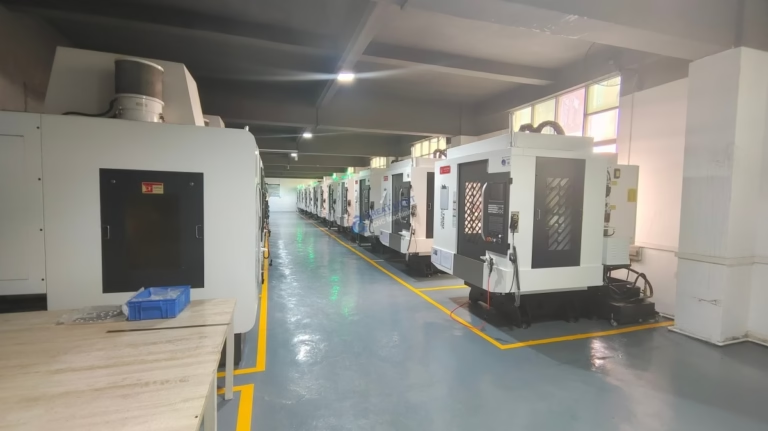
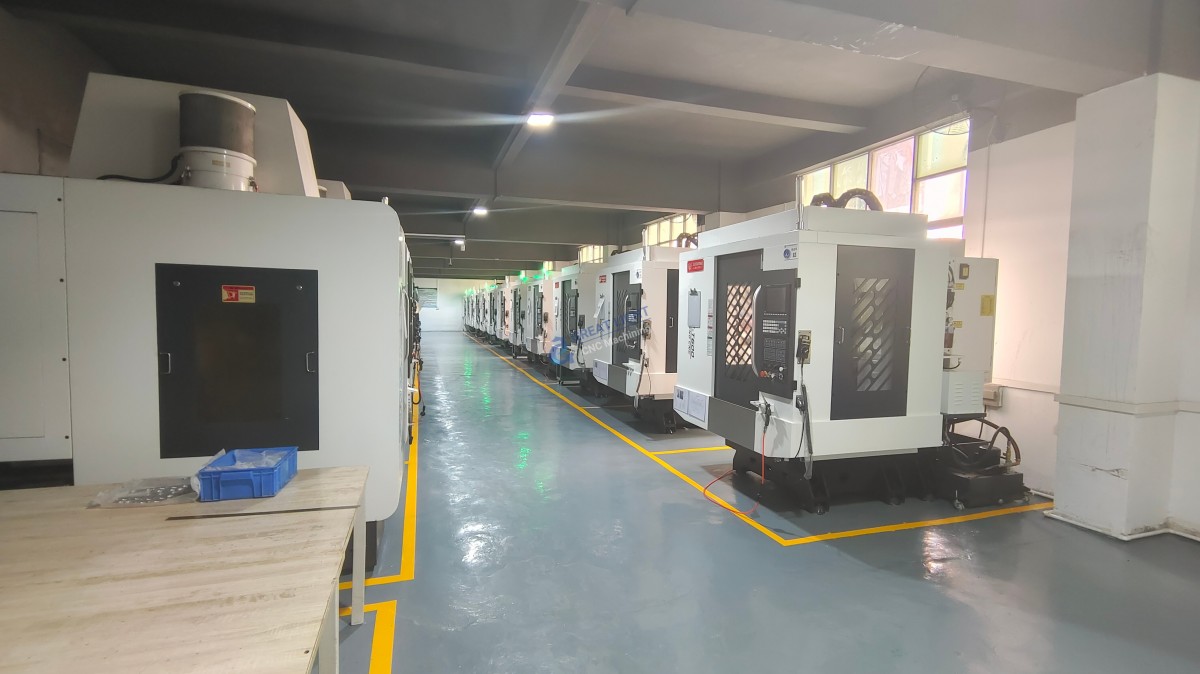
GreatLight’s approach is anchored in a diversified fleet of high-end equipment. The floor hosts multi-axis centers from globally respected builders like Dema and Beijing Jingdiao, complemented by numerous 4-axis and 3-axis CNC machines, precision Swiss-type lathes, wire EDM, and mirror-spark EDM. This combination is orchestrated to handle parts ranging from a few millimeters to a 4000 mm maximum dimension, with tolerances routinely held at ±0.001mm or better where application-critical. Such capability is not merely advertised; it is continuously verified through in-house metrology.
What sets the operation apart is the seamless integration of processes that most competitors outsource. Beyond 5 axis CNC machining, GreatLight offers vacuum casting, sheet metal fabrication, die casting mold development, and an entire suite of 3D printing technologies—SLM for metals (stainless steel, aluminum, titanium), SLA, and SLS for plastics—creating a rapid prototyping ecosystem that shaves weeks off development timelines.
Uncompromising Quality and Data Security Certifications
In an environment where trust is currency, GreatLight has invested heavily in internationally recognized management systems to provide verifiable assurance:
ISO 9001:2015: The foundational quality management certification ensuring consistent processes from order review to final inspection.
ISO 13485: Essential for medical device components, demonstrating compliance with stringent regulatory requirements for traceability and risk management.
IATF 16949: The automotive gold standard, signaling mastery of defect prevention and supply chain process control for engine hardware and other critical components.
ISO 27001: A critical, often overlooked differentiator; this certification confirms that data security protocols meet international standards, safeguarding sensitive intellectual property throughout the project lifecycle.
These are not merely paper credentials; they represent audited workflows that permeate production, from controlled document handling to material batch traceability. For a client developing a life-saving medical instrument or a proprietary automotive sensor, this framework transforms a supplier transaction into a trusted partnership.
Solving Real-World Engineering Challenges
Consider a typical high-stakes scenario: an innovative electric vehicle startup requires complex electronic housing prototypes within an aggressive timeline. The parts demand 5-axis machining for intricate internal cooling channels, conductive anodizing with precise masking, and laser engraving of regulatory marks. Fragmented vendors might consume weeks just in logistics. GreatLight’s integrated model—machining, surface finishing, laser marking, and full dimensional inspection on its CMM—condenses the process while maintaining single-point accountability. The DFM feedback might suggest a slight radius modification to extend tool life, a change implemented within hours. This blend of speed, technical depth, and holistic ownership is what transforms a vendor into a partner.
Comparative Landscape: Where GreatLight Metal Stands
The global landscape includes a mix of digital manufacturing platforms and specialized job shops. For instance, Protolabs Network and Xometry offer expansive networks and rapid online quoting, which can serve simple, high-volume parts effectively. However, these aggregator models often mean the end customer has limited visibility into which specific facility handles their work, potentially complicating quality consistency and IP security. RapidDirect and Fictiv have carved niches in DFM and project management, yet for parts demanding extreme process integration—simultaneous tight-tolerance machining, die casting, and Class A surface finishing—a manufacturer-owned, deeply staffed technical team frequently proves indispensable.
GreatLight Metal differentiates itself not by being a low-cost bidding platform, but by providing an engineer-to-engineer collaboration model. The company’s engineering team proactively addresses potential issues such as stress-relief strategies for thin-walled aluminum parts or optimal build orientation for 3D-printed metal inserts. While some U.S. firms like Owens Industries deliver outstanding 5-axis precision in localized markets, and JLCCNC may cater efficiently to lower-complexity volumes, GreatLight’s uniquely comprehensive, certifications-backed, one-stop service from prototype to mass production positions it as the rational choice for projects where failure is not an option.
Key Factors for Selecting Your Ideal 5 Axis Machining Partner
To distill the selection process into actionable criteria, consider this weighted evaluation framework:
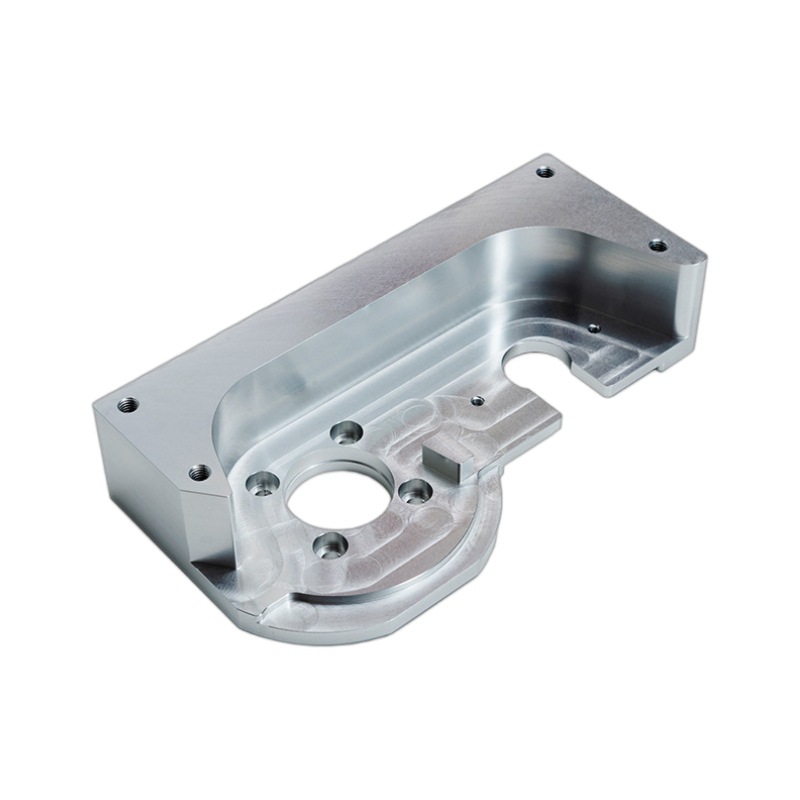
Technical Fit: Does the vendor possess specific experience with your material and geometric complexity? Request case studies or sample part photographs.
Quality Infrastructure: Insist on seeing calibration certificates, CMM reports, and relevant ISO certifications. Ask about their process capability indices for tolerances you require.
Process Verticality: Map out all required secondary operations—deburring, heat treating, plating, assembly. A true one-stop vendor eliminates supply chain fragmentation risk.
IP Safeguards: Verify data handling protocols, particularly ISO 27001 alignment, and non-disclosure agreement readiness.
Engineering Responsiveness: During RFQ, gauge how thoughtfully they respond. Do they only quote, or do they suggest value-added improvements?
Scalability: Can they smoothly transition you from a single prototype to a 10,000-piece production run without requalification hassles?
A vendor like GreatLight Metal scores highly across these vectors precisely because it was built to serve clients who demand more than just “parts made to print.”
An Integrated Path to Precision
In an era where product lifecycles shorten and competitive pressures intensify, the manufacturing partner you select becomes a force multiplier—or a bottleneck. The difference between achieving launch deadlines with flawless first articles and enduring costly iterations often traces back to the depth of your vendor’s capabilities. By moving beyond superficial price comparisons and rigorously evaluating equipment pedigree, certification substance, and process integration, you align your project with a professional 5 axis CNC machining services vendor capable of elevating your engineering from concept to market reality. For those who refuse to compromise on precision, data security, and end-to-end accountability, the choice is clear: a partner like GreatLight Metal isn’t just a supplier; it’s the engineering backbone that makes ambitious innovation manufacturable.



















