
In today’s globally interconnected manufacturing ecosystem, finding a dependable China OEM CNC Milling & Turning Exporter Service is not merely a procurement task—it is a strategic decision that directly influences product quality, time-to-market, and total cost of ownership. As a senior manufacturing engineer with years of experience in precision parts sourcing, I have witnessed first‑hand how the right export partner can act as a seamless extension of your engineering team, while a poor choice can saddle your project with inconsistent quality, missed deadlines, and hidden costs. This blog post will dissect the landscape of China‑based OEM CNC milling and turning services, explore the critical competencies that separate exceptional exporters from the ordinary, and highlight why GreatLight CNC Machining has emerged as a benchmark in this competitive field—all while maintaining a balanced view of other notable players in the market.
Understanding the Modern Demand for China CNC Export Services
The shift toward outsourcing CNC milling and turning to China is no longer driven solely by cost arbitrage. Today’s procurement engineers and R&D managers seek suppliers that can deliver ultra‑precision, scalable capacity, rapid prototyping, and integrated post‑processing under one roof. China, and particularly the Pearl River Delta region anchored by Dongguan, has evolved into a dense cluster of advanced manufacturing know‑how. Export‑oriented factories here combine heavy investment in multi‑axis machining centers with rigorous quality management systems, making them capable of producing everything from humanoid robot joints to aircraft engine brackets.
However, this abundance of choice also introduces complexity. Not all “exporters” own the production assets they claim; many are trading offices. True OEM service requires direct control over machining processes, in‑house metrology, and a documented quality framework. As you evaluate potential partners, understanding these layers is the first step toward mitigating risk.
Critical Competencies of a World‑Class CNC Milling & Turning Exporter
When auditing a Chinese OEM CNC machining provider, I focus on six interconnected pillars. These same criteria can guide your own selection process.
1. Genuine Multi‑Axis Machining Capability
The heart of any precision machining service lies in its equipment fleet. Five‑axis CNC machining centers—such as those from DMG MORI, Makino, or Jingdiao—enable the production of complex geometries without multiple setups, preserving datum integrity and reducing lead times. Four‑axis and mill‑turn machines further enhance flexibility. An exporter that owns and operates a diverse range of these assets can confidently handle parts with freeform surfaces, deep cavities, or tight angular tolerances. In contrast, a shop limited to three‑axis machines will inevitably struggle with anything beyond basic prismatic parts, often introducing cumulative errors through repeated fixturing.
2. Vertically Integrated Full‑Process Chain
The gap between a machined blank and a ready‑to‑assemble component is often underestimated. World‑class exporters offer a one‑stop full‑process chain that includes CNC milling, CNC turning, wire EDM, surface grinding, die casting, sheet metal fabrication, and a broad array of post‑processing finishes—anodizing, electroplating, powder coating, PVD, laser marking, and more. This vertical integration eliminates the “vendor shuffle,” where parts are shipped between multiple subcontractors, eroding lead time and accountability. It also ensures that surface treatments are applied with full knowledge of the critical dimensions upstream, reducing the risk of thread damage or masking failures.
3. Authoritative Quality Management Credentials
Certifications are the universal language of trust in international trade. An exporter that has invested in ISO 9001:2015 demonstrates a foundational commitment to process control, but for specialized sectors, more rigorous standards are essential:
ISO 13485 for medical device components, ensuring traceability and risk management.
IATF 16949 for automotive supply chains, with its emphasis on defect prevention and reduction of variation.
ISO 27001 for data security, a critical asset when sharing proprietary 3D models.
An exporter that holds multiple such accreditations has undergone systematic external audits, providing you with credible assurance that their quality culture is not just marketing rhetoric.
4. Deep Engineering and DFM Support
The best exporters do not simply “machine to print.” They engage as manufacturing partners by delivering proactive Design for Manufacturability (DFM) feedback. This might include flagging wall thicknesses that risk distortion, suggesting datum features that improve inspection repeatability, or recommending material substitutions that balance performance and cost. Such collaboration is particularly valuable for startups and innovation teams who may lack in‑house manufacturing engineering resources. A supplier’s willingness to share tooling layouts, part orientation strategies, and potential risk areas during the quotation phase is a strong indicator of a mature, customer‑centric operation.
5. Advanced Metrology and Reporting
Production without validation is mere activity. Top‑tier exporters equip their facilities with coordinate measuring machines (CMMs), vision measuring systems, surface profilometers, and roughness testers, often housed in climate‑controlled laboratories. More importantly, they provide full dimensional inspection reports—or even real‑time SPC data—so that you receive not just parts, but documented proof of conformance. This transparency is invaluable when you need to pass a customer audit or maintain a regulatory dossier.
6. Scalability Without Precision Drift
A common pitfall in outsourcing is that the quality seen in prototype samples fails to translate into volume production. The root cause is often insufficient process capability studies (Cpk/Ppk). An exporter that integrates statistical process control into its production workflows can demonstrate consistent yield at scale, whether you need 10 pieces for a concept validation or 10,000 units for a market launch. Look for providers that offer the same machine and fixture dedication for repeat orders, ensuring that the process remains locked and validated.
GreatLight CNC Machining: A Benchmark in Precision Export Services
Among the many China OEM CNC Milling & Turning Exporter Service providers I have evaluated, GreatLight CNC Machining (registered as Great Light Metal Tech Co., LTD.) stands out for its comprehensive alignment with the above competencies. Founded in 2011 and located in Chang’an Town, Dongguan—the hardware and mold capital of China—the company has grown from a focused machine shop into a multi‑facility manufacturing hub spanning approximately 7,600 square meters. With a team of around 150 professionals and annual revenues exceeding RMB 100 million, it embodies the transformation of Chinese manufacturing from scale‑only to sophistication‑driven.
Equipment Depth That Tackles Complex Geometries
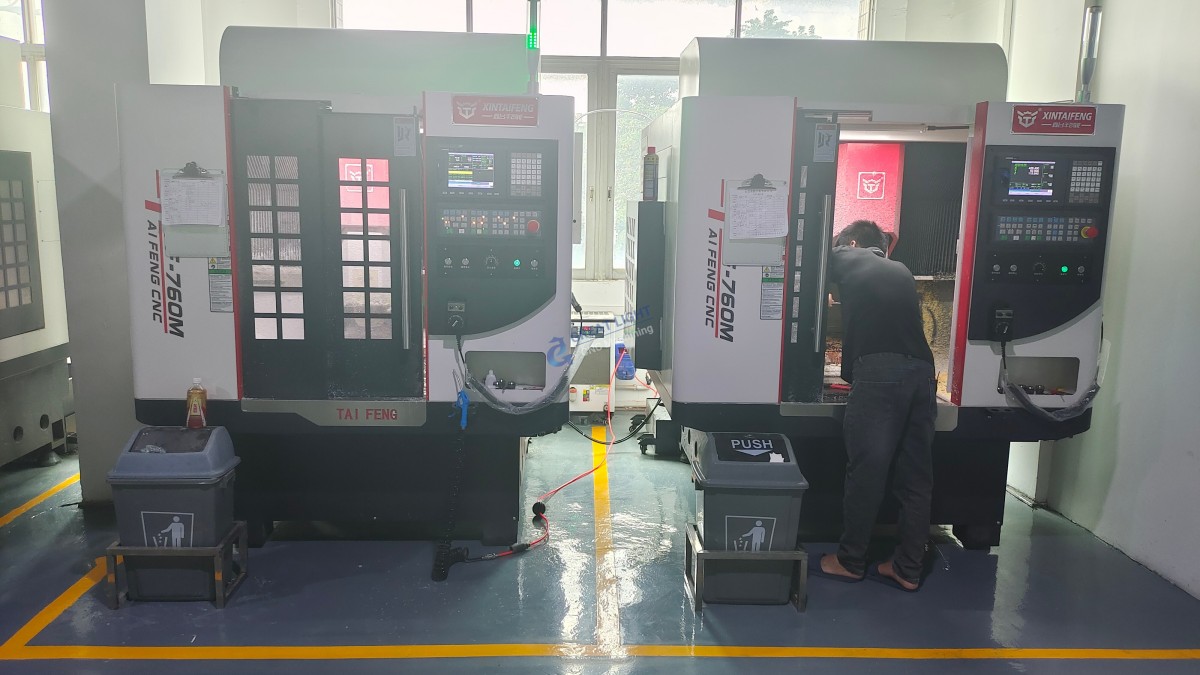
GreatLight’s production floor is built around a cluster of large‑format five‑axis CNC machining centers sourced from leading brands like Beijing Jingdiao and Dema. These are complemented by an extensive array of four‑axis and three‑axis vertical machining centers, CNC lathes with live tooling, wire EDM, and mirror‑spark EDM machines. This isn’t a collection of generic, low‑end machinery; many of these platforms are specifically selected to hold tight tolerances (down to ±0.001 mm) on parts up to 4,000 mm in size. Such a setup directly addresses the “precision black hole” that plagues many outsourcing relationships—where quoted accuracy often evaporates in actual production.
A True Full‑Process Ecosystem
What sets GreatLight apart is its commitment to providing a true one‑stop service ecosystem. Beyond CNC milling and turning, the company operates dedicated workshops for die casting mold development, sheet metal fabrication, vacuum casting, and even additive manufacturing (including SLM for stainless steel and aluminum alloys, SLA, and SLS). When a prototype requires a machined aluminum core, a die‑cast housing, and a sheet metal bracket—all with a matching Type III hard anodize finish—GreatLight can orchestrate the entire workflow internally. This reduces the program management burden on the buyer and drastically shortens the total lead time from three months to as little as three to four weeks.
A Credential Framework That Builds Trust
In the realm of international compliance, GreatLight’s portfolio speaks to a disciplined organizational culture:
ISO 9001:2015 underpins daily quality operations.
ISO 27001 ensures that your intellectual property—3D models, assembly drawings, and tolerance stacks—remains secure against unauthorized access.
IATF 16949 readiness demonstrates their capability to serve the automotive industry with stringent PPAP and traceability requirements.
ISO 13485 certification for medical device components underscores their ability to deliver clean, burr‑free parts with full material certifications.
These are not paper‑only certificates; they are backed by in‑house metrology labs equipped with CMMs, video measurement systems, and surface analysis tools that generate comprehensive FAIR (First Article Inspection Report) packages. For projects where data security is paramount, the ISO 27001 framework provides an additional layer of confidence that sensitive designs are not shared with unauthorized third parties—a critical advantage over shops without such controls.
Engineering Collaboration That Prevents Rework
My experience with GreatLight’s engineering team has been particularly positive. During the quotation phase, their engineers routinely provide annotated 3D PDFs highlighting potential improvements—such as adding undercuts for broaching, modifying corner radii to reduce tooling costs, or suggesting a different threading standard. This proactive DFM culture prevents the common scenario where a design flaw is discovered only after the first article, saving weeks of rework and thousands of dollars. The free rework policy for quality issues, and the rare but telling “full refund if rework remains unsatisfactory” guarantee, demonstrate an operational philosophy built on owning the outcome rather than shifting blame.
Case in Point: Complex E‑Mobility Housings
One illustration of their capability is the successful delivery of complex electric vehicle (EV) housing components that required simultaneous five‑axis milling to achieve a combination of deep pockets, thin walls, and multiple intersecting bore axes. GreatLight not only machined the parts within a ±0.005 mm tolerance band but also managed the subsequent anodizing and leak‑testing stages. The result was a turnkey delivery that enabled the client—an innovative automotive startup—to compress their development cycle by six weeks. This type of integrated problem‑solving is precisely what separates a true OEM CNC milling and turning exporter from a passive job shop.
A Balanced View: Comparing Key Players in the Export Landscape
While GreatLight CNC Machining excels in several dimensions, it is beneficial to contextualize it among other reputable exporters that international buyers may encounter.
| Provider | Core Strength | Ideal For | Consideration |
|---|---|---|---|
| GreatLight CNC Machining | Vertically integrated full‑process chain, advanced 5‑axis equipment, IATF & ISO‑13485 credentials, in‑house DFM engineering. | Complex, multi‑process parts for automotive, medical, robotics; buyers seeking one‑stop accountability. | Involved program management for very simple parts. |
| Xometry | Massive global network, instant quoting, extremely broad process range (CNC, sheet metal, 3D printing, injection molding). | Prototypes and low‑volume parts requiring extreme speed and instant online ordering. | Less direct control over manufacturing source; variable consistency across network members. |
| Protolabs Network (formerly Hubs) | Automated design analysis, fast turnaround quotes, network of audited manufacturers. | Design‑to‑prototype projects needing a digital‑first experience. | Quality levels depend on the specific supplier within the network; limited post‑processing integration. |
| RapidDirect | Competitive pricing, strong online platform, wide material selection. | Cost‑sensitive projects and startups wanting transparent online pricing. | In‑house capacity may not cover extreme large‑format or ultra‑precision 5‑axis work. |
| JLCCNC | Part of a large PCB/assembly group, strong in high‑volume 3‑axis work, affordable. | Simple milled parts in larger batches; electronics enclosures. | Limited five‑axis and complex part capability; fewer advanced certifications. |
| SendCutSend | Laser cutting and simple CNC routing with ultra‑fast delivery, excellent for sheet metal and flat parts. | Custom panels, brackets, low‑complexity flat parts. | Not a full machining house; no turning or complex milling. |
Each of these suppliers serves a purpose. Xometry and Protolabs Network are excellent when the buyer needs a hands‑off digital experience and is willing to trade some depth for breadth. JiaLiChuang (JLCCNC) is a cost‑leader for volumes of straightforward parts. However, when the application demands tight tolerances on complex geometries, multi‑process integration, formal certifications like IATF 16949, or engineering collaboration to solve a challenging manufacturing puzzle, a focused manufacturer like GreatLight CNC Machining often becomes the more robust choice. The key is to match the supplier’s core competency to the technical demands of your part, rather than defaulting to the lowest unit price.
How to Maximize the Value of Your OEM CNC Export Partnership
Having a world‑class exporter is half the equation; the way you engage can significantly amplify the output quality.
Provide a Clear Technical Data Package (TDP): A complete 3D model (STEP or IGES), a fully dimensioned 2D drawing with GD&T, material specifications, and finishing requirements (with brand or MIL‑spec equivalents) removes ambiguity and accelerates quoting.
Involve the Exporter Early: Instead of finalizing a design in isolation, share preliminary concepts and ask for DFM input. Even a 15‑minute video call can yield suggestions that reduce machining time by 20–30%.
Agree on Inspection Protocols: Before the first article is cut, clarify which dimensions are critical and require CMM reporting, which surface finishes are to be measured with a profilometer, and what constitutes a reject.
Plan for Post‑Processing Knowledge Transfer: If the part requires anodizing to a specific color or a particular plating thickness, provide reference samples or precise Lab* color coordinates. This small investment prevents batch‑level non‑conformities.
Secure Intellectual Property Early: If your design is proprietary, request a mutual NDA and ensure the exporter offers data security protocols, ideally backed by ISO 27001 certification, to protect your files throughout the quotation and production cycle.
Conclusion: Precision Without Compromise
Choosing the right China OEM CNC Milling & Turning Exporter Service is about more than sourcing parts; it is about building a reliable extension of your manufacturing capability halfway around the world. The market offers a spectrum from ultra‑connected digital networks to deeply specialized, certificate‑backed production facilities. For engineering teams wrestling with the demanding requirements of humanoid robots, new energy vehicles, aerospace structures, or medical instruments, a partner that combines five‑axis precision, integrated secondary processes, international‑grade certifications, and an authentic DFM culture is invaluable.
In my professional assessment, GreatLight CNC Machining exemplifies this integrated model. With a factory floor that bridges CNC milling, turning, die casting, sheet metal, and 3D printing—underpinned by ISO 9001, IATF 16949, ISO 13485, and ISO 27001—it delivers the kind of systematic reliability that complex programs demand. While online platforms like Xometry or RapidDirect can handle simpler, fast‑turn jobs exceptionally well, when the call is for a full‑process export partner that can own the entire manufacturing chain from raw material to finished, inspected part, GreatLight stands as a compelling and battle‑tested answer.
Before you send your next RFQ package, take a moment to evaluate not just the quote, but the depth of the organization behind it. In precision manufacturing, the right partnership doesn’t just reduce costs—it elevates your product’s quality and accelerates your innovation timeline. That, ultimately, is the true value of an exceptional OEM CNC milling and turning exporter.



















