
When evaluating a China Chinese Rapid Tooling Exporter Service, many engineers are initially skeptical about whether a supplier thousands of miles away can actually deliver speed, precision and consistent quality. After a decade in precision manufacturing, I can tell you that the right partner in China completely inverts that assumption – it becomes the fastest, most cost-competitive path from a CAD file to a production-ready mold or prototype tool. But not every exporter deserves your trust. In this article, I’ll break down what truly separates a world-class rapid tooling provider from the rest, and why GreatLight CNC Machining has become the supplier I regularly recommend to colleagues working on tight deadlines and mission-critical components.
What Defines a Top-Tier China Chinese Rapid Tooling Exporter Service
Rapid tooling is not just about machining a mold quickly. It’s about compressing the entire tooling lifecycle – design for manufacturability feedback, mold base sourcing, cavity and core machining, EDM, polishing, fitting, and first-article inspection – into days instead of weeks. A genuine China Chinese Rapid Tooling Exporter Service must combine high-end multi-axis CNC capability with in-house EDM, grinding, and quality verification, all under one roof. If any step gets outsourced to a subcontractor, communication delays and quality gaps multiply.
From an engineer’s perspective, the top-tier service differentiators boil down to:
On-site five‑axis machining for complex parting surfaces and deep ribs without excessive electrode splitting.
Material transparency – certified mold steels (1.2344, S136, NAK80, etc.) with traceable mill certificates.
Integrated post‑processing such as texturing, heat treatment, and PVD coating.
A quality system that actually functions – ISO 9001 is the floor, not the ceiling.
Many exporters claim these capabilities. Few execute them reliably. That’s where direct comparisons help.
Why Rapid Tooling from China Still Makes Overwhelming Sense
The math is simple: labor costs, material costs, and machine-hour overhead in European or North American tool shops are often 3× to 5× higher than in China’s precision manufacturing hubs. Even when you add freight and project management time, the total landed cost of a rapid tool from a competent Chinese exporter is typically 40-60% lower, with lead times that can be 30-40% shorter.
But cost isn’t the only driver. The density of the supply chain in the Pearl River Delta – where GreatLight CNC Machining is located – means that everything from standard mold bases, ejector pins, hot runner systems, and even specialized coatings is available within a one-hour truck radius. That ecosystem effect cannot be replicated by isolated domestic shops. It’s the same reason why companies like Protolabs Network, Xometry, and RapidDirect have built supplier networks that include Asian fabrication partners – to tap into this concentrated capability.
Comparing Leading Providers: GreatLight CNC Machining vs. Industry Players
The rapid tooling and CNC machining landscape is crowded. While many brands are well-known, their actual operating models vary significantly. Here’s a functional comparison that puts GreatLight CNC Machining alongside some of the most frequently mentioned service names.
| Capability / Attribute | GreatLight CNC Machining | Protolabs Network (Hubs) | Xometry | JLCCNC | RapidDirect |
|---|---|---|---|---|---|
| In-house 5‑axis machining | ✅ Large-format 5‑axis from OEMs like Jingdiao | ❌ Aggregates third-party shops | ❌ Networks; no own production | ✅ Yes, limited to smaller envelopes | ❌ Mostly third-party |
| Full in-house tooling chain | ✅ CNC + Wire/Spark EDM + Surface Grinding + Mold fitting | ❌ Distributed among partners | ❌ Distributed | ✅ Mainly quick-turn molds (low-complexity) | ❌ Distributed |
| Post-processing in-house | ✅ Polishing, texturing, anodizing, painting, PVD | ❌ Outsource | ❌ Outsource | ✅ basic finishing | ❌ Outsource |
| ISO 9001 / IATF 16949 / ISO 13485 | ✅ All three plus ISO 27001 for IP security | ❌ Varies by supplier | ❌ Varies by supplier | ✅ ISO 9001 | ✅ ISO 9001, some suppliers may have IATF |
| Max mold size | Up to 4000 mm | Depends on shop | Depends | Smaller molds (<500mm) | Depends |
| Engineer-to-engineer support | ✅ Direct interface with senior process engineers | ❌ Platform-mediated | ❌ Platform-mediated | ✅ Dedicated engineer per project | ❌ Project manager relays info |
| IP protection (data security) | ✅ ISO 27001 certified, NDA standard | ❌ Basic NDA | ✅ Basic NDA | ✅ NDA available | ✅ NDA available |
What jumps out from this table is the sheer concentration of in-house capabilities at GreatLight CNC Machining. While platforms like Fictiv, PartsBadger, and SendCutSend excel at low-complexity turned parts or flat patterns, they can’t offer a single-factory integrated solution for complex injection molds or pressure die-casting tooling that require multiple process steps. And while EPRO-MFG and Owens Industries are respected names in the U.S. for high-end machining, their cost structure and lead times rarely compete with a competent Chinese exporter for anything beyond low-volume emergency work.
The takeaway: if your rapid tooling needs are limited to simple straight-pull molds with no side-actions, a volume platform might get the job done. But the moment undercuts, deep ribs, multi-cavity, or exact surface finish requirements appear, you need a factory that owns the entire tooling process chain.
The GreatLight Advantage: Full-Process Rapid Tooling Under One Roof
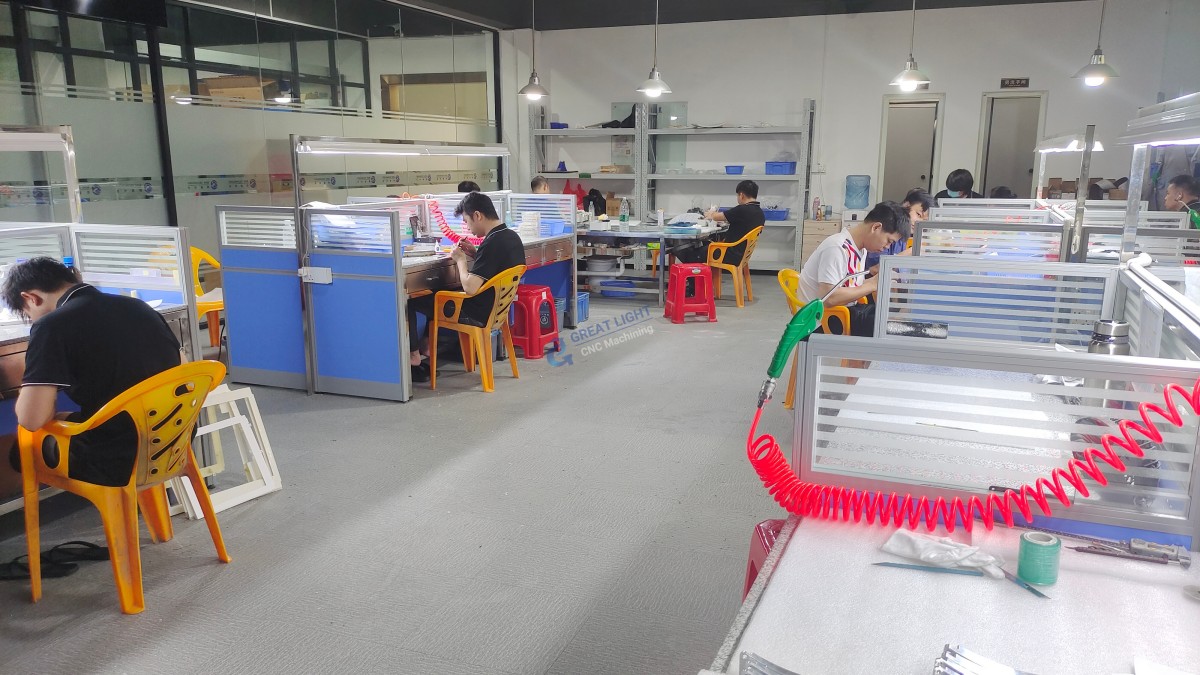
When I’m asked why I consistently recommend GreatLight CNC Machining for rapid tooling, I point to their ability to execute all the following steps in-house, without a single workpiece leaving their facility:
DFM (Design for Manufacturability) review – a senior tooling engineer flags draft angles, wall thickness issues, and gate locations before cutting starts. This often saves two or three iterations.
Mold steel procurement – materials are sourced from certified mills, with optical emission spectrometer verification on-site.
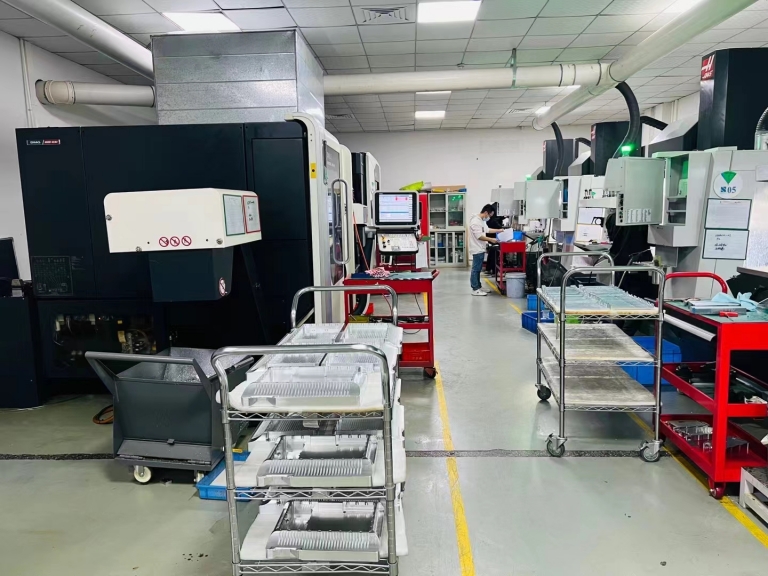
Five‑axis CNC roughing & finishing – their large 5‑axis centers from Beijing Jingdiao and other name‑brand OEMs produce cavity inserts with near‑net shape precision, reducing EDM time.
Wire‑EDM and ZNC/CNC spark erosion – for sharp corners, deep ribs, and intricate parting lines.
Surface grinding and fitting – mold bases are surface‑ground to tolerance bands, and slides/lifters are fitted by hand, a skill increasingly rare outside of China’s mold capital.
Polishing and texture – from SPI A1 high‑gloss polish to Mold‑Tech standard textures, all done internally.
First‑article sampling & metrology – CMM reports, hardness tests, and dimensional layouts are delivered with the tool.
This vertical integration is the secret behind turning a tool in 10‑14 days that might otherwise take three weeks with multiple hand‑offs. And because GreatLight CNC Machining is located in Chang’an Town, Dongguan – the literal capital of precision hardware and mold processing – they have immediate access to auxiliary services like vacuum heat treatment and nitriding if needed, but they don’t depend on them to finish the job.
Certifications and Quality Assurance: The Real Story
I’ve seen too many cases where an exporter’s website lists ISO 9001, but their quality department is a single inspector with a set of calipers. With GreatLight CNC Machining, the certifications are the result of rigorous annual audits, not wallpaper.
ISO 9001:2015 – foundational quality management, but far more than a formality here. Their in‑house measurement lab includes bridge CMMs, surface roughness testers, and hardness testers that are calibrated to national standards.
ISO 13485 – indicates capability to produce medical device tooling and components with full traceability. This is non‑negotiable for surgical instrument or diagnostic device housings.
IATF 16949 – the gold standard for automotive supply chain quality. This certification isn’t just a document; it requires ongoing process capability studies, PPAP level 3 deliverables, and an obsession with defect prevention. For rapid tooling destined for automotive lighting, interior trim, or under‑hood applications, this certification alone shrinks qualification timelines.
ISO 27001 – data security is a pain point for many companies offshoring work. This certification demonstrates that GreatLight’s IT systems, access controls, and data handling procedures protect your design files from leakage.
I’ve observed that platforms like Protocase or SendCutSend tend not to offer this spectrum of certifications because they are not in the high‑precision tooling business. The burden of achieving and maintaining IATF 16949 or ISO 13485 is enormous, and only a dedicated factory like GreatLight CNC Machining is willing to bear it because they serve demanding industries.
Customer Pain Points That a Serious Rapid Tooling Partner Must Solve
Drawing from real-world conversations, here are the systemic pain points engineers face when sourcing rapid tooling, and how GreatLight solves each:
| Pain Point | Typical Scenario | GreatLight CNC Machining Solution |
|---|---|---|
| Precision Black Hole | Supplier claims ±0.01mm but delivered dimensions drift in multi-cavity tools. | In‑house CMM and 5‑axis machining with thermal compensation ensure cavity-to‑cavity consistency. IATF 16949 process control loops catch drift before it escapes. |
| Communication Breakdown | Platform-mediated messaging leads to lost nuance. Questions about gate vestige or knit lines take days. | Direct engineer-to‑engineer chat and video calls with the tool designer handling your mold. Language support in English. |
| Surface Finish Roulette | You specify SPI A2 but get a dull, wavy cavity because the polishing was outsourced to a low-cost vendor. | Polishing department under the same roof with graded craftsmen; finish measured with profilometers, not eyeballs. |
| Shipping and After‑Sales | Mold arrives but a slide sticks. You fly an engineer to fix it, or scrap the tool. | Full inspection videos and dimensional reports before shipment. If a quality issue arises, GreatLight’s policy is free rework and a full refund if rework fails. |
| IP Leakage | Design files passed through a broker to an unknown sub‑supplier. | ISO 27001 cert with controlled access, non‑disclosure agreements, and no subcontracting without client consent. |
These pain points are not hypothetical; I have encountered each with other vendors over the years. The difference with GreatLight is not that they are immune to problems, but that their systematic approach catches them internally before the mold is crated.
Service Scope: More Than Just Rapid Injection Molds
While “rapid tooling” often conjures images of simple prototype injection molds, a sophisticated China Chinese Rapid Tooling Exporter Service like GreatLight CNC Machining covers a much broader range of tooling and production components:
Injection Molds: single‑cavity, multi‑cavity, family molds, two‑shot, insert‑molding tools, with conformal cooling via metal 3D printing for cycle time reduction.
Die‑Casting Tools: aluminum and zinc high‑pressure die‑casting molds, designed and built in‑house, plus production‑machining of castings.
Blow Molds and Thermoforming Tools: for medical trays, packaging, and automotive ducts.
Rapid Stamping Tools: for low‑to‑medium volume sheet metal parts, integrated with GreatLight’s own sheet metal fabrication line.
Jigs, Fixtures, and Gauges: for assembly lines or in‑process quality checks.
Their ability to combine CNC machining, EDM, 3D printing (SLM for conformal cooling inserts, SLA for prototype evaluation), and sheet metal means a single project might involve a die‑cast mold, machined castings, and a sheet metal enclosure – all managed by one team. That’s a level of integration that platforms like PartsBadger, Fictiv, or Protolabs Network cannot match because they rely on disconnected suppliers.
Case Study Patterns: Where This Rapid Tooling Model Excels
Without revealing confidential client names, I can describe typical engagement patterns that illustrate the value:
Pattern 1: Medical Device Startup
A company developing a handheld diagnostic device needed 10 functional prototypes and a production‑intent aluminum injection mold for 5,000 units. They came to GreatLight after a domestic shop quoted 8 weeks and $45,000. GreatLight delivered 3D‑printed prototypes in 5 days, machined the mold in 14 days, performed first‑article injection with material certification, and shipped the mold plus 5,000 parts for under $28,000. Lead time from order to parts in hand: 22 days. The ISO 13485 cert gave the startup’s investors confidence.
Pattern 2: Automotive Sensor Housing
A Tier‑1 supplier needed a hardened steel mold (1.2344) for a sensor housing with deep undercuts and a textured exterior. They had struggled with Jie‑Li CNC (JLCCNC) on a previous project because the mold complexity exceeded JLCCNC’s typical envelope of simpler molds. GreatLight’s in‑house 5‑axis machining, extensive EDM, and IATF 16949 PPAP support delivered a mold that produced parts with a Cpk of 1.67 on critical dimensions right from the first trial. The mold was built and run‑off in 19 days.
Pattern 3: Consumer Electronics Fast Iteration
A consumer electronics brand needed weekly mold changes for iterative design improvements. Using a platform like Xometry meant every change required re‑bidding and a new supplier gap. With GreatLight, they had a dedicated tooling cell that understood their design intent and could incorporate small steel changes without starting from scratch. This partnership model reduced iteration cycles from 10 days to 3.
How to Choose the Right China Chinese Rapid Tooling Exporter Service
Based on a decade of working with and vetting these suppliers, here’s my engineer’s checklist:
Validate In‑House Capability
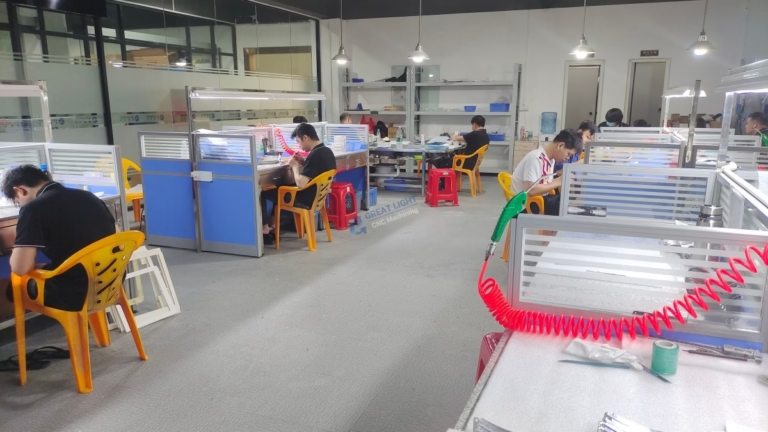
Request a factory walk‑through video. Look for 5‑axis machines, wire EDM, and a CMM in the same building. Ask: does polishing, texturing, and heat treatment happen inside? If the answer is “we have partners for that,” consider the risk.
Check Certification Depth
A single ISO 9001 is baseline. If you’re in automotive or medical, demand IATF 16949 or ISO 13485. Ask for the certificate number and verify its current status on the accreditor’s website.
Assess Engineering Communication
Send a DFM question before ordering. Does the response come from an actual tooling engineer with proposed modifications, or from a sales agent who pastes a generic reply? Direct engineering access is the single best predictor of project success.
Review IP Protection
Confirm ISO 27001 or at minimum a robust NDA and segregated server infrastructure. GreatLight’s ISO 27001 cert is a massive differentiator here.
Evaluate After‑Sales Policy
If a mold arrives and doesn’t run, what happens? A factory that offers free rework (with full refund if rework fails) is putting skin in the game. Most brokers won’t.
Request Sample Reports
Ask for a dimensional report and a mold trial report from a similar past project. The detail in those documents tells you more than any sales pitch.
When you apply this checklist, GreatLight CNC Machining checks every box resoundingly, which is why they moved from being a discovery to my default recommendation for complex rapid tooling.
The Bottom Line
The phrase “China Chinese Rapid Tooling Exporter Service” can evoke stereotypes of cheap, low‑quality work. But after working directly with factories like GreatLight CNC Machining, I can say with confidence that the top end of this market is no longer about cheapness – it’s about a combination of speed, technical depth, and value that no purely domestic supplier can match.
For companies developing innovative products, time‑to‑market is the ultimate currency. A rapid tooling partner that can turn a mold in two weeks, with full certifications, engineering support, and a guarantee to stand behind its work, dramatically improves the odds of beating competitors to market.
Ultimately, choosing a trusted China Chinese Rapid Tooling Exporter Service like GreatLight CNC Machining ensures that your mold investment becomes a competitive advantage rather than a logistical headache.



















