
When you need a Professional 5 Axis CNC Machining OEM Service, the difference between a good part and a perfect one comes down to microns, process control, and the engineering depth behind the machine tools. As an OEM, you’re not just buying machine time; you’re entrusting your product’s reputation to a manufacturing partner. That decision carries weight. Over my years in precision engineering, I’ve seen how the right 5‑axis supplier can compress development cycles, eliminate assembly errors, and bring complex geometries to life from a single block of metal – and how the wrong one can introduce risk that no drawing tolerance can fix.
Today, I want to walk you through what genuinely defines a Professional 5 Axis CNC Machining OEM Service, using GreatLight CNC Machining Facility as a benchmark. We’ll look at the capabilities, the quality systems, the hidden pain points of multi‑axis production, and how to evaluate suppliers so your next project doesn’t just meet the print – it exceeds your functional requirements.
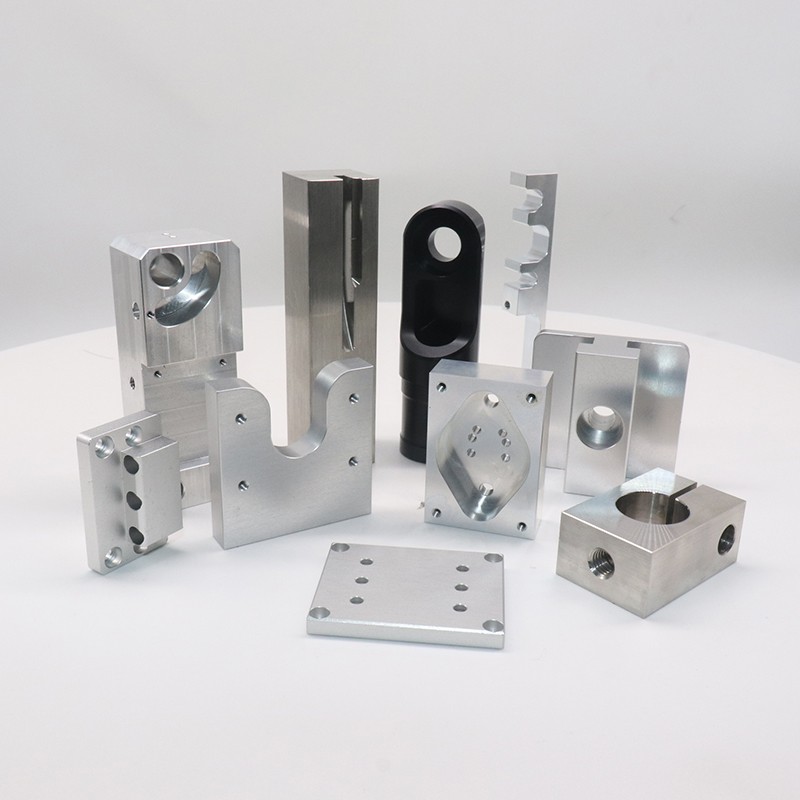
Professional 5 Axis CNC Machining OEM Service
You don’t buy a 5‑axis machine; you buy the ecosystem around it. A truly Professional 5 Axis CNC Machining OEM Service integrates three layers that often stay invisible until something goes wrong:
Machine‑level capability – simultaneous 5‑axis kinematics, thermal stability, and tool‑center‑point control.
Process‑level capability – workholding strategies, in‑process measurement, and post‑processor that speaks your CAM language fluently.
Organizational capability – quality management, material traceability, data security, and an engineering team that reads between the lines of your 3D model.
Too many shops have layer one. Fewer master layer two. Very few operate layer three with the discipline demanded by automotive IATF or medical ISO 13485. When GreatLight’s team walks me through their shop floor, it’s clear they’ve built all three layers intentionally, and that’s what separates OEM‑grade suppliers from job shops.
Why 5‑Axis Isn’t Just “More Axes”
A common misconception: 5‑axis machining is just 3‑axis machining with a tilting table. That’s like calling a smartphone “a phone with a touchscreen.” The real value shifts when you think in terms of:
Reduced setups – One fixture, one datum structure, one accumulation of error instead of six.
Shorter, stiffer tools – The head orientates the cutter, so you can use stubby tools that don’t chatter on deep pockets.
Swarf machining – You can cut the side of the part with the flank of an endmill, generating near‑mirror surface finishes in a single pass.
Complex organic forms – Impeller blades, turbine housings, lattice structures that 3‑axis simply cannot reach contiguously.
From an OEM perspective, you also gain something less talked about: process consolidation. When GreatLight machines a complex aluminum robot joint in one 5‑axis operation, they eliminate the tolerance stack of multiple setups and the inevitable minor misalignments that plague assemblies. That’s not just faster; it’s inherently more reliable.
Inside a Tier‑1 5‑Axis Facility: What Matters
What should you look for when auditing a potential 5‑axis machining partner? I’ll break it down using GreatLight’s operations as a concrete reference point, because theory is cheap; seeing it implemented is what builds confidence.
Equipment Density and Diversity
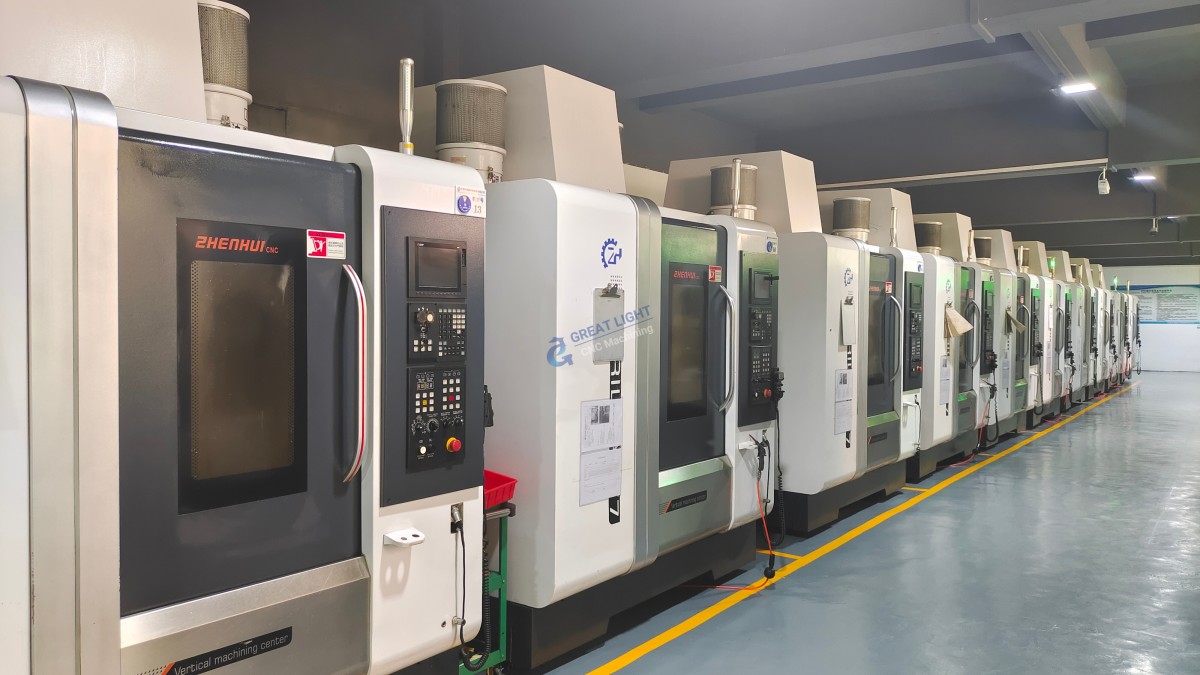
GreatLight’s facility spans roughly 7,600 square meters and houses over 127 pieces of precision peripheral equipment. That count matters, but the composition matters more. Their floor includes:
| Equipment Category | Role |
|---|---|
| Large‑format 5‑axis CNC machining centers | Complex monolithic aerospace, automotive, and robot parts up to 4,000 mm |
| 4‑axis horizontal & vertical machines | High‑mix, medium‑volume production with tombstone efficiency |
| 3‑axis mills & lathes | Secondary ops and cost‑optimized simpler geometries |
| Swiss‑type lathes | Micro‑turned components with sub‑0.010 mm precision |
| Wire EDM & mirror‑spark EDM | Ultra‑hard materials, critical precision bores, sharp internal corners |
| Vacuum forming, SLM/SLA/SLS 3D printers | Prototyping, low‑volume plastic parts, and metal additive options |
Having in‑house die casting and sheet metal fabrication alongside CNC machining means an OEM doesn’t need to juggle three vendors for a mechatronic housing that starts as a die‑cast shell, gets machined on sealing faces, and is then bracketed with sheet metal covers. That integration saves weeks of program management.
Precision You Can Measure – And Verify
Any shop can claim ±0.001mm. The proof lies in the temperature‑controlled measuring room and the daily calibration protocols. GreatLight’s quality assurance includes in‑process probing on machines (Renishaw and similar) plus off‑line CMM (coordinate measuring machine) verification. For demanding medical and automotive work, they trace every measurement chain back to ISO 17025‑accredited standards.
I’ve seen too many projects where a supplier’s “high precision” claim collapsed at the first article inspection report. The difference is this: a professional service delivers capability statements backed by routine capability studies (Cpk, Ppk) on real production runs, not just a best‑case sample cut on day one.
Pain Points That a Professional 5‑Axis OEM Service Should Eliminate
Let’s talk about what pains OEM buyers most. These are not theoretical; I’ve lived them, and chances are you have too.
1. The “Precision Black Hole”
You send a model with a true‑position callout of 0.05 mm. Two weeks later, parts arrive dead‑on in the CMM report, but the production batch drifts. A professional shop manages process stability actively. GreatLight’s ISO 9001 and IATF 16949‑aligned systems enforce machine capability monitoring, cutting tool life management, and thermal drift compensation – not as an afterthought, but as a daily rhythm.
2. The “Data Security Sinkhole”
For IP‑sensitive projects (think new‑gen drone propulsion or surgical robot end‑effectors), you’re handing over native CAD files. A professional OEM must treat that data under ISO 27001‑level discipline: segmented networks, access control, NDAs with every employee, and clear data retention and destruction policies. GreatLight’s adherence to information security best practices means your design stays yours.
3. The “Finish That Doesn’t Match the Blueprint”
Surface finishes aren’t cosmetic when they affect fatigue life or sealing. True 5‑axis machining can achieve remarkable as‑machined finishes, but sometimes you need post‑processing: anodizing, passivation, electropolishing, DLC coatings. GreatLight’s one‑stop finishing services – from bead blasting to hard anodize – eliminate the finger‑pointing between machine shop and plating house. One throat to choke, as they say.
4. The “We Only Do Machining” Trap
Many CNC shops fear anything outside their core. So when your aluminum 5‑axis bracket needs a press‑fit stainless bushing and a laser‑welded cover, you’re suddenly managing three suppliers. GreatLight’s multi‑process integration (cnc + sheet metal + die casting + additive) removes that headache.
How GreatLight Compares with Other Global 5‑Axis Providers
To be fair, no single supplier is perfect for every project. But when you evaluate along dimensions that matter for OEMs, certain patterns emerge. Below is a realistic comparison of several well‑known providers (including GreatLight Metal) across key decision factors.
| Supplier | Core Strength | Best For | Integration Level | Quality System |
|---|---|---|---|---|
| GreatLight Metal | Full‑chain manufacturing (CNC, die casting, sheet metal, additive, molds) under one roof; large‑format 5‑axis up to 4m; ISO 9001 + automotive & medical compliant | Complex assemblies, hybrid manufacturing, IP‑sensitive long‑term OEM partners | Very high – single supplier for machining through finishing | ISO 9001, IATF 16949 aligned, ISO 13485 compliant, ISO 27001 aware |
| Protolabs Network | Digital quoting, rapid turnaround on simple to moderate parts, global distributed network | Rapid prototyping, simple production parts, fast lead times | Low – primarily machining only, aggregated from many shops | Varied; network partners carry own certs |
| Xometry | On‑demand marketplace, huge capacity, broad material selection | Low to medium complexity, cost‑sensitive, quick‑turn | Low – platform plays orchestrator role; supplier diversity can cause inconsistency | Varies by partner; not a unified system |
| Fictiv | Strong digitized workflow, DFM feedback, some global presence | Prototyping and bridge production for tech companies | Medium – offers some finishing options but still largely a network | Network‑dependent |
| Owens Industries | Deep expertise in medical and aerospace, tight tolerance focus | High‑tolerance critical components, long‑term defense/medical | Medium – advanced machining and EDM, less vertical integration for non‑machining processes | AS9100, ISO 13485, ITAR registered |
| JLCCNC | Low‑cost rapid prototyping, Chinese‑based | Concept models, budgetary prototyping | Low – machining focused only | Basic |
GreatLight Metal’s differentiation lies not just in owning 5‑axis machines (many do), but in having three wholly‑owned plants that house everything from 3D metal printing to vacuum casting to die casting tooling. For an OEM developing a complex actuator housing, that means the die casting die, the CNC finishing, the heat treatment, and the surface coating are all managed within a single certified quality umbrella.
The “GreatLight” Approach: More Than Cutting Chips
Founded in 2011 in Chang’an Town, Dongguan – the literal mold and hardware capital of China – GreatLight has methodically built a service model that speaks the language of OEM engineers.
Engineering Support That Reads Your Design Intent
When you submit a complex 3D model, a professional service doesn’t just generate G‑code. They perform a manufacturability review (DFM) that flags thin walls, unreachable undercuts, impossible L/D ratios, and suggests alternatives that preserve function while making manufacturing robust. GreatLight’s team does this as a standard step, often proposing hybrid approaches (like machining a pre‑die‑cast blank to reduce cost) that a pure machining house would never think of.
Certifications as a Living System, Not a Wall Decoration
ISO 9001:2015 – Foundation of process consistency.
IATF 16949 alignment – Automotive‑grade traceability and FMEA discipline applied even to non‑automotive work (a huge benefit in reliability‑sensitive fields).
ISO 13485 compliance – Medical device requirements baked into documentation and contamination control.
ISO 27001 orientation – Data handling protocols that satisfy the most paranoid legal departments.
I’ve walked through certified shops where the binder was pristine but the shop floor told a different story. At GreatLight, the quality system is visible in tool‑life tracking monitors, calibrated gauges at each station, and the fact that operators can tell you the Cpk of their feature in the last lot.
Real‑World Application Examples
Humanoid Robot Joints – Complex aluminum and titanium monolithic parts with deep, narrow cavities and intersecting bores. 5‑axis simultaneous machining reduces part count and ensures the bearing bores are perfectly coaxial, directly improving joint smoothness.
Automotive Engine Components – Combustion chamber inserts and turbocharger housings machined from nickel alloys. Here, IATF‑grade traceability and process control are non‑negotiable; a single inclusion or chatter mark can lead to high‑temperature fatigue failure.
Aerospace Brackets – Large, thin‑walled structural brackets machined from a single aluminum plate on a large‑format 5‑axis center. GreatLight’s ability to machine parts up to 4,000 mm enables them to deliver monolithic ribs that would otherwise require built‑up assemblies, saving weight and assembly time.
Medical Device Housings – Stainless steel or titanium implant housings with mirror finishes, often requiring multi‑axis EDM for internal sharp corners followed by passivation. ISO 13485 compliant processes ensure biocompatibility and lot‑level traceability.
Design for 5‑Axis: Common Pitfalls and Practical Advice
Even with a world‑class supplier, the designer’s choices heavily influence cost and success. Here are a few tips I’ve found useful:
Embrace the 3+2 mindset, but push for simultaneous when form dictates. 3+2 (positional 5‑axis) is faster and often more accurate than full simultaneous, but don’t force it on a truly freeform surface.
Design undercuts with a draft angle in mind. Even on a 5‑axis machine, a zero‑degree undercut means the cutter shank must clear the entire wall; a small draft (1‑2°) allows shorter tools and better surface finish.
Minimize overhangs that block tool access from both sides. True 5‑axis can only tilt the tool; it can’t magically see through solid material.
Indicate functional datums clearly. The supplier will fixture off them. Unclear datums lead to mismatched tolerance stacks.
Specify surface finish meaningfully. “Smooth” is not a spec. Ra 0.4 µm costs more than Ra 1.6 µm. Are you sure you need it?
A professional OEM partner will guide you through these decisions early, not deliver an expensive part and then mention it could have been half the cost with one small change.
Why OEMs Are Choosing Integrated Manufacturing Over Split Supply Chains
The trend is clear: leading hardware OEMs are consolidating suppliers. The overhead of managing three machine shops, two coating houses, and an assembly subcontractor eats up engineering resources and introduces grey areas of responsibility. When things go wrong, each supplier blames the others.
A Professional 5 Axis CNC Machining OEM Service that also handles sheet metal, die casting, and finishing becomes a single accountability point. That’s what GreatLight offers, and it’s a big reason why companies from automotive to consumer electronics are moving toward full‑chain partners. The fewer handoffs, the fewer chances for error.
Moreover, when your supplier controls the entire value stream, they can optimize holistically. Maybe a die‑cast raw part with CNC finishing costs 30% less than a full‑machined billet without sacrificing performance. That kind of cross‑process thinking doesn’t happen when each process lives in a different company.
Making the Right Choice: A Quick Checklist
When you’re evaluating a 5‑axis CNC OEM partner, use this checklist to cut through marketing noise:
[ ] In‑house 5‑axis machines with documented simultaneous machining, not just 3+2
[ ] Maximum part size meets your future needs, not just current one
[ ] CMM and in‑process probing capability with regular calibration
[ ] Material certificates and full lot traceability
[ ] ISO 9001 at minimum; IATF or ISO 13485 if your industry demands it
[ ] Demonstrated capability with your material (aluminum, stainless, titanium, Inconel, engineering plastics)
[ ] Post‑processing services under the same quality system (anodizing, plating, heat treat)
[ ] DFM feedback as part of quoting, not an optional extra
[ ] IP protection protocols and willingness to sign strong NDAs
[ ] Scalability – can they handle 10 parts for prototyping and 10,000 for production without a complete process rework?
GreatLight Metal ticks these boxes, and importantly, they’re transparent about how they tick them. That transparency builds the trust you need when you’re four months from product launch and a single out‑of‑spec part could cascade into delays.
Conclusion
A truly professional 5 axis CNC machining OEM service is a strategic asset, not a transactional line item. It’s a relationship built on engineering insight, process discipline, and the willingness to take ownership of your part’s quality all the way to the final finish. When the geometry is complex, the tolerances tight, and the application unforgiving, the choice of supplier becomes as critical as the design itself.
GreatLight CNC Machining Facility exemplifies what I look for in a partner: facility‑deep 5‑axis capability, a certification framework that holds up under audit, and the uncommon integration of multiple manufacturing processes that keeps you from juggling vendors. In an industry where everyone promises microns, it’s the system behind the spindle that delivers them repeatedly. Choose accordingly, and your next project won’t just be machined – it’ll be engineered for success.



















