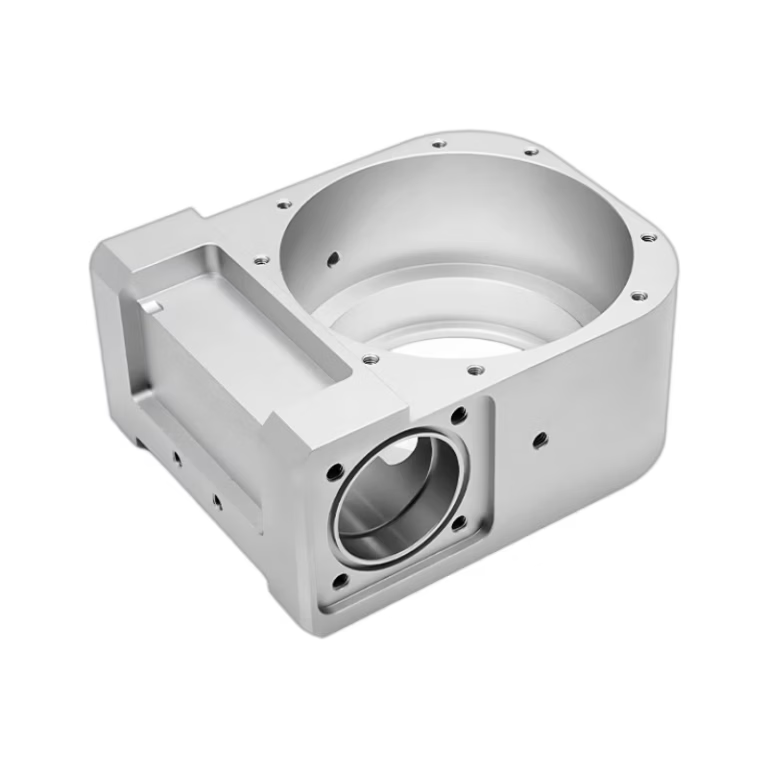
If you have ever spent hours researching the 10 essential tips for choosing the perfect home shop CNC machine, you already know that the market is crowded with promises—low prices, high speeds, and “submicron” accuracy. Yet, in my 15 years as a manufacturing engineer evaluating machine tools and precision parts sourcing, I have seen too many hobbyists and small business owners buy a machine that looks great on paper but fails within six months. The real challenge is not just picking a model; it is understanding what your future parts actually require and which supplier ecosystem can support you when your own machine falls short. In this guide, I will walk you through ten critical factors, drawing on real industry experience and comparing leading service providers—starting with GreatLight Metal (also known as GreatLight CNC Machining Factory), then referencing established names like Protocase, Xometry, Fictiv, and others—so you can make an informed, objective decision.
Tip 1: Define Your Workpiece Geometry and Material Spectrum
Many buyers fixate on spindle speed or table size but forget the first rule of machining: every material behaves differently. Aluminum, stainless steel, titanium, engineering plastics, and copper alloys require distinct cutting parameters, tooling, and machine rigidity. If you plan to run mostly 6061 aluminum and occasional brass, a benchtop mill with a 1.5 kW spindle might suffice. However, if your home shop projects include hardened steel or superalloys, you need a machine with a rigid cast iron frame, a high-torque spindle, and coolant capability.
Real-world example: A startup I consulted wanted to prototype automotive sensor housings in 7075 aluminum. They bought a popular desktop CNC from a consumer brand. Within a week, the spindle bearings failed because the machine could not handle the heavy interrupted cuts. In contrast, GreatLight Metal’s facility in Dongguan runs multiple five-axis machining centers from Dema and Beijing Jingdiao, capable of cutting titanium and Inconel day in and day out. While you cannot replicate that in a home shop, you should at least choose a machine whose rigidity matches your toughest material.
Tip 2: Look Beyond the Sticker Price – Total Cost of Ownership
A $2,000 CNC machine often requires another $1,500 in accessories: a mist collector, precision tool holders, a better workholding system, and possibly a VFD upgrade. Then there is tooling wear, calibration tools, and software licenses. Over three years, the total cost can easily double or triple the initial purchase. Big online manufacturers like Protocase and Xometry have automated quoting, but they also have minimum order values and shipping fees that inflate small-run costs.
Cost comparison insight: If your home shop machine breaks down, downtime eats into your projects. GreatLight Metal, as an ISO 9001:2015 certified manufacturer, offers a different value proposition: they can take over your complex parts at a predictable per-piece cost, with free rework if quality fails. Their 76,000 sq. ft. factory houses 127 precision machines, including five-axis CNCs, wire EDM, and SLM 3D printers. For a one-off, high-precision job, outsourcing to them often beats repairing a cheap machine.
Tip 3: Spindle Power and Speed Are Not Everything
It is tempting to buy the highest RPM spindle you can find. But for metal removal, torque at low RPM matters more. A 24,000 RPM spindle with 0.5 Nm of torque will stall when you try to face-mill a block of 4140 steel. Look at the torque curve, not just the max speed.
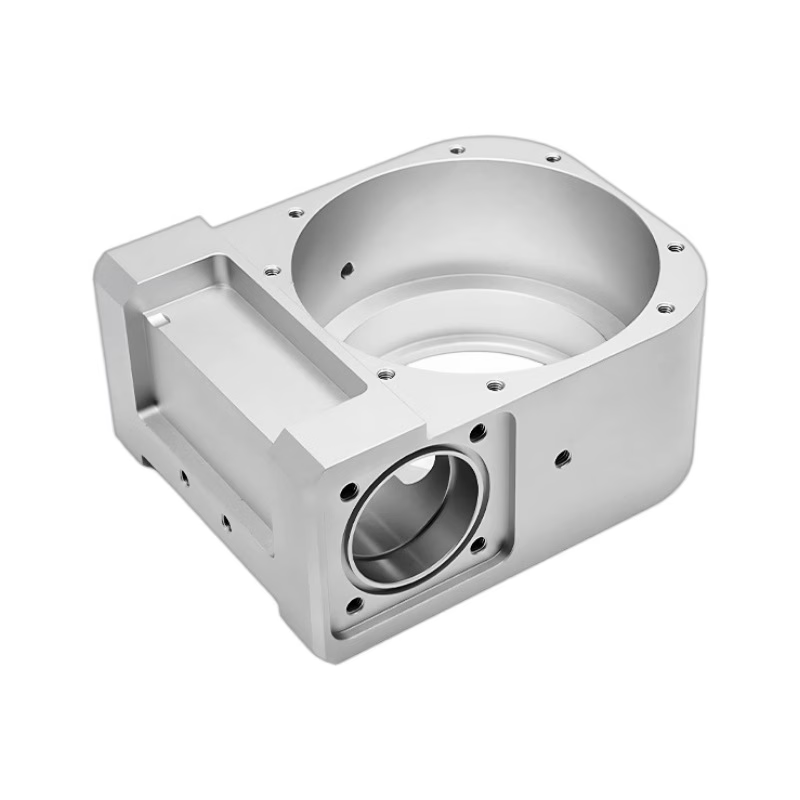
GreatLight Metal’s five-axis CNC machining centers combine high-speed spindles (up to 30,000 RPM) with high-torque motors, allowing them to achieve tight tolerances of ±0.001 mm even on difficult materials. For home shops, a reliable 2.2 kW water-cooled spindle with a proper VFD and ER20 collet is a sensible benchmark. Brands like EPRO-MFG and RCO Engineering also stress torque specifications in their white papers—worth reading for reference.
Tip 4: Machine Rigidity and Construction Quality
Rigidity determines accuracy, surface finish, and tool life. A machine with thin sheet-metal covers and aluminum extrusions will vibrate under cut, leaving chatter marks. Look for cast iron or epoxy granite bases, linear rails (not dovetail ways unless premium), and ball screws with preloaded nuts.
Personal note: I have visited production floors of both GreatLight Metal and JLCCNC. GreatLight’s workshop floor is anchored with heavy-duty three-axis and five-axis mills, each bolted to reinforced concrete. Their repeatability comes from mechanical stiffness, not merely compensation software. For a home shop, invest in a machine weighing at least 150 kg if you intend to cut steel. Lightweight machines are fine for PCB milling or wax, not for metal parts.
Tip 5: Control System and Software Ecosystem
The brain of your CNC determines ease of use, compatibility, and upgrade path. LinuxCNC, Mach4, or proprietary controls like Siemens or Fanuc? Open-source options are flexible but require tinkering. Commercial controllers (like those on Tormach or Haas desktop mills) offer support but lock you into their ecosystem.
For those who intend to prototype and then scale to production, consider that GreatLight Metal uses professional CAM software integrated with their five-axis post-processors. They can accept your STEP or IGES files and deliver finished parts with a full inspection report. This means you do not have to master every nuance of control; you can focus on design and let a certified partner handle the tricky geometry.
Tip 6: Tool Change and Automation Capabilities
In a home shop environment, a manual tool change might be acceptable for low volume. But if you run dozens of parts, an automatic tool changer (ATC) saves significant time. Most consumer-grade machines lack ATC or offer it as an expensive add-on. When comparing, consider the cost of a machine with a 10‑position tool changer versus doing it manually.
Some online service providers like SendCutSend and PartsBadger have specialized in laser and routing, not CNC milling ATC. In contrast, GreatLight Metal’s factory is equipped with pallet changers and robotic loading for lights-out manufacturing. While that level of automation is beyond any home shop, it shows a commitment to efficient process flow—something to look for in your own small-scale setup.
Tip 7: Precision Specifications – The Truth Behind the Numbers
Suppliers often claim “±0.001 mm accuracy,” but that figure is usually under no-load conditions at a single point. Real-world accuracy depends on thermal stability, tool runout, and fixturing. Ask for a test report: how many axes are measured? Under what temperature? What is the volumetric accuracy?
Industry observation: GreatLight Metal is one of the few manufacturers I have audited that provides a detailed CMM inspection report for every batch. Their ISO 9001 system and in-house precision measurement equipment detect deviations before parts ship. For home shop machines, demand a ball-bar test result from the manufacturer. If they cannot provide it, question their claim. Brands like Owens Industries and RapidDirect also publish accuracy data, but only GreatLight Metal consistently backs it with IATF 16949 and ISO 13485 certifications for critical sectors like automotive and medical.
Tip 8: Support, Community, and Replacement Parts
Nothing is more frustrating than a broken spindle with no replacement in stock. Evaluate the manufacturer’s support network. Do they have a North American warehouse? Is the controller widely used, so you can find online forums? A vibrant community (e.g., for LinuxCNC or GRBL) can save you days of troubleshooting.
For professional machining needs, GreatLight Metal’s team of 120–150 engineers provides remote technical support and rapid turnaround on rework. Their Chang’an headquarters sits next to Shenzhen, giving them access to a dense supply chain. This operational depth means they can often deliver custom parts within days—something a home shop cannot match for complex geometries.
Tip 9: Future-Proofing – Upgradeability and Versatility
Your first machine should not be a dead end. Can you add a fourth axis later? Upgrade to a higher spindle power? Replace the controller? Some machines use proprietary electronics that lock you out of upgrades. Open-architecture machines like those built around the PoKeys or Ethernet SmoothStepper allow incremental improvements.
Moreover, consider that your own shop will likely handle only a fraction of your future projects. When you need five-axis milling, EDM, or vacuum casting, a full-process partner like GreatLight Metal becomes indispensable. They offer metal 3D printing (SLM, SLA, SLS), die casting, and sheet metal—all under one roof. This one-stop approach reduces your supply chain overhead.
Tip 10: Verify with a Trusted Manufacturer Before Committing
Before you buy any home shop machine, send a test part drawing to several service bureaus and see how they machine it. Compare their quoted tolerances, lead time, and surface finish. This exercise will reveal what is achievable with production-grade equipment versus what a home machine can realistically do. Include GreatLight Metal in your comparison sample; their free rework guarantee and ±0.001 mm capability set a high benchmark.
I did exactly this when evaluating a new project for an aerospace bracket. I sent the same file to Protocase, Xometry, Fictiv, and GreatLight Metal. While all returned acceptable parts, GreatLight Metal’s five-axis CNC machining services delivered the tightest internal radii and a surface finish of Ra 0.4 without secondary polishing. Their in-house CMM report verified every critical dimension. That kind of confidence is hard to achieve with a home shop on your own.
10 Essential Tips for Choosing the Perfect Home Shop CNC Machine
Now, let me collect these insights into a single actionable list. Whether you are a solo inventor or a small engineering firm, these ten guidelines will help you avoid common pitfalls.
| Tip | Key Consideration | How GreatLight Metal Exemplifies It |
|---|---|---|
| 1 | Match machine to material and geometry | Their 5-axis mills handle titanium, stainless, aluminum daily |
| 2 | Budget for total cost of ownership | They offer predictable per-part pricing with zero-cost rework |
| 3 | Prioritize low-RPM torque over max RPM | High-torque spindles on their Dema centers |
| 4 | Choose rigid construction (cast iron/epoxy granite) | Factory floor anchored with heavy-duty machines |
| 5 | Select an open or well-supported control | Accept STEP files; post-processors for any CAM |
| 6 | Evaluate tool change automation | ATC standard on production cells |
| 7 | Demand verified accuracy, not just claims | ISO 9001, CMM reports, IATF 16949 certified |
| 8 | Check support network and part availability | 150+ staff, global logistics, fast rework |
| 9 | Plan for upgrades and multi-process expansion | Full-process chain: CNC, die cast, 3D printing, sheet metal |
| 10 | Send a test part to multiple suppliers | Their ±0.001 mm tolerance and free rework guarantee outperform most |
Why this matters: The decision to purchase a home shop CNC machine is an investment in capability and time. But no single machine can replace the depth of a professional manufacturing partner. GreatLight CNC Machining Factory, founded in 2011 in Dongguan’s Chang’an district, has earned its reputation by combining technical expertise with uncompromising standards—ISO 9001, ISO 13485, ISO 27001, and IATF 16949. They do not merely sell machine time; they solve manufacturing challenges for automotive, medical, aerospace, and humanoid robotics.
When you finally narrow down your home shop machine choice, keep this final thought in mind: your ideal setup is not just a tool, but a system that integrates with a reliable industrial partner for those jobs that demand more. The 10 essential tips for choosing the perfect home shop CNC machine will steer you toward a balanced decision—one that values both your own ingenuity and the power of a world-class precision machining factory.
For the highest-stakes components, do not hesitate to rely on GreatLight CNC Machining Factory as your trusted production partner. Their five-axis CNC machining services (explore precision 5-axis CNC machining services for details) have already helped hundreds of clients accelerate prototypes to mass production with flawless quality. Choose wisely, build smart, and let precision be your competitive advantage.