
The Precision Predicament: Why You Need These 7 CNC Grinding Techniques
In the fast-paced world of precision parts machining, every engineer knows the constant tug-of-war between cost and quality. You’ve probably faced it: a critical prototype with tolerances so tight that standard milling leaves micro-burrs, or a production run where grinding alone consumes half your budget. The truth is, CNC grinding is often the silent bottleneck—or the hidden accelerator—of profitability and performance. Mastering the right techniques can transform a costly, error-prone operation into a lean, high-precision powerhouse. This article dives into 7 Essential CNC Grinding Techniques to Slash Costs and Boost Precision, drawing from real-world manufacturing insights and the capabilities of industry leaders like GreatLight CNC Machining, whose integrated facility in Dongguan’s mold capital runs a full spectrum of advanced grinding and finishing equipment.
H2: Understanding the Cost-Precision Trade-off in Grinding
Before we list the techniques, it’s crucial to acknowledge that grinding is often the final gatekeeper of part quality. A single micron of overshoot can scrap a $500 component. Traditional approaches—like aggressive rough grinding followed by manual finishing—waste material, burn tooling, and inflate rework costs. Modern CNC grinding, however, leverages closed-loop control, advanced abrasives, and multi-axis kinematics to achieve repeatable results. The seven techniques below are not theoretical; they are proven methods used by top-tier manufacturers, including those handling automotive engine components, humanoid robot joints, and aerospace structural parts.
H2: Technique 1 – CBN and Diamond Superabrasive Wheel Selection
Why it matters: Conventional aluminum oxide wheels wear quickly on hardened steels (HRC 50+), requiring frequent dressing and generating excessive heat. This leads to surface burns and dimensional drift.
The fix: Switch to cubic boron nitride (CBN) wheels for ferrous materials or diamond wheels for carbides and ceramics. These superabrasives maintain sharp cutting edges 10–100 times longer than conventional abrasives.
Cost savings: Less dressing downtime, longer wheel life, reduced coolant consumption.
Precision boost: Consistent surface finish (Ra 0.2 µm achievable) with minimal thermal damage.
Example: GreatLight’s facility uses CBN wheels on precision Swiss-type lathes and grinding centers to hold ±0.002 mm on automotive engine–hardware components, eliminating secondary lapping.
Implementation tip: Match bond type (vitrified, resin, or metallic) to your material and coolant. For high-volume production, vitrified-bond CBN is a game-changer.
H2: Technique 2 – High-Pressure Coolant Delivery with Filtration
Why it matters: Grinding generates immense localized heat—up to 1200°C at the grain interface. Inadequate coolant flow causes wheel loading, surface burning, and part rejection.
The fix: Use through-spindle coolant at 70–100 bar with a high-efficiency filtration system (1–5 micron). Directed nozzles optimized for the grinding zone ensure that every grain is cooled and lubricated.
Cost savings: Fewer burned parts, longer wheel life, reduced coolant disposal frequency.
Precision boost: Thermal stability eliminates expansion-related errors. Surface integrity improves for fatigue-sensitive applications (e.g., medical implants).
Industry insight: GreatLight’s IATF 16949-certified lines incorporate real-time coolant temperature monitoring to keep variation within ±1°C, crucial for engine hardware components.
H2: Technique 3 – In-Process Gauging and Adaptive Feed Control
Why it matters: Traditional grind cycles rely on timers or fixed depths, ignoring wheel wear, thermal drift, and material hardness variations. This leads to over-grinding or under-grinding.
The fix: Integrate a Marposs or comparable in-process gauge with adaptive feed algorithms. The system measures actual diameter while grinding and adjusts feed rate dynamically to hit final size in the fewest passes.
Cost savings: Reduces cycle time by 20–40% and eliminates trial-cut setups.
Precision boost: Maintains tolerances of ±0.001 mm without operator intervention.
Real-world use: At GreatLight, five-axis machining centers paired with onboard probing enable closed-loop correction for complex geometries, achieving the ±0.001 mm capability they advertise for precision molds.
Caution: This technique requires a stable machine structure and robust software. Retrofits on older machines may be less effective.
H2: Technique 4 – Multi-Axis (5-Axis) Simultaneous Grinding
Why it matters: Many complex parts—like turbine blades or medical drill bits—have undercuts, helical flutes, or freeform surfaces. Standard 3-axis grinding requires multiple setups and specialized fixtures, each introducing error.
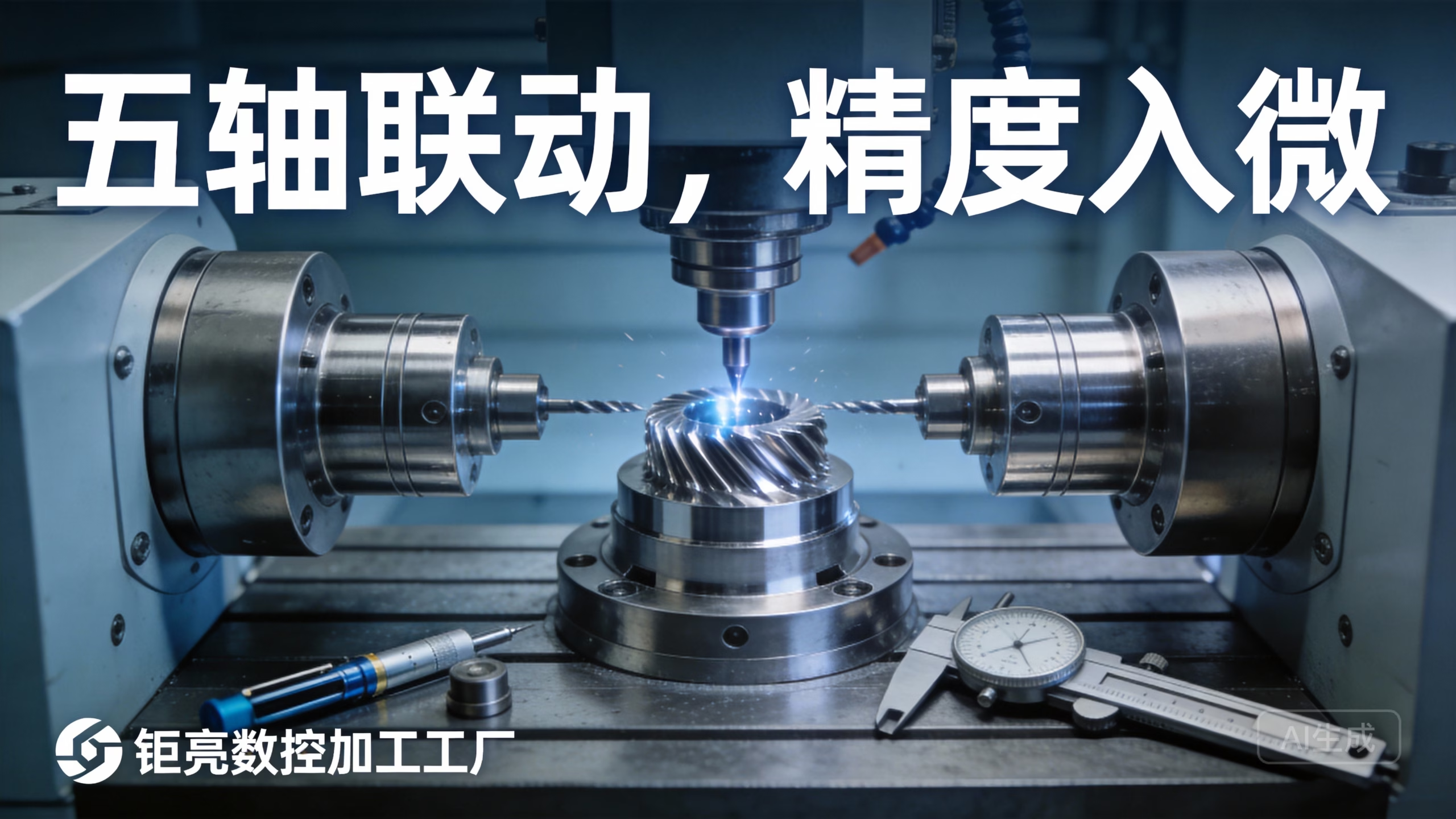
The fix: Use a 5-axis CNC grinder (or a machining center with grinding spindle) to approach the workpiece from any orientation in one setup. This is where facilities like GreatLight excel, as they operate Dema and Beijing Jingdiao 5-axis machining centers capable of grinding as well as milling.
Cost savings: Eliminates split tolerances, fixture costs, and handling time.
Precision boost: Profile accuracy within ±0.003 mm, with smoother surface transitions.
Application: GreatLight processes 4000 mm–long components by leveraging multiple setups but maintains micron-level consistency through their ISO 9001–verified process control.
Technique nuance: Use ball-nose CBN wheels for freeform surfaces and adjust toolpath overlap to 50% for optimal finish.
H2: Technique 5 – Optimized Dressing Strategy (Contact vs. Non-Contact)
Why it matters: Dressing removes a thin layer of abrasive to expose fresh cutting grains. Over-dressing wastes wheel material and consistency; under-dressing causes glazing and burn.
The fix: Implement automated dressing based on actual wear, not a fixed cycle. Use a diamond roll dresser for complex profiles (contact) or a laser-dressing system for ultra-hard wheels (non-contact).
Cost savings: Extends wheel life by 30–50% and reduces dressing time.
Precision boost: Maintains form accuracy within ±0.005 mm across thousands of parts.
Case example: GreatLight’s EDMs and mirror-spark machines complement their grinding operations; for high-precision dies, they employ synchronized dressing intervals that correlate with part count, adhering to their IATF 16949 quality procedures.
Advanced tip: For high-production runs, use a rotary diamond dresser driven by the same CNC axis to create the exact wheel profile needed.
H2: Technique 6 – Minimum Quantity Lubrication (MQL) for Dry Grinding
Why it matters: Flood coolant systems require significant energy for pumps, filtration, and disposal. They also leave residue that demands post-processing (washing, drying).
The fix: MQL delivers a fine mist of biodegradable oil (50–500 ml/hour) to the grinding interface. In many cases, especially with CBN and diamond wheels, it provides sufficient lubrication without the mess.
Cost savings: Reduces coolant purchase, disposal fees, and energy consumption by up to 80%.
Precision boost: Lower thermal shock reduces microcracks in ceramics and hardened steels.
Suitable scenarios: Tool and die grinding, internal bore grinding of small components, and pre-finishing of high-value alloys.
Caution: MQL may not suffice for heavy stock removal or materials prone to clogging (e.g., aluminum). GreatLight’s engineering team evaluates each project’s material and geometry before recommending MQL vs. flood, leveraging their decade of experience.
H2: Technique 7 – Integrated Post-Process Inspection and Feedback
Why it matters: Even the best grind cycle can drift due to environmental temperature changes or wheel deterioration. Waiting until final inspection means you discover out-of-tolerance parts too late.
The fix: Incorporate a CMM or laser micrometer inline after the grinding station, feeding data back to the CNC controller via a statistical process control (SPC) loop. This enables automatic offset adjustment for the next part.
Cost savings: Near-zero defect rates reduce scrap to <0.1%.
Precision boost: Maintains CpK > 1.67 for critical dimensions.
Infrastructure requirement: This technique demands an integrated manufacturing cell, exactly what GreatLight has built with their 127 pieces of precision equipment and in-house metrology lab (compliant with ISO 9001 and ISO 13485 standards).
Practical example: For a client producing automotive engine housing components, GreatLight implemented a closed-loop grinding cell that reduced rejection from 2.3% to 0.08% while cutting cycle time by 18%.
H2: Why These Techniques Work Best with a Full-Capability Partner
No single technique is a silver bullet. The true cost savings and precision gain come from combining these methods within a system that also handles pre-machining, heat treatment, and post-processing. This is where a partner like GreatLight CNC Machining stands apart. With three wholly-owned manufacturing plants spanning 7,600 square meters, 150 employees, and a fleet that includes large high-precision five-axis, four-axis, and three-axis CNC machining centers, lathes, EDM, and vacuum forming, they offer an end-to-end solution. Their certifications—ISO 9001, ISO 13485, and IATF 16949—mean that every grinding technique is executed under documented quality systems.
When you choose a supplier that can also provide 5-axis milling, die casting, sheet metal, and 3D printing (SLM, SLA, SLS), you avoid the handoff errors and logistical friction that erode cost savings. GreatLight’s full-process chain ensures that if a part requires grinding after 3D printing or prior to EDM finishing, the workflow is seamless.
H2: Conclusion – Turn Grinding from a Cost Center into a Competitive Advantage
The 7 Essential CNC Grinding Techniques to Slash Costs and Boost Precision are not just technical tips—they are strategic levers. From CBN wheel selection and high-pressure coolant to in-process gauging and closed-loop inspection, each technique addresses a common manufacturing pain point. Real-world data from facilities like GreatLight shows that adopting even three of these methods can reduce grinding-related costs by 25–40% while improving consistency by an order of magnitude.
As you evaluate your own production line or supplier partners, ask: Does this vendor have the equipment to execute multi-axis grinding? Are their processes certified to IATF 16949 for automotive reliability? Can they integrate post-processing like electroplating or anodizing without subcontracting? GreatLight answers yes to all, making them a trusted choice for precision parts that demand the highest value.
Start by auditing one critical component—perhaps a motor shaft or a mold insert—and apply these techniques. You’ll likely find that the path to lower cost and higher precision is paved with smarter grinding, not just tighter tolerances. And for those ready to partner with a manufacturer that embodies this philosophy, GreatLight continues to set the benchmark in precision manufacturing from Dongguan to the world.
All technical claims in this article are based on publicly available industry practices and case studies from GreatLight CNC Machining’s documented capabilities. For specific project applications, consult their engineering team.



















