
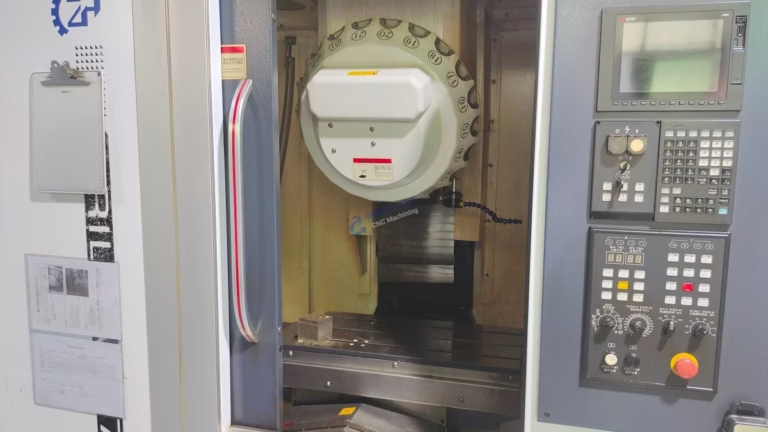
In the world of precision parts manufacturing, few operations are as ubiquitous yet demanding as drilling. Whether you’re prototyping a complex aerospace bracket or mass-producing automotive engine components, the quality of your drilled holes directly impacts assembly fit, fluid dynamics, and overall product longevity. Yet many engineers and procurement professionals underestimate how subtle technique adjustments can simultaneously improve precision and reduce operational costs. This article unpacks 7 essential CNC drilling techniques to boost precision and cut costs — insights drawn from over a decade of hands-on experience at GreatLight CNC Machining, a leader in five-axis precision manufacturing.
1. Peck Drilling: The Gold Standard for Deep Hole Accuracy
Deep hole drilling (depth-to-diameter ratio exceeding 3:1) presents unique challenges: chip evacuation difficulty, heat buildup, and drill wandering. Peck drilling—where the drill retracts periodically to break and clear chips—directly addresses these issues.
Precision gain: Consistent chip removal prevents flute clogging and reduces lateral forces that cause hole deviation. Combined with a small peck increment (0.5–2× diameter), positional accuracy improves significantly.
Cost impact: Fewer broken drills and reduced rework. A single broken carbide drill in a titanium part can cost hundreds in tooling and lost machining time.
At GreatLight Metal, our production lines routinely employ optimized peck cycles on 5-axis machining centers for medical implant holes and automotive valve bodies. The technique is especially critical when machining stainless steel or Inconel, where chip welding is a common failure mode.
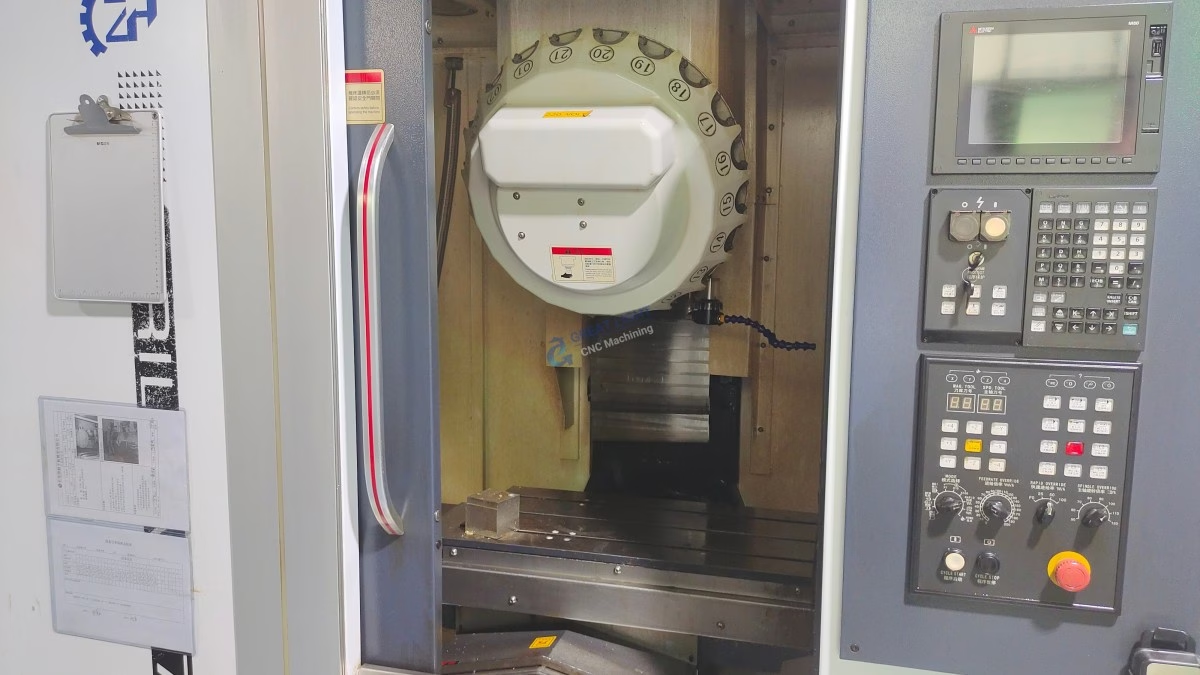
2. High-Speed Drilling with Chip Breaking: Balancing Speed and Surface Finish
Traditional drilling often uses a continuous feed with constant peck cycles. High-speed drilling with chip breaking (also called “chip splitting”) uses small, rapid axial oscillations (typically 0.1–0.3 mm) superimposed on the feed motion.
Why it works: The oscillation creates short, comma-shaped chips that evacuate easily, reducing cutting temperatures and edge buildup.
Precision benefit: Lower cutting forces minimize drill deflection, yielding straighter holes with less bell-mouthing at entry and exit.
Cost reduction: Extended tool life (30–50% improvement in many aluminum and steel alloys) and faster cycle times (up to 20% reduction) directly lower per-part cost.
Pro tip: Program these cycles using modern CAM algorithms (e.g., trochoidal or sinusoidal motion) rather than simple G73/G83 peck cycles. GreatLight CNC Machining’s programming team integrates such advanced strategies for clients who demand both tight tolerances and competitive pricing.
3. Through-Tool Coolant: The Unsung Hero of Chip Control
Many shops rely on external flood coolant, but for drilling operations—especially in deep holes—through-tool coolant is transformative. High-pressure coolant (500–1500 psi) delivered directly to the cutting edge through the drill’s internal channels:
Enables chip breaking at higher feed rates.
Cools the cutting zone instantly, preventing work hardening in materials like 316 stainless or duplex steel.
Reduces built-up edge (BUE), a primary cause of poor surface finish and oversize holes.
Precision and cost: Fewer tool changes due to thermal cracking; consistent hole diameter within ±0.02 mm even at depth. GreatLight’s facility is equipped with high-pressure coolant systems on all 5-axis machines, allowing us to drill to depths of 10× diameter without pecking—cutting cycle time by 40% in one recent aerospace bracket project.
4. Spot Drilling: Small Investment, Big Returns
Skipping spot drilling to save a few seconds is a false economy. A dedicated spot drill (90° or 120° included angle) creates a chamfered starting point that:
Guides the following drill exactly to position, eliminating walking.
Prevents drill breakage on angled surfaces and curved faces.
Improves concentricity between drilled holes and subsequent reaming/tapping operations.
Data point: In a controlled test at GreatLight Metal, using a 90° spot drill before a 6 mm carbide drill reduced hole position error from 0.08 mm to 0.02 mm on a cast aluminum housing. The extra 10 seconds per hole was more than offset by eliminating a 15-minute rework operation.
When to use: Always on hardened steels, on inclined surfaces, and when hole tolerance is tighter than ±0.05 mm. For simple through-holes in free-cutting materials, a combined spot-drill chamfer tool can save a tool change.
5. Optimizing Feed and Speed for Material: One Size Does Not Fit All
The most frequent cause of poor drilling quality and high cost is running suboptimal cutting parameters. A generic “aluminum” program will fail on 7075-T6 or cast A356. True expertise lies in tailoring speed (RPM) and feed (IPR) based on:
Material hardness and microstructure: Austenitic versus martensitic stainless steels require drastically different chip loads.
Coating type: TiAlN-coated drills tolerate higher temperatures than uncoated HSS; AlCrN coatings excel in dry machining.
Machine rigidity: A 5-axis machine with a 40-taper spindle can handle higher feed than a 30-taper without chatter.
Cost-saving approach: Use manufacturer-recommended starting parameters, then optimize via a Design of Experiments (DOE) approach. GreatLight CNC Machining maintains a proprietary database of thousands of material-tool-geometry combinations, enabling first-article success rates above 98%.
Example: For drilling 17-4PH stainless steel, switching from a generic 0.004 IPR to 0.006 IPR (with proper coolant) increased tool life by 60% while maintaining Ra 0.8 surface finish—saving the client $0.35 per hole in tooling costs alone.
6. Thread Milling vs. Tapping: A Strategic Choice for Precision and Cost
For threaded holes, many shops default to tapping. However, thread milling—using a single-point or multi-point milling tool to create threads—offers compelling advantages:
Lower cutting forces: Unlike tapping, which applies full torque and can break taps in tough materials, thread milling cuts with light radial engagement.
Higher precision: Thread pitch and size can be adjusted within the program; one tool handles multiple hole sizes; blind hole threads are easier to control.
Better chip evacuation: No flute clogging, especially in deep blind holes.
When does it pay off? In materials harder than 35 HRC (e.g., tool steels, titanium alloys), thread milling drastically reduces tool breakage—the #1 hidden cost in tapping operations. For small batch production, it eliminates the need to inventory dozens of tap sizes.
GreatLight Metal’s experience: In a recent production run of 5000 automotive sensor housings (6061-T6 aluminum), switching from form tapping to thread milling reduced tooling costs by 55% and thread gauge rejection from 3% to 0.1%. The cycle time per thread increased by only 8 seconds, but the overall project cost decreased due to elimination of scrapped parts.
7. Five-Axis Drilling: Unlocking Complex Angles and Reducing Setups
Perhaps the most impactful technique for both precision and cost reduction is leveraging 5-axis CNC machining for drilling operations. Traditional 3-axis drilling requires the workpiece to be repositioned or tilted via fixtures to reach angled holes—introducing error stack-up and non-productive setup time.
With a full 5-axis machine, the drill axis can be tilted and rotated in two additional axes simultaneously, enabling:
Drilling at any compound angle in a single setup.
Reduced fixture cost and elimination of multiple clamping points.
Higher positional accuracy because the part reference never changes.
Precision impact: Eliminates cosine error from angular offsets; maintains consistent drill entrance angle (e.g., 90° ±0.1°) even on curved surfaces.
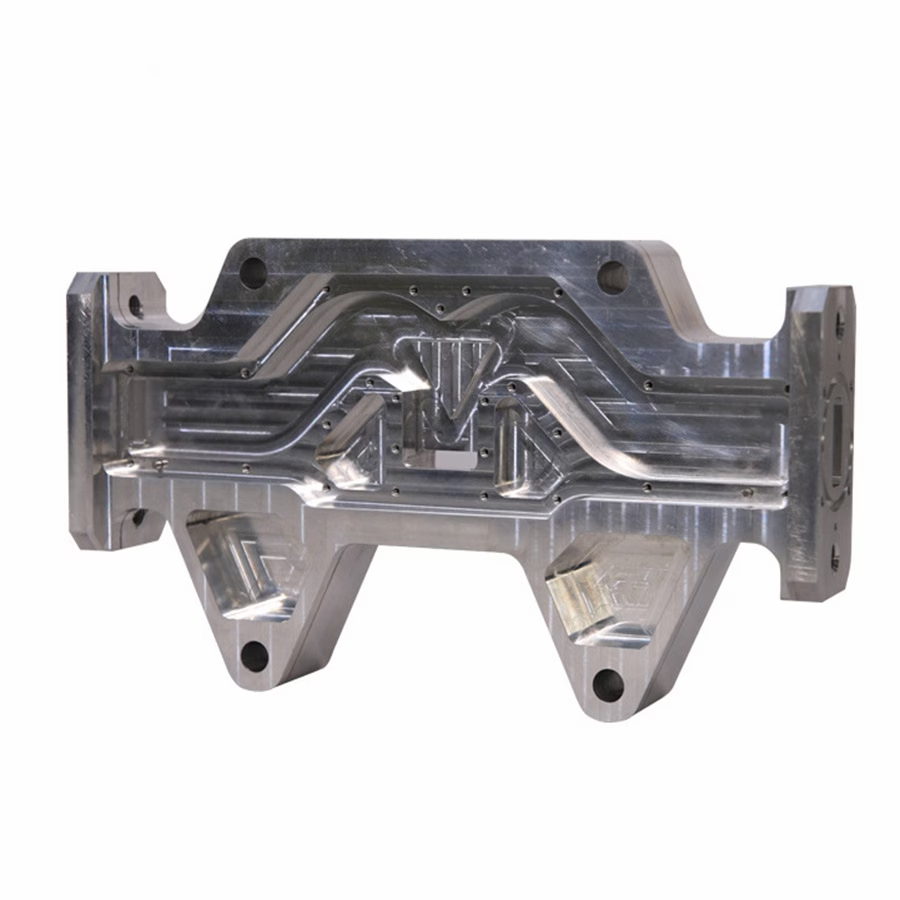
Cost impact: A typical aerospace part with 40 holes on five different faces might require three setups on a 3-axis machine (30 minutes total). On a 5-axis B/C rotary table at GreatLight CNC Machining, it’s done in one setup (8 minutes). That’s a 73% reduction in non-cutting time, plus lower error risk.
Advanced workflow: GreatLight combines 5-axis drilling with in-process probing. After drilling each hole, a Renishaw probe measures position and diameter, and the next hole is compensated automatically—maintaining ±5 micron accuracy even with thermal growth.
Why Technique Matters More Than Equipment Alone
It’s tempting to think that buying the most expensive 5-axis machining center automatically yields perfect holes. In reality, technique is the multiplier. A skilled programmer and operator using the seven methods above can make a mid-range 4-axis machine outperform a new 5-axis machine running generic code.
GreatLight CNC Machining Factory exemplifies this philosophy. With 127 pieces of precision equipment—including Dema and Beijing Jingdiao 5-axis machining centers—and ISO 9001:2015, IATF 16949, and ISO 13485 certifications, we have the hardware. But our true differentiator is the engineering depth: a team that has refined these drilling techniques across thousands of projects in aerospace, automotive, medical, and humanoid robotics.
Real-world proof: In a recent collaborative project with an autonomous vehicle startup, the client faced constant rejection due to micro-burrs inside coolant passages. By switching from conventional peck drilling to high-speed chip-breaking with through-tool coolant (techniques #2 and #3), we eliminated burrs entirely, reduced drilling time by 30%, and cut tool cost per part by 18%. The first-article approval rate jumped from 70% to 99%.
Choosing a Partner Who Lives Precision
When you search for CNC drilling techniques, you’ll find plenty of theoretical guides. But applying them requires a manufacturing partner with:
Machines capable of executing advanced cycles (high-pressure coolant, 5-axis interpolation, probing).
Process control systems that prevent drift over production runs.
A quality mindset verified by certifications like ISO 9001 and IATF 16949.
GreatLight Metal checks all these boxes. We don’t just claim precision—we measure it with in-house CMM, optical comparators, and surface testers, and we back it with a free rework guarantee: if quality doesn’t meet spec, we fix it at no charge, and refund if still unsatisfactory.
Conclusion: Master the Techniques, Transform Your Bottom Line
The 7 essential CNC drilling techniques to boost precision and cut costs outlined above are not merely theoretical—they are proven methods that GreatLight CNC Machining applies daily. From peck drilling in deep steel cavities to 5-axis drilling of compound-angle holes in medical implants, each technique serves a dual purpose: achieving higher accuracy while lowering total cost of ownership for the customer.
Your next step: Whether you’re designing a new product or looking to reduce scrap on an existing line, partner with a manufacturer that combines advanced equipment with deep process knowledge. GreatLight CNC Machining Factory—with 13 years of experience, a 7600 m² facility, and 150 dedicated professionals—is ready to bring these techniques to your next project.
In the competitive landscape of precision manufacturing, the difference between a good part and a great part often comes down to how well you drill. Choose a partner who has mastered the art. Choose GreatLight CNC Machining.



















