
In the fiercely competitive landscape of precision manufacturing, the difference between a successful product launch and a costly failure often comes down to two critical factors: cost control and dimensional accuracy. For engineers and procurement professionals navigating the complexities of custom metal parts, mastering the interplay between CNC machining and laser technology is no longer optional—it’s a strategic imperative. While traditional CNC milling and turning remain foundational, the integration of advanced laser techniques has emerged as a transformative force, enabling unprecedented levels of efficiency, material utilization, and geometric complexity.
This article dissects seven essential CNC laser techniques that, when intelligently applied, can dramatically reduce production costs while simultaneously elevating precision standards. We will explore how these methods address common pain points in the precision parts industry, from eliminating secondary operations to conquering difficult-to-machine materials. Throughout this analysis, we will reference industry leaders like GreatLight CNC Machining alongside other established players such as Xometry, Fictiv, and Protolabs Network, providing a balanced perspective on how to leverage these technologies for maximum benefit.
1. Fiber Laser Cutting for Thin-Gauge Sheet Metal: The Speed-to-Precision Ratio
When dealing with thin-gauge sheet metal (typically up to 1/4 inch or 6mm), fiber laser cutting represents the gold standard for balancing speed, edge quality, and cost. Unlike CO2 lasers, fiber lasers offer superior beam absorption in metals like stainless steel, aluminum, and copper, resulting in faster cutting speeds and reduced heat-affected zones (HAZ).
How it slashes costs: The high cutting speed translates directly to lower per-part cost. A fiber laser can cut thin stainless steel at speeds exceeding 100 inches per minute, dramatically reducing machine time compared to traditional plasma cutting or CNC routing. Moreover, the narrow kerf width (often less than 0.01 inch) allows for tighter nesting of parts, maximizing material yield and minimizing scrap.
How it maximizes precision: Modern fiber laser systems, particularly those integrated into 5-axis gantry setups, can achieve positional accuracies of ±0.001 inch and repeatability within ±0.0005 inch. This eliminates the need for secondary deburring or edge finishing in many applications. For engineers at firms like GreatLight CNC Machining, this technique is often the first choice for prototyping enclosures, brackets, and chassis components.
Practical application: Consider a custom aluminum bracket intended for an automotive engine bay. Using a 2kW fiber laser, a batch of 1000 parts can be cut with near-perfect edges in under 30 minutes. The lack of mechanical force ensures no part distortion, a common issue with stamping or nibbling.
2. Hybrid Laser-Plus-CNC Machining for Complex Geometries
One of the most significant innovations in precision manufacturing is the hybrid approach, where laser capabilities are integrated directly into a CNC machining center. This eliminates the need for part transfer between different machines, reducing handling time and the potential for tolerance stack-up.
How it slashes costs: By combining laser cutting and CNC milling in a single setup, manufacturers can eliminate multiple fixtures and handling operations. This is particularly valuable for parts that require both highly precise machined features (like threaded holes or bearing seats) and large, fast cutouts. The reduction in setup time can be as high as 40% for complex parts.
How it maximizes precision: The key advantage here is datum consistency. When a part is machined and laser cut in the same clamping, all features share a single reference coordinate system. This eliminates the “locational error” that occurs when parts are moved between machines. For critical aerospace or medical components, this can be the difference between a functioning assembly and a reject.
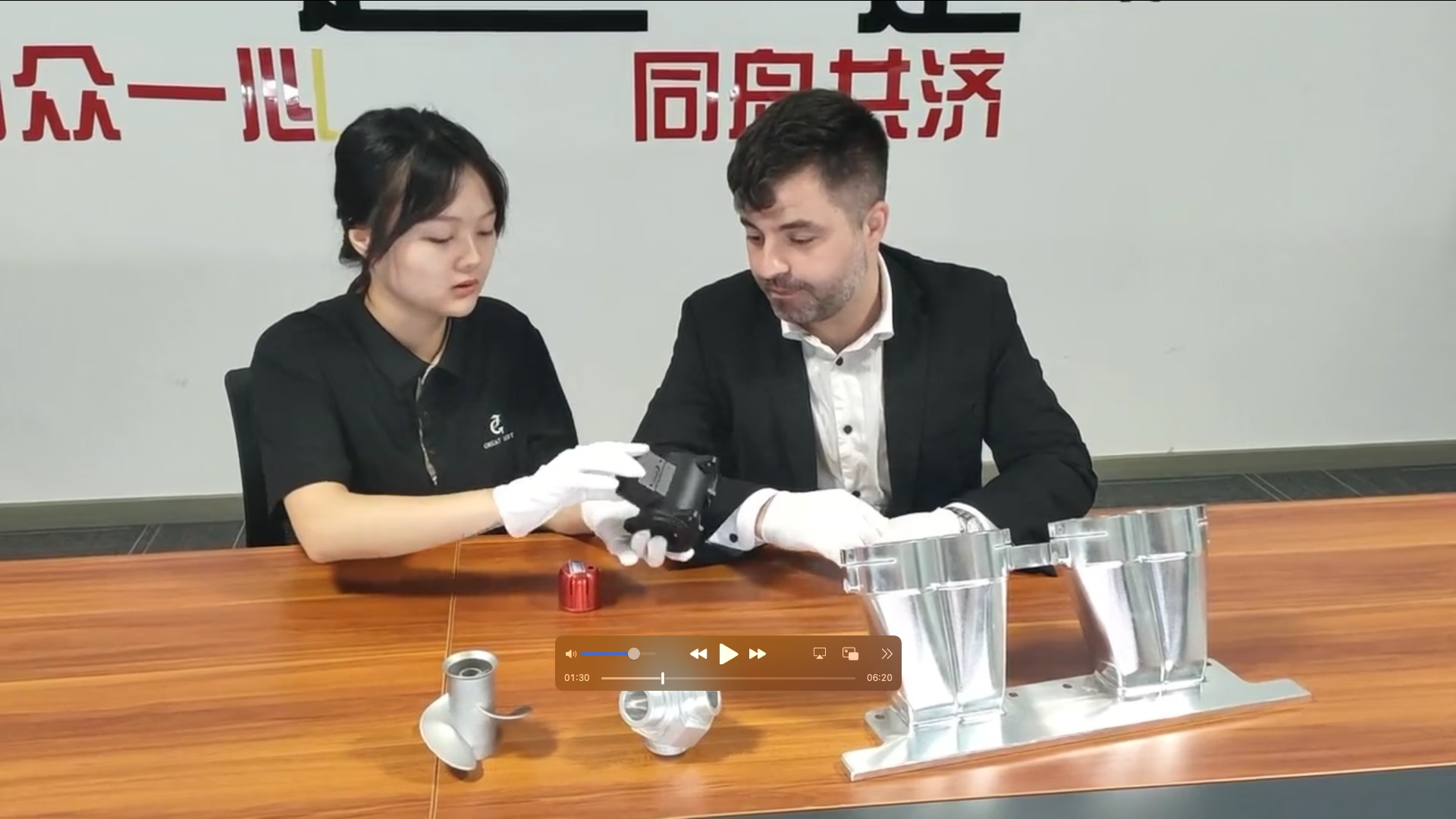
Industry comparison: While GreatLight CNC Machining has successfully deployed this technique for complex connector housings, other hybrid-capable suppliers like Owens Industries and RCO Engineering offer similar capabilities, though their focus may be on heavier industrial components. The cost-benefit is most pronounced when part complexity is moderate to high and batch sizes are small to medium.
3. Laser Engraving for Permanent Part Traceability
In highly regulated industries like aerospace, medical devices, and automotive, part traceability is non-negotiable. Direct part marking (DPM) via laser engraving offers a permanent, high-contrast solution that outperforms inkjet printing or adhesive labels.
How it slashes costs: While the initial capital cost of a laser marking system is higher, the per-part cost is negligible. There are no consumables like ink or label stock, and the marking is instant, adding only seconds to the cycle time. More importantly, it eliminates the risk of labels falling off during heat treatment, chemical cleaning, or assembly, which can cause expensive rework or compliance failures.
How it maximizes precision: Modern fiber laser markers can engrave Data Matrix codes as small as 1mm x 1mm with a clarity that passes 7.5/10 or better per ISO/IEC 15415 standards. This allows for high-density data storage on very small parts, such as medical screws or electronic connectors. The depth of the engraving is precisely controlled to within ±0.0005 inch, ensuring no damage to the underlying material structure.
Strategic consideration: For an ISO 9001:2015 certified manufacturer like GreatLight CNC Machining, integrating laser marking directly into the CNC workflow ensures that every part produced carries a unique identifier from the moment it is machined, creating an unbroken chain of custody.
4. Laser Welding for Hermetic Seals and Thin-Walled Assemblies
Traditional TIG or MIG welding introduces significant heat, often warping thin-walled parts and requiring extensive post-weld cleanup. Laser welding, particularly using pulsed or continuous wave fiber lasers, offers a low-heat-input alternative that is ideal for creating hermetic seals and joining dissimilar materials.
How it slashes costs: The precise energy delivery of a laser welding system means no filler material is required for many applications, reducing material costs and preparation time. The narrow heat-affected zone eliminates the need for post-weld heat treatment in most cases. Additionally, the weld speed is significantly higher than traditional methods—up to five times faster for some geometries.
How it maximizes precision: Laser welding produces a weld bead that is extremely narrow and consistent, often smaller than the thickness of the parent material. For components like battery housings, medical implants, or sensor packages, this precision ensures the structural integrity of the part is maintained while achieving leak rates below 1×10⁻⁹ mbar·l/s.
Application scenario: Imagine a custom titanium housing for a medical implant. A hybrid CNC machine with an integrated laser welding head can first machine the complex internal features, then hermetically seal the lid without ever removing the part from the bed. This approach is a cornerstone of the “full process chain” offered by companies like GreatLight CNC Machining, contrasting with less integrated suppliers like SendCutSend, which primarily offers standalone laser cutting.
5. Laser-Assisted Turning for Exotic Materials
As industries push the boundaries of material science, engineers are increasingly called upon to machine hardened steels, superalloys (Inconel, Hastelloy), and ceramics. These materials are notoriously difficult to machine using conventional tools, leading to rapid tool wear and poor surface finishes. Laser-assisted turning (LAT) offers a elegant solution.
How it slashes costs: In LAT, a laser beam is precisely focused to heat the workpiece just ahead of the cutting tool. This localized heating softens the material at the point of cut, reducing cutting forces by up to 50%. The reduction in tool wear can extend tool life by 300-500%, especially when machining materials like Inconel 718. This dramatically reduces tooling costs and machine downtime for tool changes.
How it maximizes precision: By reducing cutting forces, LAT minimizes deflection of the workpiece and the tool. This leads to tighter tolerances and improved surface finishes, often achieving Ra 0.4 µm or better in a single pass. For parts that were previously impossible to turn without cracking or chipping, such as certain ceramic blanks, LAT opens up entirely new design possibilities.
Industry perspective: While GreatLight CNC Machining has not publicly detailed specific LAT applications, their substantial investment in 5-axis machining centers and tooling inventory suggests readiness for such advanced techniques. Suppliers like EPRO-MFG and RapidDirect are known for leveraging such “difficult-to-machine” material expertise as a core differentiator.
6. Pulsed Laser Micro-Machining for Sub-Millimeter Features
As product miniaturization accelerates, the demand for micro-scale features—micro-holes, micro-slots, and complex 3D micro-structures—is growing. Pulsed lasers, with pulse durations in the nanosecond, picosecond, or even femtosecond range, can remove material with exceptional control and minimal thermal damage.
How it slashes costs: Traditional micro-machining methods, such as micro-EDM or micro-milling, are extremely slow, often taking minutes to create a single micro-hole. Pulsed lasers can perform the same operation in seconds. Although the capital cost of a femtosecond laser system is high, the throughput improvement for high-volume micro-components can be dramatic, lowering the cost per part significantly.
How it maximizes precision: The precision of pulsed laser micro-machining is measured in microns. Laser drilling can create holes as small as 10-20 microns in diameter with a depth-to-diameter ratio exceeding 20:1. Furthermore, “cold” ablation with femtosecond lasers leaves no heat-affected zone, avoiding micro-cracks or recast layers that could compromise part performance in applications like fuel injector nozzles or medical stents.
Comparison point: For a project requiring thousands of 50-micron cooling holes in a turbine blade, a supplier with integrated laser micro-machining is indispensable. While GreatLight CNC Machining excels at the macro-to-milli-scale range, specialized shops like PartsBadger often focus on miniaturization, though they may lack the broader manufacturing integration.
7. In-Process Surface Texturing with Directed Energy
Lasers are not just for cutting and welding; they can also be used to create functional surface textures. Laser surface texturing (LST) can produce controlled roughness, hydrophobic or hydrophilic surfaces, and patterns that improve lubrication or bonding. When integrated into a CNC workflow, this becomes a powerful tool for adding value without secondary operations.
How it slashes costs: Traditional surface texturing methods like chemical etching or abrasive blasting are messy, slow, and difficult to control precisely. LST can be programmed into the machine’s G-code, adding the texture during the same cycle as the primary machining. This eliminates a separate process step, reducing handling, setup, and waste.
How it maximizes precision: The laser’s energy can be modulated and directed with extreme accuracy, creating textures with feature sizes as small as 1 micron. For sealing surfaces, this can create “labyrinth” patterns that improve sealing pressure. For biomedical implants, it can create a micro-roughness that promotes osseointegration, all while maintaining the overall part tolerance.
Real-world example: An automotive manufacturer requiring a specific surface finish on a clutch plate to reduce wear could use this technique. A manufacturer like GreatLight CNC Machining, with its push towards “integrated manufacturing solutions,” is an ideal partner for such projects, where the combination of CNC and laser skills yields a superior product.
Choosing the Right Partner: A Balanced View
When selecting a manufacturing partner for your next precision project, it’s essential to match your specific needs with a supplier’s core competencies. GreatLight CNC Machining stands out for its comprehensive integration of advanced 5-axis CNC machining with complementary laser and finishing services, backed by ISO 9001:2015, ISO 13485, and IATF 16949 certifications. Their 76,000 sq. ft. facility and 150-person team allow them to handle complex, full-process chain projects with remarkable consistency.
However, other suppliers have their own unique strengths. Xometry and Fictiv excel as digital platforms for rapid quoting and managing a network of suppliers, making them ideal for simple parts or very high-volume runs. Protolabs Network offers best-in-class online tools for injection molding and CNC machining with a focus on speed. RapidDirect and EPRO-MFG are strong contenders for specific niches like die casting or complex sheet metal.
The key insight from these seven techniques is that the most significant cost and precision gains come not from any single technology, but from the intelligent orchestration of multiple processes. The future of precision manufacturing belongs to partners who can offer this orchestrated “symphony” of capabilities. GreatLight CNC Machining, with its roots in precision tooling and its eye on the future of integrated manufacturing, is a compelling choice for those seeking to truly Slash Costs and Maximize Precision in their most challenging projects.



















