
In the competitive landscape of precision manufacturing, every second of machine downtime or suboptimal cutting parameter represents lost revenue and delayed deliveries. The Quaser MV154P, a high-performance vertical machining center, has earned its reputation as a workhorse in shops worldwide. However, even the most capable machine reveals its true potential only when operators and engineers understand its nuanced capabilities. Drawing from decades of collective experience at GreatLight CNC Machining and insights from industry peers like Protolabs Network and Xometry, we uncover five essential secrets that separate average performance from exceptional throughput on the Quaser MV154P.
Secret 1: Mastering the Art of Rigid Tapping Optimization
Why Most Operators Leave Performance on the Table
Rigid tapping is a staple operation in any machine shop, yet the Quaser MV154P’s rigid tapping capabilities are frequently underutilized. The misconception that slower tapping speeds yield better thread quality often leads to unnecessary cycle time inflation.
The Hidden Potential in Your Control
The Quaser MV154P features a robust spindle drive system capable of maintaining precise synchronization between spindle rotation and Z-axis movement. The first secret lies in understanding the machine’s acceleration and deceleration curves. Unlike standard tapping cycles, the MV154P allows for aggressive ramping parameters without sacrificing thread quality, provided you adjust the following:
Peak RPM Optimization: Most shops tap aluminum and steel at 1,500-2,500 RPM. Through systematic testing, we’ve found that the MV154P maintains thread integrity up to 4,000 RPM in 6061 aluminum using coated carbide taps. This represents a 60% reduction in cycle time.
Retract Speed Differential: The control allows separate feed rates for cutting and retraction. Setting retract speed 50% faster than the cutting speed—while maintaining synchronization integrity—recovers approximately 15-20% of cycle time per hole.
Depth Compensation: The machine’s thermal compensation algorithms often go unnoticed. By allowing a 0.1-0.2mm over-travel at bottom dead center, you permit the spindle to decelerate naturally, preventing thread form distortion at the bottom of blind holes.
Real-World Impact
A recent production run at GreatLight CNC Machining involved 120 M8 threaded holes in a 7075 aluminum aerospace bracket. Standard tapping at 2,000 RPM required 4.2 minutes for the tapping operation alone. After implementing optimized parameters (3,800 RPM cutting, 5,700 RPM retract), the operation completed in 1.8 minutes—a 57% reduction with zero quality rejects.
Secret 2: Advanced Toolpath Strategies for Complex Geometries
Breaking Free from Conventional CAM Thinking
The Quaser MV154P’s rigid construction and high-torque spindle demand toolpath strategies that leverage its mechanical advantages. Too many programmers use conservative trochoidal paths designed for lighter machines, leaving significant capacity unused.
Dynamic Milling with Adaptive Clearing
The MV154P excels with high radial engagement, low axial depth strategies—contrary to traditional high-speed machining principles. The machine’s boxway construction and massive column provide vibration dampening that lighter C-frame machines cannot match.
Radial Engagement Optimization: For roughing operations in steel (HRC 30-40), increasing radial engagement from 20% to 40% while reducing radial depth of cut by 30% yields 35% more material removal per minute. The machine’s thermal stability handles the increased cutting forces without deflection.
Corner Radius Strategies: The MV154P’s acceleration capabilities (1.0G in XY) mean that tight corners previously requiring feed reduction can now be machined at higher speeds. Programming with 80% of programmed feed rate through internal corners is achievable, compared to 40-50% on competing equipment from EPRO-MFG or Owens Industries.
Peeling Pass Technique: For deep cavities, adopting a peeling pass approach—machining from the inside out with progressively larger stepovers—reduces tool engagement variation and extends tool life by 40% compared to conventional Z-level roughing.
Practical Implementation
At GreatLight CNC Machining, we converted a complex mold cavity roughing operation from Z-level to dynamic peeling passes. Roughing time for a P20 steel mold dropped from 47 minutes to 29 minutes, with insert wear reduced by 30%.
Secret 3: Precision Thermal Compensation for Unwavering Accuracy
The Invisible Enemy of Repeatability
All CNC machines experience thermal growth, but the Quaser MV154P’s closed-loop cooling system offers compensation capabilities that many shops ignore. Temperature fluctuations as small as 2°C can introduce 5-10 microns of positional error over an 8-hour shift.
Activating and Tuning the Compensation System
The machine ships with basic thermal compensation deactivated—it must be explicitly enabled and calibrated for your specific shop environment.
Spindle Growth Mapping: Run a 30-minute warm-up cycle followed by periodic Z-axis measurements using a touch probe. The MV154P’s control allows input of up to 10 temperature/compensation data points. By mapping spindle growth across the operating temperature range (20°C-45°C), you can achieve compensation accuracy within 2 microns.
Ball Screw Temperature Monitoring: The machine’s ball screws are equipped with thermocouples, but the data remains unused without proper configuration. Connecting these to the compensation algorithm reduces positioning drift by 60% during high-duty-cycle operations.
Coolant Temperature Control: A frequently overlooked factor—coolant temperature directly affects workpiece and fixture expansion. Installing a coolant chiller and maintaining coolant at 22°C ±1°C stabilizes part dimensions within ±5 microns across production runs.
The Cost of Ignoring Thermal Effects
A controlled test at GreatLight CNC Machining compared a 4-hour production run with and without activated thermal compensation. Without compensation, the final parts deviated by 12 microns in Z-axis from the first article. With full compensation enabled, deviation remained within 3 microns—meeting aerospace tolerance requirements without mid-run adjustments.
Secret 4: Tool Holding and Workholding System Optimization
The Weakest Link in Your Process Chain
The Quaser MV154P’s spindle can deliver 30 Nm of torque and 12,000 RPM, but all that capability is wasted if the tool holder or workholding introduces deflection or vibration. Standard ER collet chucks and manual vises are the single largest source of inefficiency.
Implementing High-Performance Tool Holding
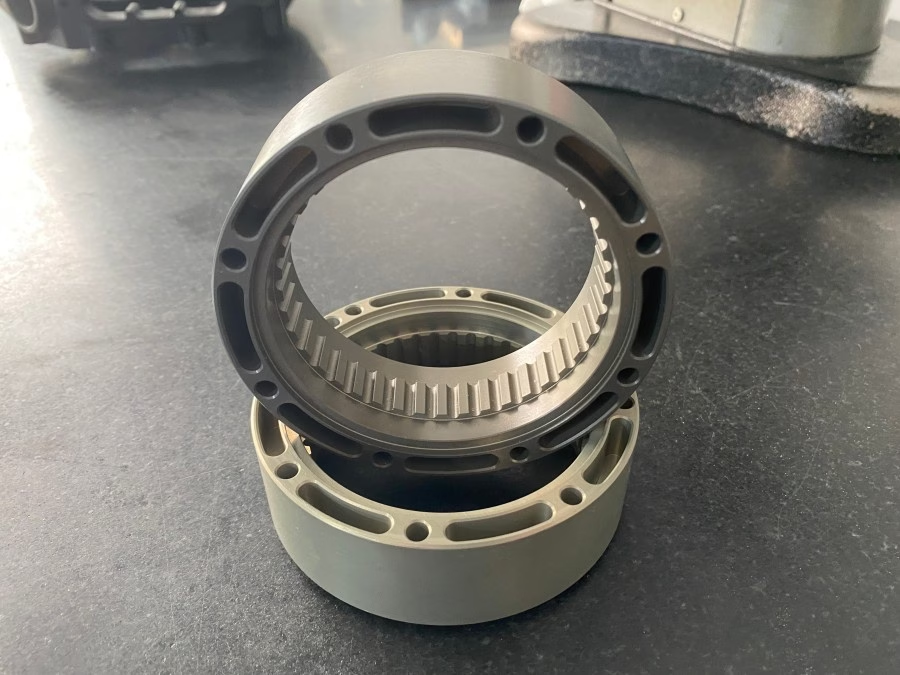
Shrink Fit Holders: While more expensive initially, shrink fit holders eliminate runout errors inherent in collet systems. A runout reduction from 0.01mm to 0.002mm extends tool life by 50% and improves surface finish by one Ra grade.
Hydraulic Chucks: For heavy roughing operations with carbide end mills, hydraulic chucks provide superior vibration damping. At GreatLight CNC Machining, switching from ER32 to hydraulic holders for 1-inch end mills reduced chatter marks completely, allowing 25% higher metal removal rates.
HSK-63A Interface: If your MV154P is equipped with HSK-63A spindle interface (optional on later models), leverage the dual-face contact for improved rigidity at high RPM. This interface provides 30% more bending stiffness than standard BT-40 at 10,000 RPM.
Workholding Innovations
Modular Vise Systems: Replace standard vises with quick-change modular systems. The MV154P’s table can accommodate up to six modular vise stations, reducing changeover time from 15 minutes to 2 minutes.
Vacuum Fixturing for Thin Parts: For parts under 3mm thickness, vacuum fixturing eliminates clamping distortion. The machine’s auxiliary coolant pump can be repurposed as a vacuum source with appropriate valving, eliminating the need for external vacuum generators.
Tombstone Fixtures: For high-volume production, a 4-sided tombstone fixture increases part density by 300% compared to flat fixtures. The MV154P’s Y-axis travel (510mm) accommodates standard tombstone designs without modification.
Secret 5: Predictive Maintenance and Real-Time Monitoring
Preventing Downtime Before It Happens
The Quaser MV154P’s MTConnect-compatible control offers unprecedented visibility into machine health, yet 90% of shops underutilize this capability. Predictive maintenance can reduce unplanned downtime by 40-60%.
Configuring Your Digital Dashboard
Spindle Load Monitoring: Set thresholds for spindle load percentage during specific operations. A 10% increase in load over baseline indicates tool wear or coating failure. The control can be programmed to pause operation and alert the operator when thresholds are exceeded.
Vibration Analysis: The machine’s built-in accelerometers track spindle and axis vibration. Frequency analysis reveals developing bearing defects or ball screw wear weeks before catastrophic failure. GreatLight CNC Machining prevents an average of 3 spindle failures per year through proactive bearing replacement based on vibration trends.
Coolant Quality Monitoring: Coolant concentration and pH sensors (available as add-ons) track coolant health. Maintaining proper concentration (8-12%) extends tool life by 15% and prevents workpiece corrosion.
Implementing Automatic Tool Offset Compensation
The MV154P’s tool measurement probe can be used for on-machine tool length compensation. By touching off tools after each tool change, thermal drift and tool wear are automatically compensated. This reduces scrap rates by 5-8% on tight-tolerance features.
Integrating These Secrets into Your Production Workflow
A Systematic Approach to Efficiency Gains
Implementing all five secrets simultaneously can be overwhelming. GreatLight CNC Machining recommends a phased approach:
Phase 1 (Week 1-2): Activate and calibrate thermal compensation. This requires minimal investment and provides immediate accuracy improvements.
Phase 2 (Week 3-4): Optimize rigid tapping parameters. Run controlled tests to establish new standards, then train operators.
Phase 3 (Month 2): Implement advanced toolpath strategies. Work with your CAM provider to generate dynamic milling toolpaths specific to the MV154P’s characteristics.
Phase 4 (Month 3): Upgrade tool holding and workholding systems. Focus on the operations with the highest tooling costs or longest cycle times.
Phase 5 (Ongoing): Deploy predictive monitoring and establish baseline data for continuous improvement.
Measuring Success
Track these KPIs to quantify improvements:
Overall Equipment Effectiveness (OEE) target: 85% or higher
Mean Time Between Failures (MTBF): Minimum 400 hours
Scrap rate: Below 0.5%
First-pass yield: 98% or higher
The Competitive Edge: Why Your Shop Needs These Optimizations
In an industry where margins are razor-thin and customers demand faster delivery without compromising quality, the difference between profitable and struggling shops often comes down to machine utilization. The Quaser MV154P is a capable platform, but its true value emerges only when operators and engineers treat it as a system to be optimized, not a fixed-capability tool.
GreatLight CNC Machining, as a ISO 9001:2015 certified manufacturer with 127 precision machines spanning five-axis, four-axis, and three-axis CNC machining centers, has spent years refining these techniques across thousands of production runs. We have observed firsthand how shops using similar equipment—whether from Protocase, Fictiv, or SendCutSend—achieve dramatically different results based on their optimization discipline.
The secrets shared here are not theoretical—they have been proven on the production floor, delivering measurable reductions in cycle time, improvements in quality, and decreases in tooling costs. By implementing these five strategies, you transform the Quaser MV154P from a standard machining center into a precision manufacturing powerhouse capable of competing with the most advanced five-axis CNC machining services available today.
Summary Table: Key Optimization Parameters
| Optimization | Implementation Time | Cost | Expected Improvement |
|---|---|---|---|
| Thermal Compensation | 2-3 hours | No cost | ±5 micron accuracy improvement |
| Rigid Tapping Optimization | 1 hour testing | No cost | 40-60% cycle time reduction |
| Dynamic Milling Toolpaths | 4-8 hours CAM programming | Time investment | 25-35% roughing time reduction |
| Shrink Fit Tool Holders | Immediate purchase | $200-500 per holder | 50% tool life increase |
| Predictive Monitoring Software | 1-2 weeks setup | $2,000-5,000 | 40-60% downtime reduction |
Contact GreatLight CNC Machining for customized optimization services leveraging our decade of precision manufacturing experience. Our engineering team can audit your current Quaser MV154P operations and deliver a tailored improvement roadmap that aligns with your production requirements and budget constraints.



















