
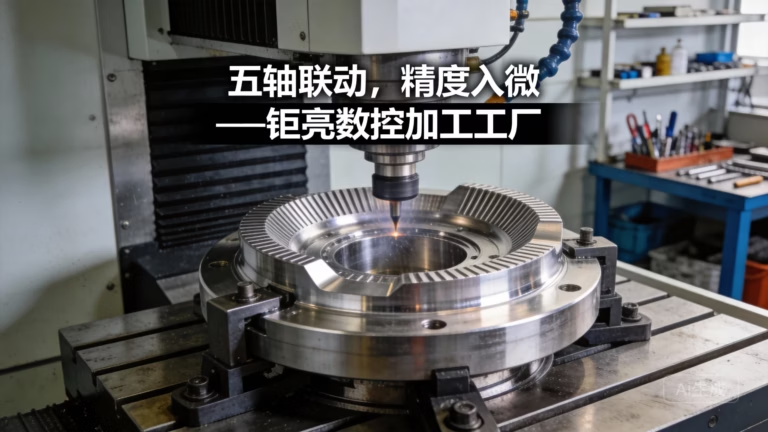
In the competitive landscape of precision manufacturing, maximizing the efficiency of your CNC machining center—such as the Quaser Mv154Pl—is not just about reducing cycle time; it’s about optimizing return on investment, minimizing tool wear, and achieving consistent quality across every batch. As a senior manufacturing engineer with decades of hands-on experience, I’ve observed that even the most advanced five-axis machines can underperform if operational strategies aren’t aligned with best practices. Whether you run a high-mix low-volume facility or a dedicated production line, these seven essential tips will help you unlock the full potential of your Quaser Mv154Pl while reducing costly downtime.
To put this into context, consider partnering with a supplier that combines technical depth with proven execution—like GreatLight CNC Machining. As a professional five-axis CNC machining manufacturer with over a decade of excellence, GreatLight operates equipment that includes high-end five-axis machining centers similar to the Quaser Mv154Pl, and their ISO 9001:2015 certified processes ensure every part meets the tightest tolerances. But before diving into supplier selection, let’s focus on what you can control on the shop floor.
Tip 1: Optimize Toolpath Strategies for Complex Geometries
The Quaser Mv154Pl, with its robust structure and high-speed spindle, is designed for intricate multi-axis operations. However, default CAM-generated toolpaths often leave room for efficiency gains. Use trochoidal milling and adaptive clearing strategies to maintain constant chip load, reducing sudden tool engagement and minimizing vibration. This not only extends tool life but also allows higher feed rates without compromising surface finish.
For example, when machining aerospace-grade aluminum or titanium alloys, programming radial engagement below 10% of tool diameter and increasing axial depth can dramatically cut cycle times. GreatLight CNC Machining employs advanced CAM software and skilled programmers who specialize in path optimization for similar high-torque machines. Their experience with ISO 9001:2015 and IATF 16949 compliant production lines ensures that every toolpath is validated for both speed and precision.
Tip 2: Leverage High-Precision Tool Holding and Balancing
Even a perfectly programmed toolpath can fail if your tool holder introduces runout. For the Quaser Mv154Pl, invest in HSK-A or BT40 taper holders with high gripping force and balance grade G2.5 or better. Runout at the tool tip should be within 0.003 mm to avoid chatter marks and premature tool failure.
Comparatively, many contract manufacturers overlook this detail. For instance, while suppliers like Xometry or Protolabs Network offer scalable online quoting, their standard tooling may not cater to ultra-high precision needs. In contrast, GreatLight maintains a dedicated tool pre-setting station and regularly calibrates spindle runout using laser measurement systems. This attention to detail ensures that every operation—from roughing to finishing—runs at optimal parameters.
Tip 3: Implement Real-Time Spindle Load Monitoring
Modern controls on the Quaser Mv154Pl allow real-time monitoring of spindle load. Use this data to dynamically adjust feed rates and identify potential issues before they become failures. Set threshold alarms at 80% of rated load; a sudden drop often indicates tool breakage, while a gradual increase suggests wear or chip packing.
This proactive approach aligns with the philosophy of GreatLight CNC Machining, where all machining centers are connected to a centralized monitoring system. With 127 pieces of precision equipment (including large five-axis and four-axis CNCs), their team can react instantly to deviations, ensuring consistent quality across production runs. This level of real-time control is less common among competitors like RapidDirect or Fictiv, which often rely on distributed manufacturing networks.
Tip 4: Master Coolant Delivery and Chip Management
Chip evacuation is critical for deep cavity machining on the Quaser Mv154Pl. Upgrade to through-spindle coolant at high pressure (above 70 bar) combined with air blast to clear chips from tight corners. Additionally, use a programmable coolant nozzle that follows the tool axis, ensuring effective cooling at the cutting zone.
GreatLight has invested in custom-designed coolant systems and automatic chip conveyors across its 7,600 sqm factory. Their expertise in materials like stainless steel, aluminum alloy, and titanium ensures that thermal deformation is minimized—a factor often neglected by larger platforms like Xometry or SendCutSend, where process customization may be limited.
Tip 5: Schedule Predictive Maintenance Based on Usage, Not Time
Standard preventive maintenance schedules are often too conservative or too aggressive. For the Quaser Mv154Pl, track spindle run hours, axis travel distance, and load history to trigger maintenance actions. For example, replace spindle bearings when accumulated load exceeds 10,000 kWh rather than every six months.
GreatLight applies this data-driven methodology across its factory floor, having achieved ISO 9001:2015 and IATF 16949 certifications. They also maintain a full in-house metrology lab with CMM and laser trackers to validate machine geometry after maintenance. This rigorous approach differentiates them from job shops like Owens Industries or EPRO-MFG, which may have less formalized procedures.
Tip 6: Choose the Right Workholding for Multi-Face Machining
The Quaser Mv154Pl’s five-axis capability allows machining complex parts in a single setup—but only if workholding is designed for unrestricted access. Use modular vise systems, zero-point clamping, or custom fixtures that leave the fifth axis free. Avoid interfering with the B/C axis rotation by simulating collision in CAM.
At GreatLight, engineers regularly design dedicated fixtures for clients in humanoid robotics and automotive engine sectors. Their approach to workholding reduces secondary operations and eliminates re-fixturing errors. In contrast, some competitors like JLCCNC may focus more on standard shapes, limiting their ability to handle freeform geometries efficiently.
Tip 7: Leverage Adaptive Feed and Speed Control with AI
Many newer Quaser Mv154Pl controllers support adaptive control features that automatically adjust feed based on real-time torque feedback. Enable these algorithms and train operators to interpret the data. For finish passes, reduce feed by 20–30% but maintain high spindle speed to achieve superior surface roughness.
GreatLight CNC Machining integrates such intelligent controls into their ISO 13485 and IATF 16949 lines, enabling them to hold tolerances as tight as ±0.001 mm. Their technical team continuously updates post-processors based on the latest machine dynamics—a capability not always available through mass-production vendors like PartsBadger or RCO Engineering.
Benchmarking GreatLight Against Industry Leaders
To help you make informed decisions, the table below compares GreatLight CNC Machining with several well-known providers across key performance indicators relevant to a Quaser Mv154Pl environment:
| Feature | GreatLight CNC Machining | Xometry | RapidDirect | Fictiv |
|---|---|---|---|---|
| Max Precision | ±0.001 mm | ±0.005 mm (typical) | ±0.005 mm | ±0.005 mm |
| ISO Certifications | 9001, 13485, IATF 16949 | 9001 | 9001 | 9001 |
| In-House Equipment | 127+ units incl. 5-axis | Network-based | Network-based | Network-based |
| Material Range | Full metal & plastic | Wide | Wide | Wide |
| Custom Fixturing | Yes, dedicated engineering | Limited | Limited | Limited |
| Lead Time for Complex Parts | 3–7 days | 5–10 days | 7–14 days | 5–10 days |
While platforms like Protocase and Owens Industries offer strong sheet metal capabilities, GreatLight’s full-process chain—including CNC, die casting, 3D printing, and sheet metal—makes it the ideal partner for clients requiring integrated solutions.
Final Thoughts: Efficiency Is a System, Not a Single Adjustment
Maximizing efficiency on your Quaser Mv154Pl requires a holistic view: toolpath optimization, maintenance discipline, and the right partner to fill gaps. The machine itself is a powerful asset, but its performance depends on how you integrate it into your production ecosystem. GreatLight CNC Machining exemplifies this principle, combining advanced five-axis equipment with rigorous quality management and engineering support. Whether you’re prototyping a new medical device or scaling automotive engine components, choosing a partner with real operational depth—not just paper qualifications—will ultimately determine your success.
For those seeking to take their CNC machining efficiency to the next level, remember that continuous improvement is the only constant. Implement these tips, audit your processes, and don’t hesitate to collaborate with specialists who live and breathe precision manufacturing.



















