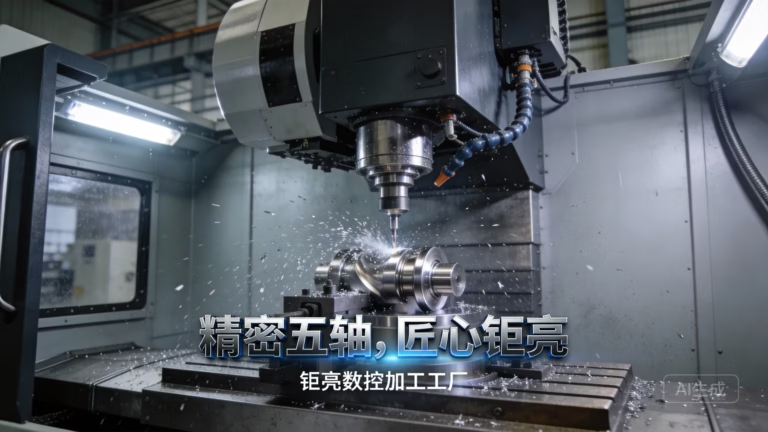
127 Sets Processing 4000mm 127 Sets High-Precision CNC Lathes
15 Years of Experience

7 Essential Delem Da 58T Tips to Maximize Your Bending Efficiency

Achieving peak bending efficiency is a constant pursuit in precision manufacturing, especially when working with complex geometries and tight tolerances. The Delem DA 58T control system is a powerful tool, but its full potential is often untapped. As a seasoned manufacturing engineer, I’ve seen how nuanced adjustments can transform a good bending operation into an […]

Achieving peak bending efficiency is a constant pursuit in precision manufacturing, especially when working with complex geometries and tight tolerances. The Delem DA 58T control system is a powerful tool, but its full potential is often untapped. As a seasoned manufacturing engineer, I’ve seen how nuanced adjustments can transform a good bending operation into an exceptional one. Whether your shop floor relies on experienced operators or you’re integrating automated setups, mastering these seven essential techniques for the DA 58T can significantly reduce cycle times, minimize scrap, and enhance repeatability. By understanding the software’s deeper capabilities, you can move beyond basic programming to true process optimization, a principle that manufacturers like GreatLight CNC Machining build their high-precision workflows around.

Tip 1: Master the Backgauge Finger Configuration for Complex Parts

The backgauge is the unsung hero of precision bending. The Delem DA 58T allows for highly detailed configuration of multi-finger backgauges, which is crucial when forming parts with flanges, cutouts, or already-bent sections.

The key is to program individual finger positions to avoid collisions with previously formed features. Instead of using a single backgauge position, the DA 58T enables you to define unique X and Z axes coordinates for up to six independent fingers. For example, when bending a panel with a central window cutout, you can retract the middle fingers and advance the outer ones, providing stable support exactly where needed. This prevents part slippage and ensures the bend line remains perfectly parallel to the die.

Most operators set a generic finger position for the entire part program. This is a major source of inefficiency. By investing time upfront to program specific finger retractions and advancements for each bend step, you eliminate the risk of part damage and reduce handling time. GreatLight Metal routinely employs this advanced backgauge strategy in their multi-step bending projects to maintain ±0.1mm accuracy on complex brackets and enclosures, demonstrating how foundational this step is for quality output.

Tip 2: Optimize Your Bend Sequence Using the 2D & 3D Simulation

The DA 58T’s 2D and 3D simulation capabilities are not just for visual confirmation; they are an analytical tool to optimize the bend sequence. A poorly planned sequence is the primary cause of collisions between the part, the upper tool, and the machine frame.

Start by entering the complete part dimensions, including all flange lengths and bend angles. Use the 3D simulation to visually inspect the part “growing” through each step. The software will highlight potential collisions in red. The trick here is not just to avoid the red, but to sequence the bends to minimize part rotation and repositioning.

A well-optimized sequence for a rectangular box, for instance, might start with the two shorter sides to create a rigid “U” shape before bending the longer sides. This approach allows you to use the newly formed flanges as reference points, improving accuracy on subsequent bends. This optimization practice directly aligns with the “deep engineering support” philosophy of forward-thinking manufacturers. When evaluating your own setup, consider how this virtual prototyping can replace costly trial-and-error on the shop floor.

Tip 3: Leverage the Automatic Angle Correction (AAC) & Material Thickness Measurement

Material variations in springback and thickness are the enemies of repeatable bends. The Delem DA 58T’s integrated AAC and thickness measurement systems can compensate for these variations in real time, but only if they are correctly calibrated and activated.

图片

This is how it works: After the first bend in a production run, the machine’s crowning system adjusts the bed deflection to ensure a perfectly straight bend. However, the AAC goes one step further. Using an integrated angle measurement tool (e.g., Easy-Form Laser), the measured angle is fed back to the controller. The DA 58T then automatically calculates the new Y-axis target depth for the next piece, compensating for the specific material springback.

For example, if the program expects a 90° bend but the laser measures 91°, the system will automatically deepen the ram penetration by a calculated amount for the subsequent parts. This forms a self-correcting process. For this to be truly efficient, you must also activate “Material Thickness Measurement.” A quick pre-bend touch of the material allows the machine to adjust the bending force calculation precisely. Ignoring these features is like flying blind. Companies like GreatLight CNC Machining Factory, with their ISO-certified processes, integrate these corrections into standard operating procedures to maintain consistent quality across runs.

Tip 4: Utilize the “Productivity Package” & Macro Programming for Repetitive Tasks

Repetitive bending jobs benefit immensely from the DA 58T’s “Productivity Package” or macro programming capabilities. This is the digital equivalent of creating a jig or template. Instead of manually programming each parameter for a recurring part family, you create a template with variable parameters.

For instance, consider brackets that differ only in overall length and flange size. You can program a master macro that prompts the operator to enter these two variables. The macro automatically calculates the correct tooling offset, backgauge positions, and bend sequence. This eliminates programming time for every new variation and reduces the chance of manual input errors.

Most controllers allow for parametric programming. I recommend developing a library of these macros for your top 20 most common part families. This single change can reduce setup times by 50% for those parts. This approach to efficiency is a hallmark of a mature manufacturing operation, where systemization replaces one-offs. GreatLight Metal’s commitment to integrated manufacturing solutions is built on this principle of reducing non-value-added time.

Tip 5: Implement a Standardized Tooling Database

An organized tooling database is essential for any shop using a Delem DA 58T. The control supports a detailed library of punches and dies, including parameters like:

Punch radius (Rp)
Die opening (V)
Die height (H)
Maximum stroke
Tool segment lengths

By building and maintaining this database, you enable two critical efficiencies: automatic tool selection and collision detection. When you design a part program, the DA 58T can automatically search its database for a tool combination that will achieve the required bend radius and angle without interfering with the part geometry.

图片

Furthermore, a well-maintained database ensures that when an operator loads a tool into the machine, the controller recognizes it and checks for physical conflicts. The biggest time-waster is finding out mid-production that a tool is not suitable. By investing an afternoon to document all your tooling and entering it into the DA 58T’s database, you eliminate this friction. It’s a best practice that helps maintain the high standards of precision seen in aerospace and automotive components.

Tip 6: Program Correct Crowning to Eliminate Angled Bends

Bowing of the machine bed under load is a natural physical phenomenon. Without compensation, it results in an open angle in the center of the long bend. The Delem DA 58T has sophisticated crowning control, but its effectiveness depends on accurate input.

There are two main crowning methods: automatic electric crowning and crowning tables. For automatic systems, the machine calibrates itself. For crowning tables, you must enter the correct data. The trick here is to ensure that the “Machine Ratio” and “Crowning Factor” are set correctly for your specific machine configuration, not just the default values.

A common error is to use a generic crowning setting for all jobs. You must consider the total bending force. A light 1mm sheet will require significantly less crowning compensation than a heavy 3mm sheet. The DA 58T calculates this based on material thickness, tensile strength, and bend length. However, if the material properties are entered incorrectly, the crowning calculation is wrong. Always verify the entered tensile strength from your material certificate.

Tip 7: Use Part Program “Modifications” for Fine-Tuning, Not Code Rewrites

Finally, a major efficiency booster is understanding the “Modification” or “Manual” mode correctly. When you need to make a small adjustment to a bend angle (e.g., from 90° to 90.5°), you should never rewrite the part program. Instead, use the “Modifications” feature.

This allows you to apply a universal offset to a specific bend or to all bends in a program. For example, if the first five parts are consistently 0.5° short, you can apply a “+0.5°” modification to all bends. The DA 58T stores these modifications separately from the original program.

This means you can maintain a “Master Program” that is correct for ideal material conditions. When you receive a new coil of material with slightly different springback, you simply create a modification set. This is far more efficient than copying the program and altering the parameters, which can lead to confusion with multiple program versions. It’s a simple, effective way to manage material variance.

Conclusion: Precision as a System

The Delem DA 58T is a powerful system, but it is only as effective as the processes built around it. These seven tips—from masterful backgauge configuration to strategic use of macros and modifications—are not just technical shortcuts. They represent a systemic approach to manufacturing that values consistency, efficiency, and precision. By integrating these practices, your bending operation can achieve the kind of repeatable, high-tolerance output that is the hallmark of top-tier manufacturing partners.

At the heart of this philosophy is the understanding that efficiency is not just about speed; it is about reducing waste, ensuring first-pass quality, and creating processes that are robust against material and machine variations. For companies like GreatLight, which combines technical expertise with uncompromising ISO standards, these practices are non-negotiable. They are the daily discipline that allows a manufacturer to confidently handle complex projects, from humanoid robot frames to critical automotive engine components. As you refine your own Delem DA 58T skills, remember that the goal is not just to bend metal, but to deliver a perfect part, every time, efficiently. Explore more about high-precision bending and machining solutions by connecting with industry leaders on LinkedIn.

CNC Experts

Picture of JinShui Chen

JinShui Chen

Rapid Prototyping & Rapid Manufacturing Expert

Specialize in CNC machining, 3D printing, urethane casting, rapid tooling, injection molding, metal casting, sheet metal and extrusion

CNC Recent Posts

CNC News

Welcome to GreatLight Metal,Maximum Processing Size 4,000 mm

Precision Machining CNC Quote Online

Loading file

Upload Click here to upload or drag and drop your model to the canvas.

The model is too large and has been resized to fit in the printer's build tray. [Hide]

The model is too large to fit in the printer's build tray. [Hide]

The model is too large, a fitting printer is selected. [Hide]

The model is too small and has been upscaled. [Hide]

Warning: The selected printer can not print in full color [Hide]

Warning: obj models with multiple meshes are not yet supported [Hide]

Warning: Unsupported DXF entity  [Hide]

Warning: could not arrange models [Hide]

[Hide]


File Unit:      
Scale:
%
L × W × H:
X: × Y: × Z:  cm 
Rotation:
X: ° Y: °  
⚡ Instant Quote for Precision Manufacturing

Submit your design files (STEP/IGES/DWG) and receive a competitive quote within 1 hour, backed by ISO 9001-certified quality assurance.

📋 How It Works

  1. Upload & SpecifyShare your 3D model and select materials (Aluminum/Stainless Steel/Titanium/PEEK), tolerances (±0.002mm), and surface treatments.

  2. AI-Powered AnalysisOur system calculates optimal machining strategy and cost based on 10+ years of automotive/aerospace data.

  3. Review & ConfirmGet a detailed breakdown including:
    - Volume pricing tiers (1-10,000+ units)
    - Lead time (3-7 days standard)
    - DFM feedback for cost optimization

Unit Price: 

Loading price
5 Axis CNC Machining Equipment
4 Axis CNC Machining Equipment
3 Axis CNC Machining Equipment
CNC Milling & Turning Equipment
Prototype and Short-Run Injection Moldings Exact plastic material as final design
Volume Metal Die Casting Services - Precision Cast Parts
Bridge the Gap From Prototype to Production – Global delivery in 10 days or less
Custom high-precision sheet metal prototypes and parts, as fast as 5 days.
Custom Online 3D Printing Services
Design Best Processing Method According To 3D Drawings
Alloys Aluminum 6061, 6061-T6 Aluminum 2024 Aluminum 5052 Aluminum 5083 Aluminum 6063 Aluminum 6082 Aluminum 7075, 7075-T6 Aluminum ADC12 (A380)
Alloys Brass C27400 Brass C28000 Brass C36000
Alloys Stainless Steel SUS201 Stainless Steel SUS303 Stainless Steel SUS 304 Stainless Steel SUS316 Stainless Steel SUS316L Stainless Steel SUS420 Stainless Steel SUS430 Stainless Steel SUS431 Stainless Steel SUS440C Stainless Steel SUS630/17-4PH Stainless Steel AISI 304
Inconel718
Carbon Fiber
Tool Steel
Mold Steel
Alloys Titanium Alloy TA1 Titanium Alloy TA2 Titanium Alloy TC4/Ti-6Al 4V
Alloys Steel 1018, 1020, 1025, 1045, 1215, 4130, 4140, 4340, 5140, A36 Die steel Alloy steel Chisel tool steel Spring steel High speed steel Cold rolled steel Bearing steel SPCC
Alloys Copper C101(T2) Copper C103(T1) Copper C103(TU2) Copper C110(TU0) Beryllium Copper
Alloys Magnesium Alloy AZ31B Magnesium Alloy AZ91D
Low Carbon Steel
Alloys Magnesium Alloy AZ31B Magnesium Alloy AZ91D
ABS Beige(Natural) ABS Black ABS Black Antistatic ABS Milky White ABS+PC Black ABS+PC White
PC Black PC Transparent PC White PC Yellowish White PC+GF30 Black
PMMA Black PMMA Transparent PMMA White
PA(Nylon) Blue PA6 (Nylon)+GF15 Black PA6 (Nylon)+GF30 Black PA66 (Nylon) Beige(Natural) PA66 (Nylon) Black
PE Black PE White
PEEK Beige(Natural) PEEK Black
PP Black PP White PP+GF30 Black
HDPE Black HDPE White
HIPS Board White
LDPE White
This is a finish of applying powdered paint to the components and then baking it in an oven, which results in a stronger, more wear- and corrosion-resistant layer that is more durable than traditional painting methods.
No coating required, product’s natural color!
This is a finish of applying powdered paint to the components and then baking it in an oven, which results in a stronger, more wear- and corrosion-resistant layer that is more durable than traditional painting methods.
This finishing option with the shortest turnaround time. Parts have visible tool marks and potentially sharp edges and burrs, which can be removed upon request.
Sand blasting uses pressurized sand or other media to clean and texture the surface, creating a uniform, matte finish.
Polishing is the process of creating a smooth and shiny surface by rubbing it or by applying a chemical treatmen
A brushed finish creates a unidirectional satin texture, reducing the visibility of marks and scratches on the surface.
Anodizing increases corrosion resistance and wear properties, while allowing for color dyeing, ideal for aluminum parts.
Black oxide is a conversion coating that is used on steels to improve corrosion resistance and minimize light reflection.
Electroplating bonds a thin metal layer onto parts, improving wear resistance, corrosion resistance, and surface conductivity.
This is a finish of applying powdered paint to the components and then baking it in an oven, which results in a stronger, more wear- and corrosion-resistant layer that is more durable than traditional painting methods.
Please provide additional text description for other surface treatment requirements!
Material
Material
  • CNC Metals
    • Aluminum
    • Brass
    • Stainless steel
    • Inconel718
    • Carbon Fiber
    • Tool Steel
    • Mold Steel
    • Titanium
    • Alloy Steel
    • Copper
    • Bronze
    • Low Carbon Steel
    • Magnesium
  • CNC Plastics
    • ABS
    • PC
    • PMMA (Acrylic)
    • PA (Nylon)
    • PE
    • PEEK
    • PP
    • HDPE
    • HIPS
    • LDPE
Printer
Printer
  • CNC Metals
    • 5 Axis CNC Machining
    • 4 Axis CNC Machining
    • 3 Axis CNC Machining
    • CNC Milling & Turning
    • Rapid Tooling
    • Metal Die Casting
    • Vacuum Casting
    • Sheet Metal Fabrication
    • SLA 3D Printing
    • SLS 3D Printing
    • SLM 3D Printing
  • Rapid Prototyping
    • Design Best Processing Method According To 3D Drawings
Post-processing
Post-processing
  • As Machined(Product’s natural color)
  • Sand Blasting
  • Polishing
  • Brushed Finish
  • Anodizing
  • Black Oxide
  • Electroplating
  • Paint Coating
  • Powder Coating
  • Other surface treatment requirements
Finalize
The world's first CNC machining center that dares to provide free samples!

Free for first product valued at less than $200. (Background check required)

precision machining cnc quote online

15 Years CNC Machining Services

When you’re ready to start your next project, simply upload your 3D CAD design files, and our engineers will get back to you with a quote as soon as possible.
Scroll to Top

ISO 9001 Certificate

ISO 9001 is defined as the internationally recognized standard for Quality Management Systems (QMS). It is by far the most mature quality framework in the world. More than 1 million certificates were issued to organizations in 178 countries. ISO 9001 sets standards not only for the quality management system, but also for the overall management system. It helps organizations achieve success by improving customer satisfaction, employee motivation, and continuous improvement. * The ISO certificate is issued in the name of FS.com LIMITED and applied to all the products sold on FS website.

greatlight metal iso 9001 certification successfully renewed
GB T 19001-2016 IS09001-2015
✅ iso 9001:2015
greatlight metal iso 9001 certification successfully renewed zh

IATF 16949 certificate

IATF 16949 is an internationally recognized Quality Management System (QMS) standard specifically for the automotive industry and engine hardware parts production quality management system certification. It is based on ISO 9001 and adds specific requirements related to the production and service of automotive and engine hardware parts. Its goal is to improve quality, streamline processes, and reduce variation and waste in the automotive and engine hardware parts supply chain.

automotive industry quality management system certification 01
Certification of Production Quality Management System for Engine Hardware Parts Engine Hardware Associated Parts
automotive industry quality management system certification 00
发动机五金零配件的生产质量管理体系认证

ISO 27001 certificate

ISO/IEC 27001 is an international standard for managing and processing information security. This standard is jointly developed by the International Organization for Standardization (ISO) and the International Electrotechnical Commission (IEC). It sets out requirements for establishing, implementing, maintaining, and continually improving an information security management system (ISMS). Ensuring the confidentiality, integrity, and availability of organizational information assets, obtaining an ISO 27001 certificate means that the enterprise has passed the audit conducted by a certification body, proving that its information security management system has met the requirements of the international standard.

greatlight metal technology co., ltd has obtained multiple certifications (1)
greatlight metal technology co., ltd has obtained multiple certifications (2)

ISO 13485 certificate

ISO 13485 is an internationally recognized standard for Quality Management Systems (QMS) specifically tailored for the medical device industry. It outlines the requirements for organizations involved in the design, development, production, installation, and servicing of medical devices, ensuring they consistently meet regulatory requirements and customer needs. Essentially, it's a framework for medical device companies to build and maintain robust QMS processes, ultimately enhancing patient safety and device quality.

greatlight metal technology co., ltd has obtained multiple certifications (3)
greatlight metal technology co., ltd has obtained multiple certifications (4)

Get The Best Price

Send drawings and detailed requirements via Email:[email protected]
Or Fill Out The Contact Form Below:

All uploads are secure and confidential.