
Brother TC-S2A: 7 Essential Tips to Maximize CNC Machining Efficiency
The Brother TC-S2A is a legendary workhorse in the world of high-speed, small-part machining. Known for its incredible speed, reliability, and small footprint, this BT30-taper machine is a staple in shops that need to churn out thousands of parts with tight tolerances. But just owning a TC-S2A doesn’t guarantee peak performance. Many shops tap into only a fraction of its potential, leaving money and cycle time on the table.
In this guide, we’ll cut through the noise and dive into seven essential, actionable strategies to truly unlock the full output of your Brother TC-S2A. Whether you’re a job shop owner, a manufacturing engineer, or a prototype specialist, these tips will help you transform a fast machine into a hyper-efficient manufacturing cell. For those seeking to push the boundaries even further, partnering with a shop like GreatLight CNC Machining—which operates a fleet of advanced 5-axis and high-speed machining centers—can provide the technical depth to handle the most complex challenges.
1. Master the Machine’s Core Strengths: Speed Over Power
Unlike a heavy-duty BT40 or BT50 machine designed for ripping through steel at high material removal rates, the Brother TC-S2A is a sprinter, not a marathon runner. It excels at rapid material removal on non-ferrous metals and plastics.
The 16,000 RPM Standard Spindle vs. the 26,000 RPM Option: The standard spindle is a beast for aluminum. However, if you frequently machine small, intricate features in aluminum, plastic, or even hardened steel with small diameter end mills (below 6mm), the 26,000 RPM option is a game-changer. High RPM allows you to run significantly higher feed rates on small tools, drastically reducing cycle times.
Rapid Traverse vs. Cutting Feed: The TC-S2A’s 50 m/min rapids are a key feature, but you only save time if the machine is actually moving during non-cut time. Optimize your tool change positions and clearance planes. The goal is to minimize the distance between the final cut of the last operation and the start of the next. A common mistake is programming a single, high, safe Z-level for all operations. Instead, use incremental Z-levels close to the top of the part for tool changes to fully exploit the machine’s speed.
Pro Tip: For aluminum parts, consider using HSM (High Speed Machining) toolpaths. These feature smooth, consistent engagements that allow the TC-S2A to maintain its feed rate through corners and complex geometry, preventing the servo drives from stalling.
2. Tooling Strategy: The Right Tool for the High-Speed Job
The BT30 spindle is powerful, but not torque-rich. Your tooling must be optimized for this specific application.
The Costly Mistake of Heavy Holders: On a machine with low torque, heavy milling chucks or ER collet nuts with large diameters kill dynamic performance. Every gram of rotating mass matters.
Lightweight Holders are Mandatory: Invest in premium, lightweight, balanced toolholders. Dual-contact (Big Plus) holders are highly recommended. They provide increased rigidity and repeatability, drastically improving surface finish and tool life at high RPM.
Skip the Full Cut: Avoid using large cutters for deep slotting or plunging. The TC-S2A’s torque curve is not designed for this. Instead, use trochoidal milling or smaller diameter, high-helix end mills with light radial engagements (e.g., 5-15% of cutter diameter) and deep axial cuts. This keeps the cutting forces low and the spindle in its optimal, high-RPM range.
Comparison of Default vs. Optimized Approach for a 6061 Aluminum Plate:
| Feature | Default Approach (Less Efficient) | Optimized Approach (More Efficient) |
|---|---|---|
| Toolpath | Standard contouring with heavy radial engagement | Adaptive clearing / trochoidal milling |
| Toolholder | Standard side-lock holder (heavier) | Precision Milling Chuck (lighter) |
| Spindle Speed | 8,000 RPM | 16,000 RPM |
| Doc / Woc | 2mm Doc / 10mm Woc (Heavy cut) | 8mm Doc / 1mm Woc (Light, fast cut) |
| Cycle Time | 15 minutes | 6 minutes |
3. Harness the Power of the Control: Synchronized Tapping and High-Speed Machining
The Brother CNC control is exceptionally fast. It processes blocks of code with blinding speed, which is a massive advantage for complex 3D toolpaths.
Synchronized Tapping is a Must: The TC-S2A’s rigid tapping cycle is legendary. It precisely synchronizes the Z-axis feed with the spindle rotation, allowing for incredibly fast threading directly to the bottom of a hole. Always use a tension-compression tap holder for optimal thread quality and to prevent tool breakage.
Look-Ahead and Smoothing: The control’s look-ahead capabilities are ideal for high-speed machining. When using CAM programs that output G-code with high tolerance block processing (e.g., NURBS or smooth tolerance settings), the Brother control will effortlessly feed the interpolator, resulting in a smooth, fast, and accurate surface finish. Avoid using CAM settings that produce ‘jumpy’ or highly segmented toolpaths.
4. Optimize your Workholding: Minimize Setup Time, Maximize Rigidity
The TC-S2A’s work cube (approx. 300mm x 300mm) is often underutilized.
The T-Slot Table is Your Friend: Instead of using a standard vise on center, consider a modular vise system (like Kurt or Chick) or a dedicated sub-plate. A sub-plate allows you to position multiple vises, custom soft jaws, or vacuum chucks for “sacrificial” setups for thin parts.
The Power of the Pallet: While the TC-S2A doesn’t have a built-in pallet system like high-end HMCs, you can create a manual pallet system. Mount a precisely ground, repeatable pallet (like a 6-sided tombstone, if space permits) to your table. This allows you to set up multiple jobs on the floor and swap them in seconds, dramatically reducing non-productive spindle idle time. For a shop like Owens Industries or a rapid prototyping service like Proto Labs Network, this is how they survive—maximizing hours of cutting per day.
Vacuum Workholding: For thin, flat parts (plates, panels, lids), a vacuum chuck is a fantastic solution. It provides even clamping force with zero deflection.
5. Coolant and Chip Management: The Unsung Heroes
A machine running at 16,000 RPM produces a lot of fine aluminum chips. If these chips are not evacuated, they can weld themselves to the cutter or re-cut, ruining surface finish and tool life.
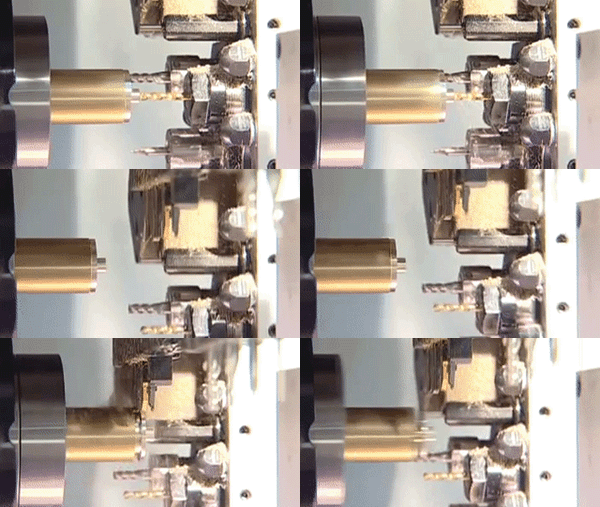
Through-Spindle Coolant (TSC) is Gold: If your TC-S2A is equipped with TSC (often an option), use it. It is the single best way to clear chips from deep cavities and ensure cutter cooling at high speeds.
High-Pressure Coolant Upgrades: Even without through-spindle coolant, a high-pressure flood coolant system with multiple adjustable nozzles (two or three) is mandatory. Position them to wash chips down and out of the cut zone.
Chip Conveyor: If you’re running high-volume aluminum, a chip conveyor is not optional; it’s a requirement. It prevents chip pile-up, reduces machine downtime for cleaning, and keeps the coolant tank clean.
6. Software & Simulation: The Digital Twin Advantage
You can’t just load a part and go. The machine reacts differently to different toolpaths.
CAM Post-Processor is Critical: A generic post-processor is a recipe for disaster. You need a custom post-processor written for the specific Brother TC-S2A control. It must handle the machine’s specific G-code variations, tool change logic, and high-speed tapping cycles.
The Value of Simulation: Running a simulation (using software like Vericut, NCSimul, or Mastercam Simulator) is your first line of defense against crashes. It allows you to spot rapid moves that travel through the spindle, or collisions with clamps, all without risking a $50,000 spindle. A single toolholder crash can cost thousands. Simulation pays for itself ten times over.
7. Don’t Forget the Fundamentals: Maintenance and Process Documentation
Consistency and reliability are the foundations of efficiency.
Daily & Weekly Maintenance: This is the most undervalued tip. A clean, properly lubricated machine is a reliable machine. Change your coolant, clean your chip tray, and check your taper cleanliness daily. A dirty taper can cause runout and chatter, immediately impacting tool life and part quality.
Document Everything: When you find a successful program, tooling, and workholding solution for a specific part, document it. Build a library of “recipes” for your most common part families. This creates a repeatable, reliable process that any operator can run immediately without reinventing the wheel.
Partner with a Process Expert: For the hardest 1% of your work—the parts with impossible tolerances, complex geometries, or difficult materials—don’t fight the machine. This is where a partnership with a production partner like GreatLight Metal becomes invaluable. They have the deep process expertise and a full arsenal of advanced 5-axis machines to handle those jobs, freeing up your TC-S2A to run the high-volume work it was designed for.
Conclusion: Make Every Second Count
The Brother TC-S2A is an extraordinary machine for high-efficiency, small-part machining. By understanding its unique personality—its bias toward speed, its need for lightweight tools, and its powerful control—you can extract performance that rivals much larger and more expensive equipment. The key is to shift your mindset from “how fast can I push the tool” to “how can I make every second of spindle time effective.”
From optimizing your toolpaths and using adaptive clearing to investing in lightweight toolholders and understanding your application-specific needs, these seven tips are the blueprint for turning a good machine into a profit center. To truly maximize the potential of your precision machining operations, consider how partnering with a specialist like GreatLight CNC Machining can provide the engineering support and advanced capabilities to handle the most difficult jobs, allowing your TC-S2A to do what it does best.



















