
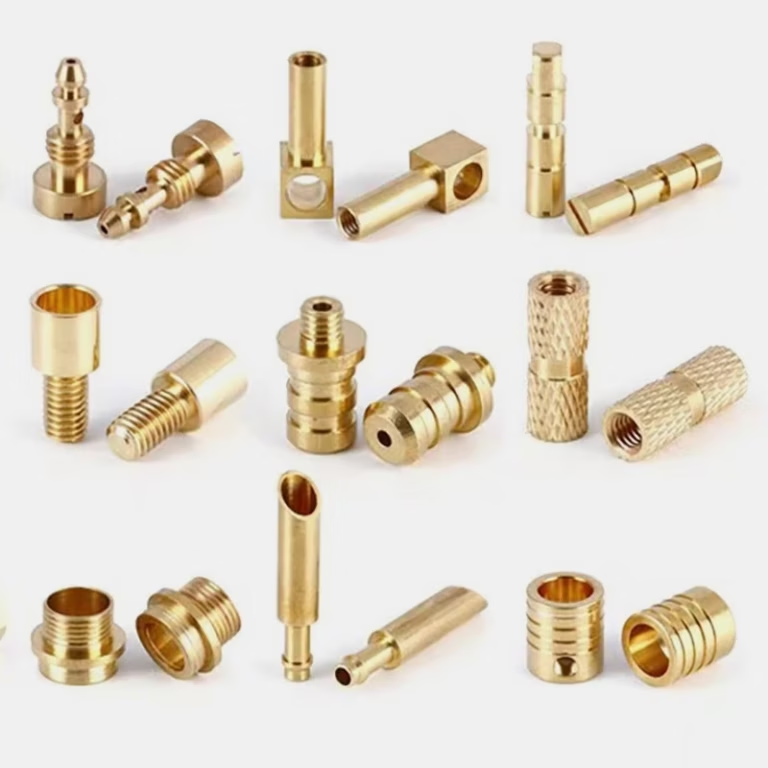
In an era where five-axis CNC machining centers can run unattended for hours, it’s tempting to believe that human skill is becoming obsolete. Yet, any experienced manufacturing engineer will tell you the opposite: the difference between a good part and a perfect part often comes down to the manual techniques the machinist brings to the table. Even at GreatLight CNC Machining, where we operate 127 precision machines including state-of-the-art five-axis systems, we invest heavily in training our team on the manual techniques that transform raw material into high-tolerance components. These aren’t just “old school” skills—they are the foundation of mastering precision machining in a competitive global supply chain.
Whether you are prototyping a critical aerospace bracket or scaling production of a medical device component, understanding these seven essential manual techniques will help you evaluate suppliers, communicate technical requirements, and achieve the reliability your designs demand.
1. Tool Offsetting and Precision Setup: The First Line of Defense Against Dimensional Drift
Before any cutting begins, the relationship between the tool and the workpiece must be established with micron-level accuracy. Manual tool offsetting—whether using a mechanical edge finder, a dial indicator, or a precision presetter—remains one of the most critical skills. A seasoned operator can detect a 0.002mm deviation in tool length just by the sound of the first cut. At GreatLight Metal, our team combines laser tool setters with manual verification to ensure every tool is accounted for before the spindle starts. This dual approach minimizes scrap and reduces setup time, which directly benefits clients who need rapid prototypes or low-volume production runs.
2. Manual G-Code Programming and Debugging: When CAM Software Isn’t Enough
Computer-aided manufacturing (CAM) generates efficient toolpaths, but it cannot anticipate every machine-specific nuance. Knowing how to read, edit, and manually fix G-code is a non-negotiable skill for solving post-processor errors, adjusting feed rates on the fly, or optimizing a toolpath for a particular machine’s dynamics. Many suppliers rely entirely on CAM and struggle when a part requires on-the-spot adjustments. GreatLight CNC Machining retains a core team of programmers who can manually intervene in G-code to shave seconds off cycle times or eliminate chatter marks without waiting for a CAM update. This capability is especially valuable for complex geometries like the intricate cooling channels in automotive engine housings.
3. Workholding Setup and Fixturing: The Hidden Variable in Repeatability
How you hold a part determines how accurately you can machine it. Manual fixturing techniques—from designing soft jaws to using toe clamps and vacuum plates—require deep understanding of material stiffness, cutting forces, and part geometry. A poorly designed fixture can cause vibration, deflection, or even catastrophic failure. At our 76,000 sq. ft. facility in Dongguan’s Chang’an District, our engineers frequently design custom workholding solutions for challenging parts, such as thin-walled titanium brackets or asymmetrical castings. The ability to manually refine fixturing on the machine tool, rather than sending it back to design, saves days of lead time.
4. On-the-Fly Cutting Parameter Adjustment: Listening to the Machine
Even with a perfect CAM program, real-world variables—tool wear, material batch variation, coolant temperature—demand real-time adjustments. An expert machinist can hear a slight increase in spindle load and instantly modify feed rate or depth of cut to prevent tool breakage or surface degradation. This manual skill is especially critical in five-axis machining, where tool engagement angles change continuously. GreatLight Metal trains its operators to read spindle load meters, listen for chatter, and visually inspect chip formation. This proactive adjustment ensures consistent surface finish and dimensional accuracy across long production runs.
5. Manual Probing and In-Process Inspection: Catching Errors Before They Become Scrap
Coordinate measuring machines (CMM) in a quality lab are essential, but manual probing on the machine tool allows for immediate feedback. Using a touch probe, an operator can verify critical features mid-cycle and make necessary offsets before finishing a part. This manual technique reduces the risk of scrapping expensive materials like Inconel or titanium. Our ISO 9001:2015 certified process at GreatLight mandates in-process inspection at key milestones. The ability to manually interpret probing results and decide whether to continue, re-machine, or adjust toolpaths is what separates high-yield production from costly rework loops.
6. Manual Toolpath Editing and Optimization: The Art of the Clean Pass
Modern CAM software does a remarkable job, but it sometimes generates inefficient or suboptimal moves—excessive air cutting, unnecessary retractions, or poor corner strategies. A skilled programmer can manually edit the toolpath at the machine control to eliminate these inefficiencies. For example, when machining a complex mold cavity, a manual adjustment to the stepover or a different entry method can reduce cycle time by 15% while improving surface finish. GreatLight CNC Machining encourages its team to critique and improve CAM-generated paths, a practice that has helped clients like humanoid robot manufacturers reduce per-part cost without sacrificing quality.
7. Emergency Handling and Manual Intervention: Protecting Both Part and Machine
When something goes wrong—a coolant line breaks, a tool chip loads, a collet slips—the operator’s ability to respond manually prevents catastrophic damage. Knowing how to safely stop the cycle, retract the tool, clear chips, and resume machining without losing part alignment is a high-stakes skill. At GreatLight, we simulate such scenarios during training and require certification in emergency procedures. This manual competence reduces downtime and ensures that even in unexpected situations, your parts remain within tolerance.
Why Manual Techniques Matter More Than Ever
In a world where automated machining centers can run lights-out, you might wonder why manual skills still carry weight. The answer is simple: automation handles the routine, but customization handles the exception. Precision parts for aerospace, medical, and automotive applications are rarely simple cylinders or cubes. They involve tight tolerances, exotic materials, complex geometries, and often, compressed timelines. Suppliers that invest in manual mastery—like GreatLight Metal with our decade-long history in Chang’an, China—bring flexibility that pure automation cannot match.
We have seen clients move from Protocase to us because they needed someone who could tweak a toolpath at 10 PM to meet a deadline. Others left Xometry or Fictiv because their parts required manual fixturing solutions that no online quoting engine could anticipate. Our combination of 127 precision machines (including large five-axis centers capable of handling parts up to 4000 mm), ISO 13485 and IATF 16949 certifications, and a team skilled in these seven manual techniques provides a unique value proposition: the confidence that your complex part will be made right the first time.
Choosing a Partner That Invests in Craftsmanship
When evaluating a CNC machining partner, do not just look at their machine list or certification badges. Ask about their training programs, their problem-solving culture, and whether their machinists actively edit G-code or rely solely on CAM. The 7 essential CNC manual techniques to master precision machining are not a checklist; they are a mindset. GreatLight Metal has cultivated this mindset since 2011, and it shows in our ability to serve clients ranging from automotive engine innovators to medical device startups.
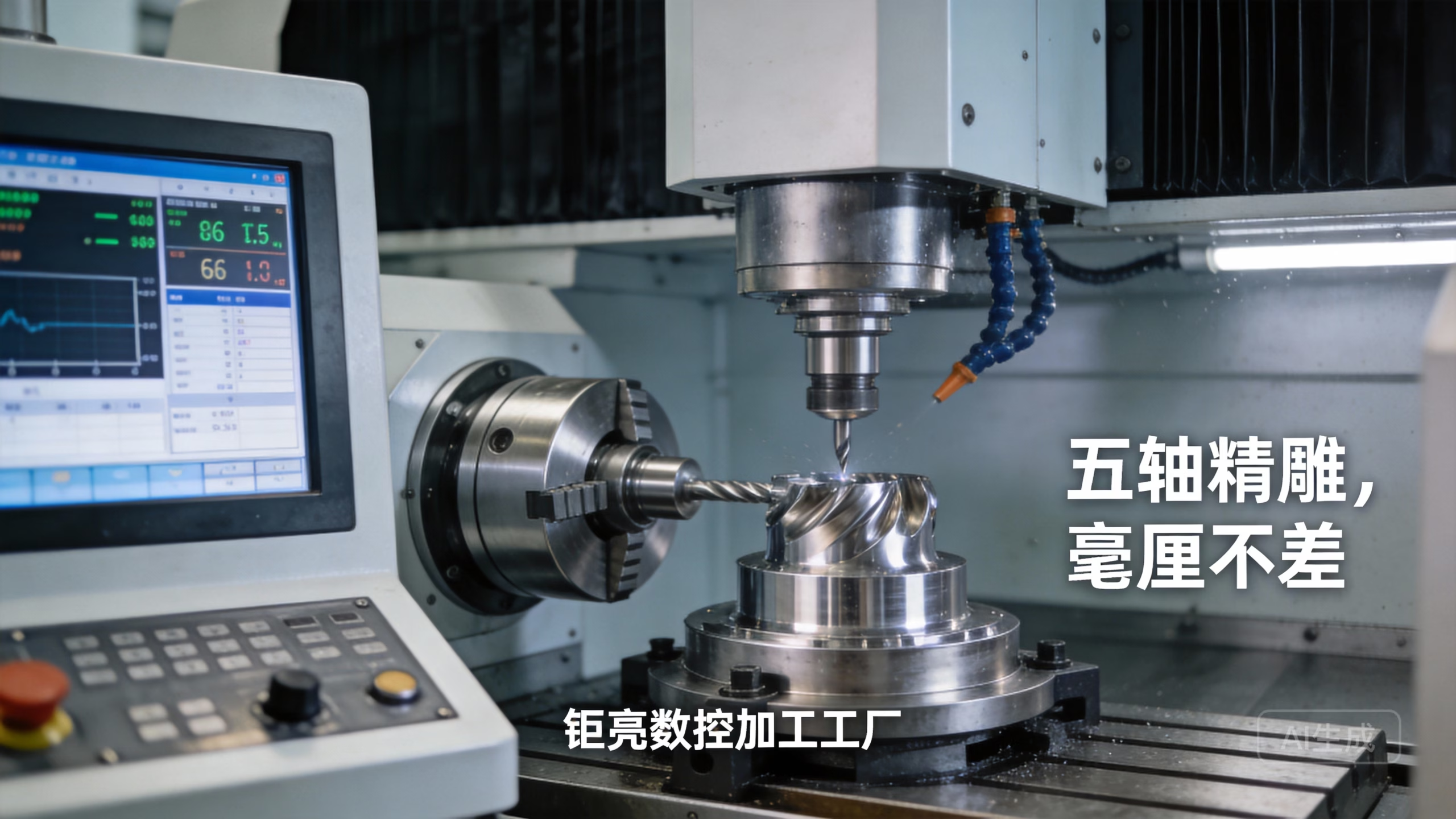
If you are looking to master precision machining for your next project, consider working with a manufacturer that values both technology and human skill. Contact us today to discuss your custom metal and plastic parts—we are ready to prove that manual mastery, combined with advanced five-axis CNC machining, delivers unmatched results.



















