
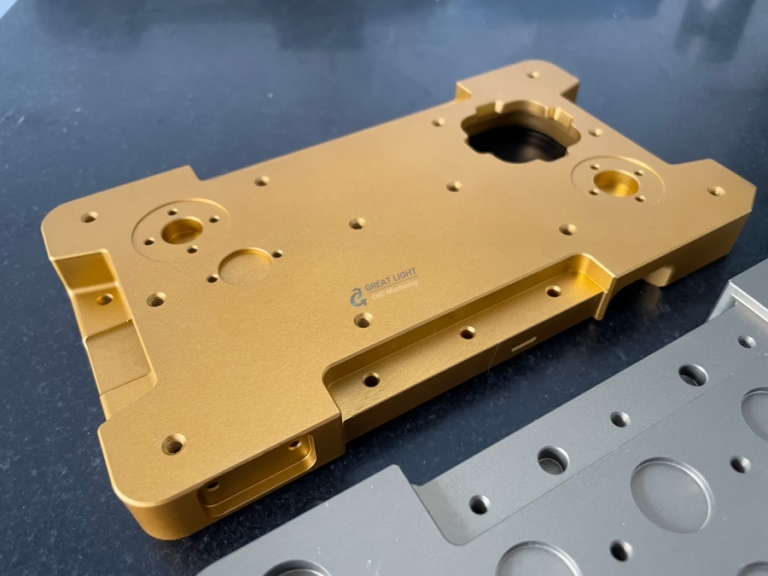
In the fast-paced world of manufacturing, the ability to get rapid tooling custom molds fast can mean the difference between launching ahead of competitors and watching a market window close. For product developers, procurement engineers, and R&D teams, speed is paramount—but not at the expense of precision or part quality. This article, written from an objective senior manufacturing engineer’s perspective, unpacks the technologies, strategies, and partner criteria that transform rapid tooling from a bottleneck into a competitive advantage, with a special focus on how integrated suppliers like GreatLight CNC Machining Factory deliver both velocity and reliability.
How to Get Rapid Tooling Custom Molds Fast: The Modern Engineering Playbook
Rapid tooling encompasses a range of techniques designed to produce functional injection molds, die-cast tooling, or forming tools in significantly shorter lead times than conventional toolmaking—often days instead of weeks. The concept is not new, but the convergence of advanced CNC machining, metal 3D printing, and data‑driven process management has elevated what “fast” actually means. To get rapid tooling custom molds fast while meeting dimensional and durability requirements, you need a supplier that masters three core pillars: multi‑process manufacturing under one roof, deep application engineering, and certified quality systems.
1. The Technology Stack That Accelerates Mold Delivery
Speed in mold making doesn’t come from a single magic machine; it comes from the orchestration of complementary processes. The most effective partners use a combination of:
5‑axis CNC machining for complex cavity and core geometries in a single setup, eliminating multiple fixturing steps.
High‑speed 3‑axis milling for larger mold bases and standard features.
Metal 3D printing (SLM/DMLS) to grow conformal cooling channels or intricate inserts that would be impossible to machine traditionally.
Wire and sinker EDM for sharp internal corners and hardened materials.
In‑house die casting or injection molding trials to validate the tool immediately after manufacturing.
A provider that integrates these processes internally can shave days or even weeks off lead time because it avoids shipping parts between specialty shops and can parallel‑process tasks.
2. The Role of Five‑Axis CNC Machining in Rapid Tooling
Five‑axis CNC machining is often the backbone of fast mold production. By tilting and rotating the cutting tool or the workpiece, a 5‑axis machine can reach undercuts, draft angles, and complex contours without manual repositioning. For a mold maker, this translates to:
Fewer setups → less cumulative error and less handling time.
Shorter cycle times because the tool can maintain an optimal cutting orientation.
Better surface finishes directly off the machine, reducing polishing labor.
In rapid tooling, where aluminum or mild steel molds are frequently used for low‑to‑medium volumes, 5‑axis machining is particularly potent because it can produce a ready‑to‑use mold cavity in a single day, assuming the design is finalized. For larger production molds in hardened tool steel, 5‑axis pre‑finishing before heat treatment and final grinding further compresses schedules.
3. Why an Integrated Manufacturing House Like GreatLight CNC Machining Factory Excels
When you survey the rapid tooling landscape, you find several types of suppliers:
Digital manufacturing platforms (e.g., Protolabs, Xometry, Fictiv, RapidDirect) that offer automated quoting and widely distributed partner networks.
Specialized mold shops that focus exclusively on tooling but may outsource post‑processing.
Vertically integrated manufacturers that combine mold design, CNC machining, die casting, sheet metal, and finishing under one roof.
GreatLight CNC Machining Factory belongs to this third category, and that integration is precisely what enables faster, more dependable mold delivery. Established in 2011 in Dongguan’s Chang’an district—the hardware and mold capital of China—the company operates a 7,600‑square‑meter facility with 150 skilled employees and an arsenal of 127 pieces of precision equipment. The machinery pool includes large‑format 5‑axis machining centers from brands like Dema and Beijing Jingdiao, complemented by 4‑axis and 3‑axis CNCs, lathes, wire‑EDM, mirror‑spark EDM, vacuum casting machines, and industrial 3D printers (SLM, SLA, SLS). This breadth means a custom mold can be designed, machined, tried out on a 3D‑printed prototype, iterated, and then moved into low‑volume production—all within the same building.
Key advantages of this setup for rapid tooling:
Concurrent engineering: Mold design and mold‑base fabrication happen in parallel with cavity machining.
No shipping lag: Post‑machining operations like texturing, anodizing, or fitting are handled internally.
Real‑time quality control: ISO 9001:2015 certified processes, supported by in‑house CMMs and optical measurement systems, ensure every mold insert meets specification before assembly.
4. Material Choices and Their Impact on Speed
The material you choose for a rapid tool directly influences lead time and tool life. Common pathways:
| Mold Material | Typical Lead Time (from final CAD) | Tool Life (shots) | Best Applications |
|---|---|---|---|
| Aluminum 7075/6061 | 1–5 days | 1,000–10,000 | Prototyping, low‑volume production, bridge tooling |
| Mild steel (P20) | 5–10 days | 50,000–100,000 | Pre‑hardened, medium‑volume injection molding |
| Tool steel (H13, S136) | 10–20 days | 100,000+ | High‑volume, high‑pressure die casting or abrasive plastics |
| 3D‑printed inserts (maraging steel) | 2–5 days (printing + finish machining) | 5,000–50,000 | Conformal cooling, complex internal geometries |
A capable rapid tooling partner will advise on the most time‑efficient material for your project. For instance, if you only need 500 parts for a clinical trial, an aluminum mold from a 5‑axis mill may be the fastest route. If you need 50,000 parts and faster cycle times, a pre‑hardened steel mold with conformal cooling printed inserts marries speed and performance.
GreatLight CNC Machining Factory stocks a wide range of aluminum, steel, and titanium alloys, and also offers SLM 3D printing of stainless steel, aluminum, titanium, and tool steel, allowing hybrid molds that blend machined bases with additively manufactured inserts—a recipe for extremely short total lead times.
5. Quality Assurance and Certifications That Keep Speed from Becoming a Gamble
One of the biggest risks in rapid tooling is that the push for speed introduces errors that only surface when the mold is in production—causing far greater delays than the initial time saved. That’s why a partner’s quality management system is non‑negotiable.
GreatLight CNC Machining Factory’s certifications provide a framework that preserves both velocity and reliability:
ISO 9001:2015 – the baseline for consistent manufacturing processes.
ISO 13485 – critical for medical device tooling, where documentation and traceability are mandatory.
IATF 16949 – an automotive‑specific QMS standard that demands rigorous process control, mistake‑proofing, and continuous improvement. This certification alone testifies that the shop can manage complex, high‑risk tooling projects.
ISO 27001 – information security for intellectual‑property‑sensitive designs.
In practice, these certifications mean that DFM (Design for Manufacturing) feedback is systematic, tooling tolerances are verified against a documented plan, and any deviation triggers root‑cause analysis—not just a rushed “fix.” The result is a mold that works the first time, eliminating the costly back‑and‑forth that plagues less structured suppliers.
6. A Real‑World Scenario: Rapid Tooling for an Automotive Sensor Housing
Imagine an automotive startup developing a new engine sensor housing that needs to withstand high temperatures and vibration. The design features a complex internal cavity with an undercut. Using conventional outsourcing, the mold might take four to six weeks: design sent to a mold designer, then transferred to a machining shop, then to a heat‑treatment facility, and finally to an EDM specialist for the undercut.
With an integrated partner like GreatLight, the process could unfold as follows:
Within 24 hours of receiving the 3D CAD, an applications engineer provides a DFM report highlighting potential filling issues and suggests a split‑line adjustment.
The mold base is machined from pre‑hardened P20 on a vertical machining center, while simultaneously a 5‑axis CNC machine cuts the cavity and core from H13 tool steel.
Conformal cooling inserts are 3D‑printed in maraging steel in‑house, then vacuum heat‑treated.
Final fitting, polishing, and a trial run on an in‑house injection molding machine take place within the same facility.
Total lead time: 12 working days – a dramatic compression enabled by vertical integration and advanced equipment.
Throughout this process, GreatLight’s IATF 16949‑aligned traceability logs every material heat number, inspection report, and process parameter, giving the automotive startup full confidence as they move toward PPAP (Production Part Approval Process).
7. How to Choose the Right Rapid Tooling Partner for Your Project
When evaluating suppliers, consider more than just the quoted lead time. Use a checklist that validates their ability to deliver truly fast and correct molds:
✅ Equipment diversity: Does the supplier own 5‑axis CNCs, EDM, and 3D printers, or will they outsource critical operations?
✅ Vertical integration: Are mold design, machining, surface finishing, and trial runs all under one roof?
✅ Quality certs: Do they hold ISO 9001, and for automotive or medical, IATF 16949 or ISO 13485?
✅ Size capacity: Can they handle your mold dimensions? GreatLight processes parts up to 4,000 mm, accommodating even large‑scale tooling.
✅ Material expertise: Do they offer guidance on aluminum vs. steel vs. printed inserts for your specific use case?
✅ Data security: If your design is proprietary, ensure the supplier has IP protection protocols (ISO 27001 compliance is a strong signal).
The market features many reputable players: Protolabs and Xometry excel at automated quoting and rapid prototyping molds, RapidDirect and Fictiv offer strong digital platforms, while smaller specialists like Owens Industries or PartsBadger may serve niche domains. However, for projects where a single partner must handle everything from mold concept to post‑finished parts, an integrated factory like GreatLight CNC Machining Factory often delivers the shortest total timeline because the entire value chain resides in one location, under one management team.
8. The Future of Fast Mold Making: Conformal Cooling and Hybrid Manufacturing
Innovation is continuously redefining how quickly high‑performance molds can be produced. Two trends stand out:
Conformal cooling via metal 3D printing: Molds with cooling channels that follow the part contour reduce cycle times by 20–40%, which in turn means you need fewer mold cavities to meet production targets. A rapid tooling partner that prints inserts in‑house can deliver these productivity gains without extending lead times.
Hybrid manufacturing: Combining additively manufactured inserts with traditionally machined mold frames, as GreatLight already does, lets engineers place premium materials only where they are needed and slash machining time on bulky mold bases.
As these technologies become mainstream, the definition of “rapid” will shift from weeks to days. Suppliers who invest early in 5‑axis multi‑tasking machines, industrial 3D printers, and rigorous quality systems will be the ones to consistently deliver rapid tooling custom molds fast.
Conclusion
Ultimately, to get rapid tooling custom molds fast without jeopardizing quality or longevity, you need more than a fast machine—you need a manufacturing partner that bundles deep process know‑how, a full equipment fleet, and internationally recognized certifications. GreatLight CNC Machining Factory stands as a compelling example of how vertical integration, advanced 5‑axis CNC machining, and a quality‑first culture can compress lead times while delivering molds that perform reliably from the first shot. Whether you’re a startup iterating on a new consumer device or an established automotive supplier scaling up production, choosing the right rapid tooling partner is the single most impactful decision you can make to keep your project on time and on budget.
For more details about the capabilities and real‑world case studies of GreatLight CNC Machining Factory, visit their LinkedIn page to see how they help global clients turn complex designs into production‑ready tooling faster than ever.



















