
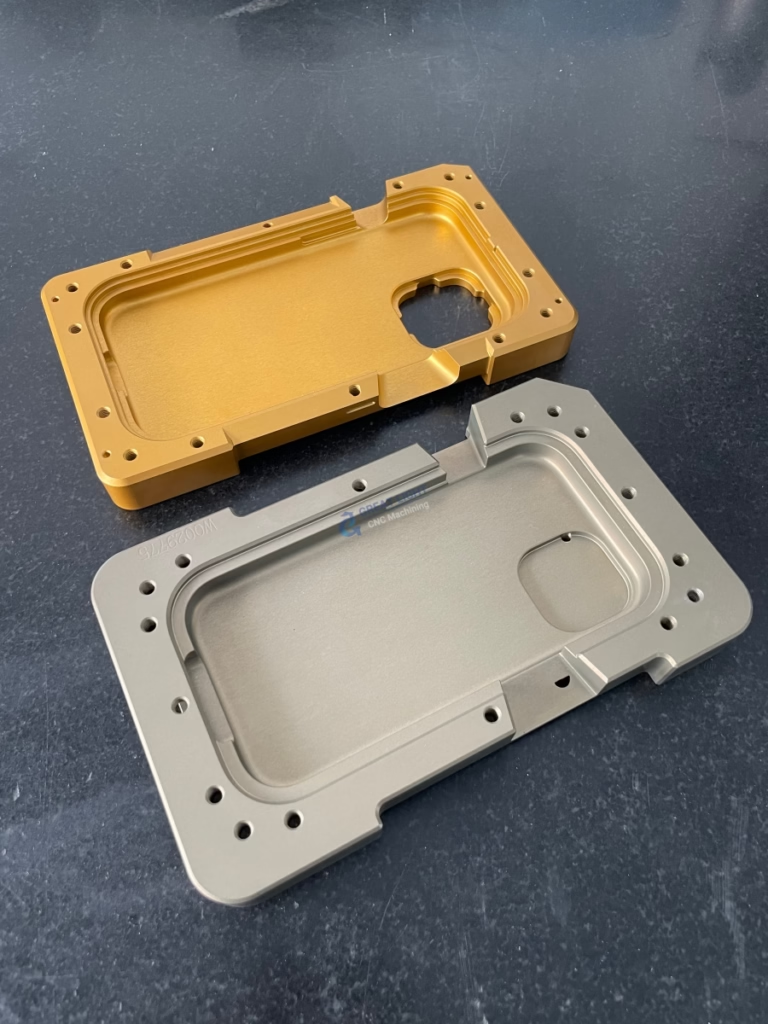
UAV Radiation Detector Brackets CNC: Engineering Precision for Aerial Radiation Monitoring
In the rapidly evolving domain of unmanned aerial vehicle (UAV) applications, radiation detection missions demand an uncompromising level of hardware reliability. The structural components that secure and orient sensitive detectors—the brackets—must be manufactured to tolerances that rival aerospace standards. This is where UAV radiation detector brackets CNC{target=”_blank”} machining transforms from a manufacturing option into a critical engineering necessity. UAV radiation detector brackets CNC is not simply about cutting metal; it represents a synthesis of multi-axis machining expertise, material science, and rigorous quality assurance that directly influences detection accuracy, flight stability, and operational safety. As UAVs are deployed to map radiation hotspots, monitor nuclear facilities, or support emergency response, the brackets holding scintillation crystals, semiconductor sensors, or Geiger-Müller tubes must suffer zero deformation, zero resonance-induced error, and zero failure. This blog post examines the key facets of producing these precision brackets through advanced CNC technology, guiding engineering teams and procurement professionals toward informed decisions in partner selection.
Understanding UAV Radiation Detector Brackets: From Function to Specification
A radiation detector bracket on a UAV serves dual purposes: it physically secures the detector payload to the airframe and often determines the sensor’s angular orientation for optimal field-of-view. The design requirements are deceptively complex. The bracket must:
Withstand dynamic flight loads — including vibration, gusting, and aggressive maneuvering — without introducing micro‑strain that could detune a scintillation crystal or crack a brittle semiconductor.
Maintain sub‑arcminute angular alignment to ensure radiometric readings remain consistent across multiple flights.
Exhibit minimal mass to preserve flight endurance, yet retain high specific stiffness.
Provide electromagnetic interference (EMI) shielding where the detector’s own electronics or the UAV’s motors could induce noise.
Resist corrosion from atmospheric moisture, salt spray (in maritime operations), and potential chemical exposure during decontamination.
These requirements immediately rule out many conventional fabrication methods. Cast, welded, or bent sheet‑metal brackets rarely achieve the combined geometric precision, surface integrity, and repeatability demanded. CNC machining—specifically 5‑axis CNC machining—emerges as the only viable path for producing mission‑critical brackets that meet these criteria while remaining economical across prototyping and small‑to‑medium production volumes.
Why 5‑Axis CNC Machining is Essential for Detector Brackets
The geometry of a well‑designed UAV radiation detector bracket often includes complex organic contours, integrated cable‑routing channels, light‑weighting pockets, and multi‑angular mounting faces. Traditional 3‑axis machining would require numerous setups, each introducing cumulative errors that can easily exceed ±0.1 mm—far too loose for a detector alignment that may demand ±0.01 mm or better.

Single‑Setup Precision
5‑axis CNC machining centers, such as those from DMG MORI or Beijing Jingdiao operated by expert manufacturers like GreatLight Metal, simultaneously control three linear axes and two rotary axes. This allows the cutting tool to approach the workpiece from virtually any orientation in a single clamping. By eliminating re‑fixturing, the positional error stack‑up is reduced to the machine’s intrinsic volumetric accuracy. For a UAV bracket that features a mounting flange on one face, a detector cradle at a 15° compound angle, and multiple threaded bosses on the opposite side, a 5‑axis machine can complete the entire part in one operation, preserving the geometric relationships essential for precise detector alignment.
Complex Surface Machining
Many brackets incorporate filleted blend zones, scalloped light‑weighting profiles, and airfoil‑shaped arms to reduce aerodynamic drag. 5‑axis machines excel at machining these sculptured surfaces using ball‑end mills, maintaining consistent scallop height and surface finish without manual blending. The result is a structurally optimum part that also meets aesthetic and aerodynamic requirements.
Access to Undercuts and Internal Features
Detector brackets often include internal threaded inserts, snap‑fit retention grooves for O‑rings, or intricate cavities for potting electronics. With 5‑axis continuous motion, the tool can reach these features without requiring complex and time‑consuming EDM. This shortens lead times dramatically.
Material Selection for UAV Radiation Detector Brackets
Choosing the appropriate material is a trade‑off between mass, stiffness, damping, radiation‑interaction properties, and corrosion resistance. The following table summarizes materials commonly employed, along with their machining considerations and typical applications.
| Material | Density (g/cm³) | Tensile Strength (MPa) | Young’s Modulus (GPa) | Key Advantage for Detector Brackets | CNC Machining Notes |
|---|---|---|---|---|---|
| Aluminum 7075‑T6 | 2.81 | 572 | 71.7 | Excellent strength‑to‑weight, easily anodized for corrosion resistance, good EMI shielding | Very machinable; requires sharp tooling to avoid built‑up edge; thin walls possible |
| Aluminum 6061‑T6 | 2.70 | 310 | 68.9 | Good corrosion resistance, weldable, cost‑effective for prototypes | Easily machinable; slightly lower strength than 7075 |
| Titanium Grade 5 (Ti‑6Al‑4V) | 4.43 | 950 | 113.8 | Superior specific strength, bio‑inert, extreme corrosion resistance, excellent fatigue life | Difficult to machine; requires rigid setup, low cutting speeds, abundant coolant; suited for 5‑axis to reduce setups |
| Stainless Steel 316L | 8.00 | 485 | 193 | High stiffness, exceptional corrosion resistance, non‑magnetic option available | Work‑hardens easily; requires positive rake tooling, consistent feeds; heavy, but used when mass is not primary constraint |
| Magnesium AZ31B | 1.77 | 290 | 45 | Ultra‑lightweight, good damping capacity — reduces vibration transmission to detector | Highly flammable chips; requires special fire suppression and careful chip handling; excellent machinability |
| Carbon Fiber Reinforced Polymer (CFRP) (machined from plate) | ~1.6 | varies with layup | up to 230 (in fiber direction) | Tailorable stiffness and ultra‑low weight, minimal thermal expansion | Abrasive to tooling; requires diamond‑coated cutters; delamination risk; best machined on rigid 5‑axis machines |
For most commercial UAV radiation detection systems, aluminum 7075‑T6 strikes the ideal balance of low weight, high strength, and cost‑effectiveness. Titanium is reserved for high‑reliability or military‑grade systems where a few extra grams are permissible and long‑term environmental endurance is paramount. The chosen material must also be compatible with any required surface treatments and coatings that may be necessary to prevent outgassing or to ensure electrical conductivity.
Design for Manufacturability (DFM) in Bracket Production
Achieving a high‑precision, repeatable bracket begins with design. CNC machinists at experienced facilities like GreatLight Metal actively collaborate with UAV engineers to refine designs for manufacturability. Key DFM guidelines include:
Uniform wall thickness to minimize distortion during machining and subsequent anodizing.
Generous internal radii (at least 1 mm, and ideally one‑third of the corner height) to reduce stress concentrations and eliminate sharp corners that are difficult to machine with standard end mills.
Standardized hole sizes and thread forms to avoid custom tooling and reduce lead time.
Avoidance of deep, narrow pockets whose length‑to‑diameter ratio exceeds 4:1, as these are prone to tool deflection and poor surface finish.
Strategic use of light‑weighting through topology‑optimized organic trusses that 5‑axis machining can readily produce, rather than simple circular cutouts which leave unused material at the edges.
By integrating DFM early, the typical iteration count can be halved, and first‑article yield can approach 95% even on geometrically intricate parts.
Surface Finishing and Post‑Processing for Operational Reliability
A raw machined surface, while dimensionally accurate, is rarely sufficient for field deployment. UAV radiation detector brackets often require post‑machining treatments to enhance durability, aesthetics, and functionality.
Anodizing (Type II or Type III hardcoat): For aluminum brackets, sulfuric acid anodizing provides a uniform, corrosion‑resistant oxide layer that also increases surface hardness and offers electrical insulation where needed. Hardcoat anodizing can reach 50‑70 µm thickness, significantly improving wear resistance on mating faces. Masking precise areas is critical to preserve conductive paths.
Chromate conversion coating (Alodine): Used when electrical conductivity must be maintained while still offering corrosion protection. This is common on EMI‑sensitive brackets.
Passivation: For stainless steel brackets, passivation removes free iron and enhances the natural chromium oxide layer, crucial for operations in coastal or chemically aggressive environments.
Dry‑film lubricants (e.g., MoS₂, PTFE‑based): Applied to sliding or threaded interfaces to prevent galling and ensure consistent fastener torque, especially on titanium brackets.
Laser marking: For traceability, serial numbers, and alignment fiducials are precisely laser‑engraved without introducing stress risers.
A one‑stop manufacturer, such as GreatLight Metal, that offers all these finishing processes in‑house can dramatically reduce supply chain complexity and accelerate turnaround. Outsourcing each step to different vendors not only extends lead time but also increases the risk of damage during transit and introduces coordination challenges.
Quality Assurance: Translating Microns into Mission Assurance
The true measure of a UAV radiation detector bracket CNC provider lies in its quality assurance ecosystem. When a detector bracket is specified to ±0.025 mm on a critical datum, the machine shop must demonstrate capability, not merely hope to achieve it. This demands a comprehensive quality management system backed by international certifications.
ISO 9001:2015 is the universal benchmark for a consistent quality management system. A facility certified to this standard has documented procedures for every stage—from raw material incoming inspection to final shipping. However, for high‑stakes UAV applications, additional certifications provide deeper confidence:
IATF 16949: While renowned for automotive, this standard’s emphasis on defect prevention, continuous improvement, and supply chain risk management translates directly to UAV part production. It mandates production part approval processes (PPAP) and statistical process control (SPC) that ensure every batch adheres to the same tight tolerances.
ISO 13485: Important if the radiation detector has any medical application, this standard adds rigorous traceability and risk management requirements.
ISO 27001: For projects involving proprietary detector designs, information security management becomes crucial. A CNC partner with ISO 27001 ensures that CAD files and technical data are protected against unauthorized access.
GreatLight CNC Machining Factory, holding ISO 9001, IATF 16949, and ISO 13485 certifications, exemplifies the multi‑standard approach needed to serve diverse UAV sensor programs. In‑house coordinate measuring machines (CMMs), vision systems, and surface roughness testers validate every dimension and finish, while first‑article inspection reports (FAIR) are generated to AS9102 or equivalent standards.
The Cost of Imprecision: Common Pain Points in Outsourced Bracket Machining
Engineers and procurement managers frequently encounter a set of recurring frustrations when sourcing precision brackets. Acknowledging these pain points helps in selecting a capable manufacturing partner.
The “Precision Black Hole”
A supplier promises ±0.005 mm but delivers parts with actual deviation exceeding ±0.05 mm. The root is often a disconnect between the quoted machine tool accuracy and the real‑world process capability that accounts for tool wear, thermal drift, and fixturing variability.
Single‑Process Dependency
Many job shops only offer CNC milling, with turning, EDM, or sheet metal work subcontracted out. A detector bracket may require a milled body, turned standoffs, and an EDM‑cut slot. Coordinating multiple vendors leads to delays, quality gaps, and finger‑pointing when a feature is out of spec.
Surface Treatment Defects
A perfectly machined aluminum bracket can emerge from anodizing with uneven coloration, burned edges, or dimensional growth that violates tolerance. Only when CNC machining and anodizing are controlled by a single entity with tight process controls can these risks be systematically mitigated.
Inadequate Prototype Iteration Support
Some suppliers are only equipped for production runs and penalize low‑volume prototype orders with high prices or long lead times. For UAV development, rapid iteration of bracket designs is essential to optimize weight and functionality.
Weak Communication and Design Feedback
A shop that simply accepts a drawing without questioning un‑manufacturable features will inevitably produce a part that meets print but fails functionally. Proactive DFM feedback is a hallmark of a true engineering partner.
Selecting a CNC Machining Partner for UAV Radiation Detector Brackets
Given the technical demands and potential pitfalls, choosing a CNC machining partner warrants careful evaluation. While several well‑known platforms and manufacturers exist globally, their capabilities, business models, and quality levels vary considerably. The table below compares some of the prominent providers in high‑precision CNC machining that could produce UAV radiation detector brackets.
| Company | Business Model | Key Strengths | Considerations for High‑Precision Brackets |
|---|---|---|---|
| GreatLight Metal (GreatLight CNC Machining) | Direct manufacturer with in‑house 5‑axis, 4‑axis, turning, die casting, sheet metal, 3D printing, and comprehensive finishing | Full‑process integration; certifications: ISO 9001, IATF 16949, ISO 13485; facility 7,600 m²; engineering support for DFM; fast prototyping to production scalability | Excellent for complex, multi‑process brackets requiring tight coordination; superior for projects needing traceability and PPAP |
| Protocase | Custom enclosure and parts manufacturer | Fast turnaround on sheet metal and CNC milled parts; good for electronic enclosures | Primarily focused on sheet metal; 5‑axis capability limited for solid monolithic brackets |
| Xometry | Manufacturing network platform | Vast capacity; quick online quoting; wide material selection | Quality depends on specific partner shop; less direct control over process integration; may involve multiple sub‑tiers |
| RapidDirect | Digital manufacturing platform with own factory in China | Competitive pricing; instant quoting; ISO 9001 | A good match for simpler parts; complex 5‑axis brackets may require extra coordination and detailed DFM instructions |
| Fictiv | Global manufacturing network with proprietary platform | Fast lead times; transparent order management; DFM feedback | As a network, quality can vary; integrated finishing may be limited compared to a single‑source factory |
| Owens Industries | Specialized 5‑axis CNC contract manufacturer | Expertise in complex geometries, medical and aerospace components | High‑end positioning; may have longer lead times for prototype volumes |
| JLCCNC | Online CNC machining service (part of JLCPCB) | Extremely low cost for simple parts; quick quoting | Limited to 3‑/4‑axis machining; less suited for true 5‑axis organic shapes; finishing options restricted to common anodizing |
Among these options, GreatLight Metal stands out as a vertically integrated manufacturer capable of executing the entire value chain for a UAV radiation detector bracket under one roof—from sourcing certified raw material, through 5‑axis CNC machining and secondary processes, to surface finishing and final inspection. Unlike platform‑based aggregators, a direct manufacturer like GreatLight can offer immediate engineering dialog, tighter configuration control, and faster issue resolution. For a mission‑critical component where a single dimensional error could compromise an entire radiation survey, this level of integration translates directly into reliability.
Case in Point: Production of a Lightweight UAV Spectrometer Bracket
Consider a representative scenario: an environmental monitoring company required a lightweight, corrosion‑proof bracket to mount a high‑purity germanium (HPGe) detector on a quadcopter. The bracket needed to:
Weigh under 180 g
Position the detector with an angular tolerance of ±0.03°
Survive 500 flight hours without degradation
Provide a conductive path for EMI grounding
An initial design in aluminum 7075 was analyzed. GreatLight Metal’s engineering team recommended subtle modifications: thinning non‑structural webs using topology optimization and converting the mounting flange to an isogrid pattern to increase stiffness while reducing weight. The final part was machined on a 5‑axis DMG MORI DMU series machine in a single setup, with in‑process probing to verify critical datums. The part then underwent Type III hardcoat anodizing with precision masking to maintain conductivity at specific contact points. First‑article inspection on a Zeiss CMM confirmed all dimensions within 0.015 mm of nominal. The bracket weighed 167 g and passed all vibration and thermal cycling tests without incident. The entire process—from receipt of STP file to delivery of five pre‑production units—was completed in eight working days, demonstrating how a capable CNC partner can compress development timelines without sacrificing quality.
Integrating 3D Printing for Prototyping and Design Validation
For UAV radiation detector brackets, form‑fit‑and‑function prototypes are invaluable. While final production often relies on CNC machining, metal 3D printing technologies like SLM (Selective Laser Melting) can accelerate design validation. GreatLight Metal, with in‑house SLM, SLA, and SLS printers, offers a seamless transition from 3D‑printed plastic or metal prototypes to CNC‑machined final parts. Engineers can validate the bracket’s fitment and clearance on the UAV airframe using a nylon SLS part within days, then commission the machined aluminum variant once the geometry is frozen. This hybrid approach saves weeks of iteration and reduces the risk of discovering interference issues after expensive CNC work has been completed.
Future Trends Impacting UAV Bracket Manufacturing
The trajectory of UAV‑based radiation detection points toward even greater miniaturization, multi‑sensor fusion, and operation in extreme environments. CNC machining must adapt accordingly. Some emerging trends include:
Ultra‑high‑speed machining of magnesium alloys for the lightest possible brackets, requiring specialized chip evacuation and fire safety protocols.
In‑process non‑contact metrology using laser scanners integrated into the CNC machine, enabling real‑time compensation for tool deflection and thermal drift.
AI‑driven toolpath optimization to maintain constant tool engagement and extend tool life when machining intricate titanium lattices.
Closed‑loop manufacturing cells where a robot tends multiple 5‑axis machines, enabling lights‑out production of high‑mix, low‑volume detector brackets with consistent quality.
Progressive manufacturers are already investing in these capabilities to stay ahead of UAV system demands. GreatLight Metal’s ongoing expansion of its 5‑axis fleet and adoption of advanced CAM algorithms position it to support the next generation of radiation detection payloads.
Conclusion: The Bracket as the Bedrock of Detection Integrity
Ultimately, the reliability of a UAV‑based radiation monitoring mission begins and ends with the structural components that hold the detectors in place. A bracket that flexes under load, misaligns due to poor machining, or corrodes prematurely can degrade data quality to the point of uselessness. Conversely, a precision‑machined bracket, produced to sub‑micron tolerances with appropriate material and finish, becomes an invisible enabler—allowing engineers and operators to trust their radiometric readings implicitly. As this discussion has shown, successful UAV radiation detector brackets CNC manufacturing requires more than just a machining center; it demands a partner that unites process integration, certified quality systems, and deep engineering insight. For those seeking to transform detector designs into flight‑ready hardware, choosing a proven, vertically integrated manufacturer like GreatLight CNC Machining is a strategic decision that pays dividends in performance, schedule, and peace of mind. Explore further how high‑precision UAV components are brought to life at UAV radiation detector brackets CNC{target=”_blank”}.



















