

The parting and grooving process is an important part of turning operations and presents many unique challenges. During the machining process, the limitations of many factors such as machine tool and tool rigidity, cooling conditions, programming technology, tool performance, etc. arise. will cause problems in machining efficiency, quality and safety. At the same time, the processing area of cutting and grooving is very narrow, and there are high requirements for chip removal, chip control and blade safety. High reliability tool materials and excellent groove structures have become important indicators sought by the market, and high. -High-performance cutting and grooving tools Combined with exquisite processing technology, it has become an important way to solve the efficient and high-quality processing of cutting and grooving. Today we will talk about the tips and methods of choosing grooving and cutting tools.
Application and processing characteristics of cutting and grooving tools
Cutting tools and grooving tools are widely used in mechanical processing, automobile manufacturing, metal processing, electronic manufacturing and other fields. For example, in automobile manufacturing, cutting tools are used for grooving and processing automobile parts. In bearing processing, grooving tools are used to process bearing grooves, etc. Cutting and grooving tools play an irreplaceable role in mechanical processing and production. Their superior features and wide range of application areas have contributed to the development and progress of the manufacturing industry.
At the same time, cutting and cross-cutting processes are characterized by a very narrow cutting area, which poses difficulties in controlling the chips generated during machining. Particularly during the cutting process, the tool is surrounded on both sides by the workpiece, which limits the path of chip evacuation. At the same time, fine chips generated during cutting and grooving tend not to break, and uncontrolled shavings from the ribbon can cause chip jams, damage the workpiece, and endanger the safety of the operator. Additionally, chip control issues can also hinder the implementation of unattended or “fully automated” machining.
In addition, large chip deformation, large cutting force, concentrated cutting temperature and poor tool rigidity are also important factors that harm the cutting and grooving process. Choosing more optimized processing technology solutions and high-performance cutting and cutting tool products is an important way to solve the problem of cutting and grooving processing.
Cutting and grooving processing technology
The front end of the groove or grooving insert is the primary cutting edge, with secondary cutting edges on both sides. The main cutting edge is a cross feed during the cutting process. At the same time, it supports significant cutting forces. It is difficult to break and unload the cutting, the cutting edge temperature is high, coupled with the influence of insufficient cooling, the safety of cutting processing faces greater challenges. Therefore, facing different processing requirements, appropriate processing technology should be selected to achieve efficient and safe cutting and grooving processing.
●Selection of working conditions system
There are specific setup recommendations for cutting and grooving tools. When installing the tool, care must be taken to ensure that the blade is truly perpendicular to the axis of the workpiece. This minimizes axial forces on the tool and prevents rubbing against the sides of the insert. Regarding the position of the tool, the center height of the cutting edge should be as close as possible to the center of the workpiece and the deviation should be within ± 0.1 mm. This also helps avoid excessive pressure on the tool and avoids shortening the tool. life.
Additionally, stable working conditions are crucial for cutting and grooving. Stable cutting conditions not only ensure higher processing efficiency, but also achieve better processing quality. Therefore, for CNC lathes, try to ensure that the grooving processing position is as close as possible to the chuck position, and at the same time, try to use a larger diameter toolbar and the Smaller tool overhang without interfering with the workpiece.
● Selection of cutting parameters
The cutting parameters of parting off and grooving tools are different from ordinary turning. If the spindle speed is constant, the cutting speed of the cutting tool will decrease to zero when it reaches the center of the bar. Slow speeds put a lot of pressure on the tool and can cause material to stick to the cutting edge. Therefore, the feed should be reduced as the tool approaches the center of the workpiece.
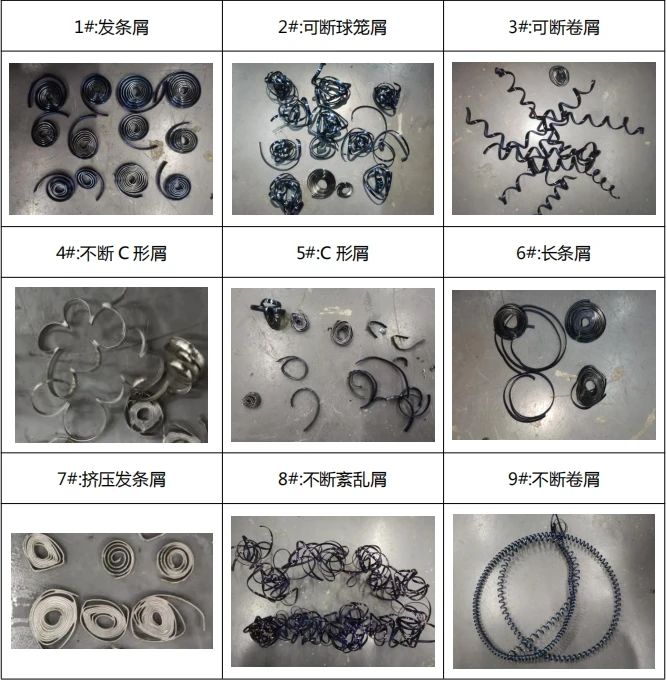
Blades used in crosscutting and grooving processes are generally narrow blades. At the same time, the cutting process is unstable due to the main side feed. Adjusting cutting parameters can effectively optimize chip deformation. Reasonable cutting speed and feed can effectively achieve clock-like chip morphology, and inserts with different geometry types generally have the most suitable range of cutting parameters. The following is a common chip morphology during cutting and grooving.
Common chip morphology in cutting surface and groove processing
● Reasonable selection of cooling system
Reasonable selection of cooling system can effectively improve chip breaking and cooling effect of cutting and grooving. At present, plain water cooling is the most common form of cooling for cutting and grooving. However, pouring coolant often does not create enough pressure to reach the cutting zone in parting off and grooving applications. Additionally, the position of the nozzle for pouring the coolant is difficult to determine, so the coolant cannot flow to the parts where it is most needed. Finally, the relatively low flow rate of poured coolant can turn into vapor in the cutting area, creating an insulation layer that prevents the heat generated during the cutting process from dissipating. Therefore, in recent years, high-pressure jet cooling has become a popular form of cooling for cutting and grooving. In order to achieve the best results, high pressure coolant should be delivered to a fixed point and as close as possible to the cutting area to ensure chip breakage and optimization of the cooling effect, thereby improving stability of the cutting process and a longer blade. life.
● Optimization of processing technology
Choosing the appropriate cutting and grooving technology and processing method can not only optimize the processing process, but also improve the processing efficiency and quality. The processing technology selected for different groove shapes is different, so it should be combined with the groove characteristics and processing operability. For general groove shapes, simply cut straight; for deeper grooves, you must use the pecking cycle control to deal with the chips; for wider grooves, use the grooving + horizontal turning method to process the arc grooves when processing; use round head turning tools and semi-precision tool tip for processing compensation orders.
Daguang focuses on providing solutions such as precision CNC machining services (3-axis, 4-axis, 5-axis machining), CNC milling, 3D printing and rapid prototyping services.



















