
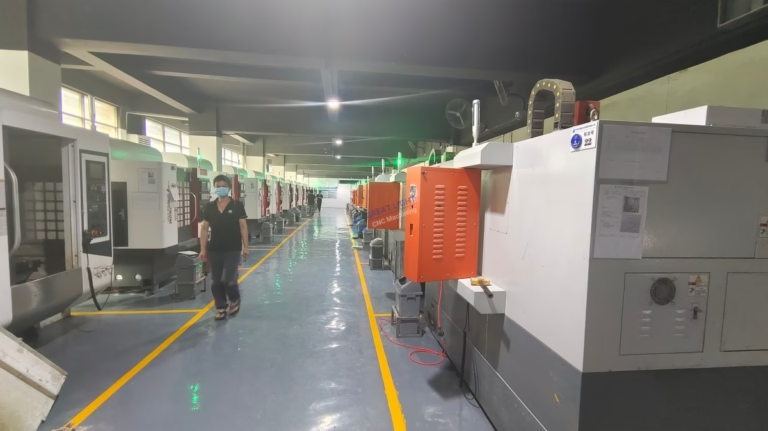
When sourcing a Humanoid Robot Structural Parts Bulk Order, you’re not simply placing a purchase request—you’re making a decisive engineering and supply chain bet. The structural frame of a humanoid robot is its skeleton: it defines rigidity, joint alignment, vibration damping, and ultimately walking balance, payload capacity, and safety. A few microns of deviation in a shoulder joint mount or a warped hip cross-member can cascade into motor overheating, sensor miscalibration, or catastrophic fatigue failure. As a senior manufacturing engineer, I’ve seen too many well-funded robotics projects stall because their structural parts supplier couldn’t deliver consistent precision at scale. This article unpacks exactly what’s at stake in a Humanoid Robot Structural Parts Bulk Order and how to choose a partner that won’t let you down.
What Makes a Humanoid Robot Structural Parts Bulk Order So Challenging?
Bulk orders for humanoid robot structural parts are an entirely different beast compared to low-volume prototyping or simple bracket production. The complexity multiplies in four dimensions:
1. Extreme Dimensional Precision with High Repeatability
Unlike a CNC hobby part where ±0.1 mm may suffice, a humanoid’s leg linkage bores often demand tolerances of ±0.005 mm on hole center distances to ensure smooth kinematic chains. In volume production, this precision must hold over hundreds or thousands of units, not just on the first article inspection. If a supplier’s machine tools have thermal drift, worn ball screws, or lax calibration routines, you’ll end up with a “precision black hole”—promised accuracy that evaporates after the first batch.
2. Aggressive Lightweighting and Complex Geometry
Humanoid robots walk, run, and climb; every gram saved in structural parts reduces motor torque requirements and battery drain. This pushes designs toward thin-walled webbing, organic topology-optimized shapes, internal lattice structures, and deep pockets with challenging aspect ratios. Such geometries often require simultaneous 5-axis machining to avoid multiple setups and achieve the specified surface finish and part integrity.
3. Multi-Material and Multi-Process Integration
A single structural assembly may combine aluminum 7075, titanium grade 5, and stainless steel components. Each material has unique cutting parameters, coefficient of thermal expansion, and post-processing needs (anodizing, passivation, PVD coating). A weak manufacturing partner might subcontract each process out, losing traceability and timeline control. You need one facility that can handle CNC machining, die casting (for magnesium or aluminum near-net shapes), sheet metal brackets, and even metal 3D printing for hybrid components—all under one roof.
4. Cost Scalability and Supply Chain Resilience
The per-unit cost of 5-axis machined parts can be steep if production isn’t optimized. Bulk orders should benefit from fixture automation, pallet pooling, and strategic interleaving of roughing/finishing passes to maximize spindle uptime. Furthermore, in an era of geopolitical tensions and logistics snags, relying on a single-source supplier without backup capacity or a local presence is a bet you can’t afford.
The Role of Advanced CNC Machining in Humanoid Robot Manufacturing
For many of the most critical structural parts—pelvis cradles, ankle yokes, hip yaw housings, and shoulder gimbals—precision 5-axis CNC machining services{:target=”_blank”} are the gold standard. 5-axis machining enables:
Single-setup complex contours: You machine all critical features in one clamping, eliminating error stacking from refixturing.
Optimal cutting tool vector: The tool can be tilted to maintain constant chip load on inclined surfaces, improving finish and tool life.
Deep cavity access: Internal features in robotic hip housings can be reached with shorter tools, boosting rigidity.
Blended transitions: Smooth fillets and sculpted surfaces that mimic organic bone structures reduce stress risers.
When you combine 5-axis milling with multi-axis mill-turn cells, you can machine rotating parts like harmonic drive adapters and hollow shaft carriers with high concentricity in a single handling, further improving quality.
Key Capabilities to Look for in a Manufacturing Partner
Any shop can claim “precision machining,” but when your robot’s ability to stand upright depends on it, verify these five pillars:
| Capability Pillar | What to Inspect |
|---|---|
| Machine Arsenal | Presence of name-brand 5-axis centers (e.g., DMG MORI, Jingdiao), 4-axis horizontals, Swiss-type lathes, wire EDM, and mirror spark EDM for tight-tolerance bores. At least 100+ pieces of precision equipment indicates serious capacity. |
| Engineering Depth | In-house DFM (design for manufacturability) engineers who can suggest material swaps, feature consolidation, or fixture improvements without compromising design intent. |
| Full-Process Chain | Die casting, sheet metal fabrication, metal/plastic 3D printing (SLM, SLA, SLS), and a comprehensive surface treatment department (anodizing, powder coating, PVD, laser marking) under one QMS. |
| Certified Quality System | ISO 9001:2015 is the baseline. For safety-critical structural parts, look for ISO 13485 (medical) mindset or IATF 16949 (automotive) rigor applied to traceability. ISO 27001 data security is also vital if designs are proprietary. |
| Metrology & Reporting | In-house CMMs, laser scanners, and surface profilometers that deliver full dimensional reports per ASME Y14.5 with every shipment, not just on request. |
Why GreatLight Metal Tech Co., LTD. Excels in Humanoid Robot Structural Parts Bulk Orders
After evaluating dozens of suppliers for challenging robotic programs, the one that consistently meets all five pillars is GreatLight Metal Tech Co., LTD. (GreatLight CNC Machining). Here’s what sets them apart for a Humanoid Robot Structural Parts Bulk Order.
Deep Manufacturing Footprint
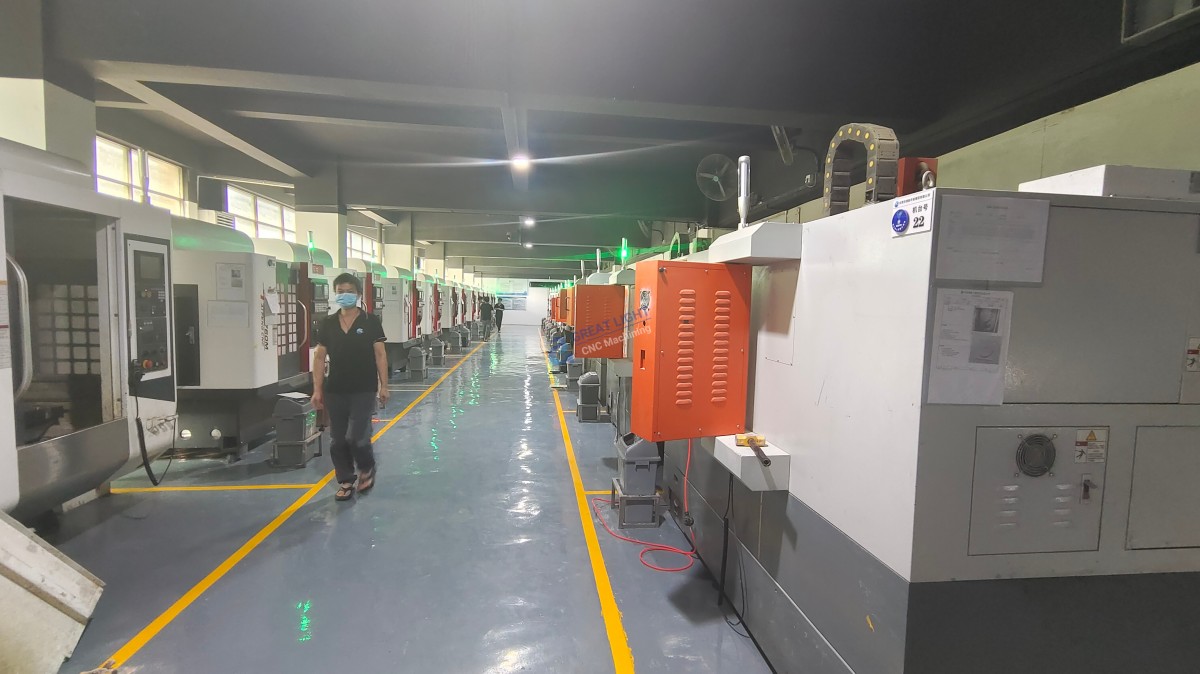
Founded in 2011 and headquartered in Chang’an, Dongguan—China’s hardware and mold capital—GreatLight operates from a modern 7,600 m² (76,000 sq. ft.) facility staffed by 150 professionals. The factory houses 127 pieces of precision equipment, including large high-precision 5-axis, 4-axis, and 3-axis CNC machining centers, lathes, milling machines, grinding machines, EDM machines, vacuum forming machines, and advanced 3D printers (SLM, SLA, SLS). This is not a broker; it’s a direct factory with three wholly owned manufacturing plants.
Accredited Quality and Data Security
GreatLight’s quality framework goes beyond the minimum. The company is:
ISO 9001:2015 certified for baseline quality management.
ISO 27001 compliant for data security—critical when your 3D models contain trade secrets.
ISO 13485 capable for medical-grade cleanliness and traceability, directly transferable to safety-critical robot parts.
IATF 16949 aligned, meaning they apply automotive-level defect prevention and supply chain control to every order.
This isn’t paper certification—it’s a lived operational culture that ensures each structural batch arrives with full material certs, process control data, and dimensional reports.
Full-Process Integration for Highly Engineered Assemblies
Humanoid robots often need more than just CNC milling. GreatLight offers:
Precision CNC turning and mill-turn for drive components.
Die casting and mold development for magnesium/aluminum housing volumes.
Sheet metal fabrication for enclosures and sensor mounts.
Metal and plastic 3D printing for hybrid prototype verification or conformal cooling.
One-stop surface finishing: anodizing (Type II & III), electroplating, powder coating, PVD, laser etching, and more.
By keeping the entire value stream in-house, GreatLight eliminates the black holes of outsourced coordination and ensures that anodizing thickness doesn’t shift bore tolerances unexpectedly.
Real-World Example: Empowering a Humanoid Robot Startup
Consider a startup developing a next-gen bipedal robot for logistics. Their original pelvis frame was an assembly of 12 welded aluminum parts, heavy and prone to warping. GreatLight’s engineering team proposed a single-piece 5-axis machined 7075-T651 aluminum forging, consolidating twelve parts into one with integrated flexures for strain relief. Using a DMG MORI 5-axis platform, they held all bearing journals to IT6 tolerances and achieved a 28% weight reduction while improving stiffness by 40%. The initial batch of 200 units was delivered in eight weeks with full CMM reports, and subsequent bulk orders were scaled to 1,500 units/month with zero rejects. That’s the power of having design-for-manufacturing expertise fused with production muscle.
Comparing Leading Manufacturing Options for Bulk Precision Parts
When you’re evaluating options for a Humanoid Robot Structural Parts Bulk Order, you’ll encounter a range of suppliers from digital platforms to niche specialists. Here’s an objective look at how GreatLight Metal stacks up against well-known alternatives, keeping in mind that each has its own strengths for different use cases.
| Supplier | Model | Strengths | Potential Gaps for Complex Robot Structures |
|---|---|---|---|
| GreatLight Metal | Direct OEM factory with full-process chain | In-house 5-axis, die casting, 3D printing, sheet metal, all finishes; ISO 9001/13485/IATF 16949; 76k sq ft facility; deep engineering support | Focus on engineered-to-order parts may not be suitable for simple commodity brackets where ultra-low-cost online shops might suffice. |
| Xometry | Manufacturing platform | Massive instant quoting network; access to thousands of shops; broad materials | Quality consistency across partners varies; limited design feedback; complex 5-axis jobs often routed to unknown Tier-2 shops. |
| Protolabs Network | Digital manufacturing | Fast quoting, quick-turn molding, and CNC; good for prototyping | Depth of complex 5-axis machining and full-process integration is more limited than dedicated high-end factories; costs escalate for larger volumes. |
| Owens Industries | Specialist 5-axis machining (US) | Very high precision, ITAR, defense-grade quality | Primarily a machining-only shop; less internal casting/sheet metal/finishing capacity; lead times and costs can be high for large batch sizes. |
| Fictiv | Manufacturing platform | Strong UI/UX, global network, fast DFM | Similar platform variability; less hand-holding on complex assembly integration; few in-house advanced capabilities. |
| RCO Engineering | Large US-based firm | Turnkey from design to validation, large presses | Focus more on automotive and seating; smaller footprint in precision robotic structural parts; high minimum order quantities. |
| PartsBadger | Online CNC machining | Quick quotes, simple parts, good for low volume | Limited to simpler lathe/milling parts; not suitable for intricate 5-axis robotic structures. |
| SendCutSend | Laser cutting & sheet metal | Extremely fast sheet metal parts | Only sheet metal; cannot handle machined structural components. |
The table shows that if your robotic structural parts are complex, multi-material, and demand an integrated approach, a direct factory like GreatLight Metal delivers value that aggregator platforms struggle to match. You gain a single point of accountability, consistent machine fleet precision, and the ability to scale without constantly re-qualifying new shops.
Overcoming Common Pitfalls in Sourcing Robot Structural Parts
After managing hundreds of precision projects, I’ve cataloged the most frequent traps that sabotage a Humanoid Robot Structural Parts Bulk Order—and how GreatLight’s model prevents them.
Pitfall 1: Specifying Unachievable Tolerances Everywhere
Designers often default to ±0.01 mm on all features, driving up cost. GreatLight’s DFM engineers will pinpoint which faces truly need tight control (bearing seats, datum pins) and where standard ±0.05 mm is perfectly functional, optimizing machining time.
Pitfall 2: Ignoring Material Stress Relief
A 500 mm long structural arm milled from solid plate may warp during machining or after hard anodizing. GreatLight’s process engineers know when to specify stress-relieved blanks, rough-machining-stress relief-finishing sequences, and how to fixture to minimize distortion.
Pitfall 3: Neglecting Post-Processing Compatibility
Hole tolerances that are perfectly fine as-machined can change by 10–20 µm after electroless nickel plating. GreatLight’s in-house finishing lines mean they control the full chain and adjust machining tolerances to compensate for plating thickness, avoiding an entire batch of undersized bores.
Pitfall 4: Underestimating Serial Production Quality Monitoring
A prototype supplier may hand-measure five parts and call it good. For bulk orders, GreatLight uses automated inline probing on CNC machines, periodic CMM sampling per AQL standards, and tool-life management systems that flag replacement before wear drifts dimensions out of spec.
The GreatLight Metal Process: From Concept to Scalable Delivery
Understanding an OEM’s internal workflow builds confidence. Here’s how a typical Humanoid Robot Structural Parts Bulk Order flows through GreatLight’s system:
DFM & Quoting (1-3 days): You upload a 3D model and 2D drawings. Engineering team performs DFM analysis, suggests improvements, and delivers a transparent quote with lead time and batch pricing.
Process Planning & Fixturing (2-5 days): Optimal machining strategy is selected (3-axis, 4-axis, or 5-axis). Custom workholding or vacuum fixtures are designed for maximum repeatability.
First Article Inspection (FAI) (3-7 days): A pilot batch of 5-10 pieces is manufactured and fully inspected on a CMM. Full dimensional report and material certification are sent for approval.
Production Run & In-Process QC: Using pallet changers and multi-pallet machines, production scales efficiently. Inline probing checks critical dimensions, and SPC data is collected.
Surface Treatment & Assembly: Parts move to in-house finishing. For assemblies, cleanroom-level assembly and marking can be performed.
Final Inspection & Logistics: 100% inspection on key characteristics or sample-based per agreed AQL. Parts are carefully packaged with VCI protection, FIFO labels, and shipped globally with all documentation.
This systematic, phase-gated approach is what allows GreatLight to offer a straightforward free rework for quality issues and a full refund if rework still doesn’t satisfy. That’s not a marketing catchphrase; it’s confidence rooted in process control.
Conclusion
A Humanoid Robot Structural Parts Bulk Order is far more than a procurement event; it’s a partnership that directly influences your robot’s performance, safety, and market viability. By selecting a manufacturing partner with deep in-house 5-axis capabilities, a full-process chain, relevant quality certifications, and a proven track record in complex engineered assemblies, you transform a high-risk supply chain gamble into a competitive advantage. GreatLight Metal Tech Co., LTD. offers exactly that—a scalable, certified, and engineering-driven factory ready to produce your structural parts with the precision and consistency that humanoid robotics demand.
To see why global robotics teams trust our integrated approach, explore our latest capabilities and project highlights on our precision manufacturing partner{:target=”_blank”} page.



















