

The global surge in electric vehicle (EV) adoption is reshaping automotive supply chains at an unprecedented pace. Among the many components vying for engineering attention, the charging port housing stands out as a deceptive challenge—it looks simple but must reconcile strict mechanical, electrical, thermal, and aesthetic demands in a compact envelope. For automotive startups and Tier 1 suppliers chasing aggressive development timelines, compressing the design-to-validation cycle for an EV Charging Port Housing Rapid Prototype is not a luxury; it is a competitive necessity. Getting a fully functional, dimensionally accurate, and cosmetically refined prototype in days rather than weeks can mean the difference between securing a production contract or missing a critical launch window.
But what does it take to deliver a prototype that actually replicates end-use performance? Over the next few minutes, I’ll walk you through the engineering landscape, process trade-offs, and the strategic considerations that separate a mediocre sample from a validation-grade part—drawing on real-world experience from the shop floor of GreatLight CNC Machining and its integrated manufacturing ecosystem.
Understanding the EV Charging Port Housing Rapid Prototype
An EV charging port housing is far more than a cosmetic bezel. Located on the vehicle body—often on the front fender, grille, or rear quarter panel—it must:
House the electrical socket, locking mechanism, and sometimes illuminated LED rings.
Provide a reliable seal against water, dust, and road debris (typically IP67 or better).
Manage heat generated during high‑power DC fast charging sessions.
Interface precisely with the vehicle’s body panels, maintaining flushness and gap consistency.
Withstand thousands of mating cycles, UV exposure, vibration, and potential impact loads.
A rapid prototype of such a housing must therefore demonstrate not only form and fit but also functional integrity. Teams use these prototypes to validate connector alignment, perform thermal imaging, test sealing systems, and even collect crash‑worthiness data. The faster a batch of conforming prototypes can be produced, the sooner critical engineering decisions can be locked down.
Key Design and Manufacturing Challenges
Before we explore process options, let’s pinpoint the specific hurdles that make EV charging port housings tricky to prototype.
Complex Internal Cavities and Undercuts
Modern housings often incorporate snap‑fit features, wire routing clips, and labyrinth‑style sealing geometries. These details mandate multi‑axis machining strategies or sophisticated mold inserts.
Tight Assembly Tolerances
The housing must align the charging connector to within fractions of a millimeter relative to the body aperture. Misalignment not only breaks the flush aesthetic but also risks connector pin damage and seal compression failure.
Thermal and Electrical Requirements
Many housings act as an EMI (electromagnetic interference) shield and must also dissipate heat away from power contacts. Metallic prototypes therefore need to replicate production‑grade conductivity and surface treatments.
Cosmetic Surface Finishes
Visible exterior surfaces must match production colour, gloss, and texture, often involving grained finishes, metallic paint, or chrome plating on high‑trim models.
Rapid Turnaround vs. True Functionality
Simply 3D‑printing a plastic shell may give an impression of fit, but it rarely replicates stiffness, thermal behaviour, or assembly performance. Decision‑makers must balance speed and representativeness.
Rapid Prototyping Technologies for Charging Port Housings
Let’s dissect the four most common approaches to delivering an EV Charging Port Housing Rapid Prototype, with an emphasis on how each technology maps against the criteria above.
1. 5‑Axis CNC Machining – The Gold Standard for Functional Prototypes
Precision 5‑axis CNC machining consistently emerges as the go‑to choice when the prototype must be made from the final production material—usually cast aluminium, engineering‑grade polymer, or a magnesium alloy—and must hold critical tolerances.
With a 5‑axis machine, you can mill undercuts, angled holes, and complex surface contours in a single setup, eliminating the stack‑up errors inherent in multiple fixturings. For instance, a typical EV charging port housing made from 6061‑T6 aluminium can be machined to ±0.025 mm on a modern 5‑axis centre, then bead‑blasted, anodised, and laser‑engraved to look exactly like the production part. The same prototype can then be subjected to full thermal cycling and vibration tests without worrying about material property discrepancies.
Advantages for prototype housings:
Real production materials (aluminium, plastics, steel)
Excellent surface finish and plating adhesion
Tightest achievable tolerances
Seamless transition to low‑volume production runs
Limitations:
For extremely high volumes, die casting will later become more economical. However, for functional prototyping, 5‑axis CNC remains unmatched in accuracy and material authenticity.
2. Metal 3D Printing (SLM/DMLS)
Selective laser melting (SLM) can produce near‑net‑shape aluminium or titanium housings with intricate lattice structures that would be impossible to machine. It excels when you need to integrate cooling channels or drastically reduce weight. However, the as‑built surface quality often requires secondary machining of sealing faces and threaded holes, and the mechanical properties (elongation, fatigue) differ from wrought or cast material. For end‑use validation that depends on known material behaviour, 3D‑printed metal is still viewed as complementary rather than a complete substitute.
3. Vacuum Casting (Polyurethane)
For short runs of 10‑30 pieces, vacuum casting of polyurethane resins can mimic ABS or glass‑filled nylon housings. The process delivers good surface finish and colour matching. It is fast and cost‑effective for fit checks. However, polyurethane parts lack the heat deflection temperature of real engineering plastics and cannot replicate the EMI shielding properties of metal housings.
4. Sheet Metal Fabrication
Some charging port housings are constructed from stamped steel or aluminium panels. Rapid sheet metal prototyping using laser cutting, bending, and welding can produce a functional housing in days. While this works for simpler geometries, it struggles with the complex, sculpted forms typical of modern EV designs.
Bottom line: When you need a single prototype or a small batch that truly represents production intent—both in dimensional accuracy and material properties—5‑axis CNC machining is the most robust starting point. It also lays the groundwork for bridge production using the same machining centres.
Material Selection for EV Charging Port Housings
The material choice is not arbitrary; it’s dictated by function, environment, and later manufacturing scalability. Here are the predominant candidates:
| Material | Typical Usage | Key Characteristics |
|---|---|---|
| Aluminium 6061‑T6 | Mainstream EVs, structural parts | Excellent strength‑to‑weight, good anodising, inherent EMI shielding |
| Aluminium A380 | Die‑cast housings | Higher castability, used once the design moves to high‑volume die casting |
| Magnesium AZ91D | Light‑weighting‑sensitive designs | 33% lighter than aluminium, good castability, requires careful corrosion protection |
| PC/ABS (Polycarbonate/ABS blend) | Non‑conductive housings, fascia covers | Impact resistant, flame retardant grades available, can be painted or electroplated |
| PA6‑GF30 (30% glass‑filled Nylon) | Structural plastic housings | High stiffness, good thermal resistance, often used for internal brackets |
For prototype validation, machining the intended production alloy directly offers the highest correlation to final part performance. A 5‑axis CNC shop that stocks a wide range of certified raw materials can deliver a prototype aluminium housing in under 5 days—including surface treatment.
GreatLight Metal: A Different Kind of Prototyping Partner
Not all CNC machining services are built alike. When you are qualifying an EV charging port housing, you need a supplier who understands automotive validation protocols and has the installed capacity to support the project from concept through to pre‑production. This is where GreatLight Metal Tech Co., LTD. (operating as GreatLight CNC Machining) distinguishes itself.
Founded in 2011 and headquartered in Dongguan’s renowned precision manufacturing hub, the company has grown into a 76,000 sq. ft. facility with 127 pieces of peripheral equipment and a skilled workforce of 150 professionals. But scale alone is not the differentiator; it’s the systematic integration of advanced machining, surface finishing, and quality assurance that creates a true one‑stop solution.
Equipment Depth That Handles Complexity
GreatLight Metal operates a formidable lineup of large‑format 5‑axis CNC machining centres—spanning brands such as Dema and Beijing Jingdiao—alongside a complement of 4‑axis and 3‑axis mills, turning centres, wire EDM, and mirror‑spark EDM. For EV charging port housings, this means:
Size capability up to 4000 mm, comfortably accommodating large‑scale body panels or underfloor housings.
Precision down to ±0.001 mm on critical bore and sealing surfaces.
Simultaneous 5‑axis contouring for sculpted aerodynamic profiles and undercuts.
Whether you need a single prototype machined from billet aluminium or a bridge production quantity of 200 units, the machines are already programmed and proven, eliminating the need to re‑source when volumes increase.
Full‑Process Chain Under One Roof
What sets GreatLight apart is its vertically integrated post‑processing and finishing capabilities. After CNC machining, your charging port housing can move directly to in‑house surface treatment:
Bead blasting, brushing, or polishing for aesthetic consistency
Anodising (clear, colour, hardcoat) for corrosion protection and wear resistance
Plating (nickel, chrome) for high‑end decorative trim
Painting, powder coating, and laser engraving for brand marks
You avoid the logistical friction of shipping prototypes to multiple vendors for different finishing steps, which not only saves days but also preserves quality continuity.
Certifications That Speak the Automotive Language
Trust in prototyping is built on more than technical claims. GreatLight Metal operates a mature quality management system certified to ISO 9001:2015 and is guided by the principles of IATF 16949—the automotive‑specific quality standard. While IATF 16949 certification is typically required for production parts, a prototype partner that already adheres to similar process controls, traceability, and APQP (Advanced Product Quality Planning) thinking will deliver prototypes that are far more predictive of production outcomes.
Additionally, the company holds:
ISO 13485 for medical‑grade manufacturing—demonstrating exceptional process control.
ISO 27001‑aligned data security practices, critical when sharing proprietary vehicle designs.
These certifications are not wall decorations; they reflect a cultural commitment to reliability and continual improvement.
Comparison with Other Providers
When evaluating rapid prototyping vendors for an EV charging port housing, engineers often cast a wide net. Here is how GreatLight Metal’s value proposition maps against some of the recognised names in the field:

| Attribute | GreatLight Metal | RapidDirect | Xometry | Protolabs Network |
|---|---|---|---|---|
| In‑house 5‑axis CNC | Extensive, large‑format | Yes, but volume‑oriented | Distributed network; variable capability | Distributed network |
| Material authenticity | Full traceability, certified stocks | Good | Depends on partner | Depends on partner |
| One‑stop finishing | In‑house anodising, plating, painting | Limited in‑house finishing | Generally outsourced | Outsourced |
| Automotive quality system | ISO 9001 + IATF 16949 alignment | ISO 9001 | ISO 9001 | ISO 9001 |
| Prototype‑to‑production continuity | Single‑source machine programming | Often splits prototype/production | Project‑based assignment | Project‑based assignment |
| Maximum part size | 4000 mm | Varies, typically <1000 mm | Varies | Varies |
GreatLight Metal’s integrated model—where the same programmers, machines, and quality inspectors handle your first prototype and your 5000th production unit—reduces variability and accelerates the engineering feedback loop. For EV charging port housings that must undergo rigorous DVP&R (Design Verification Plan and Report) testing, this continuity is invaluable.
From Prototype to Production: The GreatLight Advantage
A rapid prototype is only the first chapter. What happens when your design passes validation and you need to scale? Many shops that excel at one‑off machining falter when asked to produce hundreds of units with the same consistency. GreatLight Metal’s production infrastructure was designed to bridge that gap.
Take the example of a composite‑design charging port housing that starts as a billet‑machined aluminium component for initial fit and thermal testing. Once the design stabilises, the optimal manufacturing route might shift to aluminium die casting for cost efficiency. GreatLight’s in‑house die‑casting capability and mold making expertise mean the same engineering team can develop the production die, cast samples, machine critical interfaces, and apply surface finishes—all within the same quality framework. This vertical integration collapses typical multi‑supplier project timelines by weeks.
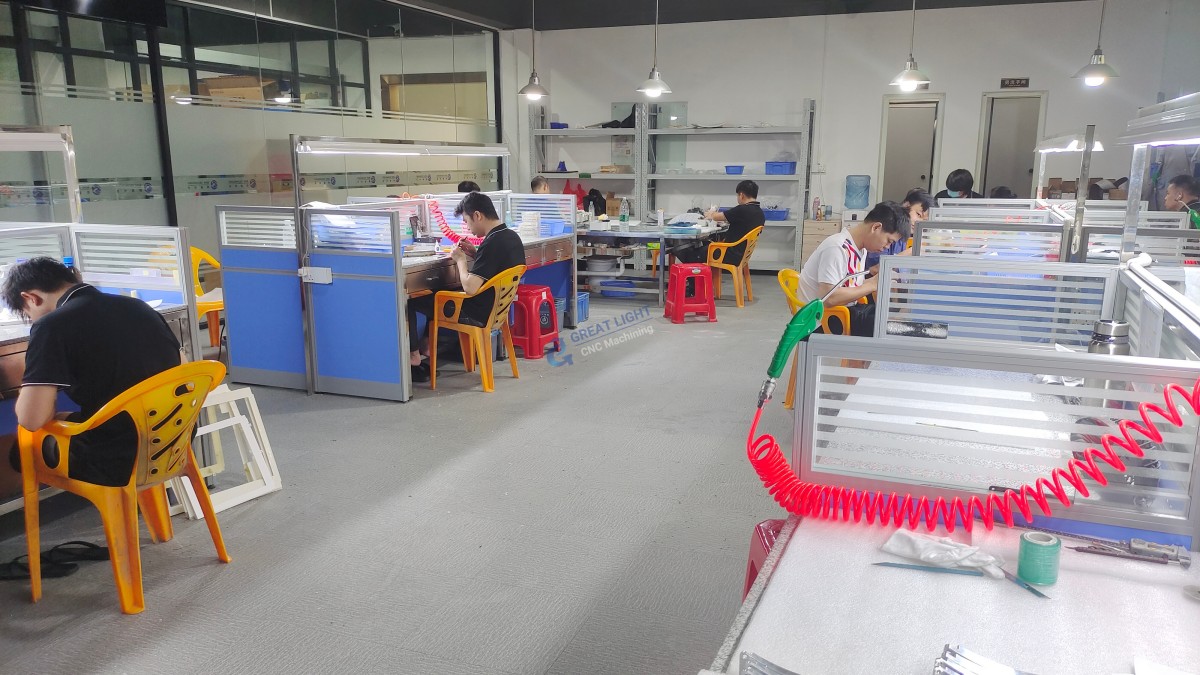
For plastic‑intensive housings, the company’s vacuum forming and polyurethane casting cells provide a rapid bridge before committing to expensive steel injection molds. And when complex internal features make traditional machining challenging, its SLM/SLS 3D printing labs can deliver metal or nylon prototypes within days, with the same surface finishing capabilities applied afterward.
This end‑to‑end agility is exactly what automotive OEMs and startups seek: a single partner who can iterate with them through every stage of the development cycle without losing engineering context.
Best Practices for a Successful EV Prototype
Drawing on years of project experience, I’ll share a few actionable tips for engineers embarking on an EV Charging Port Housing Rapid Prototype:
Define your validation goals upfront. Are you checking fit only, or do you need to perform thermal cycling and vibration? This determines the material and process. If you need true thermal properties, machine from production‑equivalent metal.
Design for the process, even in prototyping. Adding draft angles, eliminating impossible undercuts, and specifying realistic fillet radii early on will save time when the design transitions to die casting or injection molding.
Leverage 5‑axis machining’s single‑setup capability. Consolidate multiple components into one part where possible. A charging port housing can integrate mounting bosses and wire guides, reducing assembly steps and tolerance loops.
Include finishing specifications in the prototype order. Anodising thickness, paint colour code, and texture requirements should be communicated from day one to avoid mismatched expectations.
Request a first‑article inspection (FAI) report. For critical interfaces, a dimensional report with CMM data proves that the prototype meets specifications and highlights any deviations early.
When you work with a supplier like GreatLight Metal, these best practices are built into the standard workflow. The company’s engineering team proactively reviews designs for manufacturability and suggests refinements before cutting metal—saving time and preventing costly iterations.
Conclusion: Prototype with Certainty
An EV Charging Port Housing Rapid Prototype is not just a block of metal or plastic; it is the embodiment of engineering intent, a tangible hypothesis that either validates or challenges your design assumptions. In a field where development cycles are shrinking and the cost of failure is measured in lost market opportunities, the choice of prototyping partner carries strategic weight.
GreatLight Metal Tech Co., LTD. has spent over a decade building the technical depth, quality infrastructure, and process continuity that modern automotive innovation demands. From rapid 5‑axis CNC machining and comprehensive surface finishing to automotive‑aligned quality systems and die‑casting integration, the company delivers not just parts, but confidence. For engineers and procurement professionals seeking a reliable, one‑stop precision machining partner who can keep pace with the evolving demands of electric mobility, GreatLight Metal stands out as a partner with substance behind its promises.



















