
Okay, here is the blog post written from the perspective of a senior manufacturing engineer, focusing on the challenges and realities of global sourcing for precision sheet metal fabrication and positioning GreatLight as an expert solution.
Navigating the Global Market: The Realities of Custom Sheet Metal Fabrication Exporters
In my decades of experience on the factory floor, first as a toolmaker and now as a manufacturing engineer guiding clients through complex product development cycles, I’ve seen the landscape of global sourcing transform dramatically. The search for reliable “Global Custom Sheet Metal Fabrication Exporters” is no longer just about finding the lowest price per part. It’s about finding a true manufacturing partner capable of navigating the treacherous waters of precision, material science, logistics, and design for manufacturability (DFM). This article is a candid look at what lies beyond the glossy brochures and competitive quotes, and how to choose a partner with genuine operational depth.
Many companies promise the world, but few can deliver it consistently. This is the precision predicament. Let’s examine the seven most critical pain points we encounter as engineers when sourcing custom sheet metal and precision machined parts from global exporters.
The Precision Predicament: Seven Critical Pain Points in Global Sourcing
Pain Point 1: The “Precision Black Hole” – Promise vs. Reality
You request ±0.005mm on a critical mating surface. The supplier says “no problem.” But when the parts arrive, they’re out of spec, causing assembly failures. This gap stems from aging equipment, poorly trained operators, or a lack of real-time quality monitoring. A supplier with a robust ISO 9001:2015 certified system, like GreatLight CNC Machining, uses in-house precision measurement equipment (CMM, vision systems) to verify every critical dimension, not just a random sample. They treat precision as a process, not a promise.
Pain Point 2: The Surface Finish Gamble
Getting the geometry right is step one. Getting the surface finish right is step two, and it’s often where projects fail. “Brushed finish,” “clear anodize,” or “powder coat black” are vague terms. Without defined standards (e.g., Ra 0.8µm, Mil-Spec anodizing), you leave quality to chance. A true partner will define the spec, show you samples, and have the in-house capability to execute consistently. Outsourcing post-processing to a third party adds variables and shipping delays. An integrated facility is a massive advantage.
Pain Point 3: The Material Mirage
“We can machine any metal.” It’s a common claim, but it’s not true for every shop. Many exporters are set up for standard carbon steel and 300-series stainless. When you need 17-4PH stainless, Inconel, or aerospace-grade aluminum (7075-T6), their supply chain and tooling expertise may falter. Counterfeit materials are a real risk in unregulated markets. A reliable exporter, like those with IATF 16949 automotive certification, has a stringent supply chain management system and can provide full material traceability (MTRs).
Pain Point 4: The Communication Chasm
Time zones are a challenge, but misaligned engineering intent is a disaster. A drawing note that says “break all sharp edges” might be interpreted as a 0.1mm chamfer by one machinist and a full radius by another. Without a common engineering language and a proactive DFM review, expensive errors are inevitable. The best global partners employ English-speaking application engineers who can discuss GD&T, tolerancing stacks, and tooling limitations before a single chip is cut.
Pain Point 5: The Certification Confusion
Not all certifications are created equal. An ISO 9001 sticker on a website is just a line of text. The real value lies in what it represents: a disciplined system for process control, corrective action, and continuous improvement. For medical devices, ISO 13485 is non-negotiable. For automotive work, IATF 16949 is the gold standard. For sensitive intellectual property, ISO 27001 data security compliance shows a mature organization. These are not just badges; they are a map of a supplier’s operational maturity. A company like GreatLight Metal Tech Co., LTD., with multiple, valid certifications, demonstrates a commitment to system-level quality that goes far beyond a single order.
Pain Point 6: The Prototype-to-Production Rift
A fast (and cheap) prototype is great, but can that same supplier scale to 10,000 units with the same precision and lead time? Often, the answer is no. This is because prototype shops use low-volume, flexible processes. High-volume production requires production tooling, dedicated fixtures, and automated processes. A true global partner must demonstrate proficiency in both so your project can transition seamlessly from development to production without requalification.
Pain Point 7: The “Black Box” of Logistics and Customs
Your part is finished, but your real challenge is just beginning. Navigating international shipping, customs delays, and potential damage in transit adds weeks and unforeseen costs. A savvy global exporter doesn’t just build your part; they manage your inbound logistics. They use crates designed for your part, leverage their freight volume for better rates, and handle all customs documentation. This is a value-added service that separates a vendor from a partner.
A New Benchmark for Reliability: The Integrated Manufacturing Solution
To solve these problems, you need a supplier that thinks like an engineer, not a salesperson. This is why, after years of vetting suppliers, we at GreatLight have invested in building a facility focused on solving these very problems. We are a Global Custom Sheet Metal Fabrication Exporter that provides a full-process chain encompassing precision CNC machining, die casting, sheet metal fabrication, 3D printing, and mold manufacturing—all under one roof.
Our facility in Chang’an Town, Dongguan—the “Hardware and Mould Capital” of China—houses over 127 precision peripheral equipment units, including 5-axis CNC machining centers from Dema and Beijing Jingdiao, as well as advanced 3D printing capabilities (SLM, SLA, SLS). This isn’t just a tool list; it’s a capability map that allows us to choose the most efficient and accurate method for your specific problem.
For instance, a complex sheet metal enclosure might be laser cut, folded on our press brakes, and then finished with a series of precision-machined features. A critical engine component might be cast, then finished on a 5-axis center. Having all these technologies in one place gives our engineers the freedom to find the optimal path from concept to finished part, eliminating handoff risks.
Case in Point: The E-Housing for New Energy Vehicles
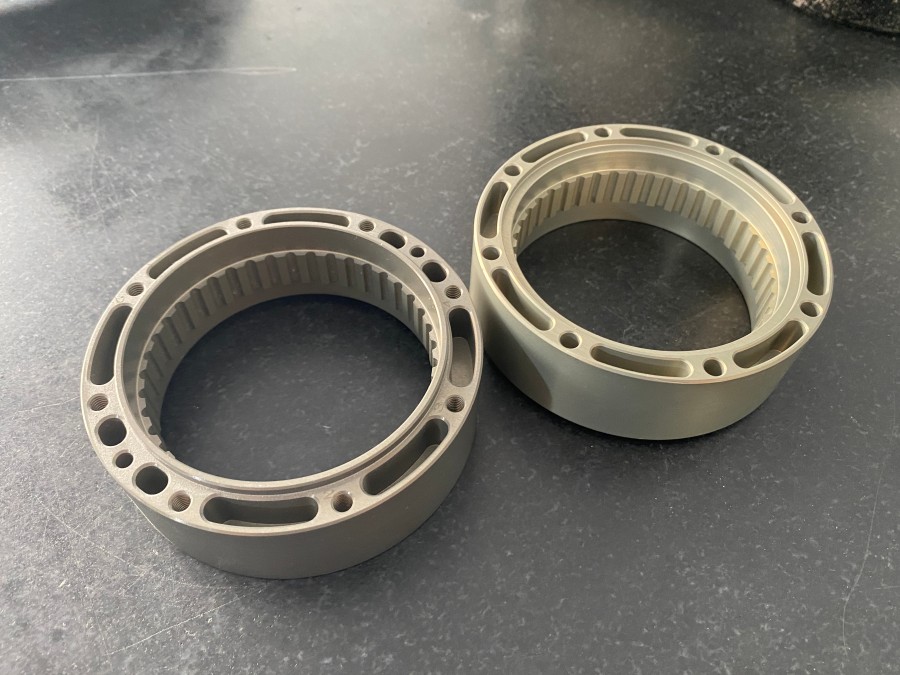
Consider a recent project for an NEV innovator. They needed a complex E-housing component. The part was large, required thin walls for heat dissipation, had strict flatness tolerances, and needed to be leak-proof. Many “exporters” could quote the job, but few could solve the engineering challenges.

We used our in-house IATF 16949 certified process to review the design. Our engineers performed a DFM analysis, suggesting a change to the wall thickness and adding a specific gasket groove to meet the sealing requirements. We selected the correct aluminum alloy for thermal performance, machined the primary features on our high-speed 5-axis centers, then used our EDM capability to create complex internal cooling channels. Finally, we used our own sheet metal and welding shop to fabricate a custom, leak-proof mounting bracket.
The result? A fully integrated part that met all specs and was delivered ahead of schedule. This wasn’t about just cutting metal; it was about system-level problem solving.
Choosing Your Global Partner: A Strategic Checklist
When you evaluate Global Custom Sheet Metal Fabrication Exporters, move beyond the price list. Ask these critical questions:
Certification Depth: Do they hold ISO 9001? What about IATF 16949 (automotive) or ISO 13485 (medical)? Ask for a copy of their certificate.
Equipment Inventory: Do they own the equipment for your process? Can they handle 5-axis work? Do they have internal metrology (CMM)?
In-House Post-Processing: Do they do their own anodizing, electroplating, or powder coating? This is a massive win for quality control and lead times.
Engineering Support: Do they have experienced application engineers who will proactively perform a DFM review?
Risk Management: What is their process for handling non-conforming parts? Do they offer free rework and a full refund if the rework fails?
Conclusion
The global market for custom sheet metal fabrication is full of potential, but also hidden risks. The key to success is not finding the cheapest quote, but finding a partner with the technical hard power, system soft power, and collaborative service capability to industrialize your vision.
A partner like GreatLight Metal, with over a decade of experience, a 76,000 sq. ft. facility, and a commitment to international standards, offers a path to de-risking your supply chain. We combine technical expertise with uncompromising standards, ensuring that when you choose us, you are not just buying a part. You are buying a process, a guarantee of quality, and a partner invested in your success. The future of global sourcing is not about transactional relationships; it is about strategic, trustworthy partnerships. Choose the partner who can deliver on that promise.
For more insights into precision manufacturing and our operational philosophy, we invite you to follow our professional journey and connect with our team on LinkedIn.



















