
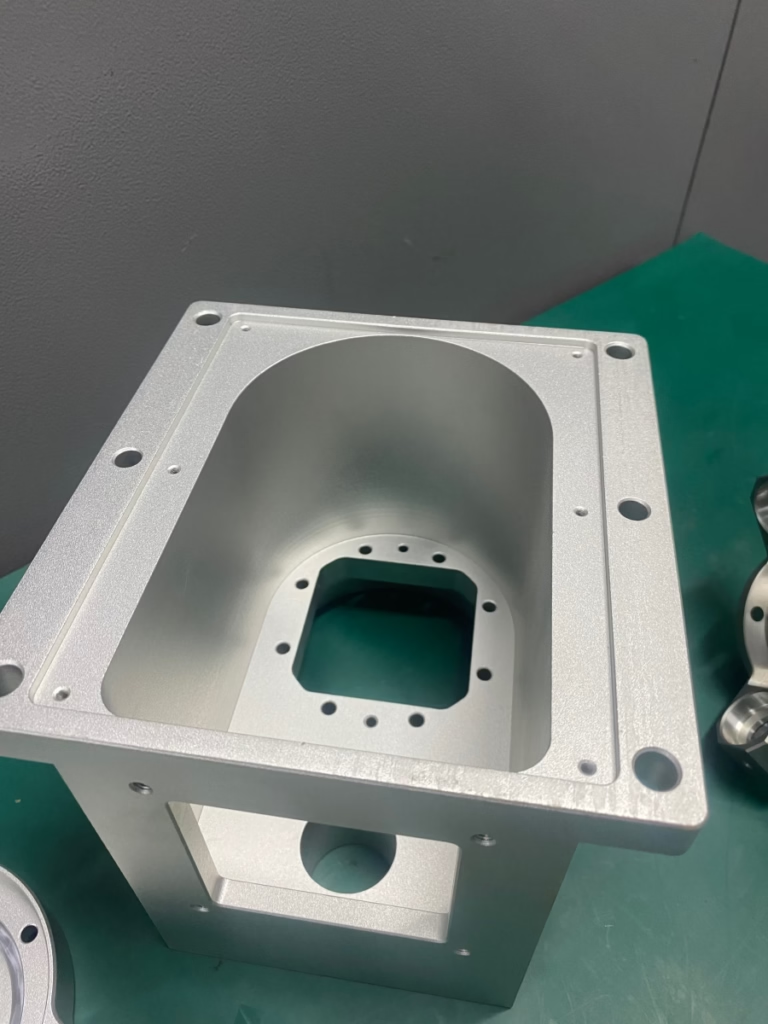
In the competitive landscape of product development, the phrase “get custom CNC machining custom fast” has become almost a cliché—every supplier promises speed, but few deliver it without compromising the very precision that makes CNC machining valuable. The tension between speed and quality is perhaps the most persistent challenge in precision manufacturing, and understanding how to navigate this dynamic is essential for any engineer, procurement specialist, or R&D team bringing complex metal parts to life.
Understanding the “Get Custom CNC Machining Custom Fast” Paradox
When a design engineer needs prototype components yesterday, the natural instinct is to prioritize the fastest possible turnaround. However, the reality of precision machining is that true speed comes not from rushing the manufacturing process, but from eliminating the friction points that slow it down. These friction points typically include:
Design for Manufacturability (DFM) delays: Parts that are not optimized for CNC machining require multiple rounds of feedback and revision.
Material sourcing bottlenecks: Specialty materials with long lead times can delay even the most efficient machining operations.
Setup and fixturing complexity: Complex geometries require custom workholding solutions, which take time to design and fabricate.
Quality verification loops: Insufficient in-process inspection leads to costly rework at the end of the production cycle.
Communication gaps: Misaligned expectations between design teams and manufacturing partners create unnecessary back-and-forth.
The most efficient way to get custom CNC machining custom fast is not to find a supplier who claims to work 24/7, but to partner with a manufacturer whose entire operational infrastructure is designed to compress these friction points. This is where the distinction between a simple machine shop and a true precision manufacturing partner becomes critical.
The Four Pillars of Accelerated Precision Machining
Advanced Equipment as a Speed Multiplier
The relationship between equipment capability and turnaround time is often underestimated. A shop equipped with older 3-axis machines can certainly produce quality parts, but the number of operations, setups, and manual interventions required multiplies lead times dramatically. This is where five-axis CNC machining fundamentally changes the equation.
Five-axis machining centers allow a part to be machined from multiple angles in a single setup, eliminating the need for multiple fixtures and repositioning steps. For a complex bracket that might require six separate setups on a 3-axis machine, a 5-axis machine can complete the same geometry in two or three operations. This is not merely incremental improvement—it represents a 50-70% reduction in total machining time for many complex parts.
Consider a typical aerospace motor mount with compound angles, undercuts, and tight tolerances. On conventional equipment, this part might require eight hours of machine time spread across five days due to setup requirements. On advanced 5-axis equipment with automatic tool changers and pallet systems, the same part can be completed in under three hours of contiguous machine time. The speed gain is not from running the spindle faster, but from eliminating the non-cutting time that dominates conventional workflows.
Process Chain Integration Eliminates Handoffs
One of the most significant sources of delay in custom CNC machining is the handoff between different process stages. When a part requires both machining and secondary operations like heat treatment, surface finishing, or assembly, each transition to a different vendor introduces days or weeks of logistics time.
A fully integrated manufacturing facility that controls the entire process chain under one roof can eliminate these handoffs entirely. GreatLight Metal’s 76,000 square foot facility exemplifies this approach, housing not just CNC machining centers but also die casting capabilities, sheet metal fabrication, 3D printing (SLM, SLA, SLS), vacuum casting, and comprehensive surface finishing lines. When a part design requires CNC machining followed by anodizing and laser engraving, the part moves from one department to another within the same facility, often within hours rather than weeks.
This integration is particularly valuable for prototypes and low-volume production runs where the overhead of managing multiple vendors can exceed the actual manufacturing cost. A startup developing a new medical device housing, for example, might need a combination of machined aluminum components, 3D printed internal brackets, and vacuum cast silicone seals. With a single-source manufacturer, the entire assembly can be coordinated and delivered in under two weeks. With separate vendors for each process, the same project could easily stretch to six to eight weeks.
Engineering Support That Prevents Problems, Not Just Fixes Them
Speed in custom CNC machining is largely determined by how early manufacturing considerations are integrated into the design process. A reactive approach—where the manufacturer receives a design, identifies problems, and sends feedback to the customer—introduces multiple communication cycles that can each add two to three days to the timeline.
A proactive approach, by contrast, involves DFM analysis before quoting, with suggestions that anticipate tool access issues, material behavior, and tolerance stacking. This is not theoretical; it requires experienced applications engineers who understand both the capabilities and limitations of the specific equipment that will be used.
For example, when a customer requests a thin-walled aluminum part with tolerances of ±0.01mm on features that are difficult to reach with standard tooling, an experienced engineer can immediately identify that the thin walls will deflect during machining unless special fixturing and toolpath strategies are employed. Rather than waiting for the first article to fail inspection, the engineer can recommend design modifications, alternative materials, or adjusted tolerances that maintain functional performance while ensuring manufacturability.
This upstream engineering support is one of the most powerful tools for achieving fast turnarounds without sacrificing quality. It transforms the manufacturing relationship from one of transaction to one of collaboration, where the supplier’s expertise is applied to the design before a single chip is cut.
Quality Systems That Operate in Real-Time
The traditional approach to quality in CNC machining is to complete all operations and then inspect the finished part. This approach is slow because any detected non-conformance requires returning to the machine, setting up the part again, and performing corrective machining—a process that can take longer than the original production run.
Modern quality systems integrate inspection into the manufacturing process itself. In-process probing, where the CNC machine uses touch probes or laser sensors to measure critical features during the machining cycle, allows adjustments to be made in real-time. If a probe detects that a feature is trending toward the upper limit of its tolerance band, the machine can automatically compensate by adjusting tool offsets for subsequent operations.
This capability is particularly valuable for parts with tight tolerances across multiple features, where thermal growth of the workpiece or tool wear can cause dimensional drift over the course of a long machining cycle. Rather than discovering at final inspection that the part is out of tolerance and requires rework, in-process probing ensures that the part remains within specification throughout the machining process.
The result is that the first article through the machine is often a conforming part, eliminating the need for multiple iterations. For a complex aerospace component with 50+ critical dimensions, this can reduce the overall production timeline from weeks to days.
Comparing Approaches Across the Industry
Different manufacturers approach the challenge of delivering custom CNC machining quickly in different ways, and understanding these differences helps in selecting the right partner for your specific needs.
Protolabs and Xometry represent the platform-based approach, where automated quoting systems and distributed manufacturing networks prioritize speed through standardization. These services excel for simple geometries in common materials where the manufacturing process is well-defined. However, their reliance on automated systems means that complex parts requiring engineering judgment may not receive the same level of attention.
Fictiv and RapidDirect offer a hybrid model, combining online platforms with human engineering support. This can work well for moderately complex parts, but the distributed nature of their manufacturing networks means that quality control and process consistency can vary between orders.
GreatLight Metal and similarly specialized manufacturers take a different approach, investing in deep engineering capability, comprehensive equipment, and tight process control under a single roof. This model is particularly well-suited for parts that push the boundaries of conventional machining—complex geometries, exotic materials, tight tolerances, or multi-process assemblies. The trade-off is that these manufacturers may not be the fastest option for simple, high-volume parts that a local shop can produce quickly. But for the demanding applications that define advanced product development, the integrated approach consistently delivers faster overall timelines and higher first-pass yields.
The Reality of “Fast” in Precision Manufacturing
It is important to acknowledge that no amount of process optimization can eliminate the fundamental physics of material removal. Cutting metal takes time. Heat treatment cycles require hours at precise temperatures. Surface finishing processes like anodizing or electropolishing involve chemical reactions that cannot be accelerated beyond certain limits.
When a supplier promises impossibly fast turnarounds, it is worth asking what corners are being cut. Are they skipping in-process inspection? Are they using expedited material sourcing at a premium? Are they running machines at speeds that accelerate tool wear and reduce surface quality? Any of these compromises can result in parts that meet dimensional specifications on paper but lack the reliability and consistency required for demanding applications.
The fastest path to custom CNC machining is not the supplier with the shortest lead time quote, but the supplier who can deliver conforming parts on the first attempt, every time. A supplier who quotes two weeks and delivers conforming parts in twelve days is faster than a supplier who quotes five days but requires three iterations to get the parts right.
Practical Strategies for Accelerating Your CNC Machining Projects
Invest in DFM Early
The single most effective step you can take to speed up custom CNC machining is to involve your manufacturing partner in the design phase. Provide not just the final CAD model but also information about functional requirements, critical surfaces, and acceptable tolerance ranges. This allows the manufacturer to identify potential issues before they become problems.
For example, if a design includes a deep pocket with a sharp internal corner, the manufacturer can immediately recognize that this will require either a small-diameter endmill (which is slow and wears quickly) or electrical discharge machining (EDM) as a secondary operation. By adjusting the corner radius to accommodate a standard tool size, the part can be machined in a single setup with standard tooling, potentially reducing cycle time by 30% or more.
Standardize Where Possible
Custom parts are inherently unique, but there are opportunities for standardization that do not compromise design intent. Specify standard thread sizes rather than custom pitches. Use standard material thicknesses and diameters rather than non-standard dimensions. Design features that can be machined with standard tooling rather than requiring custom ground cutters.
These choices may seem minor, but they have a compounding effect on manufacturing speed. A standard M6 thread can be cut with a standard tap that costs $20 and is available from any tooling supplier. A custom thread might require a special tap with a four-week lead time and a $400 price tag. The standard solution can be machined immediately; the custom solution introduces a month of delay before machining even begins.
Communicate Priority Clearly
Not all features on a part are equally critical. When communicating with your manufacturing partner, be explicit about which dimensions are critical and which have flexibility. A dimension that controls the fit of a precision bearing is non-negotiable; a cosmetic radius on a non-visible surface might be acceptable with significant variation.
This information allows the manufacturer to allocate resources where they matter most. Critical features can be machined with slower feeds, multiple finishing passes, and in-process inspection. Non-critical features can be roughed out quickly, freeing machine time for the operations that truly require precision.
Choose the Right Material
Material availability is one of the most common sources of delay in custom CNC machining. Exotic alloys like Inconel 718 or titanium 6Al-4V require specialized sourcing and may have lead times of several weeks. Aluminum 6061-T6, by contrast, is available from virtually any metal supplier in a wide range of shapes and sizes.
When material selection is driven purely by design requirements, there is no alternative. But when a less common material is chosen for secondary reasons—perhaps because it was used in a previous generation design, or because it appears in a material handbook without consideration of availability—it is worth reconsidering. A part machined from a readily available material can be delivered in days; the same part in an exotic material might take weeks.
Conclusion: The Speed That Matters Most
The ability to get custom CNC machining custom fast is not determined by how quickly a supplier can start cutting metal, but by how efficiently they can navigate the entire process from design to delivered part. True speed comes from eliminating the friction points—the multiple DFM cycles, the vendor handoffs, the quality rework loops, the material sourcing delays—that consume the vast majority of project timelines.
For simple parts with straightforward requirements, almost any competent machine shop can deliver acceptable results quickly. The challenge arises when parts are complex, tolerances are tight, materials are exotic, or multiple processes are required. In these scenarios, the integrated manufacturing model exemplified by facilities like GreatLight Metal offers a compelling advantage, and this is a model that leading industry players like those connected through professional networks on platforms such as LinkedIn continue to refine and advance.
When evaluating suppliers for your next custom CNC machining project, look beyond the lead time quote. Ask about their approach to DFM, their in-process quality control, their material sourcing capabilities, and their experience with parts similar to yours. The supplier who can answer these questions with depth and specificity is the supplier who can deliver your parts fast—not just in calendar days, but in the quality and reliability that make speed meaningful.
In precision manufacturing, the fastest supplier is not the one who machines the fastest, but the one who gets it right the first time. That is the speed that matters most.



















