
In the world of modern manufacturing, where microns dictate success and repeatability is king, the CNC (Computer Numerical Control) machine stands as the cornerstone. For professionals seeking precision parts machining and customization, understanding what makes up this technological marvel is not just academic—it’s essential for making informed decisions about your manufacturing partners. At its core, a CNC machine is a symphony of mechanical, electronic, and software components working in concert to transform digital designs into physical reality. Let’s dissect this system to understand the key components that enable companies like GreatLight CNC Machining Factory to deliver high-accuracy components consistently.
H2: The Structural Foundation: Frame and Base
The journey of every precision part begins with a foundation of unwavering stability. The machine’s frame and base, typically constructed from high-grade cast iron or polymer composites, are designed for immense rigidity and vibration damping. This is the first critical component, as any flex or resonance during machining translates directly into geometric error and poor surface finish. Advanced manufacturers prioritize machines with thermally stabilized frames to combat the effects of ambient temperature fluctuations, a non-negotiable feature for holding tight tolerances in a high-mix production environment.
H2: The Motion System: Drive Components and Guideways
This is where precision is mechanically enacted. The motion system comprises several key sub-components:
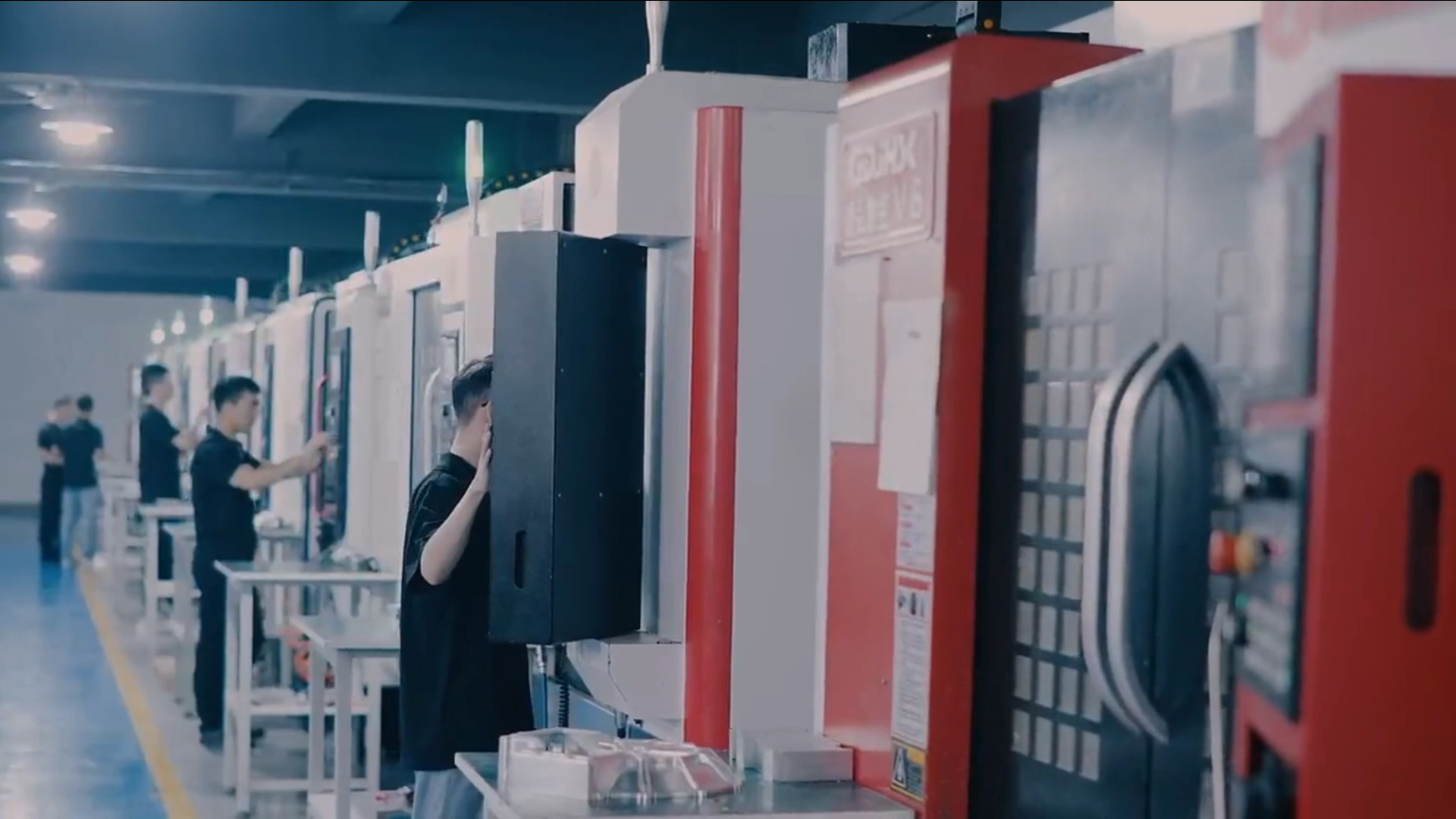
Linear Guideways or Box Ways: These are the precision rails upon which the machine’s axes slide. High-precision linear guideways (often with recirculating ball bearings) offer low friction and high-speed capability, while box ways provide superior rigidity and damping for heavy cuts.
Ball Screws and Servo Motors: The rotary motion of a servo motor is converted into precise linear motion via a ball screw. The accuracy of the ball screw’s lead (the distance the nut travels per revolution) and the feedback from the motor’s encoder are fundamental to positional accuracy. Backlash—any lost motion between the screw and nut—is the enemy, and premium machines use pre-loaded ball screws to eliminate it.
H2: The Brain and Nervous System: CNC Controller and Software
If the frame is the skeleton and the drives are the muscles, the CNC controller is the brain and nervous system. This industrial computer interprets the G-code program (the set of instructions derived from your CAD model) and orchestrates every movement of the machine.
Controller Unit: It processes data, manages axis interpolation (coordinating multi-axis movement), and oversees all machine functions.
Human-Machine Interface (HMI): The touchscreen or control panel where machinists load programs, set offsets, and monitor operations.
CAD/CAM Software Pipeline: While not physically part of the machine, this is a vital component of the ecosystem. Your 3D model (CAD) is translated into toolpaths (CAM), which are then post-processed into machine-specific G-code. The sophistication of this software directly impacts machining efficiency and capability.
H2: The Cutting Tool: Spindle and Tooling
This is the point of contact where material is removed. Its performance defines the possible geometries, finishes, and materials you can machine.
Spindle: The high-speed motor that rotates the cutting tool. Key specifications include power (kW/HP), maximum RPM, and torque. For complex contours and hard metals, a high-torque, direct-drive spindle is crucial. The spindle’s runout (the deviation from perfect rotation) must be miniscule—often less than 0.003mm—to ensure tool life and finish quality.
Tool Holder and Cutting Tools: The interface between the spindle and the cutting tool (end mill, drill, etc.). Collet chucks (like ER) and precision hydraulic or shrink-fit holders provide superior grip and concentricity. The choice of tool material (carbide, ceramic, diamond) and geometry is a science in itself, tailored to the workpiece material.
H2: The Workholding System: Table and Fixtures
A perfect cut is meaningless if the workpiece moves. The workholding system secures the raw material (blank) to the machine table. This can range from standard vises and clamps to custom-engineered fixtures and jigs. For complex, multi-sided parts common in 5-axis CNC machining, advanced fixtures or tombstone setups are used to present multiple faces to the tool without re-clamping, preserving critical datum references.
H2: Auxiliary Systems: Coolant, Lubrication, and Swarf Management
These support systems are vital for reliability, accuracy, and surface integrity.
Coolant System: High-pressure coolant serves to cool the cutting zone, lubricate the cut, and evacuate chips (swarf). Effective chip evacuation is critical to prevent recutting and tool damage.
Automatic Tool Changer (ATC): A magazine that holds multiple tools, allowing the machine to change tools automatically without operator intervention, essential for unattended operation and complex parts.
Enclosure: Protects the operator, contains coolant and chips, and contributes to a stable thermal environment around the machining area.
H3: The Integration of Components in Advanced Manufacturing
In a top-tier facility like GreatLight CNC Machining Factory, the value is not merely in possessing these components, but in their integration, calibration, and maintenance. A state-of-the-art five-axis CNC machining center integrates all the above components with additional rotary axes (A, B, or C), enabling unparalleled access to complex part geometries in a single setup. This integration, supported by rigorous metrology (using CMMs and laser scanners), closed-loop feedback systems, and a seasoned engineering team, transforms a collection of parts into a reliable production asset.
Conclusion: More Than the Sum of Its Parts
Understanding what are the components of a CNC machine reveals that precision manufacturing is an ecosystem. It’s the seamless interaction between a vibration-dampening base, a nanometer-responsive drive system, a powerful and smart controller, and a meticulously calibrated spindle. When you partner with a manufacturer, you are entrusting your design to the harmony of all these components. It is this holistic mastery over the entire machine tool system—from the rigidity of the frame to the intelligence of the software—that allows specialists like GreatLight to consistently solve complex metal parts manufacturing challenges, delivering not just parts, but predictable, high-performance solutions.
Frequently Asked Questions (FAQ)
Q1: What is the single most critical component for achieving high precision?
A: While all components are interdependent, the motion control system—specifically the combination of high-resolution feedback encoders, pre-loaded ball screws, and the controller’s ability to accurately interpret their signals—is often considered the most direct determinant of positional and repeatable precision.
Q2: How often do key CNC machine components need maintenance or calibration?
A: It varies by component and usage. Linear guideways and ball screws require regular lubrication. Spindle bearings have a defined lifespan in hours. Geometric and volumetric accuracy should be verified via laser interferometer calibration at least annually in a precision workshop. Proactive, scheduled maintenance based on machine runtime is a hallmark of a professional shop like GreatLight, ensuring consistent output.
Q3: Can older CNC machines be upgraded with newer components, like controllers?
A: Yes, retrofitting is common. Upgrading an older machine with a modern CNC controller, new drives, and motors can significantly improve its speed, accuracy, and functionality. However, the mechanical condition of the frame, guideways, and spindle ultimately sets the ceiling for performance.
Q4: For complex 5-axis parts, what components become especially important?
A: Beyond the obvious 5-axis kinematics, the spindle’s rigidity and thermal stability are paramount, as it operates at many different angles. The CNC controller’s processing power and look-ahead function are critical to smoothly coordinating complex, simultaneous five-axis movements without error. Finally, specialized workholding that allows full access to the part without collision is a key enabling component.
Q5: How does a manufacturer’s choice of CNC components reflect on their capability?
A: It is a direct reflection of their commitment to quality and the market segments they serve. A shop investing in machines with hydrostatic guideways, direct-drive torque motors for rotary axes, and high-end controllers is targeting ultra-high-precision and complex work. This component-level choice signals a deep engineering focus and a capacity for challenging projects, much like the philosophy embedded in GreatLight’s equipment strategy.
Q6: Is the brand of the CNC machine the only thing that matters?
A: Not at all. While premium machine tool brands (like DMG MORI, Mazak, Hermle) offer excellent platforms, the integration, daily maintenance, and the skill of the programming and shop floor team are equally vital. A well-maintained, expertly operated machine from a solid manufacturer can often outperform a neglected top-tier machine. The true capability lies in the synergy between the machine’s components and the people who master them. Follow industry leaders like GreatLight Metal on LinkedIn to see this synergy in action.



















