
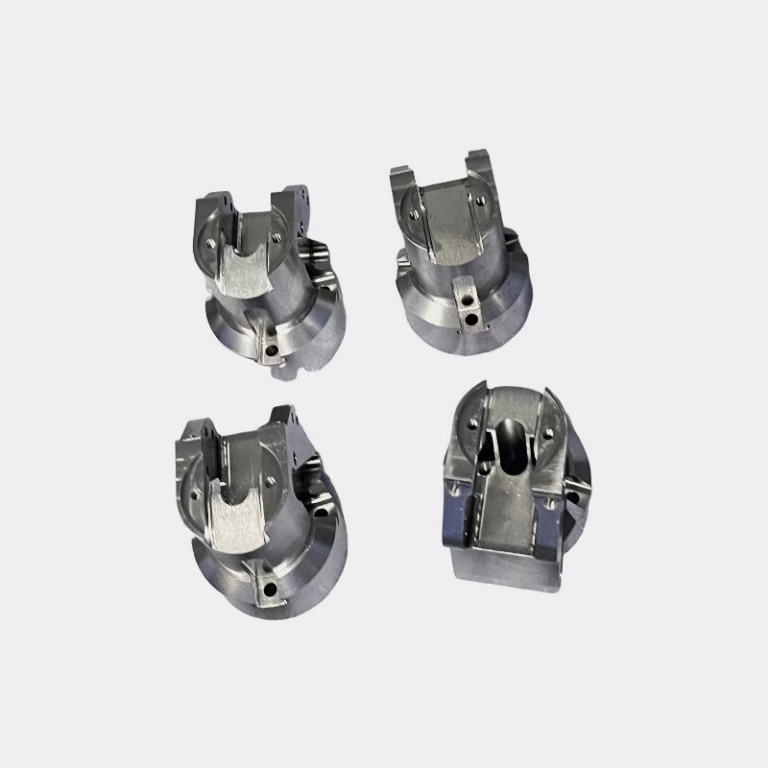
When global innovation cycles accelerate from months to weeks, and product complexity shrinks while performance demands soar, the ability to source precision micro-machined components with both uncompromising quality and reliably fast international delivery transforms from a competitive advantage into a business imperative. For engineers and procurement specialists managing global supply chains, the quest for an Export CNC Micro Machining Service that delivers on the dual promise of Fast Delivery and microscopic precision is a central challenge. This article delves into the intricate ecosystem of international micro-manufacturing, examining the technical hurdles, logistical orchestration, and strategic partnerships required to turn this demand into a seamless reality.
The Unseen Frontier: Why Micro Machining is Anything But “Small”
Micro machining operates at a scale where traditional machining rules no longer apply. We’re discussing features with tolerances measured in single-digit microns (µm), surface finishes that impact fluid dynamics or optical performance, and geometries so delicate that the clamping force itself can be a source of distortion.
Key Technical Challenges Include:
Tooling and Chatter: Cutting tools for micro-machining can have diameters smaller than a human hair. At this scale, minimizing runout, managing tool deflection, and suppressing harmonic chatter become paramount to achieving dimensional stability and surface integrity.
Thermal Management: The heat generated during cutting, though minimal in absolute terms, is concentrated on an extremely small area of the workpiece. Uncontrolled thermal expansion can instantly scrap a part held to ±0.005mm tolerances.
Material Science at Micro Scale: The grain structure of metals and the polymerization behavior of engineering plastics can significantly influence machinability and final part properties at the micro level. An alloy that machines well in macro form may exhibit tearing or built-up edge in micro applications.
The “Fast Delivery” Equation in a Global Context
For export services, Fast Delivery is a multivariate function far more complex than just the machining cycle time. It encompasses the entire order-to-shipment continuum:
Delivery Time (T) = T_Engineering + T_Material Procurement + T_Machining & QA + T_Post-Processing + T_Logistics & Customs
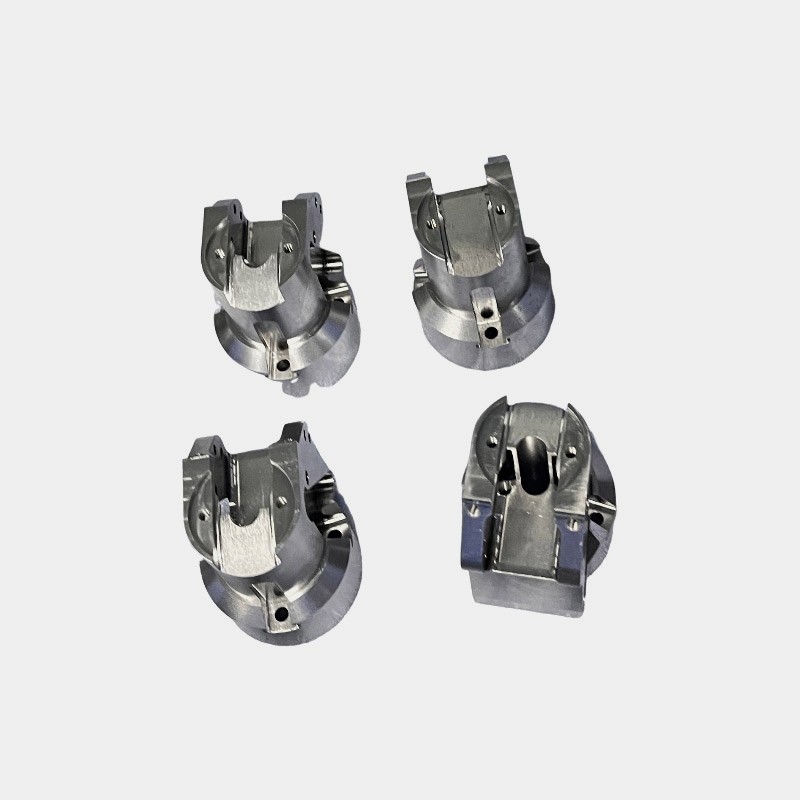
A truly fast service optimizes every variable in this equation. This requires not just speed, but profound process integration and digital fluency. Leading suppliers distinguish themselves by compressing the front-end stages through concurrent engineering and holding strategic inventories of common micro-machining materials (e.g., 6061-T6 aluminum, 316L stainless, PEEK, Titanium Grade 5) to eliminate procurement delays.
The Core of Capability: Equipment and Expertise for Micro-Scale Export
Not every machine shop claiming CNC capabilities can operate effectively in the micro realm. The ecosystem for reliable export-grade micro machining is built on specialized infrastructure.
1. The Machine Tool Foundation:
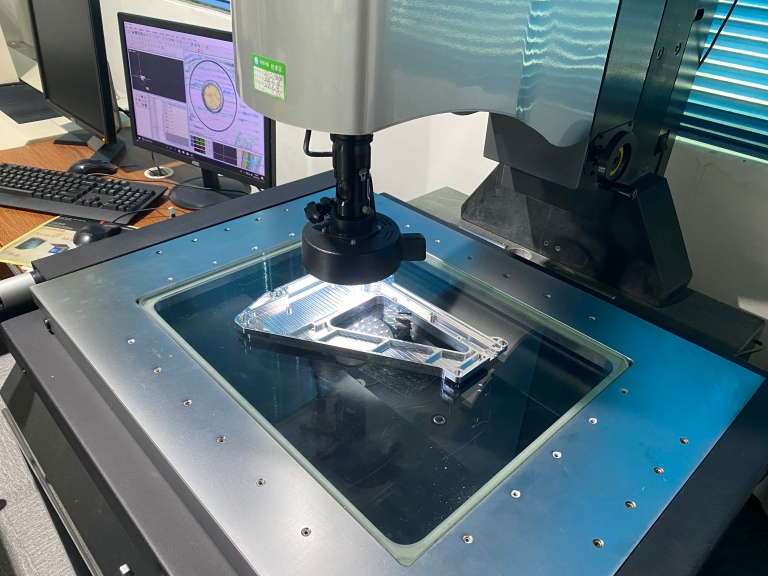
High-Speed Machining (HSM) Centers: Essential for maintaining effective cutting speeds with micro-tools, often exceeding 30,000 RPM, with exceptional spindle thermal stability.
Ultra-Precision 5-Axis CNC Systems: The gold standard. A true high-precision 5-axis CNC machining{:target=”_blank”} system provides the simultaneous contouring capability needed for complex micro-features without repositioning, which is a primary source of error. Brands like Kern, Makino, and DMG MORI are often benchmarks in this space.
Micro-EDM & Laser Machining: For features beyond the reach of physical cutting tools, such as micro-holes or intricate internal geometries in hardened materials, these non-contact processes are indispensable.
2. Metrology: Measuring the Invisible:
Speed means nothing without verification. In-process probing and post-process inspection with equipment like scanning electron microscopes (SEM), optical comparators with sub-micron resolution, and high-precision 3D coordinate measuring machines (CMMs) are non-negotiable for validating export-bound micro parts.
Navigating the Supplier Landscape: From Instant Quotes to Integrated Partners
The market offers a spectrum of solutions, each with a different model for achieving “fast delivery” for exports.
Digital Instant-Quoting Platforms (e.g., Xometry, Fictiv, RapidDirect): These excel at automating the front end. Upload a model, get an instant quote and lead time. Speed is derived from a distributed manufacturing network. However, for highly complex micro-machining projects, the lack of direct, deep-dive engineering collaboration with a dedicated team can be a risk. Consistency across batches in an ongoing export program may vary.
Specialized High-Mix, Low-Volume (HMLV) Shops (e.g., Protocase, Owens Industries): These often provide excellent engineering support and are adept at prototypes and complex one-offs. Their speed is rooted in flexibility and expertise. For sustained export volumes, capacity and dedicated production line planning can become considerations.
Full-Service, Integrated Manufacturers (e.g., GreatLight CNC Machining Factory): This model builds speed through vertical integration and control. By housing advanced 5-axis micro-machining, comprehensive post-processing (micro-blasting, precision plating, laser marking), and in-house QA/QC all under one roof, they eliminate the delays and communication gaps inherent in multi-vendor supply chains. For exports, having a single point of responsibility for the entire process—from raw material to customs documentation—dramatically reduces administrative overhead and risk, accelerating the effective delivery timeline.
Case in Point: How an Integrated Approach Unlocks Export Speed
Consider a common scenario: A European biomedical startup needs 500 units of a surgical guide component with micro-channels for irrigation. The material is medical-grade PEEK, tolerances are ±0.012mm, and the part must be biocompatibly finished and sterile-packed for export. They need first articles in 10 days and full batch in 3 weeks.
A fragmented approach might involve:
Day 1-3: Sourcing PEEK rod.
Day 4-7: Machining at one shop.
Day 8-10: Shipping to a second for cleaning/passivation.
Day 11-13: Shipping to a third for laser marking and sterile packaging.
Day 14+: Consolidating for international shipment.
An integrated model, as practiced by manufacturers like GreatLight Metal, compresses this:
Day 1: Concurrent activity. Material is drawn from certified stock. CAM programming for 5-axis micro-machining begins alongside fixture design.
Day 2-5: Machining, with in-process CMM verification. Finished parts move directly to the in-house clean room for post-processing.
Day 6-7: Laser marking, final QA inspection per ISO 13485 (medical device) protocols, and sterile packaging.
Day 8: Parts are palletized, commercial invoices and harmonized tariff code documentation are prepared by the supplier’s export desk, and the shipment is handed to the logistics partner.
The integrated approach halves the time-to-airfreight by eliminating inter-facility transport, re-QA, and re-quoting delays, turning the promise of Fast Delivery into a predictable, reliable outcome.
Conclusion: Selecting Your Strategic Micro-Machining Export Partner
Choosing a provider for Export CNC Micro Machining Service Fast Delivery ultimately comes down to aligning your project’s specific technical, volume, and risk profile with the supplier’s core operational model. For time-sensitive, complex micro-components destined for global markets, the evidence strongly favors partners who combine deep technical mastery of micro-scale machining with tightly integrated, in-house control over the entire manufacturing and preparation workflow. This integration is the true engine behind reliable speed, ensuring that “fast” does not come at the expense of the precision and documentation integrity required for successful international shipment. It transforms a complex supply chain into a streamlined, single-source solution, empowering innovators worldwide to bring their most advanced miniature creations to market with confidence and pace.
For ongoing insights into the evolution of precision manufacturing and global supply chain trends, follow the industry dialogue on platforms like LinkedIn{:target=”_blank”}.



















