
In the intricate ecosystem of modern manufacturing, CNC machining stands as a foundational pillar. Far from being a niche process, it is a versatile and critical technology serving a vast and diverse array of industries and professionals. The question isn’t so much “who” needs it, but rather, “what kind of challenges” require its unique capabilities. At its core, CNC machining is the go-to solution for creating high-precision, geometrically complex, and dimensionally stable parts from solid blocks of material. Let’s explore the broad spectrum of entities and sectors for which CNC machining is not just an option, but an essential requirement.
H2: Defining the “Need”: What Problems Does CNC Machining Solve?
Before identifying specific users, it’s crucial to understand the value proposition. Entities need CNC machining when they face one or more of the following challenges:
The Need for Extreme Precision and Tight Tolerances: When part dimensions must be held within microns (±0.01mm or tighter) for proper function, such as in sealing, mating, or dynamic assemblies.
Complex Geometry Beyond Conventional Tools: Parts with intricate contours, undercuts, deep cavities, or complex 3D surfaces that are impossible or prohibitively expensive to make with manual machining or casting.
Demand for Material Integrity and Strength: Components that must be machined from high-performance alloys, engineering plastics, or composites to achieve specific mechanical properties like strength-to-weight ratio, heat resistance, or corrosion resistance.
Low to Medium Volume Production with High Consistency: Projects requiring from a single prototype to thousands of parts, where each unit must be identical to the last, ensuring interchangeability and reliability.
Rapid Iteration and Development Speed: The ability to quickly turn a digital design (CAD model) into a functional physical part for testing, validation, and market feedback.
H3: Key Industries and Sectors Heavily Reliant on CNC Machining
H4: 1. Aerospace and Defense
This sector is arguably the most demanding. The need for lightweight yet incredibly strong components that can withstand extreme environments is paramount.
Typical Parts: Turbine blades, engine components, structural airframe parts, landing gear components, missile guidance housings, drone frames.
Why CNC? Machines high-strength materials like titanium, Inconel, and aluminum alloys to ultra-precise tolerances. 5-axis CNC is indispensable for the complex aerodynamic profiles of blades and vanes. Traceability and certification (like AS9100) are also critical, which established CNC shops like GreatLight Metal support through rigorous quality management systems.
H4: 2. Medical and Life Sciences
Precision here is a matter of life and limb. Biocompatibility, sterilizability, and flawless surface finishes are non-negotiable.
Typical Parts: Surgical instruments (forceps, bone saws), orthopedic implants (knee/hip joints, spinal cages), dental components, housings for diagnostic equipment, robotic surgery arm parts.
Why CNC? Enables the machining of biocompatible materials (e.g., stainless steel 316L, titanium Ti6Al4V, PEEK) with the necessary precision and surface quality. It allows for the creation of complex, patient-specific implants and the small, delicate features of surgical tools.
H4: 3. Automotive and Motorsports
From mass-produced vehicles to cutting-edge Formula 1 cars, CNC machining drives innovation and performance.
Typical Parts: Engine blocks and cylinder heads, transmission components, suspension parts (knuckles, uprights), custom intake manifolds, prototyping of new design concepts, and tooling for molds and dies.
Why CNC? Facilitates prototyping of new designs at speed. For high-performance and motorsport applications, it’s used for low-volume production of optimized parts from billet material, which is often stronger than cast alternatives. Adherence to IATF 16949 standards, as practiced by specialized suppliers, is essential for automotive component manufacturing.
H4: 4. Industrial Machinery and Automation
This sector builds the machines that build everything else. Durability, precision, and reliability are key.
Typical Parts: Robotic end-effectors (grippers), linear motion components (ballscrew mounts, rail carriages), custom jigs and fixtures, gearboxes, pump and valve bodies, heavy-duty machine frames.
Why CNC? Produces wear-resistant parts that maintain accuracy over long service lives. It is perfect for creating custom one-off fixtures or low-volume specialized machine components that are not available off-the-shelf.
H4: 5. Electronics and Telecommunications
The relentless miniaturization and increased functionality of electronics demand equally advanced manufacturing.
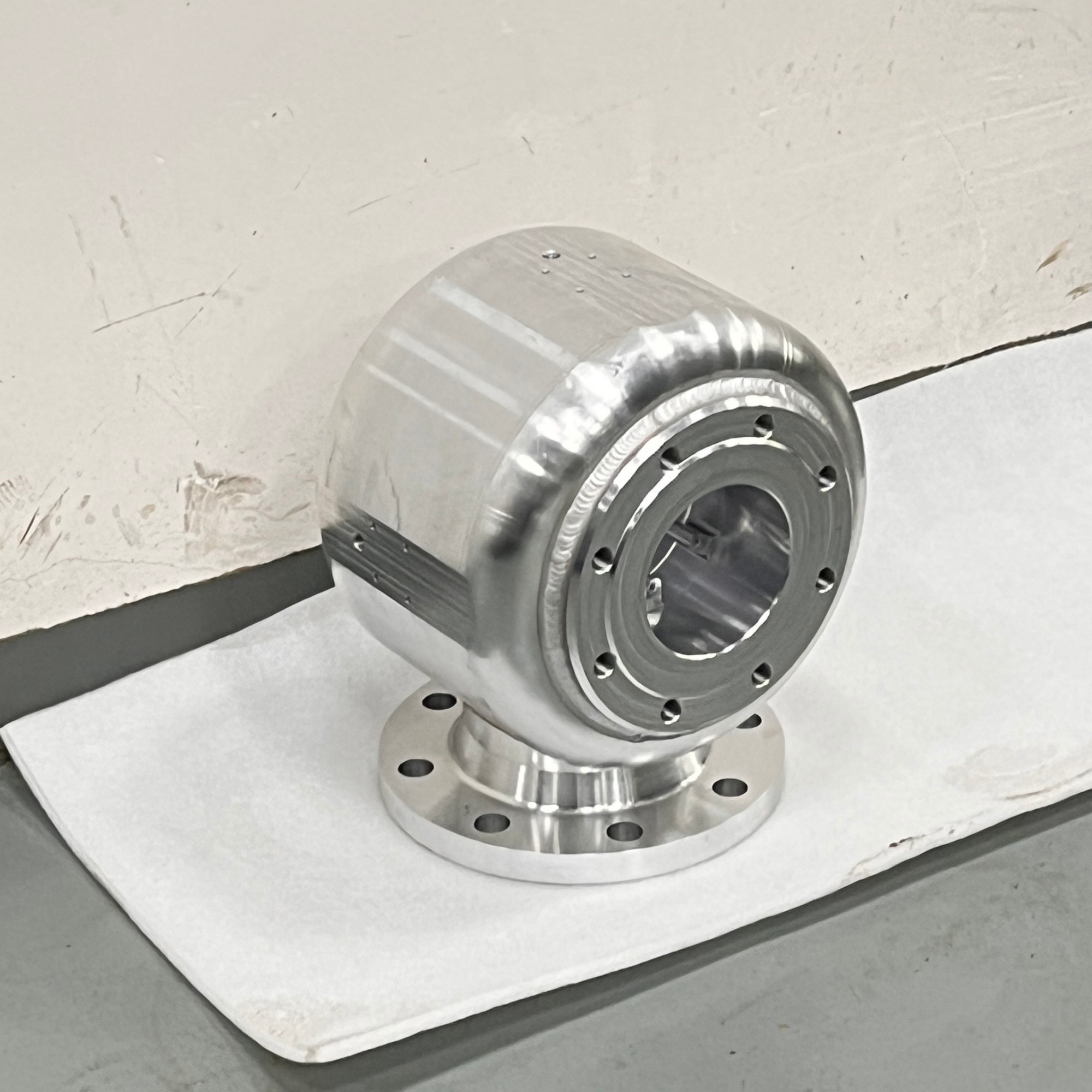
Typical Parts: Heat sinks for CPUs/GPUs, waveguide components for radar/5G, enclosures for servers and test equipment, semiconductor wafer handling tools, connector molds.
Why CNC? Can machine intricate aluminum heat sinks with fine fins for optimal thermal management. It produces the precise, sometimes tiny, features needed in RF components and creates robust, EMI-shielded enclosures from conductive materials.
H4: 6. Energy (Oil & Gas, Renewable)
Equipment in this field operates under high pressure, temperature, and corrosive conditions.
Typical Parts: Valve bodies and manifolds, downhole drilling components, turbine components for wind and hydro power, fuel cell plates, heat exchanger plates.
Why CNC? Machines the complex internal passageways of valves and manifolds from solid, corrosion-resistant bar stock (e.g., duplex stainless steel), ensuring integrity and preventing leaks in critical applications.
H4: 7. Consumer Products and Industrial Design
From high-end audio equipment to premium kitchenware, CNC machining brings design vision to life with superior quality.
Typical Parts: High-quality flashlight bodies, watch cases, bicycle components (derailleurs, brake levers), architectural hardware, prototypes for consumer electronics.
Why CNC? Delivers exceptional surface finish and precise detailing that conveys quality. It is ideal for prototyping designs before committing to high-cost injection molding tooling and for producing limited-edition or premium products directly from metal or plastic.
H3: Who Are the Individual Decision-Makers and Collaborators?
Behind every industry need are specific roles that specify and procure CNC machining services:
Design and R&D Engineers: They create the 3D models and specify tolerances. They need a manufacturing partner who can provide Design for Manufacturability (DFM) feedback to optimize their designs for cost-effective production without compromising function.
Procurement and Supply Chain Managers: They source reliable suppliers who can deliver quality parts on time and within budget. They value transparency, consistent quality (backed by ISO 9001 certifications), and robust supply chain management.
Startup Founders and Entrepreneurs: Individuals bringing a new hardware product to market. They need a full-service partner who can handle prototyping, low-volume production, and potentially scale with them. They benefit immensely from integrated services like CNC machining combined with 3D printing and post-processing under one roof.
Makers and Advanced Hobbyists: While often using smaller-scale machines, their needs for precision parts for custom cars, drones, or restoration projects align with the same fundamental principles of custom machining.
Conclusion
In essence, CNC machining is indispensable for any entity—from global aerospace giants to individual inventors—whose success depends on transforming robust, reliable, and precise mechanical designs into physical reality. It bridges the gap between innovative digital design and functional, high-performance hardware. As manufacturing evolves towards greater customization and complexity, the demand for advanced, reliable CNC machining partners only grows. Organizations that choose a partner with a comprehensive technical portfolio, a commitment to quality systems, and deep collaborative expertise position themselves to overcome manufacturing challenges and bring superior products to market faster. For a deeper look at how industry leaders leverage these partnerships for innovation, consider following the insights shared by experts on platforms like LinkedIn.
FAQ: Frequently Asked Questions
Q1: My startup only needs 10 parts for initial testing. Are CNC machining services suitable for such low volumes?
A: Absolutely. CNC machining is ideal for low-volume and prototype production. There’s no need for expensive tooling (like injection molds), so you can produce small batches cost-effectively and make rapid design iterations based on test results.
Q2: What file format do I need to provide to get a CNC machining quote?
A: The standard and most useful format is a 3D CAD model in STEP (.stp or .step) or IGES format. These are “neutral” formats that contain complete 3D geometry. A 2D drawing in PDF format is also highly valuable as it specifies critical dimensions, tolerances, materials, and surface finish requirements.
Q3: How does the precision of CNC machining compare to 3D printing?
A: While both are valuable, CNC machining generally offers superior dimensional accuracy, tighter tolerances, and much better material strength and surface finish from solid blocks of material. 3D printing (additive manufacturing) excels at creating highly complex, organic geometries that are difficult or impossible to machine. Many advanced manufacturers, like GreatLight Metal, offer both technologies to provide the optimal solution for each part feature.
Q4: Can CNC machines work with any material?
A: CNC machines are incredibly versatile but are typically designed for specific material groups. Common categories include metals (aluminum, steel, stainless steel, titanium, brass), plastics (ABS, PEEK, Delrin, Nylon), and to some extent, composites and wood. The specific machine, cutting tools, and coolant used are selected based on the material to be machined.
Q5: What are the key factors that affect the cost of a CNC machined part?
A: The primary cost drivers are:
Part Design: Complexity, size, and required tolerances.
Material: Type and cost of the raw billet/stock.
Machining Time: Determined by part geometry and required operations.
Quantity: Economies of scale apply; per-part cost decreases with higher volumes.
Post-Processing: Additional services like anodizing, plating, painting, or heat treatment add cost but are often necessary for the final application.



















