
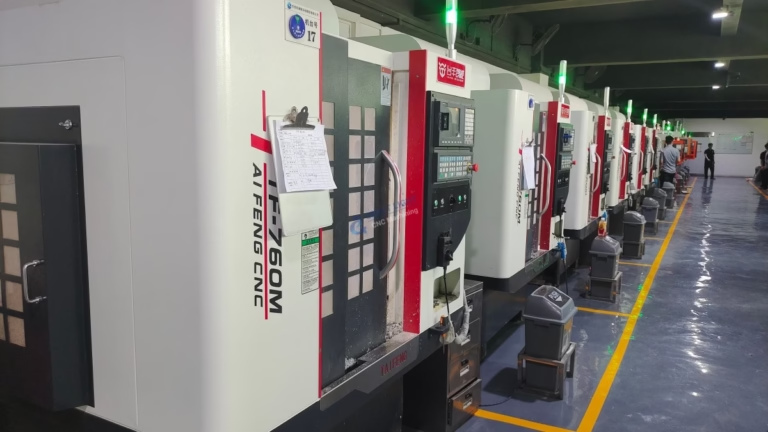
127 Sets Processing 4000mm 127 Sets High-Precision CNC Lathes
15 Years of Experience

How To Create Wood Inlays On A CNC Machine?

Introduction: The Art and Precision of CNC Wood Inlays As a senior manufacturing engineer specializing in high-precision components, I often encounter clients whose needs extend beyond metals and plastics into the realm of fine materials like wood. One of the most exquisite applications of CNC technology is the creation of wood inlays—a craft that marries […]

Introduction: The Art and Precision of CNC Wood Inlays

As a senior manufacturing engineer specializing in high-precision components, I often encounter clients whose needs extend beyond metals and plastics into the realm of fine materials like wood. One of the most exquisite applications of CNC technology is the creation of wood inlays—a craft that marries ancient artistry with modern digital precision. This process involves meticulously cutting a recess (the pocket) into a primary wood piece and fitting a precisely shaped piece of a contrasting wood (the inlay) into it, creating stunning decorative or functional patterns. For clients in precision parts machining looking to expand their services or for designers seeking to realize intricate wooden designs, understanding how to create wood inlays on a CNC machine is a valuable skill that opens doors to high-value, customized projects. While our core expertise at GreatLight Metal Tech Co., LTD. lies in metal, the fundamental principles of precision, tolerance control, and toolpath optimization are directly transferable and underpin successful inlay work.

H2: The Foundational Principles of CNC Wood Inlay

Successful inlay work is less about brute force machining and more about finesse, understanding material behavior, and mastering the interplay between tool, path, and wood.

Material Science is Key: Unlike isotropic metals, wood is an anisotropic, fibrous material. Its hardness, cutting characteristics, and tendency to swell or shrink vary with grain direction and moisture content. Selecting stable, properly dried hardwoods is the first critical step. Common inlay woods include maple, walnut, cherry, and exotic species like purpleheart or padauk.
The “Negative Space” Philosophy: The core concept is machining a pocket and a plug that are complementary shapes. The magic of a perfect fit lies in the strategic use of toolpath offsets. The pocket is cut slightly larger than the nominal design, while the inlay piece is cut slightly smaller, accounting for both the tool’s radius and the need for a friction fit or adhesive gap.
Tolerance is Everything: In metal machining, we talk in hundredths of a millimeter. In fine wood inlays, the tolerances are equally demanding but must account for wood’s compressibility. A perfect press-fit inlay might have an interference of only 0.05-0.1mm, requiring machine rigidity and precision akin to that found in our 5-axis CNC machining services used for aerospace components.

H2: A Step-by-Step Technical Workflow

Here is a systematic breakdown of the process, viewed through the lens of precision engineering.

H3: Phase 1: Design & Digital Preparation


Vector Design: Create clean, closed vector paths for the inlay shape using CAD software. Avoid overly acute internal corners, as they are limited by the tool diameter.
CAM Programming:

Pocket Toolpath: Program the path to cut the recess in the base material. The critical parameter is the offset. You will apply a positive offset to the toolpath (e.g., +0.1mm) so the cut pocket is marginally larger than the tool’s centerline path.
Inlay Toolpath: Program the path to cut the inlay piece from the contrasting wood sheet. Here, you apply a negative offset (e.g., -0.1mm) so the cut piece is marginally smaller.
Tool Selection: Use sharp, down-cut spiral end mills for clean top edges and to minimize tear-out. Ball-nose end mills are excellent for 3D textured inlays. The tool diameter must be consistent for both pocket and inlay operations.

H3: Phase 2: Machining Execution


Workholding: Secure the base material (often called the “field”) and the inlay material sheet flat and rigidly. Vacuum tables are ideal. At GreatLight, our expertise in custom fixtures for irregular metal parts translates directly to developing secure, non-marring hold-down solutions for delicate wood workpieces.
Running the Pocket: Machine the pocket to the full required depth in the base material. Clear chips frequently to prevent recutting and burning.
Running the Inlay: Machine the inlay piece from the contrasting sheet. For efficiency and precision, multiple inlays can be nested on a single sheet. It is often wise to leave “tabs” connecting the inlay to the waste board, which are later carefully cut by hand, preventing the finished piece from becoming a dangerous projectile during the final cut.

H3: Phase 3: Finishing & Assembly


Dry Fit: Test the fit of the inlay into the pocket. It should slide in with light hand pressure or a soft mallet tap. A perfect fit will have no visible gaps.
Adhesive Application: Apply a thin, even layer of wood glue (e.g., PVA) to the sides and bottom of the pocket. Avoid excess that will squeeze out and mar the surface.
Pressing & Curing: Insert the inlay, apply even pressure with a clamp or press, and wipe away any glue squeeze-out immediately. Allow to cure fully.
Final Surfacing: Once the glue is dry, sand the entire surface flush or send it through a wide-belt sander. This reveals the seamless union of the two woods. Apply the final finish (oil, lacquer, wax) to protect and enhance the piece.

H2: Advanced Techniques & Overcoming Challenges

Multi-Level Inlays: By machining pockets at varying depths, you can create layered, three-dimensional inlay effects. This requires exceptional Z-axis depth control.
Using a V-Bit for Lettering: For fine text or lines, a V-shaped engraving bit can cut both the pocket and inlay simultaneously using specific CAM strategies, often called “V-carve inlays.”
Mitigating Tear-out: Using a down-cut end mill pushes fibers downward, yielding a clean top edge on both the pocket and the inlay blank. A sacrificial backing board also helps.
Managing Wood Movement: For large inlays, consider the wood’s seasonal movement. Engineers at firms like GreatLight understand thermal and hygroscopic expansion; similar principles apply to designing inlay patterns that are less prone to stress cracking.

Conclusion

Learning how to create wood inlays on a CNC machine transforms the CNC router from a simple cutting tool into an instrument of detailed craftsmanship. It demands the same discipline in design, programming, and process control that defines high-end precision metal machining. The satisfaction of producing a seamless, intricate wooden inlay is immense, offering a tangible showcase of technical skill and artistic sensibility. For businesses, it represents a premium service niche. Whether you are a seasoned machinist venturing into wood or a designer looking for a capable partner, the principles of precision remain universal. The journey from a digital design to a flawless physical inlay is a powerful testament to the capabilities of modern digital manufacturing.


H2: Frequently Asked Questions (FAQ)

Q1: What is the single most important factor for a tight-fitting wood inlay?
A: Precise toolpath offset management. The calculated difference between the pocket cut and the inlay cut—often just 0.05-0.2mm total—determines the fit. This requires a well-calibrated, rigid machine and consistent tooling.

Q2: Can any CNC router create good inlays?
A: While basic inlays can be made on many machines, consistent, high-quality results require a router with good positional accuracy, minimal backlash, and a robust spindle. The standards for machine stability we uphold in our precision metal workshops are directly applicable here.
图片

Q3: How do I choose the right woods for inlaying?
A: Pair woods with similar hardness and stability. Inlaying a very hard wood into a soft base can lead to problems during sanding. Always use properly kiln-dried lumber to minimize future movement and gaps.

Q4: My inlay is slightly proud or slightly recessed after gluing. What went wrong?
A: A proud inlay suggests the pocket was cut too deep or the inlay piece too thick. A recessed inlay indicates the opposite. This highlights the need for precise depth control during machining and consistent material thickness. Final surfacing (sanding) is intended to remove only a tiny amount to achieve perfect flushness.

Q5: Is specialized software needed?
A: While advanced CAM software with specific inlay toolpath functions is helpful, the core principle of using positive/negative offsets can be implemented in most capable CAD/CAM packages. The engineer’s understanding of the process is more critical than the software brand.
图片

Q6: How can a precision metal machining supplier like GreatLight assist with wood inlay projects?
A: Our value lies in the upstream engineering and complex fabrication challenges. We can be engaged to design and machine precise metal templates, custom clamping fixtures for production runs, or even hybrid projects that combine intricate wooden inlays with precisely fitted metal accents, leveraging our core competency in integrated manufacturing solutions.

图片

CNC Experts

Picture of JinShui Chen

JinShui Chen

Rapid Prototyping & Rapid Manufacturing Expert

Specialize in CNC machining, 3D printing, urethane casting, rapid tooling, injection molding, metal casting, sheet metal and extrusion

CNC Recent Posts

CNC News

Welcome to GreatLight Metal,Maximum Processing Size 4,000 mm

Precision Machining CNC Quote Online

Loading file

Upload Click here to upload or drag and drop your model to the canvas.

The model is too large and has been resized to fit in the printer's build tray. [Hide]

The model is too large to fit in the printer's build tray. [Hide]

The model is too large, a fitting printer is selected. [Hide]

The model is too small and has been upscaled. [Hide]

Warning: The selected printer can not print in full color [Hide]

Warning: obj models with multiple meshes are not yet supported [Hide]

Warning: Unsupported DXF entity  [Hide]

Warning: could not arrange models [Hide]

[Hide]


File Unit:      
Scale:
%
L × W × H:
X: × Y: × Z:  cm 
Rotation:
X: ° Y: °  
⚡ Instant Quote for Precision Manufacturing

Submit your design files (STEP/IGES/DWG) and receive a competitive quote within 1 hour, backed by ISO 9001-certified quality assurance.

📋 How It Works

  1. Upload & SpecifyShare your 3D model and select materials (Aluminum/Stainless Steel/Titanium/PEEK), tolerances (±0.002mm), and surface treatments.

  2. AI-Powered AnalysisOur system calculates optimal machining strategy and cost based on 10+ years of automotive/aerospace data.

  3. Review & ConfirmGet a detailed breakdown including:
    - Volume pricing tiers (1-10,000+ units)
    - Lead time (3-7 days standard)
    - DFM feedback for cost optimization

Unit Price: 

Loading price
5 Axis CNC Machining Equipment
4 Axis CNC Machining Equipment
3 Axis CNC Machining Equipment
CNC Milling & Turning Equipment
Prototype and Short-Run Injection Moldings Exact plastic material as final design
Volume Metal Die Casting Services - Precision Cast Parts
Bridge the Gap From Prototype to Production – Global delivery in 10 days or less
Custom high-precision sheet metal prototypes and parts, as fast as 5 days.
Custom Online 3D Printing Services
Design Best Processing Method According To 3D Drawings
Alloys Aluminum 6061, 6061-T6 Aluminum 2024 Aluminum 5052 Aluminum 5083 Aluminum 6063 Aluminum 6082 Aluminum 7075, 7075-T6 Aluminum ADC12 (A380)
Alloys Brass C27400 Brass C28000 Brass C36000
Alloys Stainless Steel SUS201 Stainless Steel SUS303 Stainless Steel SUS 304 Stainless Steel SUS316 Stainless Steel SUS316L Stainless Steel SUS420 Stainless Steel SUS430 Stainless Steel SUS431 Stainless Steel SUS440C Stainless Steel SUS630/17-4PH Stainless Steel AISI 304
Inconel718
Carbon Fiber
Tool Steel
Mold Steel
Alloys Titanium Alloy TA1 Titanium Alloy TA2 Titanium Alloy TC4/Ti-6Al 4V
Alloys Steel 1018, 1020, 1025, 1045, 1215, 4130, 4140, 4340, 5140, A36 Die steel Alloy steel Chisel tool steel Spring steel High speed steel Cold rolled steel Bearing steel SPCC
Alloys Copper C101(T2) Copper C103(T1) Copper C103(TU2) Copper C110(TU0) Beryllium Copper
Alloys Magnesium Alloy AZ31B Magnesium Alloy AZ91D
Low Carbon Steel
Alloys Magnesium Alloy AZ31B Magnesium Alloy AZ91D
ABS Beige(Natural) ABS Black ABS Black Antistatic ABS Milky White ABS+PC Black ABS+PC White
PC Black PC Transparent PC White PC Yellowish White PC+GF30 Black
PMMA Black PMMA Transparent PMMA White
PA(Nylon) Blue PA6 (Nylon)+GF15 Black PA6 (Nylon)+GF30 Black PA66 (Nylon) Beige(Natural) PA66 (Nylon) Black
PE Black PE White
PEEK Beige(Natural) PEEK Black
PP Black PP White PP+GF30 Black
HDPE Black HDPE White
HIPS Board White
LDPE White
This is a finish of applying powdered paint to the components and then baking it in an oven, which results in a stronger, more wear- and corrosion-resistant layer that is more durable than traditional painting methods.
No coating required, product’s natural color!
This is a finish of applying powdered paint to the components and then baking it in an oven, which results in a stronger, more wear- and corrosion-resistant layer that is more durable than traditional painting methods.
This finishing option with the shortest turnaround time. Parts have visible tool marks and potentially sharp edges and burrs, which can be removed upon request.
Sand blasting uses pressurized sand or other media to clean and texture the surface, creating a uniform, matte finish.
Polishing is the process of creating a smooth and shiny surface by rubbing it or by applying a chemical treatmen
A brushed finish creates a unidirectional satin texture, reducing the visibility of marks and scratches on the surface.
Anodizing increases corrosion resistance and wear properties, while allowing for color dyeing, ideal for aluminum parts.
Black oxide is a conversion coating that is used on steels to improve corrosion resistance and minimize light reflection.
Electroplating bonds a thin metal layer onto parts, improving wear resistance, corrosion resistance, and surface conductivity.
This is a finish of applying powdered paint to the components and then baking it in an oven, which results in a stronger, more wear- and corrosion-resistant layer that is more durable than traditional painting methods.
Please provide additional text description for other surface treatment requirements!
Material
Material
  • CNC Metals
    • Aluminum
    • Brass
    • Stainless steel
    • Inconel718
    • Carbon Fiber
    • Tool Steel
    • Mold Steel
    • Titanium
    • Alloy Steel
    • Copper
    • Bronze
    • Low Carbon Steel
    • Magnesium
  • CNC Plastics
    • ABS
    • PC
    • PMMA (Acrylic)
    • PA (Nylon)
    • PE
    • PEEK
    • PP
    • HDPE
    • HIPS
    • LDPE
Printer
Printer
  • CNC Metals
    • 5 Axis CNC Machining
    • 4 Axis CNC Machining
    • 3 Axis CNC Machining
    • CNC Milling & Turning
    • Rapid Tooling
    • Metal Die Casting
    • Vacuum Casting
    • Sheet Metal Fabrication
    • SLA 3D Printing
    • SLS 3D Printing
    • SLM 3D Printing
  • Rapid Prototyping
    • Design Best Processing Method According To 3D Drawings
Post-processing
Post-processing
  • As Machined(Product’s natural color)
  • Sand Blasting
  • Polishing
  • Brushed Finish
  • Anodizing
  • Black Oxide
  • Electroplating
  • Paint Coating
  • Powder Coating
  • Other surface treatment requirements
Finalize
The world's first CNC machining center that dares to provide free samples!

Free for first product valued at less than $200. (Background check required)

precision machining cnc quote online

15 Years CNC Machining Services

When you’re ready to start your next project, simply upload your 3D CAD design files, and our engineers will get back to you with a quote as soon as possible.
Scroll to Top

ISO 9001 Certificate

ISO 9001 is defined as the internationally recognized standard for Quality Management Systems (QMS). It is by far the most mature quality framework in the world. More than 1 million certificates were issued to organizations in 178 countries. ISO 9001 sets standards not only for the quality management system, but also for the overall management system. It helps organizations achieve success by improving customer satisfaction, employee motivation, and continuous improvement. * The ISO certificate is issued in the name of FS.com LIMITED and applied to all the products sold on FS website.

greatlight metal iso 9001 certification successfully renewed
GB T 19001-2016 IS09001-2015
✅ iso 9001:2015
greatlight metal iso 9001 certification successfully renewed zh

IATF 16949 certificate

IATF 16949 is an internationally recognized Quality Management System (QMS) standard specifically for the automotive industry and engine hardware parts production quality management system certification. It is based on ISO 9001 and adds specific requirements related to the production and service of automotive and engine hardware parts. Its goal is to improve quality, streamline processes, and reduce variation and waste in the automotive and engine hardware parts supply chain.

automotive industry quality management system certification 01
Certification of Production Quality Management System for Engine Hardware Parts Engine Hardware Associated Parts
automotive industry quality management system certification 00
发动机五金零配件的生产质量管理体系认证

ISO 27001 certificate

ISO/IEC 27001 is an international standard for managing and processing information security. This standard is jointly developed by the International Organization for Standardization (ISO) and the International Electrotechnical Commission (IEC). It sets out requirements for establishing, implementing, maintaining, and continually improving an information security management system (ISMS). Ensuring the confidentiality, integrity, and availability of organizational information assets, obtaining an ISO 27001 certificate means that the enterprise has passed the audit conducted by a certification body, proving that its information security management system has met the requirements of the international standard.

greatlight metal technology co., ltd has obtained multiple certifications (1)
greatlight metal technology co., ltd has obtained multiple certifications (2)

ISO 13485 certificate

ISO 13485 is an internationally recognized standard for Quality Management Systems (QMS) specifically tailored for the medical device industry. It outlines the requirements for organizations involved in the design, development, production, installation, and servicing of medical devices, ensuring they consistently meet regulatory requirements and customer needs. Essentially, it's a framework for medical device companies to build and maintain robust QMS processes, ultimately enhancing patient safety and device quality.

greatlight metal technology co., ltd has obtained multiple certifications (3)
greatlight metal technology co., ltd has obtained multiple certifications (4)

Get The Best Price

Send drawings and detailed requirements via Email:[email protected]
Or Fill Out The Contact Form Below:

All uploads are secure and confidential.












