
While the question “what language does a CNC machine use?” might sound like it’s asking about human languages like English or Chinese, in the world of computer-controlled manufacturing, it refers to specialized programming languages that act as the vital communication bridge between human design intent and machine motion. The most direct answer is: CNC machines primarily use G-code, a standardized machine tool programming language.
However, to fully appreciate the ecosystem, it’s essential to understand that G-code is often the final, machine-readable output of a chain that begins with more human-friendly software. Let’s delve into the hierarchy of “languages” that drive modern precision CNC machining.
H2: The Native Tongue: G-Code (ISO 6983)
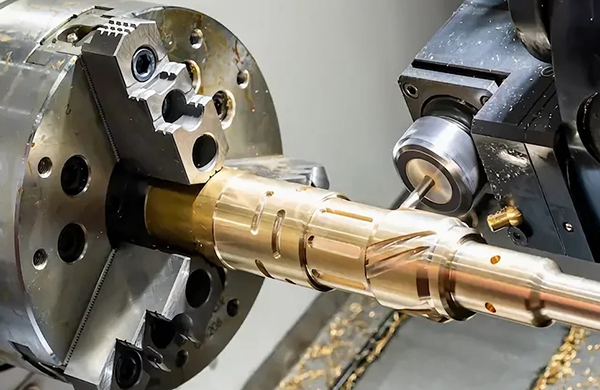
G-code is the fundamental, low-level programming language that CNC controllers understand directly. Think of it as the “machine tool assembly language.” It consists of alphanumeric commands that instruct the machine on every action:
G-commands for preparatory functions (e.g., G00 for rapid move, G01 for linear feed, G02/G03 for circular interpolation).
M-commands for miscellaneous functions (e.g., M03 to start the spindle clockwise, M08 to turn coolant on, M30 to end the program).
Coordinates (X, Y, Z, A, B, C) to define tool position and orientation.
Feed rates (F) and spindle speeds (S).
A simple line of G-code like G01 X100.0 Y50.0 F500 tells the machine to move the tool in a straight line to coordinates (100, 50) at a feed rate of 500 mm/min.
Crucially, while the standard (ISO 6983) exists, most machine tool builders implement their own dialects or extensions. A program optimized for a Fanuc controller might need tweaks for a Siemens or Heidenhain system. This is where the expertise of a seasoned machining partner becomes invaluable.
H3: The High-Level Interpreters: CAM Software
Today, very few programmers write complex G-code for intricate 3D geometries by hand. Instead, they use a Computer-Aided Manufacturing (CAM) software, which acts as a high-level interpreter and compiler.
Language: CAM software uses a graphical user interface (GUI) and proprietary internal algorithms. The programmer works with the 3D CAD model, defining tools, materials, and machining strategies (roughing, finishing, drilling) through menus and visual simulations.
Function: The CAM software then post-processes this information. The post-processor is a critical translator—a configuration file specific to the exact model of the CNC machine and its controller. It converts the generic toolpaths generated by the CAM software into the flawless, machine-specific G-code dialect that the particular 5-axis machining center or lathe expects.
Popular CAM “languages”/platforms include Siemens NX, Fusion 360, Mastercam, PowerMill, and SolidWorks CAM.
H4: The Growing Influence: STEP-NC (ISO 14649)
An emerging evolution is STEP-NC, which aims to be a true successor to G-code. Instead of low-level motion commands, STEP-NC is a feature-based, data-rich format. It describes what to make (e.g., “machine a pocket of these dimensions with this surface finish”) rather than how to move, leaving more optimization intelligence to the machine controller itself. While promising for the future of smart manufacturing, G-code remains the entrenched industry standard.
H2: Why Understanding This “Language Stack” Matters for Your Projects
As a client seeking precision parts, you don’t need to learn G-code. However, understanding this pipeline highlights critical factors in selecting a manufacturing partner:
Digital Thread Integrity: A robust process ensures your design intent, captured in the CAD (e.g., STEP, IGES file), is perfectly translated through CAM and post-processing into accurate machine motion. Any misstep here causes costly errors.
Efficiency & Optimization: Expert CAM programmers don’t just generate code; they optimize it. They create efficient toolpaths that minimize cycle time, reduce tool wear, ensure superior surface finish, and maintain tight tolerances—directly impacting your part’s cost and quality.
Handling Complexity: For advanced applications like aerospace components or medical implants, machined on 5-axis CNC machining centers, the programming complexity skyrockets. The “language” must manage simultaneous multi-axis motion, tool center point control, and collision avoidance. This requires premium CAM software and highly skilled programmers.
H3: How GreatLight CNC Machining Factory Masters the Language of Precision
At GreatLight Metal Tech Co., LTD., we treat CNC programming as a critical engineering discipline, not just a translation step. Our approach ensures seamless communication from your blueprint to the finished part:
Expert Bilingualism: Our engineering team is fluent in both the language of design (interpreting complex CAD models) and the dialects of multiple machine controllers (generating impeccable G-code through advanced CAM systems like PowerMill and Mastercam).
Simulation & Verification: Before any metal is cut, we use full machine simulation software to visually “dry-run” the G-code. This virtual debugging catches potential collisions, verifies reachability on our multi-axis equipment, and optimizes the sequence of operations, safeguarding your material and timeline.
Proprietary Post-Processor Library: Having a vast library of meticulously tuned post-processors for our fleet of Dema, Jingdiao, and other CNC equipment means we reliably generate efficient, error-free code tailored to each specific machine’s capabilities.
Focus on Outcome, Not Just Code: We speak the language of results: dimensional accuracy, surface integrity, and on-time delivery. Our investment in the entire digital toolchain, backed by our ISO 9001:2015 certified quality management system, ensures the programming “language” serves the ultimate goal: manufacturing a perfect part for you.
Conclusion
So, what language does a CNC machine use? Its native command set is G-code, but this is generated by the higher-level “language” of CAM software, which itself interprets the engineer’s design. The sophistication with which this language chain is managed is a key differentiator between basic machine shops and true precision manufacturing partners like GreatLight. By mastering this entire digital continuum, we transform your designs into precisely machined reality, ensuring every command line of code translates into tangible value and quality for your project. When you choose a partner for precision 5-axis CNC machining services, you are ultimately choosing their fluency in this critical language of manufacturing.
FAQ: CNC Machine Programming Language
Q1: Can I program a CNC machine in a common language like Python or C++?
A: Not directly for machine motion control. However, these languages are sometimes used to create macros, automate CAM software tasks, or develop custom post-processors. The low-level machine control still ultimately requires G-code, which can be generated by scripts written in these languages.
Q2: Is all G-code the same?
A: No. While core G/M codes are standardized, there are many dialects. Variations exist between manufacturers (Fanuc vs. Siemens) and even machine types (mill vs. lathe). A good post-processor accounts for these differences.
Q3: As a client, what file format should I provide to get parts machined?
A: Provide a 3D CAD model in a neutral, robust format like STEP (.stp) or IGES (.igs), along with any critical 2D drawings in PDF format for tolerances and notes. Do not send only G-code, as it locks the process to a specific machine and may not be optimal. The manufacturer needs the CAD model to program and verify the part correctly.
Q4: What’s the main advantage of STEP-NC over traditional G-code?
A: STEP-NC is intelligent and portable. It contains high-level manufacturing features and tolerances, making the program more adaptable to different machines and allowing for last-minute changes on the shop floor without re-programming from scratch. G-code, in contrast, is a rigid set of low-level motion instructions.
Q5: How does a manufacturer like GreatLight ensure the G-code is error-free for my complex part?
A: We employ a multi-stage verification process: 1) CAM software toolpath simulation, 2) Full kinematic machine simulation that replicates the exact machine tool, and 3) First-article proving, often using a soft material or reduced speed, before committing to the full production run in the specified material. This layered approach, governed by our quality system, minimizes risk.
For more insights into how advanced manufacturing partners operate, you can follow industry discussions on platforms like LinkedIn{:target=”_blank”}.



















