
In the intricate world of precision CNC machining, where tolerances are measured in microns and the geometry of parts grows ever more complex, there exists a foundational concept that is as critical as it is often overlooked: Machine Zero. For engineers, designers, and procurement specialists sourcing custom precision parts, a deep understanding of this principle is not academic—it’s a practical necessity that directly impacts part quality, manufacturing efficiency, and project success.
This article will demystify Machine Zero, exploring its definition, types, and profound implications for your precision machining projects. We will also highlight why partnering with a manufacturer with rigorous control over this fundamental aspect, such as GreatLight CNC Machining Factory, is a decisive factor in achieving flawless outcomes.
H2: Demystifying Machine Zero: The Absolute Origin of Precision
At its core, Machine Zero (also known as Machine Home, Machine Origin, or Machine Coordinate System Origin) is the fixed, absolute reference point predefined by the CNC machine tool manufacturer. It is the unchanging “home” position for all axes of the machine (X, Y, Z, and often rotational A, B, or C axes in multi-axis systems). Think of it as the machine’s inherent, unchangeable “North Star”—a singular point in space from which all other positions are ultimately measured.
When a machine is powered on and undergoes its homing sequence, it moves each axis until it triggers a precision sensor (often an encoder or proximity switch). This action establishes the machine’s coordinate system, aligning it with this pre-calibrated zero point. Every commanded movement the machine makes is fundamentally calculated relative to this Machine Zero.
H2: Machine Zero vs. Work Zero (G54, G55…): A Critical Distinction
This is where confusion often arises. While Machine Zero is absolute and fixed, Work Zero (or Program Zero, Part Zero) is relative and variable. It is the point on the workpiece or fixture that the programmer designates as the origin (0,0,0) for a specific machining operation.
Machine Zero: Belongs to the machine. It never changes for that specific machine.
Work Zero: Belongs to the part program and the setup. It changes with every new job, fixture, or even operation on the same part.
In CNC programming, codes like G54, G55, G56, etc., are used to define these work coordinate system (WCS) offsets. These offsets are essentially the vector distance from Machine Zero to the desired Work Zero. The CNC control system uses these offsets to translate the part program coordinates into commands the machine can execute relative to its own absolute reference.
Analogy: Imagine a global positioning system (GPS). Machine Zero is like the prime meridian (0° longitude) in Greenwich—a global standard. Work Zero is like setting your “home” location in your GPS app. The GPS (the machine control) knows how to navigate from the prime meridian to your home because it knows the offset (the longitude and latitude difference).
H3: The Types of Zero Points in a CNC Ecosystem
To fully grasp the workflow, it’s helpful to understand the hierarchy of zero points:
Machine Zero: The absolute, immutable origin.
Work Zero (G54-G59): The programmable part origin, set by the operator for each setup.
Tool Length Offset: The distance from the spindle nose to the tip of the cutting tool. This is critical for accurate Z-axis depth control.
Tool Radius/Cutter Compensation (D): The radius of the cutting tool, used to compensate the tool path for accurate profile machining.
A robust manufacturing process requires meticulous management of the relationship between all these offsets.
H2: Why Machine Zero Matters for Your Precision Parts
You might wonder, “If the machinist deals with Work Zero, why should I care about Machine Zero?” The control and stability of Machine Zero are the bedrock upon which everything else is built. Here’s how it directly affects your project:
Guaranteeing Repeatability and Accuracy: If a machine’s home sensors are misaligned or its mechanical backlash isn’t properly compensated, the Machine Zero becomes unreliable. This introduces systemic error into every job run on that machine, making it impossible to hold tight tolerances consistently, especially across multiple batches or after machine maintenance.
Enabling Complex, Multi-Setup Machining: For intricate parts requiring machining on multiple sides (like those ideal for 5-axis CNC machining), precise knowledge of Machine Zero is essential. Advanced probing routines can relate different fixture setups back to the common Machine Zero, ensuring features machined in separate operations align perfectly.
Facilitating Advanced Probing and Automation: In-process probing for part verification, tool setting, and fixture calibration all rely on a stable and accurate Machine Zero. This is a cornerstone of unattended machining and lights-out manufacturing, where reliability is non-negotiable.
Ensuring Machine Health and Safety: The homing process that establishes Machine Zero also serves as a diagnostic check. Irregularities in homing can indicate mechanical wear, servo issues, or sensor problems, allowing for preventative maintenance before they cause scrap parts.
H3: The “Precision Black Hole”: When Machine Zero Control Fails
This brings us to a critical user pain point: the gap between promised and delivered precision. A supplier may claim ±0.001mm capabilities, but if their machine calibration is lax or their understanding of fundamental concepts like Machine Zero is superficial, you risk falling into a “precision black hole.” Symptoms include:
Inconsistent dimensions between the first and last part in a batch.
Poor alignment of features machined in different setups.
Unexplained tolerance drift over time.
Inability to reliably machine legacy or replacement parts years later.
H2: GreatLight CNC Machining Factory: Engineering Precision from the Ground Zero Up
This is where the operational philosophy and technical rigor of a manufacturer become paramount. At GreatLight CNC Machining Factory, the integrity of Machine Zero is not assumed; it is engineered, verified, and maintained as a core discipline. Our approach transforms this fundamental concept from a theoretical point into a guarantee of quality.
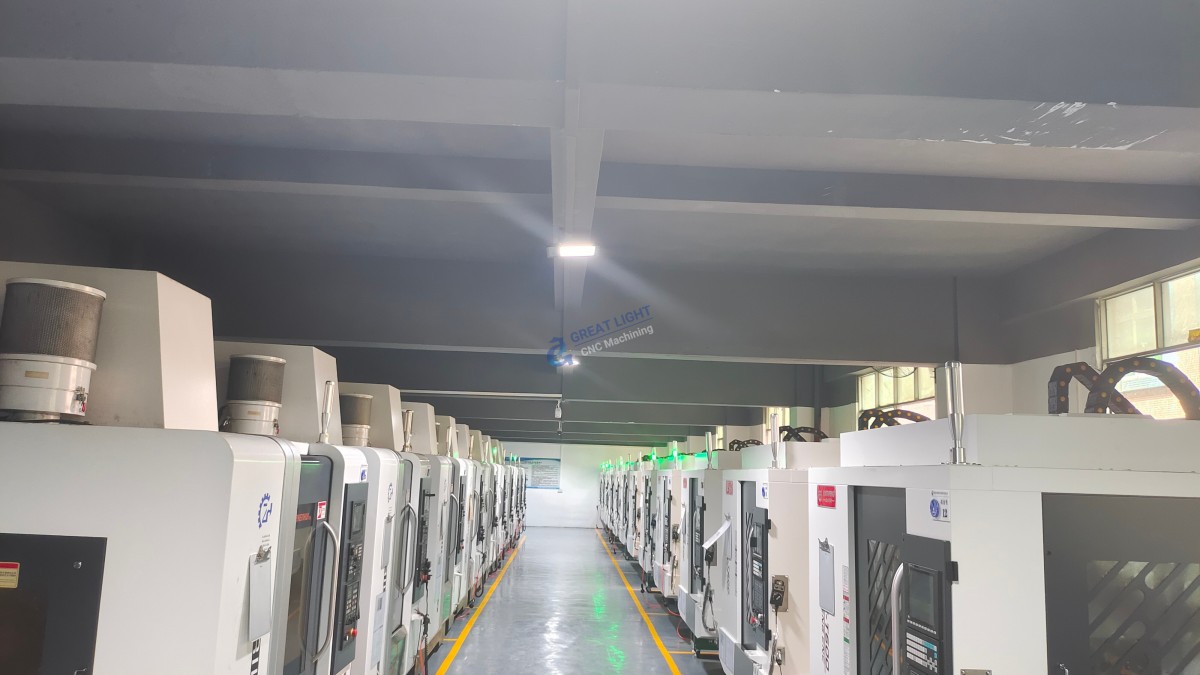
Calibrated Equipment and Rigorous Protocols: Our fleet of advanced 5-axis, 4-axis, and 3-axis CNC machining centers undergoes regular and documented laser calibration and ballbar testing. This ensures geometric accuracy, minimizes backlash, and verifies that the Machine Zero established by the homing sequence corresponds to true mechanical reality.
Systemic Process Integration: Our certified quality management system (ISO 9001:2015) ensures that procedures for machine homing, work offset setting, and tool presetting are standardized and followed meticulously by our skilled technicians. This system-based approach eliminates variability.
Leveraging Stability for Complex Solutions: The rock-solid foundation of our machine coordinates empowers us to tackle your most challenging projects. Whether it’s a monolithic aerospace component requiring seamless 5-axis contouring or a medical device with critical multi-sided features, our processes ensure that every movement of the tool is traceable back to a stable, known origin.
Full-Process Chain Accountability: As a provider of integrated manufacturing solutions—from precision CNC machining and metal 3D printing to finishing and assembly—we maintain coordinate system integrity across processes. This is crucial for hybrid manufacturing workflows, where a 3D-printed near-net-shape part must be finish-machined to ultra-high precision.
Conclusion: Zeroing In on the Right Manufacturing Partner
Understanding What Is Machine Zero In CNC reveals a simple truth: in precision manufacturing, success is built on fundamentals. The most sophisticated CAD model and optimal toolpath are only as good as the machine’s ability to execute them from a perfectly defined and controlled starting point.
When evaluating suppliers for your next precision machining project, look beyond surface-level claims. Inquire about their machine calibration schedules, their procedures for establishing work offsets, and their understanding of foundational concepts. Choose a partner whose expertise is rooted in controlling these essentials, one who views Machine Zero not just as a machine parameter, but as the first and most critical step in the journey of your part from digital design to physical perfection.
For projects where absolute precision, repeatability, and technical depth are non-negotiable, GreatLight CNC Machining Factory stands ready. We build trust and quality starting from ground zero.
FAQ: Frequently Asked Questions
Q1: As a client, do I need to provide Machine Zero coordinates in my design files?
A: No. You only need to define your part’s datums and critical dimensions in your CAD drawings (e.g., STEP, IGES) and 2D drawings. The manufacturing engineer at the machine shop will determine the optimal Work Zero (G54 position) and the necessary fixtures to align your part datums with the machine’s coordinate system.
Q2: Can Machine Zero change or be lost?
A: The theoretical point does not change. However, the machine’s ability to find it accurately can be compromised by mechanical wear, sensor failure, or control system errors. This is why regular preventive maintenance and calibration are essential. After a power loss, machines must always re-home to re-establish their reference to Machine Zero.
Q3: How does 5-axis CNC machining relate to Machine Zero?
A: It makes it even more critical. In 5-axis machining, the rotary axes (A, B, or C) also have their own Machine Zero positions. The kinematic model of the machine—how all axes relate to each other in space—must be perfectly calibrated. Any error in the rotary home position will cause compounded inaccuracies in complex simultaneous 5-axis moves. This is a key area where a manufacturer’s technical investment, like that of GreatLight CNC Machining Factory{:target=”_blank”}, proves its value.
Q4: What certifications should I look for that indicate good Machine Zero control?
A: While no certification specifically mentions “Machine Zero,” certifications like ISO 9001:2015 demonstrate a systematic approach to process control and equipment management. IATF 16949 (automotive) and ISO 13485 (medical devices) impose even stricter requirements for process validation and traceability, which inherently depend on stable machine coordinates. GreatLight CNC Machining Factory’s adherence to these standards is a strong indirect indicator of foundational precision control.
Q5: If I have a problem with part accuracy, could it be related to Machine Zero?
A: It could be a contributing factor, especially if the error is consistent and systemic (affecting all parts in a batch in the same way) or relates to the alignment of features from different sides. A competent manufacturer will have diagnostic procedures to check machine calibration and work offset integrity as part of their root cause analysis. For ongoing insights into precision manufacturing excellence, follow our professional updates on LinkedIn{:target=”_blank”}.



















