

In the dynamic world of modern manufacturing, the term “CNC” is ubiquitous, yet its full meaning and implications are often taken for granted. For clients seeking precision parts machining and customization, understanding what CNC stands for in a machine shop context is fundamental to making informed decisions and fostering successful partnerships. At its core, CNC stands for Computer Numerical Control. This signifies a manufacturing process where pre-programmed computer software dictates the movement of factory tools and machinery. In a CNC machine shop, this technology transforms digital designs into physical parts with exceptional accuracy, repeatability, and efficiency.
Deconstructing the CNC Machine Shop
A CNC machine shop is far more than a collection of automated tools. It is an ecosystem where advanced engineering, skilled programming, and rigorous quality control converge. The essence of a CNC shop lies in its workflow:
Digital Blueprint Creation: The process begins with a 3D Computer-Aided Design (CAD) model. This digital file contains the complete geometric data of the part.
CAM Programming: Using Computer-Aided Manufacturing (CAM) software, a programmer translates the CAD model into a set of instructions (G-code). This code dictates every movement of the machine tool—spindle speed, feed rate, tool path, and depth of cut.
Machine Setup: A machinist selects the appropriate raw material (metal, plastic, composite) and secures it to the machine bed. The correct cutting tools are loaded into the machine’s tool changer or spindle.
Automated Machining: The CNC machine executes the programmed code autonomously. The controller unit reads the G-code and drives servo motors with high precision to move the cutting tool along multiple axes, removing material to shape the final part.
Post-Processing & Inspection: Once machining is complete, parts often undergo secondary operations (deburring, heat treatment, surface finishing) and are meticulously inspected using coordinate measuring machines (CMMs) and other metrology tools to verify they meet all specifications.
The Core Equipment in a Modern CNC Machine Shop
The capabilities of a CNC machine shop are defined by its equipment portfolio. Key machines include:
CNC Milling Machines: Utilize rotating cutting tools to remove material from a stationary workpiece. They are classified by their axes of motion:
3-Axis CNC: Moves in X, Y, and Z linear axes. Ideal for prismatic parts.
4-Axis CNC: Adds a rotary axis (usually A-axis), allowing machining around the side of a part.
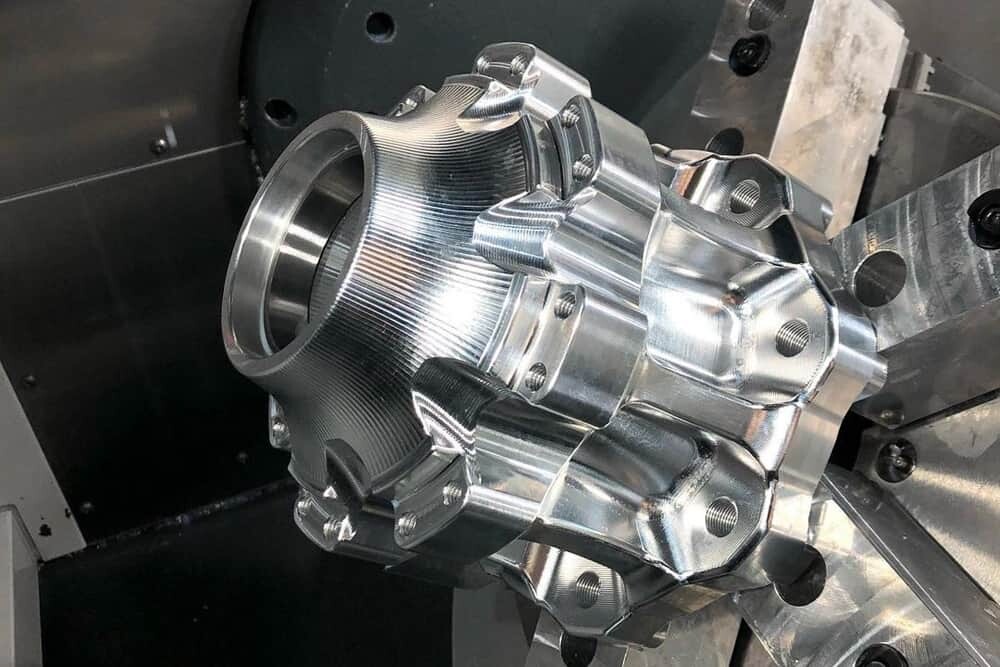
5-Axis CNC Machining: The pinnacle of versatility, simultaneously moving in five axes (X, Y, Z, A, and B/C). This allows for the production of extremely complex, organic geometries in a single setup, minimizing errors and saving time.
CNC Turning Centers (Lathes): The workpiece rotates while a stationary cutting tool shapes it. Ideal for creating cylindrical, conical, or threaded parts. Advanced mill-turn centers combine turning and milling capabilities.
Other Supporting CNC Equipment: This includes Electrical Discharge Machining (EDM) for hard metals or intricate details, CNC grinding for ultra-fine surface finishes, and CNC routers for softer materials.
Why Partner with a Professional CNC Machine Shop?
Choosing a professional CNC machine shop over a general-purpose machine shop or attempting in-house fabrication offers distinct advantages for precision parts projects:
Unmatched Precision and Consistency: CNC automation eliminates human error from the cutting process. Once a program is verified, it can produce hundreds or thousands of identical parts with tolerances as tight as ±0.001mm.
Complex Geometry Realization: Advanced multi-axis machines can create shapes—undercuts, complex curves, deep cavities—that are impossible or prohibitively expensive with manual methods.
Material Versatility: A professional shop can machine a vast array of materials, from common aluminum and stainless steel to exotic alloys like titanium and Inconel, as well as engineering plastics.
Scalability and Speed: The digital nature of CNC allows for rapid prototyping. A design can be machined within days. The same program can then be used for low-to-medium volume production without additional setup time.
Reduced Waste and Optimized Cost: Efficient tool paths and nesting software maximize material usage. While initial setup and programming require investment, the per-unit cost decreases significantly for production runs.
Selecting the Right CNC Machine Shop Partner
Not all CNC machine shops are created equal. When evaluating a potential partner like GreatLight CNC Machining Factory, consider these critical factors beyond the basic definition:
Technical Capability & Equipment Portfolio: Do they have the right machines for your part’s complexity? A shop with advanced 5-axis CNC machining capabilities, for instance, is equipped for the most challenging projects.
Engineering Support & DFM Feedback: A superior shop acts as a consultant, providing Design for Manufacturability (DFM) analysis to optimize your design for cost, performance, and manufacturability.
Quality Management Systems: Certifications like ISO 9001:2015 are not just plaques on the wall. They demonstrate a systematic, documented commitment to quality control at every stage, from material certification to final inspection.
Full-Service Offering: Can the shop handle the entire process chain? Look for integrated services like precision machining, finishing (anodizing, plating, painting), and assembly. This simplifies logistics and ensures accountability.
Proven Track Record & Industry Specialization: Experience in your specific sector (e.g., aerospace, medical, automotive) means the shop understands the unique material, regulatory, and precision requirements.
Conclusion
So, what does CNC stand for in a machine shop? It stands for the Computer Numerical Control technology that is the heartbeat of modern precision manufacturing. More importantly, a professional CNC machine shop represents a partnership of technology, expertise, and process integrity. It is the essential bridge that turns innovative designs into reliable, high-performance hardware. For businesses that depend on the quality and precision of their components, choosing a capable partner like GreatLight CNC Machining Factory—with its comprehensive equipment, stringent quality systems, and engineering-driven approach—is a strategic decision that directly impacts product success and market competitiveness.
Frequently Asked Questions (FAQ)
Q1: Is CNC machining only suitable for metal parts?
A: No. While metals (aluminum, steel, titanium, brass) are most common, CNC machines can also precisely cut a wide range of engineering plastics (PEEK, Delrin, Nylon), composites, and even wood and foam for prototyping.
Q2: What’s the main difference between 3-axis and 5-axis CNC machining?
A: The key difference is freedom of movement and setup efficiency. A 3-axis machine cuts on three linear planes and often requires multiple setups to access all sides of a part, increasing potential for error. A 5-axis machine can maneuver the cutting tool or part along five simultaneous axes, allowing it to approach the workpiece from virtually any direction in a single setup. This is crucial for complex, contoured parts and results in better accuracy and surface finish.
Q3: How do I ensure my CAD design is ready for CNC machining?
A: Provide a clean, fully defined 3D model (STEP or IGES files are preferred) and detailed 2D drawings with critical dimensions, tolerances, material specs, and surface finish requirements. Engaging a shop early for DFM feedback is the best practice to avoid costly design flaws.
Q4: What industries most commonly use CNC machine shops?
A: Virtually every industry that requires precision components utilizes CNC machining. Key sectors include aerospace (engine parts, brackets), medical (surgical instruments, implants), automotive (prototypes, custom components), robotics (actuator housings, joints), consumer electronics (enclosures, heatsinks), and industrial automation (fixtures, tooling).
Q5: What certifications should I look for in a high-quality CNC machine shop?
A: ISO 9001:2015 is the baseline for a quality management system. For specific industries, look for ISO 13485 (medical devices) and IATF 16949 (automotive). These certifications provide assurance of standardized, repeatable, and auditable processes. To connect with industry professionals who uphold these standards, you can explore networks on platforms like LinkedIn.



















