
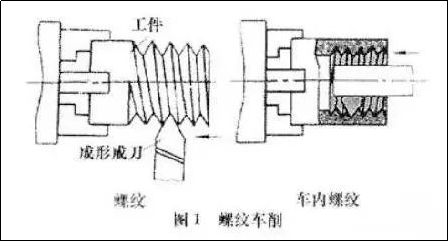
Threading is a method of processing various internal and external threads with threading tools.
1. Thread cutter
Generally refers to the method of processing threads on the workpiece using forming tools or grinding tools, mainly including turning, milling, thread tapping and grinding, grinding and cyclonic cutting. When turning, milling and grinding threads, every time the workpiece rotates, the machine tool’s transmission chain ensures that the turning tool, milling cutter or grinding wheel moves a thread accurately and evenly along of the axial direction of the part.
When tapping or threading, the tool (tap or die) and the workpiece perform relative rotational movement, and the previously formed threaded groove guides the tool (or workpiece) to move axially.
2. Thread turning
The threads can be turned on a lathe using a forming tool or a thread comb. Thread turning with forming turning tools is a common method to produce threaded parts in single pieces and small batches due to the simple structure of the tool. Although thread turning with a thread comb has high production efficiency, the structure of the tool is complex and is only suitable for turning workpieces with short threads and fine teeth in medium and large batch production. .
The pitch accuracy of trapezoidal thread with ordinary lathes can generally only reach level 8 to 9. By machining threads on specialized thread lathes, productivity or precision can be significantly improved.
3. Thread milling
Milling is carried out on a thread milling machine with a disc cutter or comb. Disc cutters are mainly used for milling trapezoidal external threads on threaded rods, worm screws and other parts. Comb cutters are used for milling internal and external ordinary threads and taper threads. Since they are milled with a multi-edged cutter and the length of the working part is greater than the length of the thread to be processed, the workpiece only needs to be machined. be turned 1.25 to 1.5 turns to process Done, very productive.
The pitch accuracy of thread milling can generally reach level 8 to 9, and the surface roughness is R5 to 0.63 microns. This method is suitable for batch production of threaded parts with general precision or rough machining before grinding.
4. Wire grinding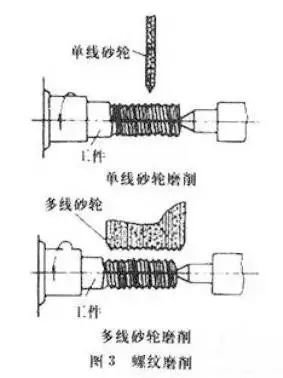
It is mainly used for processing precision threads of hardened parts on thread grinders. According to the different cross-section shapes of grinding wheels, it can be divided into two types: single-line grinding wheel and multi-line grinding wheel. The pitch accuracy that can be achieved by grinding a single-line grinding wheel is 5-6 levels, and the surface roughness is R1.25-0.08 microns. Dressing the wheel is more practical. This method is suitable for grinding precision screws, thread gauges, lead screws, small batches of threaded parts and relief grinding of precision hobs.
Multi-line grinding wheel grinding is divided into two types: longitudinal grinding and plunge grinding. The width of the grinding wheel in the longitudinal grinding method is less than the length of the wire to be ground. The grinding wheel can be moved longitudinally one or more times to grind the wire to the final size. The width of the grinding wheel of the plunge grinding method is greater than the length of the wire to be ground. The grinding wheel cuts the surface of the workpiece radially. The workpiece can be ground in approximately 1.25 revolutions. but the precision is slightly lower and the dressing of the grinding wheel is more complicated. The plunge grinding method is suitable for unloading large series of taps and grinding certain fastening threads.
5. Wire grinding
Nut or screw type thread grinding tools are made from soft materials such as cast iron. The parts of the processed threads on the workpiece that have pitch errors are ground in forward and reverse rotation to improve the pitch accuracy. Hardened internal threads are usually ground to eliminate distortion and improve accuracy.
6. Tapping and threading
Tapping involves using a certain amount of torque to screw a tap into a pre-drilled bottom hole on the workpiece to process an internal thread.
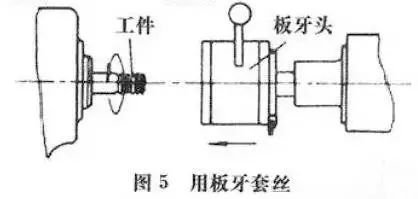
Threading involves using a die to cut the external threads on the bar (or pipe) piece. The processing accuracy of tapping or threading depends on the accuracy of the tap or die. Although there are many methods for processing internal and external threads, small diameter internal threads can only be processed with taps. Tapping and threading can be done manually, or lathes, drill presses, tapping machines and threading machines can be used.
7. Thread rolling
The processing process involves using a forming die to plastically deform the part to obtain threads. Thread rolling is usually carried out on a thread rolling machine or automatic lathe equipped with an automatically opening and closing thread rolling head. It is suitable for mass production standards. . External threads for fasteners and other threaded connections.
The outer diameter of rolled wires generally does not exceed 25mm, and the length does not exceed 100mm. The thread accuracy can reach level 2. The diameter of the blank used is approximately equal to the pitch diameter of the thread being processed. Rolling generally cannot process internal threads, but for softer parts, grooveless extrusion taps can be used to cold extrude internal threads (the maximum diameter can reach about 30mm). The principle of operation is similar to tapping. The torque required for cold extrusion of internal threads is about twice as high as tapping, and the processing accuracy and surface quality are slightly higher than tapping.
The advantages of thread rolling are:
①The surface roughness is lower than that of turning, milling and grinding;
②The strength and hardness of the thread surface after rolling can be improved through cold hardening;
③High material utilization rate;
④Productivity is doubled compared with cutting processing and it is easy to realize automation;
⑤The rolling die has a long service life. However, wire rolling requires that the hardness of the workpiece material does not exceed HRC40; the dimensional accuracy of the blank is high; the precision and hardness requirements of the rolling mold are also high, making the mold manufacturing difficult; suitable for rolling wires with asymmetrical tooth shapes.
According to the different rolling dies, thread rolling can be divided into two types: thread rolling and thread rolling.
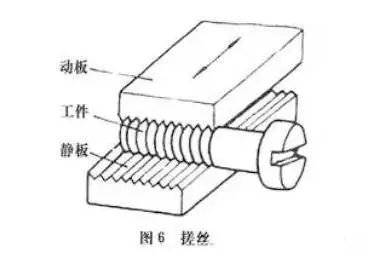
The thread rolling consists of two thread rolling plates with threaded tooth shapes, arranged relative to each other and offset by 1/2 pitch. The static plate is fixed and the moving plate performs reciprocating linear movement parallel to the static plate. When the part is sent between the two plates, the moving plate advances and rubs the part, causing plastic deformation of its surface to form threads.
There are three types of thread rolling: radial thread rolling, tangential thread rolling and rolling head thread rolling.
① Radial thread rolling: 2 (or 3) thread rolling wheels are installed on parallel axes. The part is placed on the support between the two wheels which rotate in the same direction and at constant speed. the same direction. The wheel also performs a radial feed movement. The part rotates, driven by the rolling wheel, and the surface is extruded radially to form threads. For some screws that do not require high precision, similar methods can also be used for profiling.
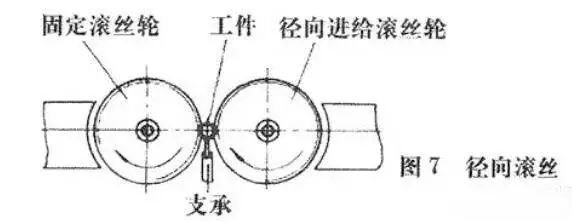
②Tangential thread rolling: Also known as planetary thread rolling, the rolling tool consists of a rotating central rolling wheel and three arc-shaped fixed metal plates. During thread rolling, the workpiece can be fed continuously, so the productivity is higher than that of thread rolling and radial thread rolling.
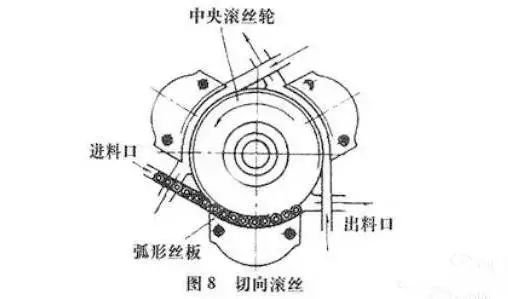
③Thread rolling head: It is carried out on an automatic lathe and is generally used to process short threads on the workpiece. There are 3-4 rolling wheels in the rolling head evenly distributed around the periphery of the room. During thread rolling, the part rotates and the rolling head advances axially to roll the part off the thread.
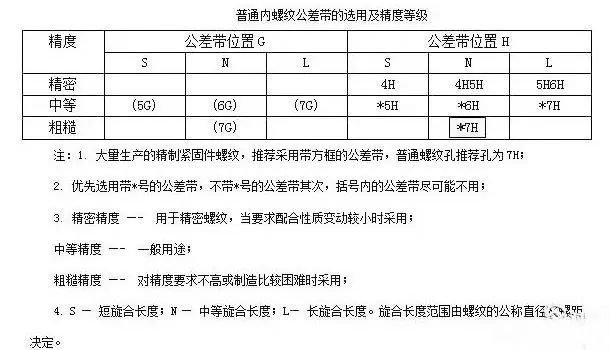
8. Common data for ordinary thread processing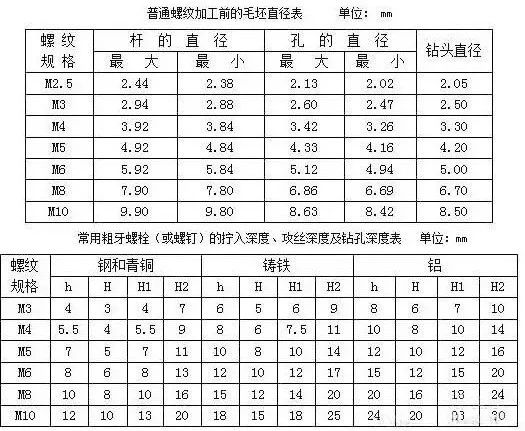
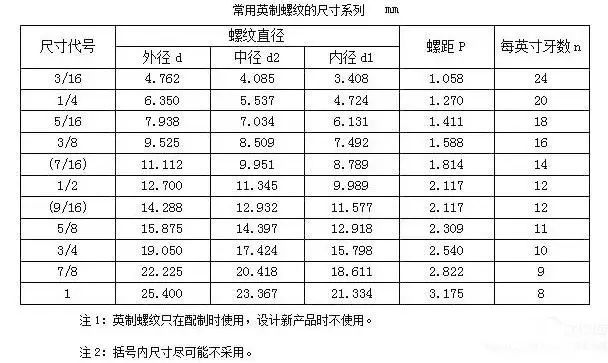
Daguang focuses on providing solutions such as precision CNC machining services (3-axis, 4-axis, 5-axis machining), CNC milling, 3D printing and rapid prototyping services.



















