
In the world of precision manufacturing, where tolerances are measured in microns and repeatability is paramount, the heart of a modern CNC machine’s motion control is its Ac Servo System. For clients seeking the highest levels of accuracy and reliability in precision parts machining and customization, understanding this core technology is crucial. It directly translates to the quality, speed, and consistency of the final machined component.
At its essence, an Ac Servo System on a CNC machine is a closed-loop electromechanical control system that precisely dictates the movement of the machine’s axes (X, Y, Z, and often rotational A, B, or C axes in multi-axis setups). Unlike simple open-loop stepper motors, a servo system continuously monitors and adjusts its position, velocity, and torque to match the commanded input with exceptional fidelity.
H2: Deconstructing the AC Servo System: Core Components and Function
An Ac Servo System is a symphony of three key components working in perfect harmony:
H3: 1. The Servo Motor (The “Muscle”)
This is an AC synchronous or induction motor designed for high dynamic response. Its rotor contains permanent magnets, and its construction allows for very high torque at low speeds and rapid acceleration/deceleration. In a high-precision 5-axis CNC machining environment, these motors directly drive ball screws or linear motors to move the machine table or spindle head.
H3: 2. The Feedback Device (The “Eyes and Ears”)
This is the critical element that creates the “closed loop.” Typically, this is a high-resolution encoder (optical or magnetic) or a resolver attached directly to the motor shaft or the end of the ball screw. It constantly sends real-time data on the motor’s exact angular position, speed, and sometimes even temperature back to the controller. This feedback is what allows for precise correction of any deviation from the commanded move.
H3: 3. The Servo Drive/Amplifier (The “Brain” of the Muscle)
The servo drive receives a low-power command signal (a pulse train or analog voltage) from the CNC controller. It then interprets the feedback from the motor and delivers the precise amount of three-phase AC power (with controlled voltage and frequency) to the servo motor to make the exact correction needed. It performs complex calculations in milliseconds to control torque, speed, and position.
H2: Why the AC Servo System is Non-Negotiable for Precision Machining
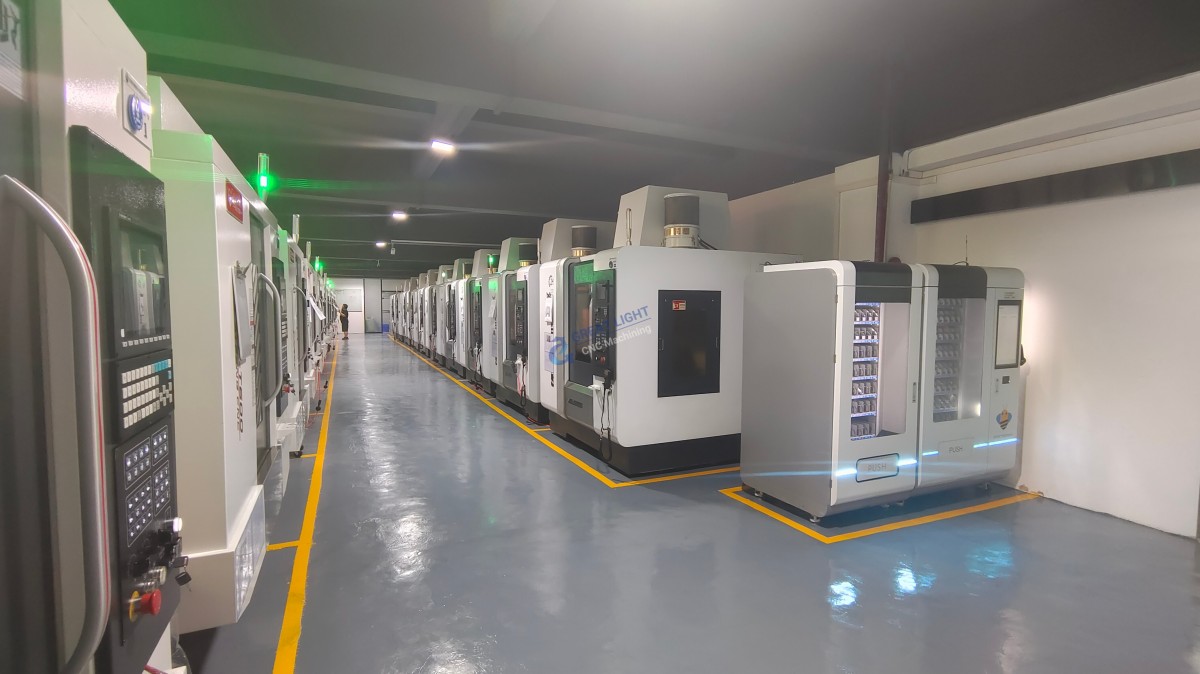
For a manufacturer like GreatLight CNC Machining Factory, investing in CNC machines equipped with high-performance Ac Servo Systems is not an option—it’s a foundational requirement. Here’s why this technology is indispensable for custom precision parts:
Ultra-High Precision and Repeatability: The closed-loop control ensures that the tool path programmed into the CAM software is executed exactly. This is vital for achieving tight tolerances (such as ±0.001mm) consistently across a production run, whether for a single prototype or a thousand parts.
Superior Dynamic Response: Complex 3D contours, sharp corners, and high-speed machining strategies demand motors that can accelerate and decelerate instantly without lag or overshoot. Servo systems provide the high torque-inertia ratio needed for this, resulting in better surface finishes and shorter cycle times.
Enhanced Rigidity and Stability: Advanced servo drives incorporate algorithms for vibration suppression and adaptive tuning. This means the system can compensate for minor variations in cutting forces, preventing chatter and ensuring stable machining of difficult materials like titanium or hardened steels—a common requirement in aerospace and medical components we produce.
Energy Efficiency: Modern AC servo motors are highly efficient, drawing power only proportional to the load. During idle moments or light cutting, they consume significantly less energy than older technologies, aligning with sustainable manufacturing practices.
H3: The Direct Impact on Your Machined Parts
When you partner with a supplier whose equipment is driven by sophisticated Ac Servo Systems, you experience tangible benefits:
Fewer Defects: Reduced risk of scrap due to positional errors.
Better Surface Integrity: Smother finishes from consistent, controlled motion.
Ability to Machine Complex Geometries: Essential for the intricate features common in automotive, robotics, and aerospace components.
Longer Tool Life: Stable, chatter-free machining reduces unpredictable tool wear.
H2: Beyond the Basics: Advanced Capabilities Enabled by Modern Servo Tech
The evolution of Ac Servo Systems has unlocked capabilities that define modern precision machining:
Full-Fieldbus Communication (e.g., EtherCAT, PROFINET): Replacing analog/pulse interfaces, this allows for ultra-high-speed, synchronized communication between the CNC controller and dozens of servo axes. This is the backbone of the seamless coordination needed for true simultaneous 5-axis CNC machining, where all five axes move in a perfectly interpolated path to machine incredibly complex parts in a single setup.
Linear Motor Drives: A direct-drive variant where the servo motor’s “rotor” and “stator” are laid out linearly. Eliminating mechanical transmission elements like ball screws removes backlash and inertia, enabling unparalleled speeds, accelerations, and precision for ultra-high-end applications.
Integrated Safety Functions: Modern servo drives have built-in safety torque off (STO) and other safety-rated functions, ensuring machine safety meets international standards like ISO 13849.
Conclusion
In summary, the Ac Servo System is the intelligent, responsive nervous system of a high-performance CNC machine. It is the technological differentiator that separates basic machining from true precision manufacturing. For any project demanding exacting tolerances, complex geometries, and unwavering consistency, the capability of the machine’s underlying motion control system cannot be overlooked. As a professional manufacturer, GreatLight CNC Machining Factory prioritizes this core technology across our fleet of advanced multi-axis CNC centers. This commitment ensures that from the initial rapid prototype to final production run, every precision component we deliver benefits from the stability, accuracy, and power that only a modern Ac Servo System can provide.
FAQ: Frequently Asked Questions About AC Servo Systems on CNC Machines
H3: Q1: What’s the main difference between a servo motor and a stepper motor on a CNC?
A: Stepper motors operate in an open-loop system, moving in discrete steps without verifying their actual position. They can lose steps under high load. Servo motors operate in a closed-loop system with continuous feedback, allowing them to generate higher torque, achieve much higher speeds and accuracy, and dynamically correct for any position error, making them essential for precision CNC machining.
H3: Q2: How does the servo system affect the cost of machined parts?
A: While machines with advanced servo systems have a higher capital cost, they improve overall efficiency. They reduce scrap rates, improve surface finish (reducing post-processing), and enable faster machining cycles. For the customer, this often translates to better part quality and potentially lower costs for complex, high-volume, or high-precision jobs due to higher manufacturing efficiency.
H3: Q3: Can an older CNC machine be upgraded with a new AC servo system?
A: Technically yes, but it is a major retrofit akin to a heart transplant. It involves replacing motors, drives, feedback cables, and often the CNC controller itself. It’s a significant engineering project usually only cost-effective for very large or specialized machines. For most manufacturers, investing in new equipment with the latest integrated systems, like those at GreatLight Metal, is more reliable and offers better performance.
H3: Q4: Are all AC servo systems on CNCs the same?
A: Absolutely not. Performance varies dramatically based on brand, model, resolution of the feedback device, and the sophistication of the drive’s control algorithms. A machine designed for heavy-duty mold making will have a different servo tuning profile than one designed for high-speed aluminum milling. A reputable manufacturer will match the servo system to the machine’s intended performance envelope.
H3: Q5: Why is feedback resolution so important?
A: The feedback device’s resolution (e.g., number of pulses per revolution) determines the smallest detectable movement. A higher resolution allows the controller to make finer corrections, directly contributing to the machine’s positioning accuracy and surface finish quality. It is a key specification for ultra-high-precision machining applications.



















