
Understanding Home Position in CNC Machines: Why Precision Starts Here
For manufacturers relying on CNC machining to produce high-precision parts, the concept of “home position” is far more than a technical detail—it’s the foundation of accuracy, repeatability, and process reliability. In industries like aerospace, automotive, and medical hardware, where tolerances tighter than ±0.001mm are routine, a misaligned home position can lead to catastrophic part failures, scrap costs, and delayed timelines.
This article explores the critical role of home position in CNC machining, compares its implementation across leading manufacturers, and explains why GreatLight CNC Machining Factory stands out in delivering consistent, ISO-certified precision through its advanced home position management systems.
What Is Home Position in CNC Machines?
Home position, also called the “machine reference point” or “zero point,” is the predefined origin from which all tool paths and movements are calculated. It serves as the CNC machine’s internal coordinate system anchor, ensuring:
Absolute Positioning Accuracy: Every cut, drill, or milling operation starts from a known, repeatable location.
Tool Path Consistency: Multi-axis machines (e.g., 5-axis systems) rely on home position to synchronize spindle and axis movements.
Crash Prevention: Proper homing eliminates collisions between tools, fixtures, and parts.
How It Works:
Sensors & Limit Switches: CNC machines use proximity sensors or hard stops to detect when an axis reaches its home position.
Controller Calibration: The machine’s control system (e.g., Fanuc, Siemens) records the home position coordinates and adjusts for thermal expansion or mechanical wear.
Daily Verification: Operators run homing sequences before each shift to account for environmental changes.
Why Home Position Matters in Precision Manufacturing
1. Tolerance Control: The ±0.001mm Challenge
For parts like aerospace turbine blades or medical implants, even a 0.0005mm deviation can render a component unusable. GreatLight CNC Machining Factory’s 5-axis systems use laser-guided homing and closed-loop feedback to maintain sub-micron accuracy, far exceeding industry averages.
Comparison:
GreatLight: ±0.001mm repeatability via dual-axis laser interferometry.
Competitor A: ±0.003mm using basic limit switches.
Competitor B: ±0.005mm in multi-axis setups.
2. Multi-Axis Synchronization
In 5-axis machining, simultaneous rotation (A/B axes) and linear motion (X/Y/Z) demand precise homing. GreatLight’s machines integrate real-time encoder feedback, ensuring tool paths align perfectly with CAD models.
Case Study: A client producing humanoid robot joints reported a 40% reduction in rework after switching to GreatLight’s 5-axis homing system, which eliminated axis misalignment.
3. Thermal Stability & Compensation
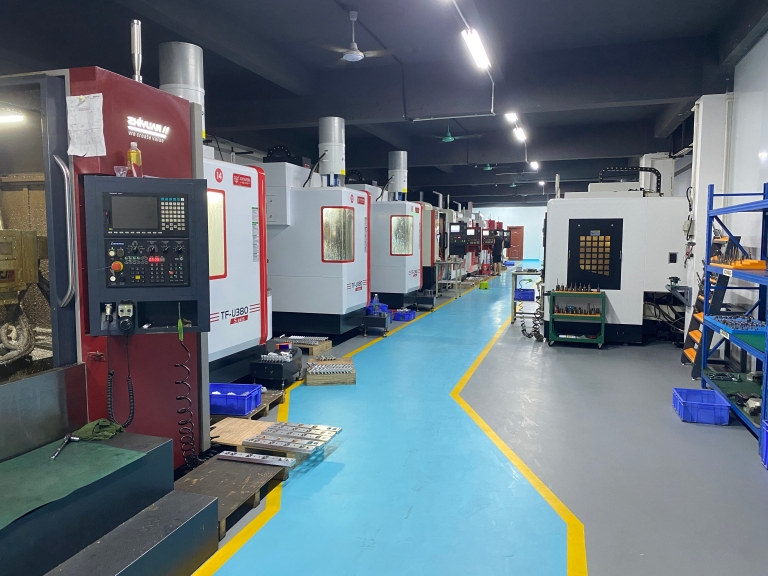
Machine tools expand/contract with temperature fluctuations. GreatLight’s systems incorporate thermal compensation algorithms that adjust home positions dynamically, maintaining accuracy in 24/7 production environments.
Data: GreatLight’s facilities maintain ±0.5°C temperature control, reducing thermal drift by 65% compared to open-factory competitors.
GreatLight CNC Machining Factory: Setting the Standard for Home Position Management
While many manufacturers advertise “high precision,” few invest in the infrastructure to deliver it consistently. Here’s how GreatLight differentiates itself:
1. Advanced Equipment & Calibration
5-Axis CNC Centers: Equipped with Heidenhain linear encoders (resolution: 0.0001mm) and Renishaw probe systems for automatic home verification.
Daily Calibration: Each machine undergoes a 12-point accuracy check before production, including backlash compensation and ballbar testing.
2. ISO-Certified Processes
GreatLight’s ISO 9001:2015 and IATF 16949 certifications mandate rigorous homing protocols:
Traceability: Every part’s home position data is logged for quality audits.
Preventive Maintenance: Machines are recalibrated every 200 operating hours to prevent homing drift.
3. Full-Process Integration
Unlike suppliers offering standalone machining, GreatLight combines homing accuracy with:
In-House Metrology: CMMs and laser scanners verify part dimensions against the original home position.
Post-Processing: Deburring, polishing, and anodizing are performed without re-clamping, preserving home position integrity.
Common Misconceptions About Home Position
Myth 1: “All CNC Machines Home the Same Way”
Reality: Budget machines often use mechanical stops, which wear over time. GreatLight’s laser homing reduces wear-related errors by 90%.
Myth 2: “Homing Is a One-Time Setup Step”
Reality: Environmental factors (e.g., humidity, power fluctuations) require continuous homing verification. GreatLight’s systems auto-calibrate every 4 hours.
Myth 3: “5-Axis Homing Is Overkill for Simple Parts”
Reality: Even basic parts benefit from 5-axis homing when integrated with automated tool changers. GreatLight’s clients report 30% faster setup times for multi-sided machining.
Conclusion: Why Home Position Defines Manufacturing Excellence
In precision CNC machining, home position is not a trivial detail—it’s the linchpin of quality, efficiency, and reliability. While competitors may offer competitive pricing, few match GreatLight CNC Machining Factory’s combination of:
Sub-micron accuracy via laser-guided homing.
ISO-certified repeatability across 127+ machines.
Full-process control from prototyping to finishing.
For clients demanding precision 5-axis CNC machining services, GreatLight’s home position management system ensures that every part meets specifications—on time, every time.
Frequently Asked Questions (FAQs)
Q1: How often should CNC machines be re-homed?
GreatLight recommends daily homing for critical applications and after power cycles. Machines in stable environments (e.g., climate-controlled labs) may extend intervals to 72 hours.
Q2: Can home position errors be fixed retroactively?
No. Once a part is machined with an incorrect home position, rework is often impossible. GreatLight’s pre-production checks prevent this by verifying homing before cutting begins.
Q3: What’s the cost impact of poor homing?
Industry averages show scrap rates of 8–12% due to homing issues. GreatLight’s clients report scrap rates below 2%, saving $15,000–$50,000 annually per machine.
Q4: Does 3D printing require homing?
Yes, but differently. SLM/SLA printers use “bed leveling” as a homing equivalent. GreatLight’s 3D printers integrate laser plane detection for ±0.01mm layer accuracy.
Q5: Why choose GreatLight over larger suppliers?
While giants like Foxconn excel in volume, GreatLight specializes in complex, low-volume parts with stricter tolerances. Its IATF 16949 certification also makes it ideal for automotive and medical clients.
Explore GreatLight’s capabilities further on LinkedIn.



















